
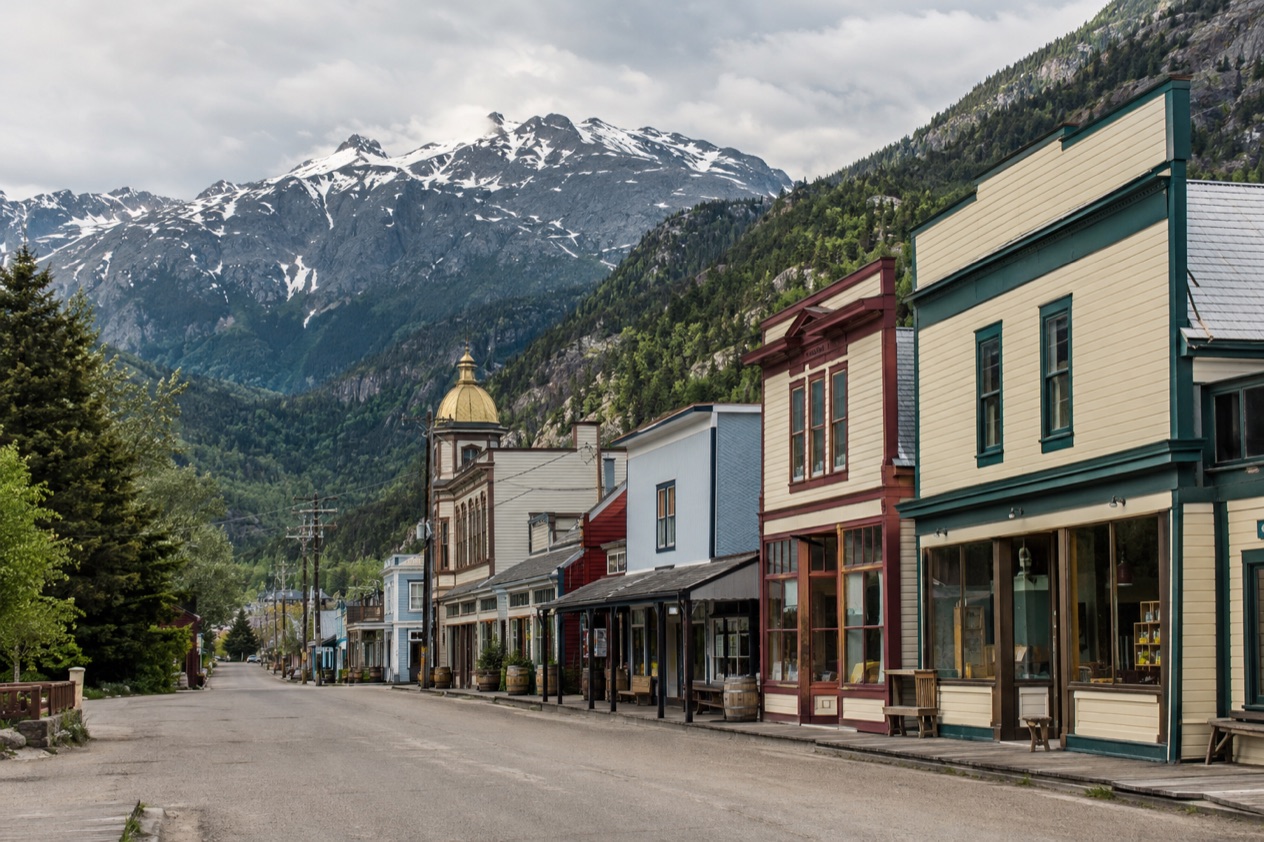
Step off the boat in Skagway and the first thing you notice is how close everything sits: wooden boardwalks, false-front buildings, mountains rising straight behind the main street. A narrow gauge train may be hissing at the waterfront, and the little town fills with visitors in summer. A few practical points about getting in, paying, dressing and behaving make the visit smoother.
What should you know before visiting Skagway?
Four things matter most: Skagway is small and tied to the outside world by only a few links, much of its life follows the summer tourist season, the weather asks for layers and a waterproof shell, and bears are part of the Alaska landscape. Everything else is easier once those are settled.
The town is in Southeastern Alaska and has a population of less than a thousand. It is the northern terminus of the Alaska Marine Highway System ferry network, and the only road out to the rest of the continent is Highway 98, which runs to Whitehorse, Yukon, by way of Carcross, Yukon. That shapes the whole trip: you arrive by water or by that one highway, and the town feels like the end of the line, in a good way.
What surprises first-time visitors is the size of the summer swing. The population doubles in the summer tourist season, and Skagway is a popular stop for cruise ships, so the tourist trade is a big part of its business.
A place of fewer than a thousand people turns into a busy waterfront, with the White Pass and Yukon Route narrow gauge railroad starting from the port and running for the tourist trade in the summer months. The history is just as present. Klondike Gold Rush National Historical Park sits in town, and you can explore on your own without a guide, or choose from a variety of commercial tours. Many people expect a museum piece and find a working town that happens to wear its gold rush past on every block.
Fees, passes and reservations
The place to begin is the National Park Visitor Center, in the restored 1898 rail depot at 2nd and Broadway. The park advises starting your visit there to learn about programs, tours and the film, and that is where you ask about ranger chats, which are offered daily on varying topics.
The park film, Gold Fever: Race to the Klondike, runs 24 minutes and is shown in the theater at the visitor center. It is a sensible way to put the boardwalks outside into context before you start walking them.
Tours are another thing to settle. Skagway has a variety of commercial tours, and M & M Tours is the only tour brokerage contracted by the Municipality of Skagway. Walking the town without a guide is also an option. If your trip falls between October and May, the park asks visitors to read about visiting during the winter first, since the offerings change.
Money, phones and getting online
Skagway is in the United States, so you are spending U.S. dollars like anywhere else in Alaska. For anything beyond that, such as how tours are paid for, the Skagway Convention and Visitors Bureau, the official visitor department for the town, is the place to ask.
One timing detail helps with calls, messages and any arranged pickup. Alaska keeps its own time zone, nine hours behind UTC in standard time and eight hours behind during daylight saving time. The clocks change on the second Sunday in March and again on the first Sunday in November, so a visitor arriving from the Lower 48 should expect a gap with home that shifts with the calendar.
Getting around and staying connected
Getting to Skagway is a question of two routes. The Alaska Marine Highway System ferry network ends here, and Highway 98 is the only road to the rest of the continent, heading to Whitehorse, Yukon, via Carcross, Yukon. Cruise ships also stop here, which is how many people first see the town.
Once in town, the park, the visitor center and the railroad depot area are all part of the same small place, and you can explore on your own without a guide. The White Pass and Yukon Route starts at the port of Skagway and operates for the tourist trade in the summer months.
If you are driving, the Alaska Department of Transportation runs Alaska 511, which gives road conditions in the categories Good, Fair, Difficult, Very Difficult, Hazardous, Road Closure and No Winter Maintenance. It also publishes Waze-reported incidents and closures, and on the map page you can add a camera to My Cameras by clicking a camera icon and then the My Cameras button in the popup.
Weather, daylight and wildlife
Skagway’s weather changes a good deal across the year, and the table gives the town’s own figures for four months.
| Month | Average high (°F) | Average low (°F) | Precipitation (in) | Days with precipitation |
|---|---|---|---|---|
| January | 30.7 | 22.2 | 2.17 | 5.8 |
| April | 49.3 | 35.2 | 1.24 | 3.8 |
| July | 64.5 | 52.0 | 1.38 | 4.6 |
| October | 48.1 | 38.9 | 3.60 | 9.3 |
In words: January is cold and wintry, April is cool, July is the mild month, and October is the wettest of the four, with rain or wet snow on about a third of the days. In the warm part of the year, Alaska temperatures run from 50 to 70 degrees with possible rain and wind, so dress in layers and carry a backpack, adding or shedding as the weather turns.
The outer layer should be a fully waterproof and breathable shell with a hood, which keeps you warm when it is windy and dry when it rains. Southeast Alaska is a wet region, and Juneau alone averages over 50 inches of precipitation a year, so a hood is not a fancy extra.
On wildlife, black bears, brown bears and polar bears all flourish in Alaska. The rule from the Alaska Department of Fish and Game is that people must keep all human sources of food secure from bears. A dangerous bear situation should be reported to ADF&G using the wildlife encounter form.
Local customs and etiquette
Alaskans dress for the weather, not for the occasion. A rain jacket, sturdy shoes and a fleece are normal at a restaurant table as much as on a trail, and nobody will look twice at muddy boots on a boardwalk. Dressing the same way keeps you comfortable and blends in.
The pace is unhurried. People greet each other on the street, shopkeepers chat, and a conversation about the weather or the ferry schedule is a normal way to start. In a town this size, it helps to be patient when the waterfront is busy and friendly with the people working through the season.
Southeast Alaska is the homeland of Alaska Native peoples, including the Tlingit, and the places around Skagway are part of a much longer story than the gold rush. Listen to that history where it is told, and treat the land with the same respect you would give a place of worship or a family home. With wildlife, the habit is distance and quiet: watch, do not follow, and never feed an animal or leave food where it can be found.
Good to know before you go
The seasonal rhythm of Skagway is the thing to keep in mind. The White Pass and Yukon Route runs for the tourist trade in the summer months, and the park asks anyone visiting between October and May to read about winter visits first.
Start at the visitor center, take in the film, and ask about the daily ranger chats. Then walk the boardwalks with a waterproof shell in your bag, whatever the sky looks like when you leave the hotel.
Sources
- Skagway Convention and Visitors Bureau (https://www.skagway.com/), checked October 11, 2026
- Skagway, things to do (https://www.skagway.com/things-to-do), checked October 11, 2026
- Wikivoyage, Skagway (https://en.wikivoyage.org/wiki/Skagway), checked October 11, 2026
- Wikipedia, Skagway, Alaska (https://en.wikipedia.org/wiki/Skagway,_Alaska), checked October 11, 2026
- National Park Service, Klondike Gold Rush National Historical Park (Skagway), plan your visit (https://www.nps.gov/klgo/planyourvisit/index.htm), checked October 11, 2026
- Wikipedia, Climate of Alaska (https://en.wikipedia.org/wiki/Climate_of_Alaska), checked October 11, 2026
- Alaska 511 (https://511.alaska.gov/), checked October 11, 2026
- Alaska Department of Fish and Game, Living with bears (https://www.adfg.alaska.gov/index.cfm?adfg=livingwithbears.main), checked October 11, 2026
- Alaska.org, what to wear (https://www.alaska.org/advice/what-to-wear-in-alaska), checked October 11, 2026
- Wikipedia, Alaska Time Zone (https://en.wikipedia.org/wiki/Alaska_Time_Zone), checked October 11, 2026
- NOAA NCEI, U.S. Climate Normals 1991-2020, monthly (https://www.ncei.noaa.gov/access/services/data/v1?dataset=normals-monthly-1991-2020&stations=USW00025335), station Skagway Ap, elevation 20 feet, checked October 11, 2026
To plan your stay
- Best Time to Visit Skagway: Summer Trains, Chilkoot Trail Season, Weather and Quiet Months
- Things to Do in Skagway: Gold Rush History, the White Pass Railway and Dyea
- Where to Stay in Skagway: Broadway, the Port and Rail Depot, and the Highway 98 Side
- Skagway from Juneau: The Ferry Route, Highway 98 and a Day in Town