
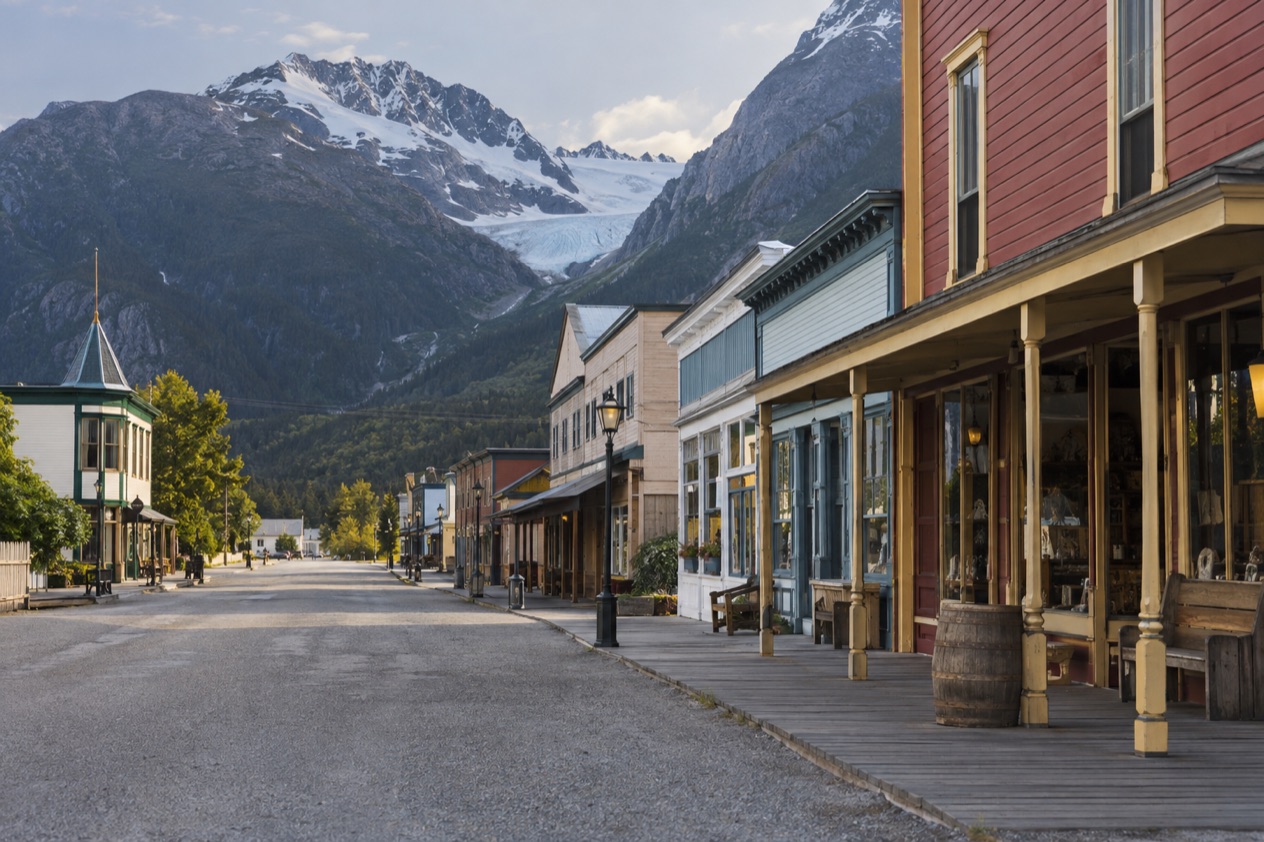
Before the town has fully woken up, the wooden boardwalks of Broadway are empty, and the mountains at the end of the street are already catching the light. Skagway sits at the head of a narrow valley, and every way out of it follows a route that gold seekers once walked, rode or hauled freight along. A day away from town can mean a narrow-gauge train, a trailhead in Dyea, a border crossing toward the Yukon or a trip to eagle country on Lynn Canal.
What are the best day trips from Skagway?
The best day trips from Skagway all follow the old gold rush corridors: a train up the White Pass, a trailhead in Dyea, the one road out through Carcross and a trip to the eagles of Haines. Each one answers a different mood, from a seat by a window to a pair of hiking boots.
- The White Pass and Yukon Route railway climbs out of the port on a narrow-gauge line that was built for miners and now carries visitors in the summer months.
- Dyea and the start of the Chilkoot Trail take you to a ghost town, a campground and the beginning of the path the prospectors walked into Canada.
- Carcross, reached by the railway or by Highway 98, is the Yukon village where the active track ends.
- Whitehorse, the capital of Yukon, is the end of the only road out of Skagway to the rest of the continent.
- Haines, on the Lynn Canal, is the eagle trip, and the birds gather there from October to February.
- The Klondike Gold Rush National Historical Park buildings in town make a rewarding warm-up or a rainy-day fallback before or after any of the above.
None of these is a spur-of-the-moment errand, because Skagway has a single road and a small harbor, and each outing depends on a service, a trail season or a border. Pick one that fits the month you are visiting, and read the details that follow before you plan a day around it.
The best day trips from Skagway
The White Pass and Yukon Route railway
The White Pass and Yukon Route is a narrow-gauge railroad that links the port of Skagway with Whitehorse, the capital of Yukon. Its original length was 107 miles, though the track now in service stops at Carcross. It began as a mining-era line, and today it runs purely for the tourist trade during the summer months, starting from the dock area in Skagway itself.
What you get is a slow climb out of the valley with the whole gold rush landscape moving past the window: rock walls, waterfalls, bridges and trestles that look improbable for their age, and views that drop away toward the water. It suits anyone who wants to see the pass without driving it, and it fits travelers who like the company of a good window seat and a camera.
Because the railway is a summer operation, it is the trip to place first when your dates fall in the warm months and the last to count on outside them. Walking the old depot district in town afterward is a natural pairing, since the train and the town grew up together.
Dyea and the Chilkoot Trail
Dyea is a ghost town and campground close to Skagway, and it is where the Chilkoot Trail begins. In 1898 this was a rival port to Skagway, and the prospectors who landed here started up the trail with their outfits. Today it is a quiet, wooded flat where you can wander among the traces of a town that disappeared when the rush ended.
The trail itself runs 33 miles from Dyea to Bennett, British Columbia. The official hiking season, with rangers on duty and a trail crew on site, usually begins in late May and ends in early September.
Go to Dyea for history, silence and the sound of the river rather than for a list of attractions. It suits travelers who like their gold rush with the buildings removed. In October the official season has ended, so treat a visit as a look at the setting and the town site more than as a trail outing.
Carcross and Highway 98
Carcross, in Yukon, is where the active rail line from Skagway ends, and it is also on Highway 98, the only road out of Skagway to the rest of the continent. That means it can be reached by either route, which is useful if you want to ride the train one way and see the road from a vehicle the other.
It is a small settlement, and its appeal lies in the contrast with Skagway: the landscape opens up, the mountains become rounder and the country feels like the Yukon interior rather than a fjord town.
The trip suits anyone who likes the idea of crossing into another jurisdiction in a single day. Plan it as a place to walk around and look rather than a destination with a long list of things to see.
Whitehorse by the Yukon road
Whitehorse is the capital of Yukon, and Highway 98 reaches it from Skagway by way of Carcross. It is where the original railroad ended, which gives the city a direct link to the story you have been following all day in Skagway. Seen as a day trip, it is the farthest of the options here, and it is best treated as a full day on the road.
Prospectors who made it over the pass found the rest of the journey to the gold fields along rivers and lakes, and Whitehorse grew up on that traffic. The city makes sense as a destination for travelers who want a change of scale from Skagway, with its larger streets and a sense of the territory beyond the coastal mountains.
This outing suits travelers who are comfortable with a long day and want to say they have been to Yukon. A better fit for a relaxed day may be a stop at Carcross alone.
Haines and the eagles
Haines is a small port community in Southeast Alaska on the shores of the Lynn Canal, the state’s longest fjord. It has a very different feel from Skagway, with fewer ships and a quieter waterfront, and it is the one trip here that comes into its own in the fall and winter.
More than 3,500 bald eagles visit the Haines area from October to February, gathering in the Alaska Chilkat Bald Eagle Preserve, where the town has the largest concentration of the birds in the world. Seeing them is a chance rather than a promise, but the season gives you good odds of looking up and finding one. Many tourists still come to Haines in summer, while the eagle season belongs to the quiet months.
The trip suits birders, photographers and travelers who prefer a calm shoreline to a busy dock. If your visit falls in October, as this one does, it is the day trip with the most reason to go right now.
Day trips from Skagway compared
| Trip | Where it lies | Best for | How to go |
|---|---|---|---|
| White Pass and Yukon Route railway | 67.5 miles of active track from Skagway to Carcross | Mountain scenery and mining history | Train from the port of Skagway, summer months |
| Dyea and the Chilkoot Trail | 15 minutes from Skagway | Ghost town, forest and gold rush trail history | Road to Dyea, trail season usually late May to early September |
| Carcross | End of the active railway, on Highway 98 | A look at Yukon after the pass | Railway or Highway 98 |
| Whitehorse | Capital of Yukon, on Highway 98 via Carcross | A full day on the road and the end of the old railroad | Highway 98 |
| Haines | On the Lynn Canal in Southeast Alaska | Bald eagles from October to February | Separate trip linked to the Alaska Highway by the Haines Highway |
To choose, start with the calendar. If you are in Skagway in the summer months, the railway is the obvious signature outing, and Dyea is a natural second day once the trail season is on.
Next, think about what you want from the day. A window seat and a narrated climb point to the railway. Silence, trees and a sense of having walked where others once did point to Dyea.
A cross-border outing with a new landscape is Carcross, and a longer one with a city at the end is Whitehorse. None of these asks for a particular fitness level, but they do ask for time, so one trip per day is a sensible pace.
Tour or on your own?
Both ways work in Skagway, because visitors can explore on their own without a guide, and the town also has a variety of commercial tours. The right choice depends on what you want to hear along the way and how much of the day you want to spend deciding things.
A tour makes sense when the outing has a story that benefits from a voice, such as the gold rush history that lies behind the railway or the road to Yukon. It also suits travelers who prefer to hand over the logistics of a long day, which is the case for the farthest destinations, where you cross a border and spend hours on a single highway. If you decide to book, M & M Tours is the only tour brokerage contracted by the Municipality of Skagway, so it is a useful name to know when you are comparing options.
Going on your own gives you a freer day when the destination is a place to wander rather than a program. Dyea fits that description, with its quiet town site and the start of the trail, and so does a walk through Skagway’s historic district before you set out.
In town, the park’s visitor center is the place to begin, set in the restored 1898 rail depot at Second and Broadway. It offers a 24-minute film called Gold Fever: Race to the Klondike, daily ranger chats on changing topics, and a clear picture of what the park buildings hold before you head out of town.
Before you commit to any outing, check the things that decide whether the day works at all: the season of the service you are counting on, since the railway is a summer operation and the Chilkoot Trail’s staffed season ends in early September, and the route you will use to get back. Skagway has one road out and a small harbor, so the return leg matters as much as the departure. The Skagway Convention and Visitors Bureau is the official visitor department for the town, and it is the source to turn to for what is running on your dates.
A last point of comparison is the way each trip fits your own pace. A tour hands you a schedule, which is comforting on a long day and slightly confining on a short one.
Going alone leaves room for a longer lunch, a detour to a viewpoint or a slow hour at a museum. In Skagway, where the park runs four museums that cover gold rush history, an unscheduled afternoon in town can be as full as a day away.
Good to know before you go
Skagway is small, with fewer than a thousand people, though its population doubles in the summer tourist season, which is part of why the town feels so different in October. The park advises anyone visiting Klondike Gold Rush National Historical Park between October and May to read its winter visiting information first, and the staffed Chilkoot season usually ends in early September.
The eagles in Haines, by contrast, are an October to February story, so the shoulder of the year has its own reward. Keep the rest simple: confirm what is running before you set out, and let the day take the shape of the road.
Sources
- Skagway Convention and Visitors Bureau (https://www.skagway.com/), checked October 11, 2026
- Skagway, things to do (https://www.skagway.com/things-to-do), checked October 11, 2026
- Wikivoyage, Skagway (https://en.wikivoyage.org/wiki/Skagway), checked October 11, 2026
- Wikipedia, Skagway, Alaska (https://en.wikipedia.org/wiki/Skagway,_Alaska), checked October 11, 2026
- National Park Service, Klondike Gold Rush National Historical Park (Skagway), plan your visit (https://www.nps.gov/klgo/planyourvisit/index.htm), checked October 11, 2026
- White Pass and Yukon Route Railway, Skagway (https://www.wpyr.com/), checked October 11, 2026
- Wikipedia, White Pass and Yukon Route (https://en.wikipedia.org/wiki/White_Pass_and_Yukon_Route), checked October 11, 2026
- Wikipedia, Chilkoot Trail (https://en.wikipedia.org/wiki/Chilkoot_Trail), checked October 11, 2026
- Wikipedia, Klondike Gold Rush (https://en.wikipedia.org/wiki/Klondike_Gold_Rush), checked October 11, 2026
- Wikipedia, Southeast Alaska (https://en.wikipedia.org/wiki/Southeast_Alaska), checked October 11, 2026
- Wikivoyage, Haines (https://en.wikivoyage.org/wiki/Haines), checked October 11, 2026
- Wikipedia, Haines, Alaska (https://en.wikipedia.org/wiki/Haines,_Alaska), checked October 11, 2026
- Wikipedia, Haines Highway (https://en.wikipedia.org/wiki/Haines_Highway), checked October 11, 2026
To plan your stay
- Best Time to Visit Skagway: Summer Trains, Chilkoot Trail Season, Weather and Quiet Months
- Where to Stay in Skagway: Broadway, the Port and Rail Depot, and the Highway 98 Side
- Skagway from Juneau: The Ferry Route, Highway 98 and a Day in Town
- Know Before You Go to Skagway: Ferry and Highway Access, Klondike Park, Weather and Bears