
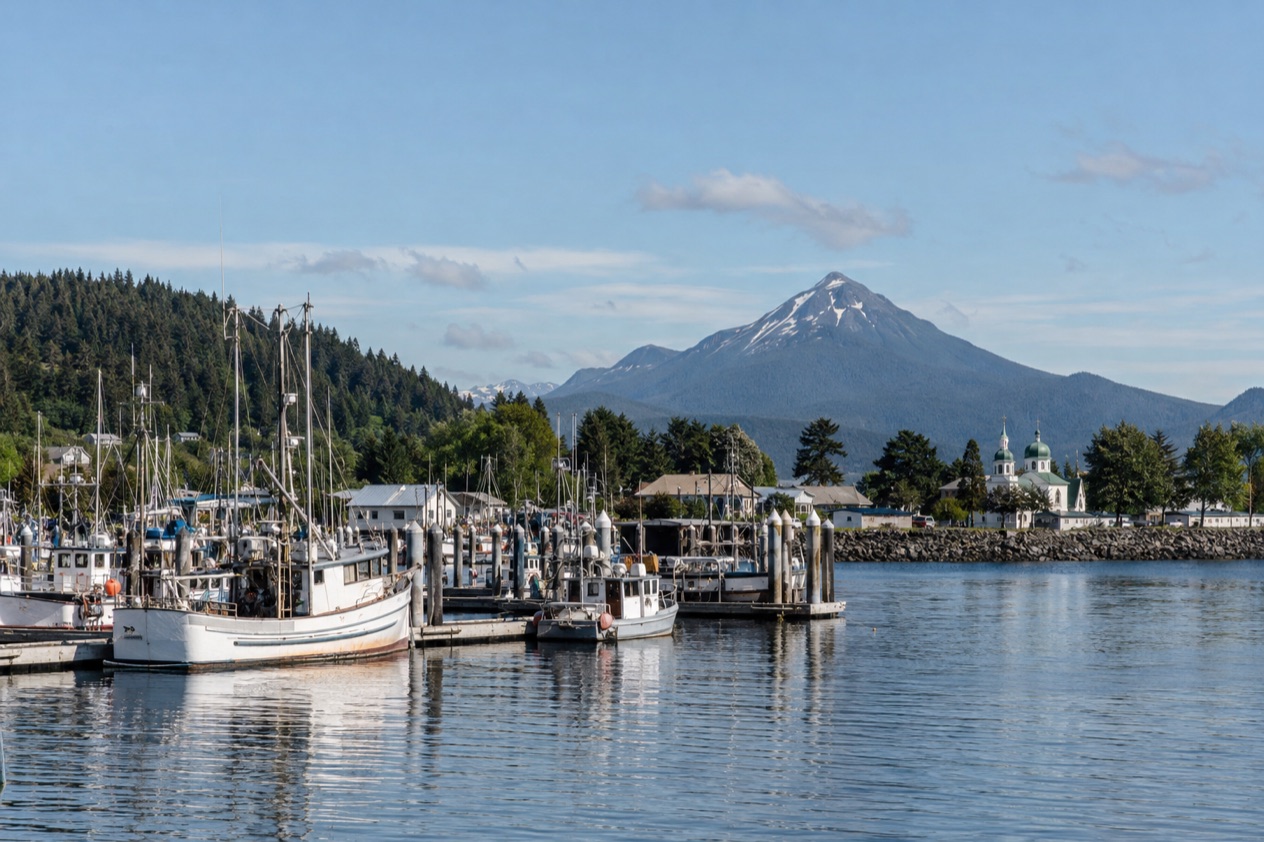
On a June evening in Sitka, the light hangs over the sound long after dinner, and the green onion dome of St. Michael’s Cathedral stays sharp against the dark spruce on the hillsides. Gulls work the harbor, fishing boats idle at their moorings, and the smell of salt, wet cedar and spruce drifts down the streets. This is Sitka in June for travelers who want Tlingit and Russian history, a temperate rain forest and a town on Baranof Island that is easy to settle into at a slow pace.
What is the weather like in Sitka in June?
June in Sitka is cool, mostly mild and often damp, with the longest days of the year and less rain than the months on either side of it. Expect jacket weather in the daytime, not sunbathing weather.
| Month | Average high (°F) | Average low (°F) | Precipitation (in) | Days with precipitation | Daylight on the 15th |
|---|---|---|---|---|---|
| May | 53.3 | 43.0 | 3.81 | 9.7 | 16 h 27 min |
| June | 57.6 | 48.3 | 2.92 | 8.8 | 17 h 51 min |
| July | 60.4 | 52.5 | 4.62 | 11.4 | 17 h 19 min |
Afternoons usually settle in the upper 50s, which feels pleasant for walking if you keep moving and have a layer on. Mornings and evenings are cooler, cool enough for a fleece and a hat when you stand still at the water’s edge. The rain here is the soft, steady kind of a humid maritime climate, and it comes as drizzle or an hour of showers more often than as a downpour.
Because the town sits in a rain forest, a gray morning is not a lost day. Mist on the trees looks good, and the museums and the cathedral are there for the wetter hours. The days are long enough that you can wait out a shower at lunch and still have a big stretch of daylight for the park trails or the waterfront afterward.
Bring rain gear and layers, as the National Park Service advises for Sitka at any time of year. A waterproof shell over a warm midlayer handles nearly every June day, and the long light means you can plan around the weather rather than around the clock.
What to do in Sitka in June
June is a month for being outdoors in the long light and indoors when the clouds settle. Sitka’s best sights are about history and landscape, and they suit this cool, damp weather well. Between a walk under the spruce and an hour among carved poles, the day fills naturally.
The town’s story is layered. Tlingit people lived here long before the Russians arrived, and the Russians later made Sitka a center of their Alaska enterprise. During the early 19th century, Sitka Sound was a major locus of the maritime fur trade. Americans came after that, and you can feel all three chapters in a single walk.
Sitka National Historical Park
This park preserves the landscape that drew Tlingit, Russians and Americans, and sometimes led to conflict between them. You can wander among totem poles obtained from Haida and Tlingit communities, set among tall trees. In the visitor center you can explore ceremonial and traditional objects from Tlingit and Russian Orthodox cultures, and many of the artifacts on display are owned by Tlingit clans and are still used for ceremonial purposes.
The park is also a rain forest. Towering spruce and hemlock close in overhead, and the tidelands hold sea stars and crabs. Kaasdahéen (Indian River) runs through it. In June’s cool, damp air the forest smells strongly of moss and wet bark, and a drizzle suits it better than you might think.
The Russian Bishop’s House belongs to the park. It has museum exhibits and a furnished second floor that show Russian activities in Alaska, so it is a good place to be when the weather turns. Pair the forest and the house on one outing and you cover most of the town’s history.
Alaska Raptor Center
The Alaska Raptor Center is a sanctuary in the Tongass National Forest in Sitka. It gives you a close look at birds of prey, and it fits a day when low cloud sits on the mountains and you want something that works in any light.
The setting does half the work. You are in the national forest, with the same wet greens as in the park, and it is a pleasant counterpoint to a morning of history. A stop here suits travelers who like wildlife but do not want to count on a sighting in the wild.
Sitka Sound and the waterfront
Sitka Sound is the body of water at the town’s door, bordered by Baranof Island to the south and the northeast, by Kruzof Island to the northwest and by the Pacific Ocean to the southwest. Walking the harbor in June, you watch boats come and go under long evening light, with the islands layered in gray and green beyond.
Humpback whales, known for breaching and other surface behaviors, are a favorite of whale watchers, and orcas are found in the waters off Alaska. Any sighting is a chance, never a promise. The water is cold and worth admiring from the shore or a boat deck, not from inside.
Food in a fishing town means seafood, and a harbor-side meal after a day of walking is a good rhythm for the month. Look for fish chowder, grilled or smoked fish and a hot drink on a cool evening. Ask what came in that day, as menus here tend to follow the boats.
Cruise ships also call here. Norwegian’s Alaska cruises list Sitka among their ports of call, so on some days the town has more people on its sidewalks, and the museums and cafés fill with day visitors. Mornings and late afternoons are quieter for a slow wander.
A two-day itinerary for Sitka in June
Day 1 starts with the forest, while the morning air is coolest and the trees are dripping. Walk the trails of Sitka National Historical Park among the totem poles and along Kaasdahéen (Indian River), then step into the visitor center for the Tlingit and Russian Orthodox objects. Take lunch in a café in town, with something warm and a view of the harbor.
In the afternoon, tour the Russian Bishop’s House and its furnished second floor, then wander to St. Michael’s Cathedral and the streets around it. The long daylight means the evening is yours. Eat seafood near the waterfront and walk the harbor as the light turns soft over the sound.
Day 2 begins at the Alaska Raptor Center in the Tongass National Forest, which gives you a calm morning among the birds and trees. Return to town for a late lunch, then spend the afternoon on the water’s edge. Watch for whales and orcas, which are chances, not promises, and linger over a hot drink as the clouds shift.
If the weather turns on either day, swap the order and spend the wet hours indoors: the visitor center, the Bishop’s House exhibits and the cathedral are all covered ground. Keep the trails and the waterfront for the breaks in the clouds, which the long June days tend to give you.
Is Sitka busy in June?
Sitka is a working town with a visitor season, and June has the longest days of that season. The pace is relaxed, but cruise calls add people to the sidewalks on some days.
Norwegian’s Alaska cruises call at Sitka, among other ports, and a ship in port changes the feel of the downtown for the hours it is there. Early mornings and evenings stay calm, and the forest trails take the crowds in stride. In June the long light lets you shift your day away from the busiest hours without losing any sightseeing.
What to pack for Sitka in June
Pack for damp, cool days, with layers you can take off and put on as the clouds move. The National Park Service recommends rain gear and layered clothing for Sitka at any time of year.
- A waterproof jacket with a hood, for drizzle in the rain forest and on the waterfront.
- A warm fleece or midlayer, because mornings and evenings are cool.
- Waterproof shoes with good grip, for wet forest paths and tidelands.
- A hat and light gloves, for standing still by the sound in the evening.
- Binoculars, in case whales or birds appear over the water.
- A small daypack that keeps a camera dry.
Good to know before you go
June gives Sitka its longest days, so a late dinner and a walk afterward are normal here. Weather forecasts for Sitka National Historical Park come from the National Weather Service, and they are worth a look the evening before an outdoor day.
Sitka sits on Baranof Island, so plan how you will arrive and leave. The Alaska Marine Highway System has a Sailing Calendar to view ferry schedules by month, port or vessel, and a Sailing Search tool where you enter a port and a date.
Sitka in June vs May and July
Moving the trip four weeks earlier brings cooler air, a bit more rain and shorter days than June. The forest is still lovely, but you will want more layers on the water and in the evenings.
Four weeks later, July is the warmest of the three and also the wettest, with rain on more days. The evenings stay long, though a little less than in June. The change is small, but the damp is more present, and a rain jacket moves from backup to daily use.
Choose June if you want the longest light and the driest of the three. Shift to May if cooler air suits you and you like a quieter feel. Choose July if you prefer the warmest air and do not mind showers on more days.
Is June a good time to visit Sitka?
Yes, June is a good time to visit Sitka, especially for travelers who like history, forest and long evenings and do not need sunshine to be happy. It is the driest of the three early-summer months here, and the light lets you fit a lot into each day.
It suits visitors who like to walk among totem poles, read about Russian America in a furnished house and watch a harbor from a bench. It is less suited to anyone who wants warm weather or a beach day, as the water is cold and the air is cool. Rain is part of the picture, and the right clothes make it part of the charm.
On arrival, head to the park first. The poles, the rain forest and the Indian River show you what the town is built around, and the rest of the visit falls into place after that. Then comes the June evening, with the sound going silver and the cathedral’s dome still catching the light.
Sources
- NOAA NCEI, U.S. Climate Normals 1991-2020, monthly (https://www.ncei.noaa.gov/access/services/data/v1?dataset=normals-monthly-1991-2020&stations=USW00025333), station Sitka Airport, elevation 14 feet, checked October 11, 2026
- Computed from the date and the latitude of the place (sunrise equation, solar elevation -0.833 degrees), October 11, 2026
- Wikipedia, Midnight sun (https://en.wikipedia.org/wiki/Midnight_sun), checked October 11, 2026
- Alaska Department of Transportation, Alaska Marine Highway System, Schedules (https://dot.alaska.gov/amhs/schedules.shtml), checked October 11, 2026
- Princess Cruises, Alaska cruises (https://www.princess.com/en-us/cruise-destinations/alaska-cruises), checked October 11, 2026
- Holland America Line, Alaska cruises (https://www.hollandamerica.com/en/us/cruise-destinations/alaska-cruises), checked October 11, 2026
- Norwegian Cruise Line, Alaska cruises (https://www.ncl.com/cruise-destinations/alaska-cruises), checked October 11, 2026
- Royal Caribbean, Alaska cruises (https://www.royalcaribbean.com/cruise-destinations/alaska-cruises), checked October 11, 2026
- National Park Service, Lake Clark National Park & Preserve, plan your visit: conditions (https://www.nps.gov/lacl/planyourvisit/conditions.htm), checked October 11, 2026
- National Park Service, Katmai National Park & Preserve, plan your visit (https://www.nps.gov/katm/planyourvisit/index.htm), checked October 11, 2026
- Wikipedia, Humpback whale (https://en.wikipedia.org/wiki/Humpback_whale), checked October 11, 2026
- Wikipedia, Orca (https://en.wikipedia.org/wiki/Orca), checked October 11, 2026
- Wikipedia, Sitka Sound (https://en.wikipedia.org/wiki/Sitka_Sound), checked October 11, 2026
- National Park Service, Sitka National Historical Park, plan your visit (https://www.nps.gov/sitk/planyourvisit/index.htm), checked October 11, 2026
- Alaska Raptor Center, Sitka (https://www.alaskaraptor.org/), checked October 11, 2026
- Wikipedia, Climate of Alaska (https://en.wikipedia.org/wiki/Climate_of_Alaska), checked October 11, 2026
To plan your stay
- Things to Do in Sitka: Russian History, Totem Parks, Wildlife and Fresh Seafood
- Where to Stay in Sitka: Downtown, the Historical Park Side and the Airport Island
- Sitka from Juneau: Ferry, Flights and What to Do on Arrival
- Day Trips from Sitka: Totem Park, the Russian Bishop's House, the Raptor Center and Sitka Sound