
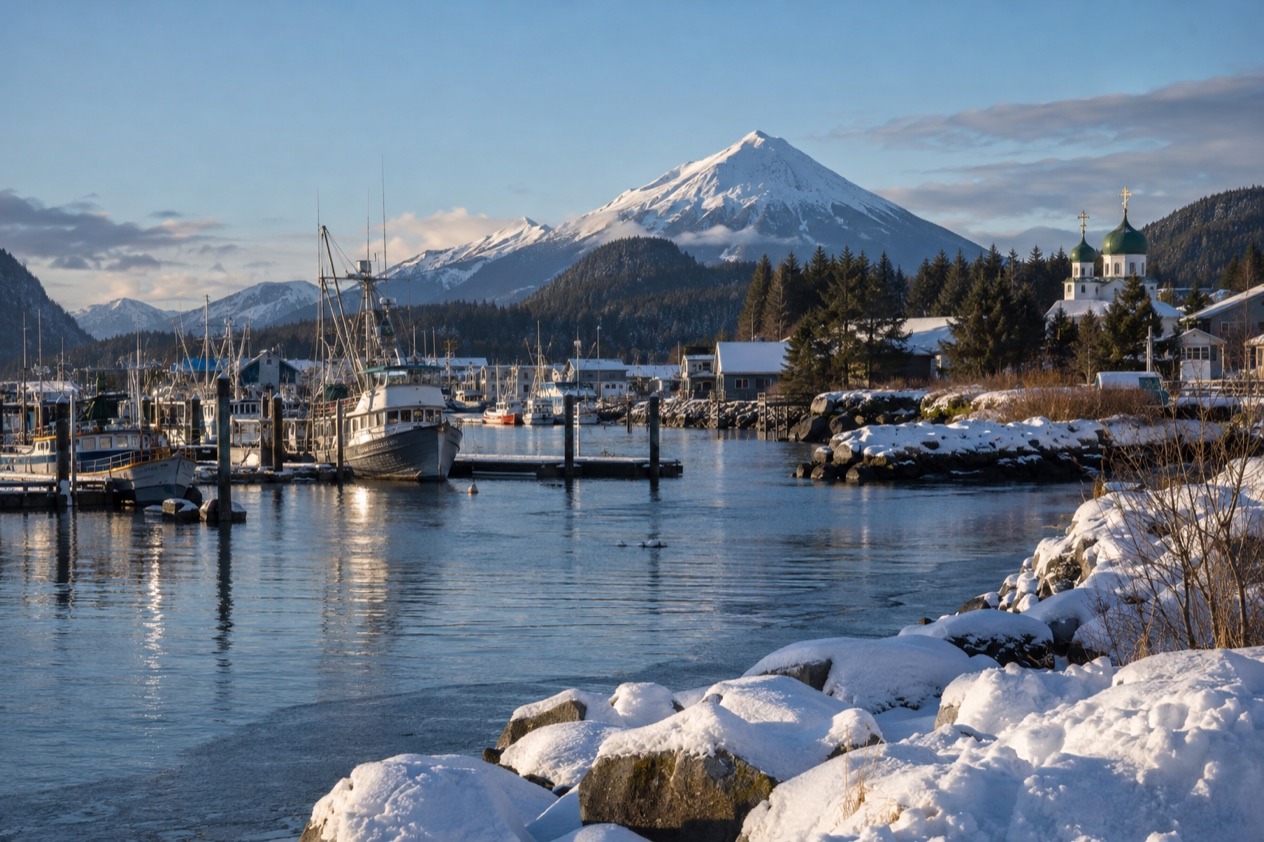
In January, Sitka wakes up slowly. Mist hangs on the spruce-covered slopes of Baranof Island, the harbor lies quiet under a low gray ceiling, and the onion dome of St. Michael’s Cathedral stands out against the wet pavement of downtown.
The town belongs to its residents at this time of year, and the pace is unhurried. It is a month for wooded walks in the rain, museum hours, and long coffees by a window.
What is the weather like in Sitka in January?
January in Sitka is cold but not frozen: a wet, gray, near-freezing month where the air hovers just above the freezing point by day and dips to it at night.
| Month | Average high (°F) | Average low (°F) | Precipitation (in) | Days with precipitation | Daylight on the 15th |
|---|---|---|---|---|---|
| December | 41.5 | 33.4 | 8.43 | 16.1 | 6 h 46 min |
| January | 40.5 | 32.4 | 8.22 | 15.4 | 7 h 21 min |
| February | 41.2 | 32.1 | 5.93 | 11.6 | 9 h 27 min |
Rain, and sometimes wet snow, falls on more than half the days of the month. It tends to arrive as a steady drizzle or a long soaking spell rather than a sharp afternoon shower, so the useful question is not whether it will rain but how hard.
Sitka is a town where people simply go out in it. Waterproof layers matter more than an umbrella, and the wooded paths hold the damp long after the sky eases.
The days are short. Light comes late and fades early, which leaves a window for outdoor time in the middle of the day. Plan walks for the hours when it is brightest, then save the dark stretch for a warm restaurant table or a museum. Sitka has a long annual rainfall and a modest seasonal snowfall, so a few flakes in town are possible, but the wet is the story more than the snow.
Mornings feel raw, with the air close to freezing, and afternoons only slightly softer. Evenings call for a hat, gloves and a layer that sheds water.
What to do in Sitka in January
The big festival of the town, the Alaska Day Festival, belongs to its own week and not to January, so this month is about the places that do not depend on a calendar. Sitka’s history is layered with Tlingit, Russian and American stories, and the best of it sits within a small area. Wet weather suits this kind of travel: you go slowly, read a lot of walls, and step in and out of the drizzle.
Sitka National Historical Park
The park at 106 Metlakatla Street is the anchor of any visit. Its two miles of wooded pathways wind among tall trees, and along them stand totem poles, many of them replicas, with others obtained from Haida and Tlingit carvers. In January’s rain the forest turns dark green and the poles look deep and weathered, and the damp air smells of spruce and salt.
The park preserves a landscape that drew Tlingit, Russians and Americans, and sometimes brought conflict between them. Inside, you can explore ceremonial and traditional objects from Tlingit and Russian Orthodox cultures, a good place to be when the weather turns. The Indian River runs through the grounds, and salmon can be seen swimming up it in the spawning season, which is a reason to come back in another month.
Go in the brightest hours of the day, wear waterproof shoes, and leave time to stop at each pole. It suits anyone who likes slow looking more than distance.
The Russian Bishop’s House
Part of the national park, the Russian Bishop’s House has been restored by the National Park Service, and parts of it once served as a schoolhouse. It is a good small stop for a gray afternoon, a place to see how the Russian period lived in rooms and furnishings rather than in dates.
Pair it with a walk through the downtown streets nearby, where the cathedral dome and the harbor give you the other side of the story. When the rain is heavy, the pairing works well: a stretch indoors, a short dash outside, then another stop.
Sitka Sound and the waterfront
Sitka Sound opens to the Pacific, bordered by Baranof Island and Kruzof Island, and in the early 19th century it was a major center of the maritime fur trade. From the waterfront you look out over that same water, now dotted with fishing boats and small craft in the harbor.
In January the sound is a place to watch rather than to be on: cloud sits low on the islands, the water turns slate and silver, and the light changes by the minute. Stand at the edge in a good rain jacket and take it in, and you may spot seabirds working the water.
Around town, expect small cafés, a bookshop or two, and a quiet harbor-town mood in the evening. This is the month for lingering over soup, chowder or a hot drink while the weather does its thing outside.
A two-day itinerary for Sitka in January
Day 1 starts late, with the light. Take a hot breakfast in a downtown café, then walk to Sitka National Historical Park in the middle of the day, when the brief daylight is at its strongest. Follow the wooded pathways past the totem poles, then step into the park’s displays of Tlingit and Russian Orthodox objects to warm up.
In the afternoon, head back toward the harbor and the Russian Bishop’s House, and finish with the cathedral and the quiet streets around it before dark falls. Dinner is a seafood or comfort-food table in town, a long one, since there is no reason to hurry back out into the dark. If the rain is heavy, stay with the indoor stops and shorten the wooded walk.
Day 2 is for the water’s edge. Spend the late morning along the waterfront and the harbor, watching boats and birds on Sitka Sound, and dress for wind as well as rain. Take lunch in a small harborside place, then give the afternoon to a bookshop, a gallery or a museum stop.
If the sky clears even briefly, use it for a second look at the water and the islands in the changing light. Close the evening with a slow dinner and a hot drink. On a wet day, the same plan works with more time inside and shorter dashes between doors.
Is Sitka busy in January?
No, January is a quiet month in Sitka, with the town running at the pace of its residents rather than of visitors. The Alaska Day Festival, the big annual event, belongs to another part of the year, so nothing pulls crowds in now.
What that means in practice is space: the wooded paths of the national park, the waterfront and the downtown streets are yours to wander without much company. Air service by Alaska Airlines runs year-round to the airport on Japonski Island, so the town stays within reach even in the dark months. The rhythm of the day is set by the short light, with the middle hours the most active and the evenings calm.
What to pack for Sitka in January
Pack for wet, cold days spent mostly outdoors between short indoor stops, and bring layers you can add and shed.
- A waterproof jacket with a hood, because rain falls on more than half the days.
- Waterproof shoes or boots for the wooded pathways of the park.
- Warm layers such as wool or fleece, for mornings near freezing.
- A hat and gloves for the wind along the waterfront.
- Rain pants, for long walks in steady drizzle.
- A small daypack cover to keep a camera and book dry.
Good to know before you go
The main thing to plan around in January is daylight: with only about seven hours of it, put outdoor stops in the middle of the day and keep evenings for indoor plans. Rain is the norm, not the exception, so build slack into any outdoor plan and keep an indoor alternative ready.
Sitka in January vs December and February
Moving earlier to December brings the shortest days of the year, with the light at its thinnest and rain slightly more frequent. The mood is even quieter and the dark longer, which suits travelers who want deep winter and do not mind fewer hours outdoors.
Moving later to February gives noticeably more light and drier weather, with fewer wet days and a lighter feel to the afternoons. The wooded paths and the waterfront are easier to enjoy, and the town begins to stir after the deep-winter lull.
If you want the longest days and the least rain, February is the better pick. If you want the quiet and the moody gray of the deepest part of winter, January or December will deliver it.
Is January a good time to visit Sitka?
Yes, for travelers who like quiet, rain-soaked forests and history told indoors and out, and no for anyone who needs long bright days or a packed events calendar. January suits people who are happy with a slow rhythm and a good raincoat.
If you come, start with Sitka National Historical Park in the middle of the day, when the light is best, and let the rest of the plan fall around it. Keep the Russian Bishop’s House and the cathedral for the darker hours. What is special about January here is the stillness: the totem poles dark with rain, the mist on the island slopes, and a harbor town that feels like it belongs to itself.
Sources
- NOAA NCEI, U.S. Climate Normals 1991-2020, monthly (https://www.ncei.noaa.gov/access/services/data/v1?dataset=normals-monthly-1991-2020&stations=USW00025333), station Sitka Airport, elevation 14 feet, checked October 11, 2026
- Computed from the date and the latitude of the place (sunrise equation, solar elevation -0.833 degrees), October 11, 2026
- Wikipedia, Sitka, Alaska (https://en.wikipedia.org/wiki/Sitka,_Alaska), checked October 11, 2026
- Wikipedia, Sitka National Historical Park (https://en.wikipedia.org/wiki/Sitka_National_Historical_Park), checked October 11, 2026
- Wikipedia, Sitka Rocky Gutierrez Airport (https://en.wikipedia.org/wiki/Sitka_Rocky_Gutierrez_Airport), checked October 11, 2026
- Wikipedia, Sitka Sound (https://en.wikipedia.org/wiki/Sitka_Sound), checked October 11, 2026
- National Park Service, Sitka National Historical Park, plan your visit (https://www.nps.gov/sitk/planyourvisit/index.htm), checked October 11, 2026
- Wikipedia, Climate of Alaska (https://en.wikipedia.org/wiki/Climate_of_Alaska), checked October 11, 2026
To plan your stay
- Things to Do in Sitka: Russian History, Totem Parks, Wildlife and Fresh Seafood
- Where to Stay in Sitka: Downtown, the Historical Park Side and the Airport Island
- Sitka from Juneau: Ferry, Flights and What to Do on Arrival
- Day Trips from Sitka: Totem Park, the Russian Bishop's House, the Raptor Center and Sitka Sound