
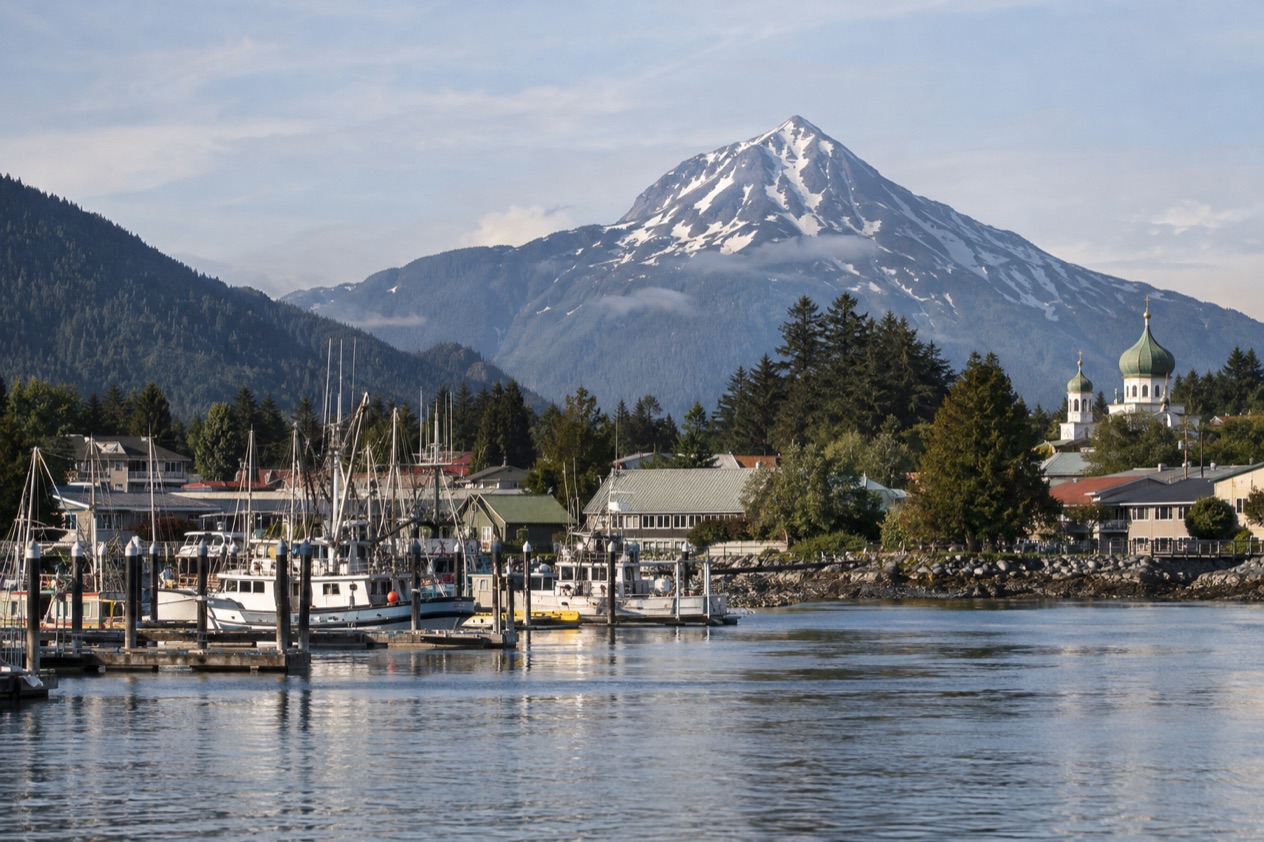
Early in the morning in Sitka, mist hangs low over the water, spruce and hemlock drip, and the onion dome of the Russian Orthodox church shows through the gray. Before the town has fully woken, you can already be among totem poles or watching an eagle on a perch. Sitka sits on an island with no road off it, so a day trip here means a day spent in the forest, on the shore and in the museums within reach of town, each one tied to the Tlingit, Russian and American stories of the Sound.
What are the best day trips from Sitka?
The best day trips from Sitka are the outings around town itself, because Baranof Island has no road to anywhere else and the town is reached only by air and by sea. What you get instead is a short list of places that each deserve most of a day, from a rain forest park to a sanctuary for injured birds.
- Sitka National Historical Park, for the totem poles, the forest paths and the Indian River, where salmon swim upstream in spawning season.
- The Russian Bishop’s House, a National Historic Landmark where you see how Russian life in Alaska was arranged room by room.
- The Alaska Raptor Center, a sanctuary inside the Tongass National Forest, for a close look at birds of prey.
- Sitka Sound, the body of water that shaped the town, with islands on its edges and the open Pacific beyond.
- The Alaska Day Festival, a week-long gathering of ceremony, talks and programs that turns the whole town into the destination.
- The tidelands of the park, where the shore shows sea stars and crabs when the water pulls back.
None of these asks for a border crossing, a ferry transfer or a long road drive, which is the difference between Sitka and towns on the road system. You can combine two of them in one day, or give a single place the whole day, and the weather will often help you decide.
Rain is part of the deal in this corner of Southeast Alaska. The forest looks its best under a wet sky, the totem poles darken and gleam, and the museums are never far away when a squall comes in.
The best day trips from Sitka
Sitka National Historical Park
The park sits at 106 Metlakatla Street in Sitka and is the place to start. It protects a landscape that drew Tlingit, Russians and Americans, and sometimes set them against each other, so the walk feels like reading a history book that happens to be outdoors. Wooded pathways run for two miles, and along them stand totem poles, many of them replicas, among towering spruce and hemlock.
At the visitor center you can look at ceremonial and traditional objects from Tlingit and Russian Orthodox cultures. Many of the artifacts on display are owned by Tlingit clans and are still used for ceremonies, which changes how you look at them. These are working pieces of living culture, not relics behind glass. Wander among the totem poles obtained from Haida and Tlingit carvers and take your time reading the figures.
The river is called Kaasdahéen, or Indian River, and in spawning season you may see salmon swimming upstream. Down on the tidelands, sea stars and crabs show up when the tide is out.
The Russian Bishop’s House
The house stands at 501 Lincoln Street, in town, and is a historic house museum and a National Historic Landmark. It was built in 1841 to 1843 and part of it once served as a schoolhouse. The National Park Service has restored it as part of Sitka National Historical Park, so it pairs naturally with a morning in the forest.
Downstairs, museum exhibits explain Russian activities in Alaska, from the church to the fur trade that once ran through Sitka Sound. Upstairs, the second floor is furnished, and walking through its rooms gives you a sense of how a bishop and his household lived in this far corner of an empire. The details are domestic, a table, a bedroom, a sitting room, and they stay with you more than a date on a plaque.
It suits history lovers and anyone who wants a dry stop on a wet day. Pair it with a walk through the old streets toward the Orthodox church, and keep the visitor center objects in mind, because the Tlingit side of the story is told just as strongly in the park.
The Alaska Raptor Center
The Alaska Raptor Center is a sanctuary located in the Tongass National Forest, just outside the center of Sitka. It takes in birds of prey every year, many of them injured, and what you see there depends on which birds are in care at that moment. Eagles are the ones visitors think of, but the forest around the center is as much a part of the visit as the birds.
The setting is a quiet, mossy stretch of the national forest, and the mood is closer to a wildlife hospital than a zoo. It suits families and anyone who enjoys watching wildlife up close, and it offers a very different kind of day from the history sites.
The center also holds an annual gala with auction items and a chance to meet supporters, a sign of how much the town cares about the place. If you are in Sitka when events are on, ask what is happening, because local life often revolves around fundraisers like this.
Sitka Sound and its islands
Sitka Sound is the water at the town’s door. Baranof Island borders it to the south and the northeast, Kruzof Island lies on its northwest side, and the Pacific Ocean opens to the southwest. In the early 19th century it was a major center of the maritime fur trade, which is why Russian ships came here at all.
Looking out from the shore, you see a scatter of forested islands and a horizon that changes with the weather. On a clear day the line between water and sky is sharp, and on a gray day the islands fade into layers of mist. Whales, otters and seabirds are chances here, not promises, and it is worth keeping an eye on the water whenever you are at the waterfront.
This is the day trip for people who want the geography of Sitka to make sense. Seeing the Sound from the water, or even from the shore, explains why Tlingit, Russians and Americans all wanted this place. The water is cold, so this is a day for looking, not for swimming.
Day trips from Sitka compared
| Trip | Where | Best for |
|---|---|---|
| Sitka National Historical Park | 106 Metlakatla Street, Sitka | Totem poles, rain forest paths, Indian River, tidelands |
| Russian Bishop’s House | 501 Lincoln Street, Sitka | Russian history, a furnished second floor, museum exhibits |
| Alaska Raptor Center | Tongass National Forest, Sitka | Birds of prey, a quiet forest setting |
| Sitka Sound | Around Baranof and Kruzof Islands | Views, maritime history, wildlife chances |
To choose, start with the weather and your mood. A dry, bright morning calls for the park and its paths, while a heavy rain sends you to the Russian Bishop’s House with its exhibits.
If you have one day, pair the park with the Bishop’s House, since both belong to the same National Park Service story and one visit completes the other. With two days, add the Raptor Center and a long look at the Sound. If you are in town during the Alaska Day Festival, let its programs set the schedule, because the reenactment and talks draw on the same history you are walking through.
Tour or on your own?
In Sitka the question looks different from the one in towns with highways, because there is no long drive to weigh. Most of what is worth seeing is in or close to town, so you can fit the outings to your own pace, stopping when the rain gets heavy and starting again when it lifts. That freedom is the real appeal of doing it yourself.
A guided experience makes the most sense where there is a story you might otherwise miss. At the historical park, the objects, poles and places carry layers of meaning for the Tlingit, Russian and American communities, and a ranger or guide can explain them.
The Russian Bishop’s House works the same way, since its exhibits and furnished rooms are there to be interpreted. Reading the signs slowly is also a good approach if you prefer quiet.
For the Sound, how you go depends on how close you want to get. From shore you see the islands and the horizon, and a trip on the water takes you into the scene. Whatever you choose, remember that Sitka Sound opens to the Pacific, so conditions can change, and local operators will know more than any guide can.
Cruise passengers have their own arrangement. From Old Sitka Dock, a free shuttle bus runs to Harrigan Centennial Hall in downtown Sitka, and the ride takes about 15 minutes. From the hall, the old streets and the Bishop’s House are the natural first stops, and the park follows when you have time.
Before you commit to anything, look at the sky and the forecast, and think about what you want from the day. A guided visit gives context, a self-led one gives room to linger, and in a town this size you can mix the two in the same day. Ask the park staff or your lodging which places are open on the day you plan to visit.
Good to know before you go
Sitka has a humid maritime climate with heavy precipitation, and annual rainfall comes to 131.74 inches, so rain gear and layers belong in your bag at any time of year. The temperature range between seasons is small, which keeps the layers simple. Alaska Marine Highway ferries serve Sitka year-round for passengers and vehicles, and Alaska Airlines flies in year-round, so reaching town is not seasonal even when the weather is.
Sources
- Greater Sitka Chamber of Commerce (https://www.sitkachamber.com/), checked October 11, 2026
- Wikivoyage, Sitka (https://en.wikivoyage.org/wiki/Sitka), checked October 11, 2026
- Wikipedia, Sitka, Alaska (https://en.wikipedia.org/wiki/Sitka,_Alaska), checked October 11, 2026
- Wikipedia, Sitka National Historical Park (https://en.wikipedia.org/wiki/Sitka_National_Historical_Park), checked October 11, 2026
- Wikipedia, Sitka Rocky Gutierrez Airport (https://en.wikipedia.org/wiki/Sitka_Rocky_Gutierrez_Airport), checked October 11, 2026
- Wikipedia, Sitka Sound (https://en.wikipedia.org/wiki/Sitka_Sound), checked October 11, 2026
- National Park Service, Sitka National Historical Park, plan your visit (https://www.nps.gov/sitk/planyourvisit/index.htm), checked October 11, 2026
- Alaska Raptor Center, Sitka (https://www.alaskaraptor.org/), checked October 11, 2026
- Wikipedia, Russian Bishop%27s House (https://en.wikipedia.org/wiki/Russian_Bishop%27s_House), checked October 11, 2026
- Wikipedia, Tlingit (https://en.wikipedia.org/wiki/Tlingit), checked October 11, 2026
- Wikipedia, Southeast Alaska (https://en.wikipedia.org/wiki/Southeast_Alaska), checked October 11, 2026