
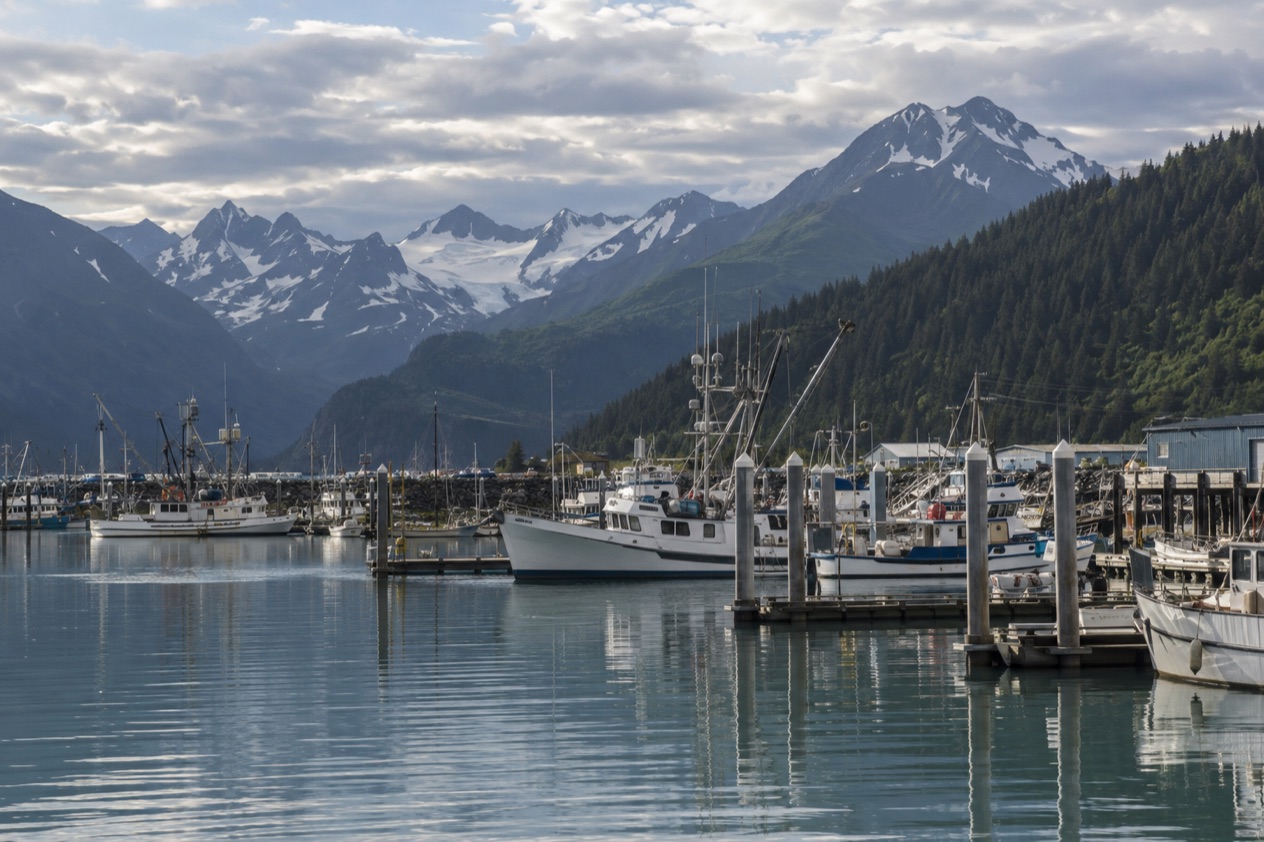
The road into Seward ends at the water, where Mt. Marathon rises steeply behind the town and Resurrection Bay opens out in front of it. Boats rock in the harbor, gulls work the docks, and the air smells of salt and diesel. A few things are worth settling before you arrive: how you reach town, what to wear, and how to behave around the wildlife.
What should you know before visiting Seward?
Four things matter most: Seward is a small port town, the road and rail connections from Anchorage run on their own schedules, the weather changes quickly, and bears are part of Alaska life. Everything else follows from those.
Seward sits at the head of Resurrection Bay on the Kenai Peninsula in Southcentral Alaska, with a population of about 2,700. It is a small place, and that is what first-time visitors tend to notice.
The town is sandwiched between the Kenai mountains and the waters of Kenai Fjords National Park, so the mountains feel close from nearly every street. The harbor is the center of daily life, and the fishing reputation is real: Seward is known as one of Alaska’s premier sportfishing destinations.
Many people are surprised by how much of the town’s story is about the water and the railroad. The Alaska Railroad owns land right in town, including the cruise ship terminal and the docks, and a great deal of cargo and many passengers move through those facilities every year. The land itself is the ancestral homeland of the Alutiiq, or Sugpiaq, people, and that history sits under the harbor-town surface.
The other surprise is how close the town is to Anchorage. The drive takes about 2.5 hours along the Seward Highway, which is why plenty of travelers arrive for a day or an overnight and then wish they had planned longer. The Alaska SeaLife Center, the state’s only public aquarium, gives a rainy hour or two a good home in town.
Fees, passes and reservations
The sources for Seward give no park passes, entry fees or reservation requirements, so there is no price to plan around from this side. What they do establish is the setting: Seward sits beside Kenai Fjords National Park, and the Alaska SeaLife Center, the Alaska Railroad and the Park Connection bus all run as separate services with their own terms.
If you plan to ride the train or the bus, settle your seat before you go, since both operate on set summer schedules. The Alaska Railroad runs daily between Anchorage and Seward from May 13 to September 14. The Park Connection bus makes two trips a day between the two towns from mid-May to mid-September. Outside those windows, these two services are not part of the picture.
Fishing trips, boat tours and lodging each have their own operators, and each sets its own terms. Work out which of these you want first, then deal with each one directly, so the pieces of the trip fit together before you leave home.
Money, phones and getting online
Seward is a U.S. town, so everything runs in U.S. dollars and your usual phone plan from home applies without any change of country. There is no currency to exchange and no foreign setup to arrange.
The sources give nothing on cell coverage, card acceptance or Wi-Fi in town, so there is little to promise here. What is useful is to know your route before you leave a connected area, and the state offers a tool for that: Alaska 511, run by the Alaska Department of Transportation, publishes road conditions and closures.
It sorts conditions into categories from Good, Fair and Difficult up to Very Difficult, Hazardous and Road Closure. It also shows incidents reported through Waze and has a map with cameras you can save to My Cameras. Looking at that map before you set out on the highway from Anchorage is a simple habit that costs nothing and tells you what the road looks like that day.
Getting around and staying connected
Seward is reached from Anchorage three ways: by car, by train or by bus. The drive takes about 2.5 hours along the Seward Highway, which the sources call scenic. Seward is easily accessible from Anchorage, and that is the reason it makes such a natural trip from the city.
The Alaska Railroad’s Coastal Classic train takes 4.5 hours to reach Seward from Anchorage, and passengers can also board in Girdwood. It runs daily in the summer, from May 13 to September 14. The Park Connection bus makes two trips a day between Anchorage and Seward in the summer, from mid-May to mid-September.
| Way to reach Seward | From | Time | Season |
|---|---|---|---|
| Seward Highway drive | Anchorage | About 2.5 hours | Road conditions on Alaska 511 |
| Alaska Railroad Coastal Classic | Anchorage (also Girdwood) | 4.5 hours | May 13 to September 14, daily |
| Park Connection bus | Anchorage | Twice daily | Mid-May to mid-September |
The sources say nothing about taxis, ride-hailing, local buses or rental cars in Seward, so none of that is assumed here. For the road, the Alaska 511 map is the one tool the sources name.
Weather, daylight and wildlife
Dress in layers. From spring to early fall, temperatures in Alaska range from 50 to 70 degrees Fahrenheit, with possible rain and wind. A backpack lets you shed layers as the weather shifts, and the outer layer should be a fully waterproof and breathable shell with a hood, which keeps you warm when it blows and dry when it rains.
Seward’s own numbers show how the seasons feel. July is the mildest month shown, with highs in the low 60s and lows around 50, and showers on roughly seven days.
October turns wetter and cooler, with highs in the mid-40s and rain or wet snow on nearly twelve days, so a hooded shell is the main thing you carry. April is cool, with highs in the mid-40s and lows just above freezing. January is cold, with highs just above freezing and lows well below it.
| Month | Average high (°F) | Average low (°F) | Precipitation (inches) | Days with precipitation |
|---|---|---|---|---|
| January | 31.3 | 21.1 | 6.47 | 10.1 |
| April | 45.4 | 32.2 | 4.29 | 9.3 |
| July | 62.2 | 50.2 | 3.11 | 7.4 |
| October | 45.7 | 34.7 | 8.69 | 11.8 |
On wildlife, all three North American bear species flourish in Alaska: black bears, brown bears (including grizzlies) and polar bears. The rule the state gives is clear: people in Alaska must keep all human sources of food secure from bears. A dangerous bear situation should be reported to the Alaska Department of Fish and Game using its wildlife encounter form.
Time in Seward follows the Alaska Time Zone, nine hours behind UTC in standard time and eight hours behind during daylight saving time. The clocks change on the second Sunday in March and again on the first Sunday in November.
Local customs and etiquette
Alaskans dress for the day, not for the occasion. Rain jackets, sturdy boots and fleece are normal in a restaurant as much as on a trail, and nobody looks twice at a muddy pair of shoes. Arrive in practical clothes and you will blend in at once.
The pace in a harbor town is unhurried. People chat on the dock, strike up conversations in line at the coffee counter and are glad to tell you what the fishing has been like.
Fishing is a big part of Seward’s identity, so asking about the day’s catch is a friendly way in. A little patience goes a long way when boats are delayed by weather, which is simply part of life on the water.
Seward is the ancestral homeland of the Alutiiq, or Sugpiaq, people, and many Alaskans carry a quiet respect for that history. Learn the name of the people whose land you are on, listen when local history is told, and treat cultural places and objects as living things rather than scenery.
Respect for wildlife is a shared habit. Locals keep their distance from animals, keep food and trash put away, and do not treat a bear or a moose as a photo opportunity. Watching from where you are, and letting the animal go about its day, is how Alaskans do it.
Good to know before you go
The Alaska Railroad’s daily Anchorage to Seward trains run from May 13 to September 14, and the Park Connection bus from mid-May to mid-September; outside those months, driving is the connection. Check Alaska 511 for road conditions before leaving Anchorage, pack a waterproof shell with a hood whatever the month, and keep any food and trash out of reach of bears.
Sources
- Visit Seward (https://www.seward.com/), checked October 11, 2026
- Seward, cruise ship terminal (https://www.seward.com/maritime/dock-facilities/seward-cruise-ship-terminal/), checked October 11, 2026
- Seward, boat harbor (https://www.seward.com/maritime/dock-facilities/seward-boat-harbor/), checked October 11, 2026
- Alaska.org, dest seward (https://www.alaska.org/destination/seward), checked October 11, 2026
- Wikivoyage, Seward (https://en.wikivoyage.org/wiki/Seward), checked October 11, 2026
- Wikipedia, Climate of Alaska (https://en.wikipedia.org/wiki/Climate_of_Alaska), checked October 11, 2026
- Alaska 511 (https://511.alaska.gov/), checked October 11, 2026
- Alaska Department of Fish and Game, Living with bears (https://www.adfg.alaska.gov/index.cfm?adfg=livingwithbears.main), checked October 11, 2026
- Alaska.org, what to wear (https://www.alaska.org/advice/what-to-wear-in-alaska), checked October 11, 2026
- Wikipedia, Alaska Time Zone (https://en.wikipedia.org/wiki/Alaska_Time_Zone), checked October 11, 2026
- NOAA NCEI, U.S. Climate Normals 1991-2020, monthly (https://www.ncei.noaa.gov/access/services/data/v1?dataset=normals-monthly-1991-2020&stations=USW00026438), station Seward Ap, elevation 22 feet, checked October 11, 2026
To plan your stay
- Best Time to Visit Seward: Summer Daylight, Weather by Month and Things to Do in Each Season
- Things to Do in Seward: Exit Glacier, the SeaLife Center, Kenai Fjords Boat Trips and Fishing
- Where to Stay in Seward: Downtown, the Boat Harbor, Mt. Marathon Streets and Lodges Outside Town
- Seward from Anchorage: the Seward Highway, the Coastal Classic Train and the Park Connection Bus