
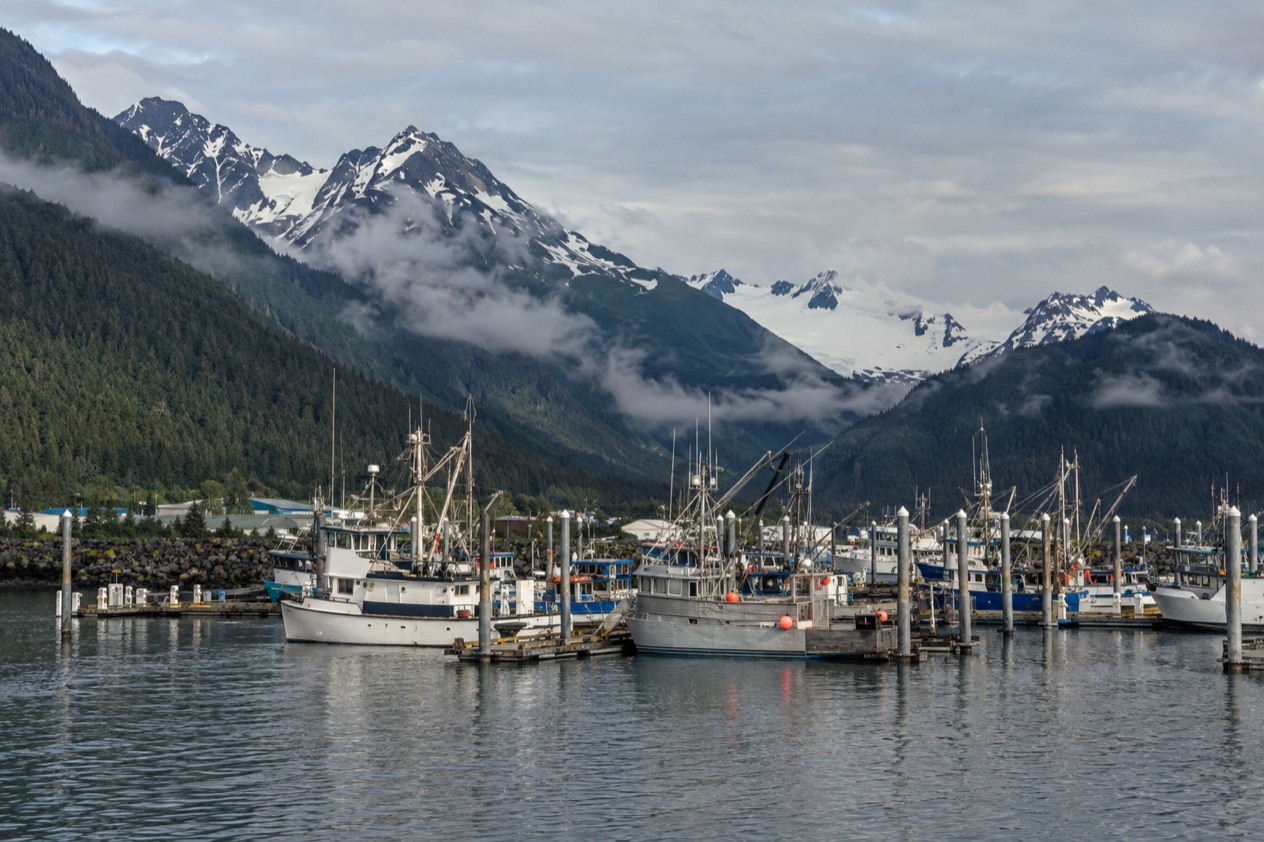
On a first morning in Seward, the harbor is the first thing you hear: halyards clinking, gulls arguing over the docks, and the low hum of boats warming up. Behind the town, Mt. Marathon climbs steeply into the clouds, and the water of Resurrection Bay lies flat in front of it. Three days is a comfortable stretch here, enough to meet a glacier, a marine aquarium and the edge of Kenai Fjords National Park.
Is three days enough in Seward?
Seward has about 2,700 residents and sits at the head of Resurrection Bay, so the town itself takes little time to learn. What fills the days is what surrounds it: a glacier you can reach by road, an aquarium on the shore and a national park whose coast opens up by water.
Three days covers all three, with a quiet evening in town after each. It leaves out the deeper park, the trail that climbs from Exit Glacier up to the Harding Icefield, and a fishing trip, since Seward has a strong reputation as one of Alaska’s premier sportfishing destinations.
With more time, add those, or a night in one of the public-use cabins scattered around the Kenai Peninsula. Seward calls itself the place where Alaska starts, and three days is a good first chapter.
Day 1 in Seward
Start at the Alaska SeaLife Center on Railway Avenue, on the shore of Resurrection Bay. It is a public aquarium, the only one in Alaska, and also the state’s only permanent marine mammal rehabilitation facility.
Going first gives you a sense of the animals that live in these waters before you go looking for them outside. Plan a slow morning among the tanks and the viewing windows, and stay as long as the exhibits hold you.
In the afternoon, walk out along the waterfront toward the boat harbor, which opened in 1964 and is a certified Alaska Clean Harbor. You can watch working boats come and go, read the water, and look up at Mt. Marathon above the roofs.
The railroad and cruise terminal grounds sit nearby too, a reminder that Seward is the southern end of the Alaska Railroad and a port where many cruises begin or end.
For the evening, stay near the water. Seward is compact, so the walk back to wherever you sleep is short in the sense that you do not need a vehicle for the day. A tip: save your energy. Day 2 starts with a road trip to a glacier, and the long evening light of the Alaska summer is better spent on the shoreline than at a table.
Day 2 in Seward
Day 2 belongs to Exit Glacier, the only part of Kenai Fjords National Park reachable by road. A spur road off the Seward Highway leads to the area, and from there a system of trails runs to the terminus of the glacier.
You can walk close to an active glacier here, and the ice has been retreating, which gives the walk a certain weight. Ranger-led walks add the story of the ice and the land around it.
| Activity | Times (summer season) | Length |
|---|---|---|
| Ranger-led walk to Exit Glacier | Daily at 10 am, 11 am, 1 pm and 2 pm | 1 to 2 hours |
Pick a morning walk and you will have the afternoon free for the trails. They also lead up toward the Harding Icefield, the huge ice field that feeds the glaciers of the park and the reason the park was created in 1980. You do not need to go all the way. Even the lower stretches give you forest, river gravel and views of the ice.
Return to town for the evening. The road to Exit Glacier is open to cars until snow arrives, usually in mid-November, after which it turns over to snow machines, dogsleds, fat-tire bicycles and cross-country skiers. After a day outdoors, a dinner near the harbor and a stroll along the shore make a gentle close.
Day 3 in Seward
Day 3 is for the coast of Kenai Fjords National Park, which visitors reach mainly by water. After a day on the glacier road, seeing the park from a boat shows you its other face, the fjords and shoreline that give the park its name.
You may see wildlife along the way, though nothing is promised. The details of such a trip belong to the day trips, so plan the day around the boat and leave the evening free.
Back in Seward, go to the shoreline at the southern end of town, where Mile 0 of the Iditarod Trail is marked. The long trail to the north starts here, and standing at the marker puts the whole town in a different light, as a gateway as much as a destination. This is also the ancestral homeland of the Alutiiq, or Sugpiaq, people, a history worth keeping in mind as you walk the waterfront.
Finish at the harbor, where boats tie up after their day and the mountains behind catch whatever light is left. It is a good place to look back over three days: an aquarium, a glacier and a fjord coast, all within a few miles of one another. Dinner in town, a last walk, and you are done.
Where to stay for three days in Seward
For this plan, the best base is in town, close to the harbor and the waterfront around Railway Avenue. Day 1 and Day 3 both happen on foot near the water, and Day 2 starts from the same place. Sleeping in town means you can wander down to the harbor after dinner without arranging anything, and it keeps the SeaLife Center within reach.
Travelers who want a quieter night might look at the public-use cabins and wilderness lodging found around the Kenai Peninsula, and Kenai Fjords National Park itself has overnight options in camping and cabins. These suit a longer stay, since they take you away from the harbor routine that shapes this itinerary. For three days, though, staying in Seward keeps things simple and puts you where the boats, the aquarium and the road to the glacier all begin.
What to skip if you only have three days in Seward
Skip the trail all the way up to the Harding Icefield. The trails leading from Exit Glacier to the icefield are a project of their own and deserve a day on their own terms. Three days gives you the glacier’s terminus and a ranger-led walk, which is plenty to understand what you are looking at. Save the climb for a return visit.
Skip adding a second town. The Kenai Peninsula stretches a long way, and places like Homer, where the paved highway system of North America ends, or the Kenai River, renowned for king salmon fishing, are lovely but pull you away from Seward. Spend that time in the bay instead, or at the harbor, where the fishing reputation is already on view.
Skip trying to see every stop along the Seward Highway on your way in or out. The road is a National Forest Scenic Byway, a State Scenic Byway and an All-American Road, and it passes through Chugach National Forest and along Turnagain Arm, so there is plenty to look at from the window.
Pull over where the view calls you, but do not turn the drive into a full day of its own. Give the time back to Seward.
Getting around Seward in three days
In town, the sights of Days 1 and 3 sit near the waterfront, and the plan works on foot. The one outing that needs a road is Exit Glacier, reached by a spur road off the Seward Highway. The coast of the national park is reached by water, so Day 3 begins at the harbor.
Getting to Seward from Anchorage is a matter of choice. By road, the drive takes about 2.5 hours along the Seward Highway, and a motorcoach takes about the same.
In summer, the Alaska Railroad also runs daily passage between Anchorage and Seward, and the Park Connection runs twice daily by bus. The Coastal Classic train takes 4.5 hours, winding along Turnagain Arm, and passengers can board in Girdwood. GoldStar Service is available on the Coastal Classic route.
Good to know before you go
Daylight and weather shape the days more than any rule. Seward’s summer brings long light and light rain on some days, while winter is short and colder, and the Exit Glacier road closes to cars once snow arrives.
| Month | Average high (°F) | Average low (°F) | Precipitation (inches) | Days with precipitation | Daylight on the 15th |
|---|---|---|---|---|---|
| January | 31.3 | 21.1 | 6.47 | 10.1 | 6 hours 38 minutes |
| July | 62.2 | 50.2 | 3.11 | 7.4 | 18 hours 10 minutes |
Sources
- Visit Seward (https://www.seward.com/), checked October 11, 2026
- Seward, cruise ship terminal (https://www.seward.com/maritime/dock-facilities/seward-cruise-ship-terminal/), checked October 11, 2026
- Seward, boat harbor (https://www.seward.com/maritime/dock-facilities/seward-boat-harbor/), checked October 11, 2026
- Alaska.org, dest seward (https://www.alaska.org/destination/seward), checked October 11, 2026
- Wikivoyage, Seward (https://en.wikivoyage.org/wiki/Seward), checked October 11, 2026
- Wikipedia, Seward, Alaska (https://en.wikipedia.org/wiki/Seward,_Alaska), checked October 11, 2026
- Wikipedia, Seward Highway (https://en.wikipedia.org/wiki/Seward_Highway), checked October 11, 2026
- Alaska SeaLife Center, Seward (https://www.alaskasealife.org/), checked October 11, 2026
- Wikipedia, Alaska SeaLife Center (https://en.wikipedia.org/wiki/Alaska_SeaLife_Center), checked October 11, 2026
- National Park Service, Kenai Fjords National Park, plan your visit (https://www.nps.gov/kefj/planyourvisit/index.htm), checked October 11, 2026
- Wikipedia, Kenai Fjords National Park (https://en.wikipedia.org/wiki/Kenai_Fjords_National_Park), checked October 11, 2026
- Wikipedia, Exit Glacier (https://en.wikipedia.org/wiki/Exit_Glacier), checked October 11, 2026
- Seward, Silver Salmon Derby and events (https://www.seward.com/events/), checked October 11, 2026
- Alaska Railroad, Coastal Classic (https://www.alaskarailroad.com/ride-a-train/our-trains/coastal-classic), checked October 11, 2026
- Wikipedia, Kenai Peninsula (https://en.wikipedia.org/wiki/Kenai_Peninsula), checked October 11, 2026
- NOAA NCEI, U.S. Climate Normals 1991-2020, monthly (https://www.ncei.noaa.gov/access/services/data/v1?dataset=normals-monthly-1991-2020&stations=USW00026438), station Seward Ap, elevation 22 feet, checked October 11, 2026
- Computed from the date and the latitude of the place (sunrise equation, solar elevation -0.833 degrees), October 11, 2026
- Alaska Railroad, Our trains (https://www.alaskarailroad.com/ride-a-train/our-trains), checked October 11, 2026
To plan your stay
- Best Time to Visit Seward: Summer Daylight, Weather by Month and Things to Do in Each Season
- Where to Stay in Seward: Downtown, the Boat Harbor, Mt. Marathon Streets and Lodges Outside Town
- Seward from Anchorage: the Seward Highway, the Coastal Classic Train and the Park Connection Bus
- Know Before You Go to Seward: Getting There, Weather, Bears and Local Habits