
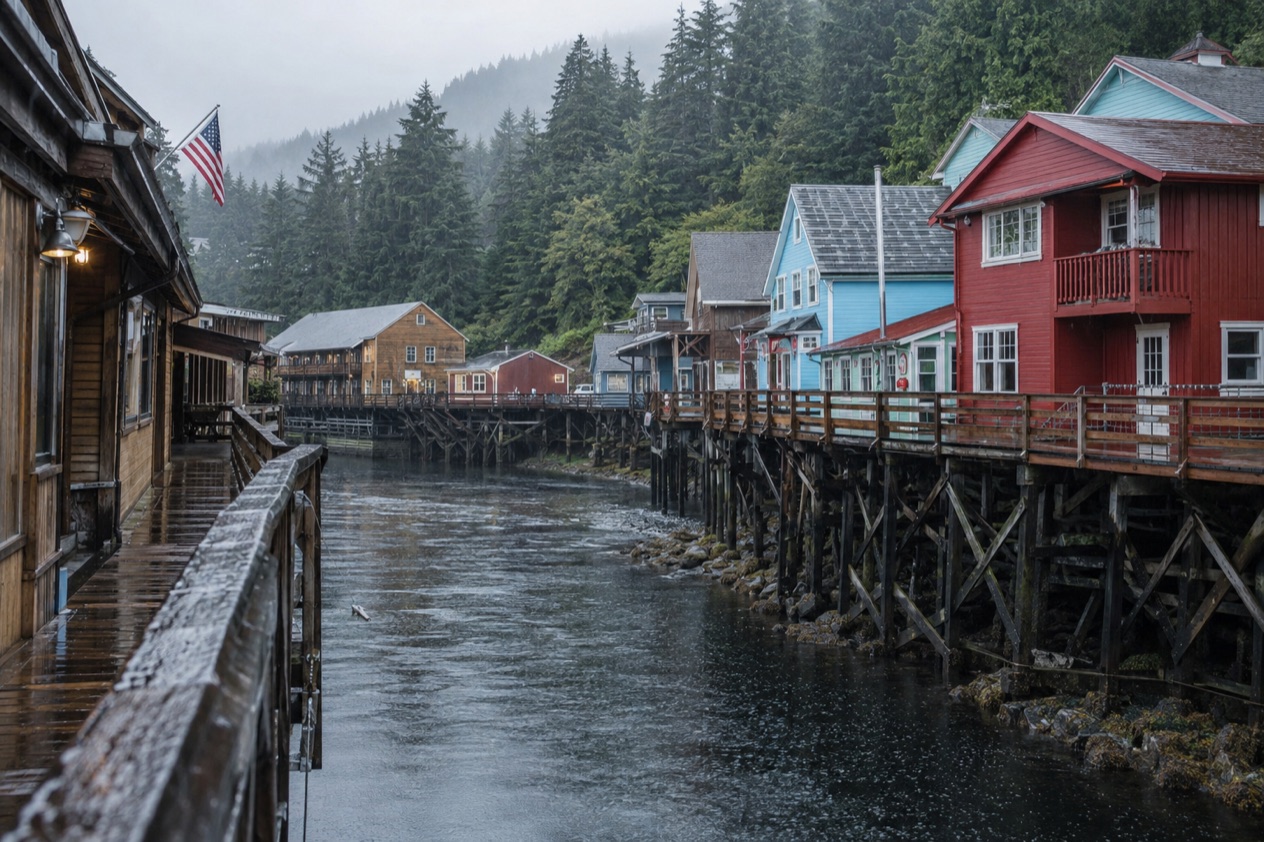
Rain taps on the boardwalk of Creek Street, and under the planks the creek runs loud and brown over the rocks. Up the hill, carved cedar faces look out from the trees, and the smell of fried halibut drifts from a waterfront window.
Ketchikan is a rainforest town on an island, shaped by Tlingit, Haida and Tsimshian cultures and by a century of fishing and logging. It suits travelers who like to see history, wild country and the table in one stay.
What are the best things to do in Ketchikan?
The best things to do in Ketchikan are the totem poles, the old boardwalk of Creek Street, a day in the Tongass rainforest and a plate of local seafood. The essentials are these, and each one is developed in the sections that follow.
- Totem Bight State Historical Park, where carved poles and a clan house stand in the forest on a former Native campground.
- Creek Street, the boardwalk row over Ketchikan Creek with a colorful past and a good stretch of gift shops and galleries.
- The Totem Heritage Center, a quieter place to see old poles and understand what they mean.
- Saxman, the Tlingit town next door, for more carving and a closer look at living tradition.
- Misty Fjords National Monument, a vast wilderness of cliffs and water reached from Ketchikan.
- The Tongass Historical Museum, which tells the story of the Canned Salmon Capital of the World.
- The Great Alaskan Lumberjack Show, a loud, funny afternoon of axes, saws and climbing between May and September.
- A plate of salmon, halibut or crab, which is as much a part of the visit as any sight.
Beyond that, the town rewards unhurried wandering. Downtown is easy to walk, with historic buildings, galleries, shops and locally made goods packed along the water, and the rain is part of the scene rather than a reason to stay in.
Sights and landmarks in Ketchikan
Ketchikan’s landmarks tell one story from three angles: the Native peoples who fished these waters first, the pioneers and canneries that followed, and the town that grew on pilings and boardwalks between the mountain and the Tongass Narrows. The settlement began as a seasonal Tlingit fish camp and became a border town that has drawn newcomers since the late 1800s. People arrived to find a fortune, start a new life, live off the land, or, as the local telling puts it, misbehave.
A good way to hear that story is through the Ketchikan story project, an Emmy Award-winning series that follows the town from the beginning of time to the recent past. Old-timers, local historians and other salty characters tell it, and the voices give the buildings you walk past a lot more life.
Creek Street
Creek Street is a lane of wooden houses on stilts and boardwalk planks above Ketchikan Creek, and it is the picture people carry home. The historic buildings recall its past as a red light district that served miners, fishermen and loggers. Today the same rooms hold gift shops, galleries and small museums, and the walk is a slow one because every window has something in it.
Stand on the footbridge and look down. When salmon are running, you may see them stacking up in the creek below, and the boardwalk becomes an unexpected wildlife stop in the middle of town.
Rain brings out the color of the old paint and the sound of the water, so a gray day is no handicap here. It suits anyone with a camera, an interest in the town’s rougher history, or an hour to fill between other plans.
Totem Bight State Historical Park
Totem Bight sits at Mile 10.5 of the North Tongass Highway, north of Ketchikan, in forest beside the water. The park stands on the former site of a traditional Native campground known as Mud Village and Mud Bight Village. A trail leads through spruce and hemlock to a clan house and a line of carved and painted poles facing the shore, and the whole place has the hush of tall trees.
The park covers 33 acres, and the historic site inside it, listed on the National Register of Historic Places, takes up only a part of that. Go for the slow part: stand in front of each pole, look for the animals and figures carved into them, and let the setting do the work. It is a good choice for people who want the poles in a forest setting rather than a museum case, and the damp air only deepens the colors.
The Totem Heritage Center and Saxman
Ketchikan has the world’s largest collection of standing totem poles, spread among Saxman Totem Park, Totem Bight, Potlatch Park and the Totem Heritage Center. The Heritage Center is the quiet one, a place to slow down and take in the carving and the meaning behind it. If Totem Bight is about the forest setting, this is about the craft.
Saxman is a separate town, with the city of Ketchikan lying just to the northwest of it. It was incorporated on January 22, 1930, and its Tlingit name is T’èesh Ḵwáan Xagu. Its totem park is the place to look at carving as a living tradition rather than a relic, and it makes a natural pairing with the Heritage Center for anyone who wants to understand the poles and not only photograph them.
Tongass Historical Museum and the town’s fishing past
The Tongass Historical Museum holds exhibits on Ketchikan’s people, businesses and events from the late nineteenth and early twentieth centuries. It is the place to understand why the town was once called the Canned Salmon Capital of the World, a title earned by commercial fishing and canneries. Salmon and timber played the largest roles in the economy, and logging and maritime trades filled out the rest.
Pair a visit with a stroll along the harbor and you start to read the town differently. The working boats, the old waterfront buildings and the creek that once carried the fish all make more sense after an hour of photographs and artifacts. It is a good rainy-day stop for adults, and it gives the next hour’s wandering some context.
| Site | Where | What you see |
|---|---|---|
| Totem Bight State Historical Park | Mile 10.5, North Tongass Highway | Clan house and carved poles in forest |
| Totem Heritage Center | Ketchikan | Totem poles and Native carving |
| Tongass Historical Museum | Downtown Ketchikan | Exhibits on the town’s early people and businesses |
| Creek Street | Along Ketchikan Creek | Historic stilted buildings, shops and galleries |
Outdoor things to do in Ketchikan
Ketchikan is an island community surrounded by rainforest and sea, and the outdoors begins at the edge of town. Deer Mountain rises behind the downtown streets, and the Tongass National Forest, the largest U.S. National Forest, wraps around everything. Visitors can explore it from Ketchikan, and the forest covers islands, fjords, glaciers and peaks of the Coast Mountains across Southeast Alaska.
Misty Fjords National Monument
Misty Fjords lies about 40 miles east of Ketchikan along the Inside Passage coast, and it is the great outing of the area. The monument takes in more than two million acres of Tongass National Forest, and almost all of it is designated wilderness. Think sheer rock walls, waterfalls dropping into narrow saltwater arms and low cloud sliding along the cliffs, which is how the place earned its name.
The U.S. Forest Service administers the monument as part of the Tongass. Wildlife here is a chance and never a promise: you may see eagles, seals or whales, and on a clear day the scale of the place can feel almost unreal.
On a misty day the scenery shifts from sharp to soft, and both versions are worth seeing. It suits travelers who want a full day of landscape rather than a list of stops.
The Tongass and the Southeast Alaska Discovery Center
The Forest Service offers visitor programs at the Southeast Alaska Discovery Center in Ketchikan. It is a good first stop for understanding the forest, its wildlife and the cultures tied to it, and the exhibits help turn a green blur out the window into something with names and stories.
Ketchikan is also where the Tongass is administered, with Forest Service headquarters offices in town. That is why so much information about trails and the national forest begins here. After an hour inside, step out into the rain and the same trees feel different, which is one of the quiet pleasures of a place called the Rain Capital of Alaska.
The Lumberjack Show and the working waterfront
The Great Alaskan Lumberjack Show is performed near Ketchikan Creek between May and September. Athletes compete in axe throwing, sawing, log rolling and tree climbing, and the commentary is as loud and funny as the chainsaws. It gives you a sense of the trade that built this town, told as theater rather than lecture.
After the show, the waterfront is the other outdoor stage. Fishing boats, seaplanes and floatplanes come and go over the Tongass Narrows, and the water traffic alone is worth a bench and a few minutes. Wildlife like eagles, seals and sea birds may show up around the docks.
For the town itself, a walking loop through downtown links the museum, the galleries and Creek Street. Because the center is easy to walk, you can fold a half day of sights into a single stroll and still have time for lunch.
Day trips from Ketchikan
Ketchikan sits on Revillagigedo Island, so most day trips involve water or the air. Each one leads out of the town into a different piece of Southeast Alaska, from wilderness fjords to a Tsimshian community to a large neighboring island.
Misty Fjords from Ketchikan
Of all the excursions, Misty Fjords is the one people have in mind. It lies about 40 miles east of town, and visitors see it by going out from Ketchikan, since the monument is wild country with no town of its own. The reward is the scale: glacier-carved walls rising straight from the water, hanging waterfalls and forest that climbs wherever it finds a foothold.
The best moment is whichever the weather gives you. Clear days open up the long views, and low cloud makes the cliffs look like ink paintings. It is a day for anyone who would rather look than do, and for photographers who like soft light. Bring a sense of patience, because in this part of Alaska the clouds decide the program.
Metlakatla and Annette Island
Metlakatla is about 16 miles south of Ketchikan, on Annette Island across the Revillagigedo Channel. Travelers usually reach it on the Alaska Marine Highway ferry, and visitors can also travel to Ketchikan and cross by boat or seaplane. That crossing is half the point: the channel feels like a threshold between the main island and a separate community.
Metlakatla is a community in its own right rather than a stop built for visitors, so the trip is one of quiet observation. It suits travelers who like a slower, smaller destination and have a day to give to the crossing.
Prince of Wales Island
Prince of Wales Island is one of the islands of the Alexander Archipelago in the Alaska Panhandle. Craig is its largest community, home to about 1,500 people, and Hollis, a community of about 100 people, has a ferry terminal. It is a big, forested island with a different pace from Ketchikan, and it appeals to people who want to see the Tongass beyond the cruise-port towns.
Among its curiosities is El Capitan Pit, a cave shaft 598.3 feet high that is possibly the deepest vertical shaft in the United States. That karst country is a reminder that the rainforest sits on top of limestone full of hidden passages.
What to eat in Ketchikan
Seafood leads the way in Ketchikan, and the town’s history as the Canned Salmon Capital of the World shows in every menu. Salmon is the star, but halibut, crab and other cold-water catches fill out a table that is simple, fresh and built around the boats you can see from the window.
Salmon, halibut and crab
Salmon turns up grilled, baked on a cedar plank, smoked, cured as lox, and folded into chowder. Smoked salmon is one of the great edible souvenirs, with its deep color and its smoky, almost sweet edge, and it travels well in a vacuum-sealed pack. Eat it first at a table, with crackers and cream cheese, to learn what you like.
Halibut is the other everyday fish, and fish and chips is the way people try it: a white, flaky fillet in crisp batter with a pile of fries. King crab and Dungeness crab arrive as legs cracked at the table with melted butter, a messy, happy meal. Order the day’s catch where the menu offers it, since freshness is the whole point.
Chowder, pubs and local flavors
On a wet day, a bowl of seafood chowder is the right answer. Creamy, thick with fish or clams and eaten with crusty bread, it warms you from the inside, and nearly every kitchen has its own version. Compare two or three if you have time.
Look also for Alaska’s smaller flavors: reindeer sausage on a bun, berry desserts made with blueberries or salmonberries, fireweed honey, and local beers from small breweries around the state. Spruce tips sometimes flavor syrups and sweets, a taste that reads like the forest itself. The waterfront has casual spots and sit-down dining rooms, and coffee stands and bakeries fill the gaps between meals.
Eating near the water
The best seat in town is often by a window over the Tongass Narrows, where you can watch fishing boats and floatplanes while the food arrives. Creek Street and the downtown streets hold small cafés, and the harbor area is where a quick lunch of fish tacos or a fish sandwich fits between a museum and a walk.
Eating here is a lesson in how closely the plate and the landscape are linked. The fish on the menu was swimming in the same waters you came in on, and that connection is what makes a simple meal feel like part of the trip.
Things to do in Ketchikan at night
Nights in Ketchikan are small-town evenings by the water. The cruise crowds thin out, the lights come on along the waterfront, and the town returns to its own pace, with locals filling pubs and the sound of the creek running under the boardwalk.
Waterfront pubs and live music
A fishing and logging town has always had its bars, and the downtown waterfront still has a pub or two where the conversation is as much the attraction as the drinks. Order a local beer, sit near a window and listen to the stories, which often run to boats, weather and the one that got away. Live music turns up in some venues, so ask around as the evening begins.
Nightlife here is informal. There are no big clubs to speak of, and the draw is atmosphere: low lights, wood paneling, wet jackets drying by the door. It suits travelers who like a drink and a chat rather than a late-night scene.
Creek Street after the crowds
Creek Street looks different at night. The old stilted houses glow against the dark hillside, the planks creak underfoot and the water below sounds louder when the shops are closed.
Take a slow walk along the boardwalk and over the footbridge, then circle back through the downtown streets. In the rain, which falls often in this self-styled Rain Capital of Alaska, the reflections on the wet planks make it the most photogenic hour of the day.
Quiet evenings
Some of the nicest evenings are the plainest. Watch seaplanes settle onto the water, linger over dinner by the harbor, or sit on a bench with a coffee and see the boats come in. The Tongass Narrows is a working channel, so there is always something moving across it.
If you want something to plan around, a seafood dinner followed by a stroll covers it. Nights here reward people who like atmosphere over action, and the town’s calm is part of what makes it a restful base after a day of sightseeing.
Things to do in Ketchikan with kids
Children do well in Ketchikan because the town is full of things to look at, from carved poles to fishing boats to a creek that may be full of salmon. The most useful thing to bring is curiosity, because nearly everything here is a story waiting to be told.
Totem poles as a treasure hunt
At Totem Bight, the poles carry animals and figures that children can try to spot: an eagle, a bear, a raven, a whale. Turn it into a game by asking them to find each creature and invent what it might be saying. The forest trail adds to the sense of exploring, and the clan house gives them a real building to peer into.
The Totem Heritage Center and Saxman offer the same pleasure at a gentler pace. Talk about what the carvings mean, and let kids notice details you might miss. It is a cultural lesson that does not feel like a lesson.
Shows, boats and the creek
The Great Alaskan Lumberjack Show, performed near Ketchikan Creek between May and September, is built to hold a crowd’s attention, with axes flying, logs rolling and a climber racing up a tall pole. Kids tend to love the noise and the competition, and the humor keeps adults engaged too.
Along the creek and the harbor, there is plenty to watch for free. Salmon may fill the creek when they are running, and floatplanes and fishing boats come and go over the water. These small sights are often what children remember best.
Learning stops and keeping them comfortable
The Southeast Alaska Discovery Center, where the Forest Service runs visitor programs, gives children a way into the Tongass and its wildlife. The Tongass Historical Museum adds the human side, with exhibits on the town’s early people and businesses. Both are useful when the weather turns wet.
Rain is part of the deal here, so plan for indoor stops between outdoor ones and let children splash in puddles rather than fight them. Downtown is easy to walk, which keeps distances manageable, and the waterfront has plenty of benches for breaks.
Good to know before you go
Ketchikan is easy to cover on foot downtown, and the harbor, the museum and Creek Street all sit close together. Cruise ships visit from early May through late September and dock either downtown or at Ward Cove, about 5.5 miles from the center, and the Ketchikan Visitors Bureau’s cruise calendar shows which. Some activities, like the Lumberjack Show, run only between May and September, so match your plans to the season.
Sources
- Visit Ketchikan (https://www.visit-ketchikan.com/), checked October 11, 2026
- Wikivoyage, Ketchikan (https://en.wikivoyage.org/wiki/Ketchikan), checked October 11, 2026
- Wikipedia, Ketchikan, Alaska (https://en.wikipedia.org/wiki/Ketchikan,_Alaska), checked October 11, 2026
- Wikipedia, Ketchikan International Airport (https://en.wikipedia.org/wiki/Ketchikan_International_Airport), checked October 11, 2026
- Wikipedia, Misty Fjords National Monument (https://en.wikipedia.org/wiki/Misty_Fjords_National_Monument), checked October 11, 2026
- Wikipedia, Saxman, Alaska (https://en.wikipedia.org/wiki/Saxman,_Alaska), checked October 11, 2026
- Wikipedia, Totem Bight State Historical Park (https://en.wikipedia.org/wiki/Totem_Bight_State_Historical_Park), checked October 11, 2026
- Wikipedia, Prince of Wales Island (Alaska) (https://en.wikipedia.org/wiki/Prince_of_Wales_Island_(Alaska)), checked October 11, 2026
- Wikipedia, Metlakatla, Alaska (https://en.wikipedia.org/wiki/Metlakatla,_Alaska), checked October 11, 2026
- Wikipedia, Tongass National Forest (https://en.wikipedia.org/wiki/Tongass_National_Forest), checked October 11, 2026
- Wikipedia, Southeast Alaska (https://en.wikipedia.org/wiki/Southeast_Alaska), checked October 11, 2026
To plan your stay
- Best Time to Visit Ketchikan: Weather by Month, Long Summer Days, Totem Parks and Quiet Seasons
- Where to Stay in Ketchikan: Downtown, Ward Cove and How to Choose Your Base
- Ketchikan from Seattle: Ferry from Bellingham, Flights, Cruise Docks and What to Do on Arrival
- Know Before You Go to Ketchikan: Rain, Cruise Docks, Bears and Local Customs