
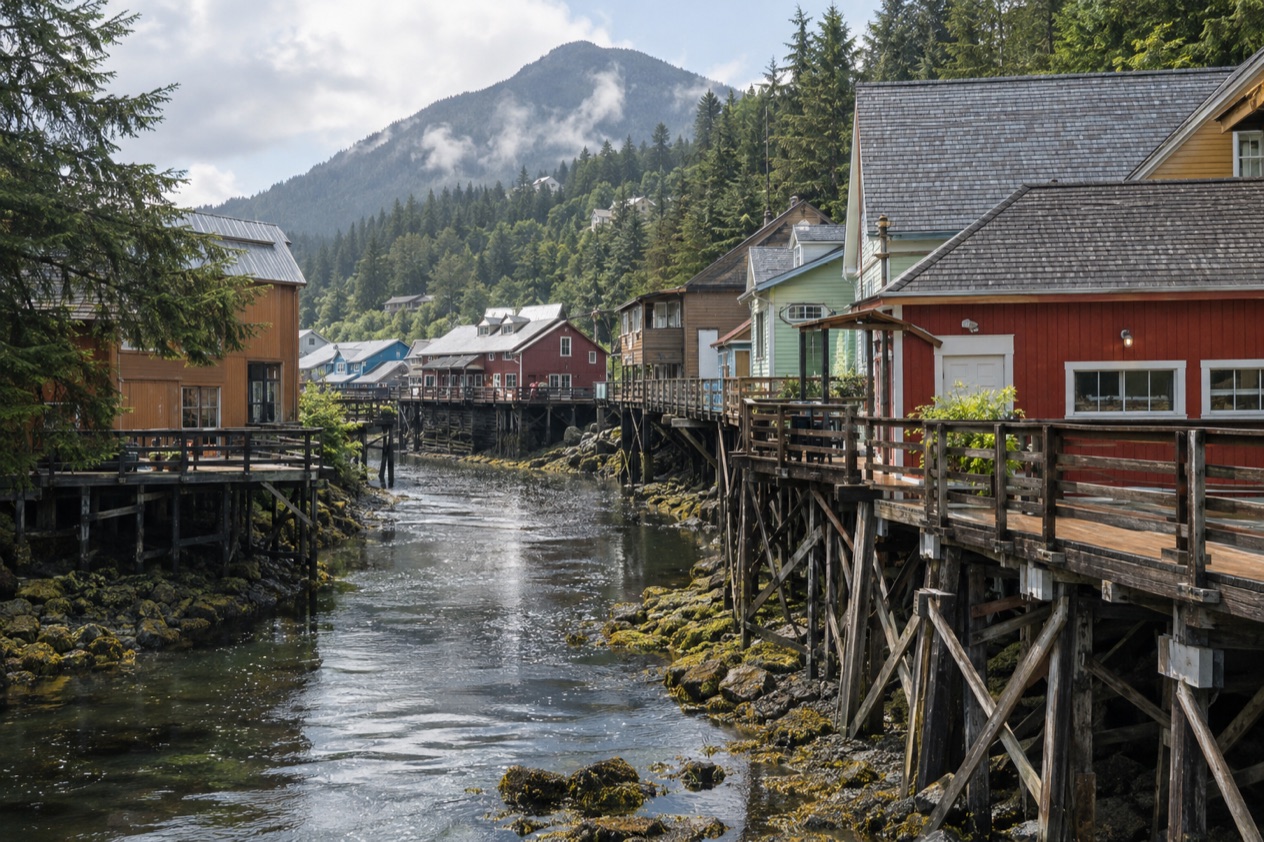
In June, the boardwalks along Creek Street shine with last night’s rain, and the long evening light lingers over the harbor long after dinner. Floatplanes buzz overhead, gulls argue on the pilings, and the smell of wet cedar and fried halibut drifts down the waterfront. It is a month of long days, green hillsides and a town that settles into its busy summer rhythm.
What is the weather like in Ketchikan in June?
June in Ketchikan is cool and damp, with mild afternoons, chilly nights and a good deal of daylight to enjoy them in. Showers come and go rather than settling in for days.
| Month | Average high (°F) | Average low (°F) | Precipitation (in) | Days with precipitation | Daylight on the 15th |
|---|---|---|---|---|---|
| May | 56.9 | 43.3 | 8.68 | 11.6 | 16 h 09 min |
| June | 61.3 | 49.3 | 7.02 | 10.6 | 17 h 25 min |
| July | 64.5 | 53.2 | 7.33 | 10.8 | 16 h 56 min |
Mornings start cool, so you want a fleece or a light insulated jacket for the first walk of the day. By afternoon the air warms to the low 60s, which feels pleasant in a sweater when the clouds break and a little chilly when they do not. Evenings cool off again, though the light stays with you for a long time.
Rain in this part of Southeast Alaska often arrives as drizzle or a passing shower, then lifts and leaves a bright, washed look over the channel and the forested slopes. About one day in three brings some precipitation, so a waterproof shell and water-resistant shoes matter more than an umbrella, which tends to fight the wind along the docks.
The daylight is generous, with the longest days of the year just ahead. You can start a walk late and still finish it with plenty of light, and a gray afternoon often brightens toward evening.
What to do in Ketchikan in June
June is a month for the things Ketchikan does best, which are totem poles, creek-side boardwalks, rainforest and seafood eaten close to where it was caught. The town stretches along a narrow strip of waterfront below steep, forested hills, so most of what you do is on foot, with time left over for the wet-weather pauses that are part of the place.
The harbor is the town’s living room. Fishing boats, floatplanes and cruise ships share the water, and a stroll along the waterfront gives you the full picture in an hour or two: bronze statues, souvenir shops in old storefronts, and cafés where you can wait out a shower with a hot drink.
Totem Bight State Historical Park
Totem Bight sits at Mile 10.5 of the North Tongass Highway, north of town, on a patch of shoreline covering 33 acres. Carved poles and a clan house stand among tall spruce and hemlock, facing the water. The historic site within the park was added to the National Register of Historic Places in 1970, and the poles are the reason people make the trip.
Go when the light is soft and the forest is dripping, since a damp day suits the dark wood and the green around it. Stand in front of each pole and look at the figures, the ravens, bears and eagles stacked one above another, each carrying a story of a family or a clan. The Tlingit, Haida and Tsimshian peoples of this region have long traditions of carving, and it is worth reading the interpretive signs as you go.
It suits anyone with an interest in Native art and a few hours to spare, and it pairs well with a lunch back in town. Bring a rain jacket, because the path runs through trees that keep dripping after the shower has stopped.
Creek Street and the downtown waterfront
Creek Street is a boardwalk of old wooden buildings raised on pilings above the creek, once the town’s red-light district and now lined with shops and small galleries. The planks are slick after rain, so walk slowly and look down at the water, where salmon may gather in the creek in the right season.
From there, wander back toward the harbor and the downtown streets. Galleries sell Native-made art, jewelry and prints, and you will find plenty of places selling smoked salmon and halibut. The town is compact, so you can dip in and out of shops whenever a squall passes through.
Tongass National Forest and the water
Ketchikan sits inside the Tongass National Forest, the largest national forest in the country at 16.7 million acres, and the Forest Service administers it from offices here in town. Islands, fjords, glaciers and peaks make up the wider forest, and the rainforest comes right down to the edge of the streets.
Humpbacks are known for breaching and other surface behavior, which is why people like to watch for them. Expect a cool, breezy day on the deck and dress in layers.
If you want to get further afield, Prince of Wales Island, in the Alexander Archipelago, has Craig as its largest community and a ferry terminal at Hollis. Metlakatla, on Annette Island, is about 16 miles south of Ketchikan and is usually reached by Alaska Marine Highway ferry.
Food is the other pleasure of the month. Look for halibut, salmon and crab on menus around the waterfront, from fish-and-chips counters to sit-down dining rooms. A bowl of chowder after a damp morning on the boardwalks is as much a part of Ketchikan in June as any sight.
A two-day itinerary for Ketchikan in June
Day 1 starts with a slow coffee in a downtown café while the town wakes up and the mist lifts off the hills. Spend the morning on the waterfront and in the galleries, then walk up to Creek Street before the boardwalks get busy and the wooden planks are at their quietest.
The long June light means you can return to town for dinner and still have a bright evening for a walk along the harbor.
Day 2 is for the water and the forest. Begin with a boat outing, where you may spot whales, eagles or sea lions, and dress warmly because the channel breeze is cool even on a bright morning. Back on land, have a bowl of chowder and browse the shops you skipped the day before.
If the rain turns steady, shift the plan indoors with galleries, museums and café stops, and save the forest for a break in the clouds. In the evening, an early dinner of salmon or halibut leaves time to stroll the harbor while the sky stays light.
Is Ketchikan busy in June?
Yes, June sits in the heart of the cruise season, and Ketchikan is among the ports of call on Norwegian’s Alaska cruises. On days when ships are in, the waterfront and Creek Street fill with visitors, while early mornings and evenings feel calmer.
The pace of the town follows the ships, so the middle of the day is the lively stretch and the long evening light is the quiet one.
What to pack for Ketchikan in June
Pack for cool, damp days that can brighten without warning, and bring layers you can add or shed through the day.
- A waterproof rain jacket, because showers arrive on about a third of June days.
- A fleece or light insulated layer for cool mornings and evenings.
- Water-resistant shoes with good grip for slick boardwalks.
- A warm hat and light gloves for time on a boat deck.
- Binoculars for watching the water for whales and birds.
- A small daypack to carry layers as the weather changes.
Good to know before you go
Daylight is the big June fact here, with more than seventeen hours on the 15th, so plan late outings and do not worry about rushing to beat the dark. Getting to some places, such as Metlakatla and Prince of Wales Island, involves the Alaska Marine Highway, which offers a Sailing Calendar and a Sailing Search tool for checking schedules by port and date.
Ketchikan in June vs May and July
May is cooler and a little wetter, with shorter days and a more subdued feel around town. The hillsides are fresh and green, and the waterfront is quieter, which suits travelers who prefer a slower pace and do not mind a chillier jacket.
July is the warmest of the three months, with highs in the mid-60s and lows in the low 50s, and the days are still very long. It feels more settled for outdoor time, though the rain still comes in regular showers, so a shell stays in the bag.
Choose June if you want the longest light and a middle path between the cool of May and the warmth of July. Shift earlier for quiet and fresh greens, and later if you want the mildest air for boats and boardwalks.
Is June a good time to visit Ketchikan?
Yes, June suits travelers who like long days, forest and water, and who accept that rain is part of the scenery. Totem poles, boardwalks and a harbor full of boats look their best under soft gray skies and bright breaks between them.
It is less ideal for anyone who wants reliably warm, dry weather or empty streets on cruise-ship days. If that describes you, plan around the quieter early and late hours, or consider another month.
On arrival, start with the waterfront and Creek Street to get your bearings, then head to Totem Bight on the first dry stretch. What makes June special here is the light, with evenings that seem to stretch on and on over the channel, long after the rain has moved off.
Sources
- NOAA NCEI, U.S. Climate Normals 1991-2020, monthly (https://www.ncei.noaa.gov/access/services/data/v1?dataset=normals-monthly-1991-2020&stations=USW00025325), station Ketchikan Intl Ap, elevation 76 feet, checked October 11, 2026
- Computed from the date and the latitude of the place (sunrise equation, solar elevation -0.833 degrees), October 11, 2026
- Wikipedia, Midnight sun (https://en.wikipedia.org/wiki/Midnight_sun), checked October 11, 2026
- Alaska Department of Transportation, Alaska Marine Highway System, Schedules (https://dot.alaska.gov/amhs/schedules.shtml), checked October 11, 2026
- Princess Cruises, Alaska cruises (https://www.princess.com/en-us/cruise-destinations/alaska-cruises), checked October 11, 2026
- Holland America Line, Alaska cruises (https://www.hollandamerica.com/en/us/cruise-destinations/alaska-cruises), checked October 11, 2026
- Norwegian Cruise Line, Alaska cruises (https://www.ncl.com/cruise-destinations/alaska-cruises), checked October 11, 2026
- Royal Caribbean, Alaska cruises (https://www.royalcaribbean.com/cruise-destinations/alaska-cruises), checked October 11, 2026
- National Park Service, Lake Clark National Park & Preserve, plan your visit: conditions (https://www.nps.gov/lacl/planyourvisit/conditions.htm), checked October 11, 2026
- National Park Service, Katmai National Park & Preserve, plan your visit (https://www.nps.gov/katm/planyourvisit/index.htm), checked October 11, 2026
- Wikipedia, Humpback whale (https://en.wikipedia.org/wiki/Humpback_whale), checked October 11, 2026
- Wikipedia, Orca (https://en.wikipedia.org/wiki/Orca), checked October 11, 2026
- Wikipedia, Totem Bight State Historical Park (https://en.wikipedia.org/wiki/Totem_Bight_State_Historical_Park), checked October 11, 2026
- Wikipedia, Prince of Wales Island (Alaska) (https://en.wikipedia.org/wiki/Prince_of_Wales_Island_(Alaska)), checked October 11, 2026
- Wikipedia, Metlakatla, Alaska (https://en.wikipedia.org/wiki/Metlakatla,_Alaska), checked October 11, 2026
- Wikipedia, Tongass National Forest (https://en.wikipedia.org/wiki/Tongass_National_Forest), checked October 11, 2026
- Wikipedia, Southeast Alaska (https://en.wikipedia.org/wiki/Southeast_Alaska), checked October 11, 2026
- Wikipedia, Climate of Alaska (https://en.wikipedia.org/wiki/Climate_of_Alaska), checked October 11, 2026
To plan your stay
- Things to Do in Ketchikan: Totem Poles, Creek Street, Misty Fjords and Fresh Seafood
- Where to Stay in Ketchikan: Downtown, Ward Cove and How to Choose Your Base
- Ketchikan from Seattle: Ferry from Bellingham, Flights, Cruise Docks and What to Do on Arrival
- Know Before You Go to Ketchikan: Rain, Cruise Docks, Bears and Local Customs