
In July, the boardwalks along Creek Street creak under rubber boots while fishing boats idle at their moorings and the smell of salt and wet spruce drifts through downtown. Light lingers deep into the evening over the Inside Passage, and the town of the totem poles and canned-salmon history keeps a brisk, friendly pace.
What is the weather like in Ketchikan in July?
July in Ketchikan is cool, damp and bright, with mild afternoons that suit a light jacket and a rain shell rather than shorts. Showers come and go, and a dry stretch can turn gray within an hour.
| Month | Average high (°F) | Average low (°F) | Precipitation (in) | Days with precipitation | Daylight on the 15th |
|---|---|---|---|---|---|
| June | 61.3 | 49.3 | 7.02 | 10.6 | 17 h 25 min |
| July | 64.5 | 53.2 | 7.33 | 10.8 | 16 h 56 min |
| August | 64.7 | 53.3 | 11.30 | 12.1 | 15 h 06 min |
Mornings start cool and often soft with low cloud hanging on the hills behind town. By afternoon the air warms into the mid-60s, enough for a walk along the waterfront in a fleece without bundling up. Evenings cool off again, so a sweater stays in the daypack.
Rain here is usually a matter of passing showers and drizzle rather than a single all-day downpour, though gray days do happen. Roughly one day in three brings some precipitation at the airport, so plan on getting wet at least once and treat it as part of the scenery. Waterproof layers matter more than an umbrella, since wind off the water can flip one inside out.
The light is the real gift of the month. Days stretch long, so dinner can be followed by a stroll with plenty of glow left in the sky. It is not the midnight sun, and the evenings do close in gradually, but you rarely feel rushed to fit things in before dark. The water of the channel stays cold, so it is a view to enjoy, not a place to swim.
What to do in Ketchikan in July
July is a month for walking downtown, looking at totems and getting out on the water. The town sits in Southeast Alaska, in the Inside Passage, and its history started as a seasonal Tlingit fish camp before it grew into a border town for pioneers, fishermen and loggers. The cultures of the Tlingit, Haida and Tsimshian people are part of the place today, and you see it in carved poles, galleries and the art in local shops.
Downtown Ketchikan is easy to walk, with historic buildings, galleries, shops and locally made goods packed close together. In July the sidewalks hum with people ducking in and out of doorways whenever a shower arrives, which gives the town a good-natured, slightly damp bustle. Cruise ships dock either downtown or at Ward Cove, so the streets can feel busier on days when ships are in.
Creek Street and the waterfront boardwalks
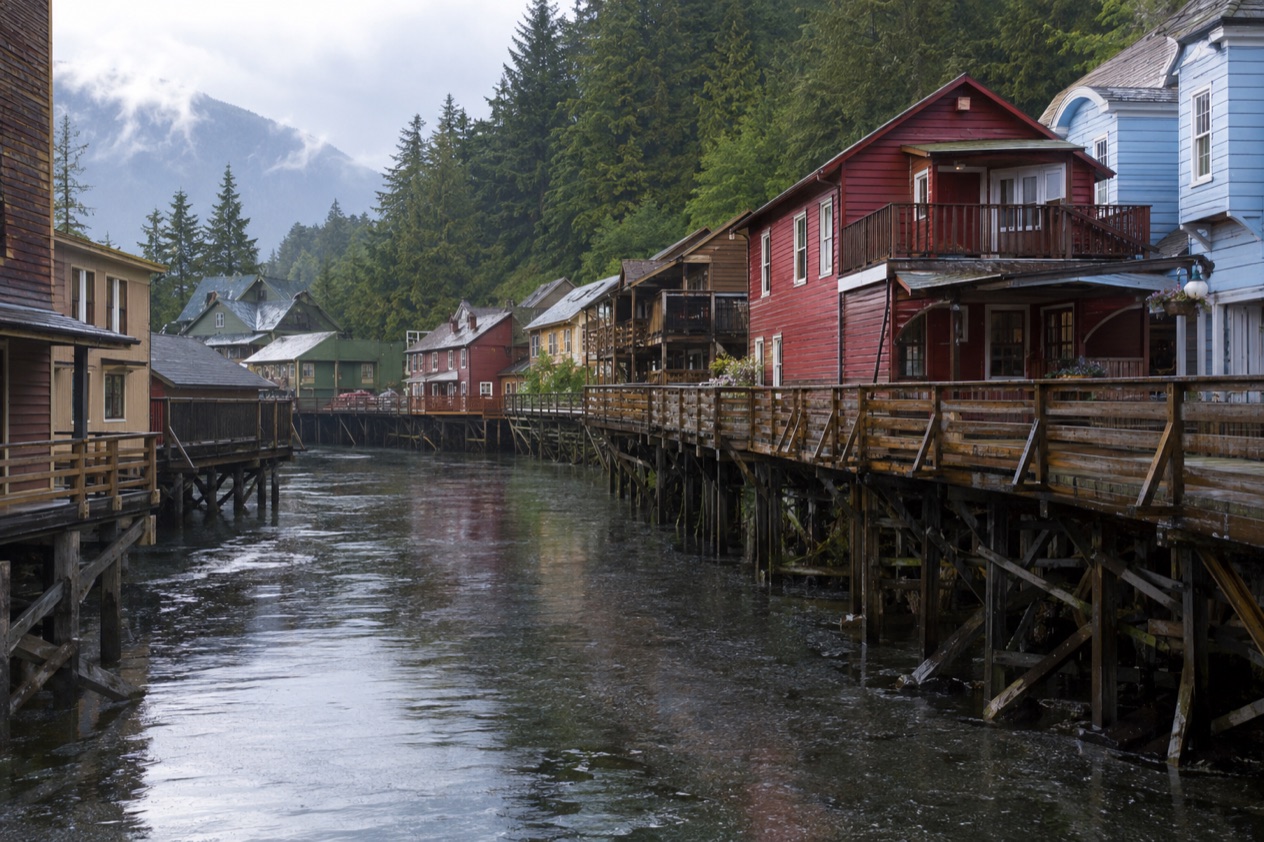
Creek Street is the postcard of Ketchikan: wooden houses on pilings above a creek, joined by a boardwalk. The buildings carry the town’s rowdier past, and today they hold small shops and galleries. Walking it in July means damp planks, hanging flower baskets and the sound of water running below your feet.
Take it slowly and look down into the creek, where in summer you may see salmon moving through the water. The boardwalk is best in the quieter hours of the morning or the long evening light, when you can stop and look without a crowd. Pair it with a stroll along the waterfront, where fishing boats and floatplanes come and go.
Totem poles and Tlingit, Haida and Tsimshian culture
Carved poles are the thread running through a visit. Ketchikan is home to the Tlingit, Haida and Tsimshian people, and the poles stand as stories in cedar: crests, animals and family histories carved by artists of those nations. Looking closely at the faces and figures, and at how weather has softened the older carvings, is time well spent on a gray, drizzly day.
Seeing poles in a quiet moment, with mist on the trees behind them, suits July’s soft light. Take your time reading the carving, since each figure is a clue to a story rather than just decoration. Galleries downtown sell work by local artists if you want to bring a piece home.
Museums for a rainy hour
Ketchikan’s economy and identity were shaped by commercial fishing, canneries, logging and maritime trades, with salmon and timber playing the largest roles. The town became known as the Canned Salmon Capital of the World, and that story is told in the local museums. The Tongass Historical Museum has exhibits on the people, businesses and events of the late 19th and early 20th centuries.
A museum stop fits neatly into a day when the clouds sit low. You come out understanding why the waterfront looks the way it does, and why the town still feels tied to the water. The Ketchikan story project, an Emmy Award-winning series, also tells the town’s story from the beginning of time to the recent past.
On the water: whales, salmon and seabirds
The waters off Alaska are home to orcas, and humpback whales, known for breaching and other surface behavior, are a favorite of whale watchers. On a boat trip from the Inside Passage you may see them, though sightings are never guaranteed. Bring binoculars and a warm layer, because the wind on the water is cooler than it feels on the dock.
All three bear species flourish in Alaska, and people in Alaska must keep all human sources of food secure from bears. Treat any wildlife as a chance rather than a promise, and enjoy the sight of eagles, gulls and boats against the dark green hills if nothing larger appears.
A two-day itinerary for Ketchikan in July
Day 1 begins early, when the boardwalks are quiet and the town is still waking up. Start on Creek Street while the light is soft and the planks are empty, then wander the downtown streets as galleries and shops open. Stop for coffee and a pastry in a small café, and look at the carved poles as the clouds shift overhead.
Midday is for the museums and a seafood lunch near the water, with salmon or halibut the obvious order. Spend the afternoon in the Tongass Historical Museum learning how canneries and logging built the town. If rain arrives, this is the plan that already keeps you dry. In the evening, walk the waterfront while the long light holds and watch the boats come in.
Day 2 is for the water. Spend the morning on a boat trip in the Inside Passage, hoping for whales, orcas, eagles or seals, with a rain shell and layers close at hand. Lunch can be a casual dockside spot back in town, where a bowl of chowder warms you after the wind.
Use the afternoon for gallery browsing, looking for locally made art and carved pieces by Tlingit, Haida and Tsimshian artists. If the weather is gray, linger over coffee and let the shops fill the hours. Finish with a relaxed dinner and a last walk in the lingering light.
Is Ketchikan busy in July?
Ketchikan is lively in July, with a town built around visitors in the warm months and cruise ships using the docks. Cruise ships dock in one of two main locations, downtown Ketchikan or Ward Cove, which is approximately 5.5 miles from downtown. Downtown has five potential docking locations, Piers 1 through 4 and Doyon Landing, which typically accommodates smaller overnight ships.
On days when ships are in, the streets around the piers fill with people, and the shops and boardwalks feel busy. Early mornings and evenings are calmer, which is a good reason to schedule the quieter sights, like Creek Street, at the edges of the day. Norwegian’s Alaska cruises, for example, call at Ketchikan among their ports of call.
What to pack for Ketchikan in July
Pack for cool, changeable weather where showers can pass through at any hour. Layers work better than one heavy coat.
- A waterproof jacket with a hood, since showers arrive on many days.
- Waterproof shoes or boots for wet boardwalks and sidewalks.
- A fleece or sweater for cool mornings and evenings.
- A warm hat and light gloves for time out on the water.
- Binoculars for whales, eagles and shoreline wildlife.
- A small daypack with a dry bag to protect a camera.
Good to know before you go
Downtown Ketchikan is easy to walk, so the center can be covered on foot. Daylight lasts nearly seventeen hours in mid-July, which gives you room for a late dinner and an evening stroll.
Ferry travelers can use the Alaska Marine Highway System’s Sailing Calendar tool to view schedules in a monthly format, or the Sailing Search tool by entering a port and travel date. Keep food secured from bears if you head out of town.
Ketchikan in July vs June and August
Moving the trip earlier to June brings cooler air and the longest days, with a little more daylight at both ends and slightly fresher mornings. The town is still lively, and the rain is similar to July in how often it falls. It suits travelers who want the most light and a touch more chill.
Moving later to August brings similar warmth to July, but noticeably more rain, with more days of showers and a shorter day. Evenings close in earlier, so the long strolls feel a little more compact. Travelers who do not mind a wetter trip and a softer, darker edge to the evenings can enjoy it just as much.
July sits in the middle: warm for the town, relatively less rain than August, and still long light. Pick June for the longest days, July for the balance, and August only if you are flexible about weather and want a slightly later season.
Is July a good time to visit Ketchikan?
It suits those who want to look at totems, wander galleries and take a boat out into the Inside Passage. It is less suited to anyone who needs reliably dry, warm days or dislikes the occasional shower.
On arrival, start with Creek Street and a slow loop of downtown, then fit a museum or a boat trip around the weather. Keep a rain shell within reach and let the showers set your pace. What makes July in Ketchikan special is the way long, soft light falls on wet boardwalks, carved cedar and moored boats, long after dinner is over.
Sources
- NOAA NCEI, U.S. Climate Normals 1991-2020, monthly (https://www.ncei.noaa.gov/access/services/data/v1?dataset=normals-monthly-1991-2020&stations=USW00025325), station Ketchikan Intl Ap, elevation 76 feet, checked October 11, 2026
- Computed from the date and the latitude of the place (sunrise equation, solar elevation -0.833 degrees), October 11, 2026
- Wikipedia, Midnight sun (https://en.wikipedia.org/wiki/Midnight_sun), checked October 11, 2026
- Alaska Department of Transportation, Alaska Marine Highway System, Schedules (https://dot.alaska.gov/amhs/schedules.shtml), checked October 11, 2026
- Princess Cruises, Alaska cruises (https://www.princess.com/en-us/cruise-destinations/alaska-cruises), checked October 11, 2026
- Holland America Line, Alaska cruises (https://www.hollandamerica.com/en/us/cruise-destinations/alaska-cruises), checked October 11, 2026
- Norwegian Cruise Line, Alaska cruises (https://www.ncl.com/cruise-destinations/alaska-cruises), checked October 11, 2026
- Royal Caribbean, Alaska cruises (https://www.royalcaribbean.com/cruise-destinations/alaska-cruises), checked October 11, 2026
- National Park Service, Lake Clark National Park & Preserve, plan your visit: conditions (https://www.nps.gov/lacl/planyourvisit/conditions.htm), checked October 11, 2026
- National Park Service, Katmai National Park & Preserve, plan your visit (https://www.nps.gov/katm/planyourvisit/index.htm), checked October 11, 2026
- Wikipedia, Humpback whale (https://en.wikipedia.org/wiki/Humpback_whale), checked October 11, 2026
- Wikipedia, Orca (https://en.wikipedia.org/wiki/Orca), checked October 11, 2026
- Alaska Department of Fish and Game, Living with bears (https://www.adfg.alaska.gov/index.cfm?adfg=livingwithbears.main), checked October 11, 2026
- Visit Ketchikan, cruise travelers (https://www.visit-ketchikan.com/cruise-travelers/), checked October 11, 2026
- Visit Ketchikan, maps (https://www.visit-ketchikan.com/about-ketchikan/ketchikan-maps/), checked October 11, 2026
- Visit Ketchikan, museums and attractions (https://www.visit-ketchikan.com/things-to-do/art-and-culture/museums-attractions/), checked October 11, 2026
- Visit Ketchikan, overview (https://www.visit-ketchikan.com/about-ketchikan/ketchikan-stories/ketchikan-overview/), checked October 11, 2026
- Visit Ketchikan, things to do (https://www.visit-ketchikan.com/things-to-do/), checked October 11, 2026
- Wikipedia, Climate of Alaska (https://en.wikipedia.org/wiki/Climate_of_Alaska), checked October 11, 2026
To plan your stay
- Things to Do in Ketchikan: Totem Poles, Creek Street, Misty Fjords and Fresh Seafood
- Where to Stay in Ketchikan: Downtown, Ward Cove and How to Choose Your Base
- Ketchikan from Seattle: Ferry from Bellingham, Flights, Cruise Docks and What to Do on Arrival
- Know Before You Go to Ketchikan: Rain, Cruise Docks, Bears and Local Customs