
In April, rain taps on the roofs along the waterfront and then thins out, and the light comes back over the hills of Revillagigedo Island a little earlier each morning. Fishing boats rock at their moorings, shop doors along the downtown streets open on gray mornings, and the smell of wet spruce and salt drifts through town.
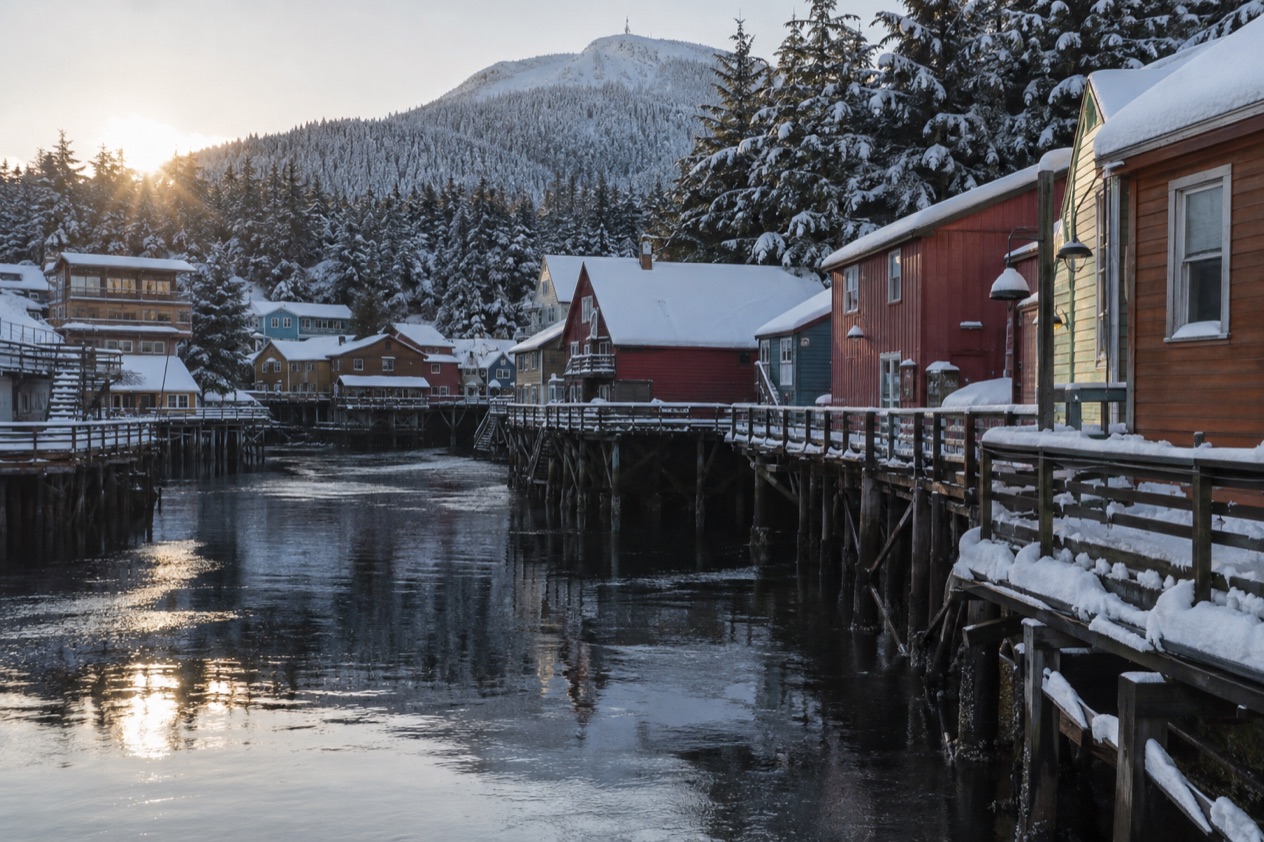
What is the weather like in Ketchikan in April?
April in Ketchikan is cool, damp and brightening, with gray, showery days far more common than long dry spells.
| Month | Average high (°F) | Average low (°F) | Precipitation (in) | Days with precipitation | Daylight on the 15th |
|---|---|---|---|---|---|
| March | 43.6 | 32.4 | 10.98 | 16.0 | 11 h 43 min |
| April | 49.8 | 37.2 | 10.25 | 14.2 | 14 h 04 min |
| May | 56.9 | 43.3 | 8.68 | 11.6 | 16 h 09 min |
What this means on the ground: afternoons are cool enough for a warm jacket, and mornings and evenings sit just above freezing territory, so layers matter more than any single heavy coat. Rain comes on most days of the month, often as steady drizzle or passing showers rather than a single downpour. A dry hour is a good moment to be outdoors, so plan walks loosely and keep the museum and shops as your fallback.
The light is the real change of the month. Days are long enough to leave the hotel after breakfast and still be strolling the waterfront when dinner comes around, and the evenings stretch out in a soft, pale glow when the clouds lift. Under overcast skies the town looks silvery, with mist hanging on the forested slopes above the buildings.
Dress for wet more than for cold: a waterproof shell, a warm mid-layer and shoes that handle damp sidewalks. The water around town is cold, so think of the harbor as scenery rather than a place to get in.
What to do in Ketchikan in April
April here is not about a single big event. It is a month for the town itself: its streets, its galleries, its museum and the stories of the people who built it. Ketchikan sits in the Inside Passage, and the rhythm of a rainy spring day suits the slow, indoor-and-outdoor mix the town does well.
Downtown on foot
Historic buildings line the streets, and galleries and shops sell locally made goods. You can step into a doorway when a shower passes and come out again ten minutes later to a different sky.
Walk without a destination at first. Look up at the old facades, follow the waterfront where the working boats tie up, and let the weather decide how long you stay outside. The pace of a damp spring day makes browsing a pleasure, since you are usually not competing with anyone for a corner of a gallery.
The salmon story and the museum
Ketchikan earned the name Canned Salmon Capital of the World through commercial fishing, and the story of canneries, logging and maritime trades shaped its economy and identity. Salmon and timber played the largest roles, and you feel that history in the working feel of the waterfront.
The Tongass Historical Museum is the place to put names and faces to it. Its exhibits cover the town’s people, businesses and events from the late nineteenth and early twentieth centuries. It is a natural stop for a wet afternoon, the kind of visit that makes the town’s streets more meaningful when you step back outside.
There is also the Ketchikan story project, an Emmy Award-winning series that tells the story of the town from the beginning of time to the recent past. It is a good way to understand how a seasonal fish camp became a border town.
Tlingit, Haida and Tsimshian cultures
Ketchikan began as a seasonal Tlingit fish camp, and today it is home to the cultures of the Tlingit, Haida and Tsimshian people. That layered heritage is part of every visit, in the art you see in galleries, in the names on the map and in the way the town talks about its past.
Slow down in the galleries and shops and look at who made what. Locally made goods are one of the town’s strengths, and April’s unhurried mood leaves time to read the labels and ask questions.
Beyond the center, the town has stories of the pioneers who arrived from the late 1800s on, some looking for fortune, some for a new life, some to live off the land and, as the town likes to put it, some to misbehave. It gives the streets a good-humored character you notice in the museum and in conversation.
For food, think of a town built on fish: a bowl of chowder or a plate of salmon fits a rainy spring afternoon well. Warm drinks at a café window while the rain runs down the glass are part of the rhythm of the month.
A two-day itinerary for Ketchikan in April
Day 1 is for the heart of town. Start in the morning on foot downtown, when the light is soft and the streets are quiet, and drift along the historic buildings, shops and galleries. Stop for coffee at a café when the first shower passes. Around midday, have a seafood lunch near the waterfront, in keeping with the town’s fishing past.
In the afternoon, head to the Tongass Historical Museum and let its exhibits on the town’s people and businesses set the story. In the evening, long April daylight leaves time for a last waterfront walk and a relaxed dinner. If heavy rain sets in, stretch the museum visit and spend more time in the galleries.
Day 2 turns to the cultures and the edges of town. Spend the morning looking at work by Tlingit, Haida and Tsimshian artists in the downtown galleries, and ask about the pieces and the people who made them. Then follow the waterfront past the piers where cruise ships can dock, to understand how the town is laid out.
After lunch, look at the maps of the town and Revillagigedo Island, and think about how far Ward Cove sits from downtown, about 5.5 miles. If you plan to travel on by ferry, use the Alaska Marine Highway Sailing Calendar to see the schedule. Finish with a quiet dinner, and if it is raining, a warm drink and a long evening indoors.
Is Ketchikan busy in April?
April feels like the town taking a breath between winter and the long days ahead, with a pace set more by the weather than by crowds. The daylight is growing, and the shops, galleries and museum are the places where the town’s life happens on a damp day.
Ketchikan has two main cruise docking areas, downtown and Ward Cove, and its downtown has several piers plus Doyon Landing. Knowing the layout helps you read the waterfront, but you should treat the harbor as a working place first. For onward travel by ferry, the Alaska Marine Highway offers a Sailing Calendar and a Sailing Search tool where you can enter a port and a date.
What to pack for Ketchikan in April
Pack for damp, cool days that change by the hour, with enough layers to add and shed as showers come and go.
- A waterproof jacket with a hood, since rain falls on most days of the month.
- Warm mid-layers such as a fleece or wool sweater for chilly mornings and evenings.
- Waterproof shoes with good grip for wet sidewalks and damp waterfront boards.
- A hat and light gloves for the cool start of the day.
- A small daypack with a rain cover, for walking between galleries and the museum.
- A compact umbrella for short walks between doorways.
Good to know before you go
Daylight is generous, which makes it easy to fit a museum visit and a long walk in the same day.
For onward travel, the Alaska Marine Highway System has a Sailing Calendar that shows ferry schedules by month, port or vessel, and a Sailing Search tool for a chosen port and date. The town’s maps, including a downtown map and a Revillagigedo Island map, help with planning.
Ketchikan in April vs March and May
Moving the trip four weeks earlier brings colder mornings, shorter days and more days with precipitation. March is the month when the light is just returning, and the town feels more like winter. It suits travelers who like a moody, quiet atmosphere and are happy to spend more time indoors with the museum and galleries.
Four weeks later, May is warmer and noticeably brighter, with the longest days of the three and fewer wet days. Evenings stretch far into the night, which gives you more room for walks and for lingering outside. If you want to spend more of the day outdoors, May is the more comfortable choice.
April sits in the middle. Choose it if you want a balance of cool, damp atmosphere and growing light, and you are content to see the town’s streets, museum and cultures at an unhurried pace. Choose March for a wintry feel and May for more outdoor time.
Is April a good time to visit Ketchikan?
Yes, April is a good time to visit Ketchikan for travelers who enjoy a cool, damp, atmospheric town and care more about stories, galleries and walking than about warm sunshine. It suits people who like to wander a historic downtown, learn about the Tlingit, Haida and Tsimshian cultures, and understand how salmon and timber built a town.
Rain falls on most days, and the air stays cool, so a trip planned around outdoor time may disappoint. If that describes you, a later month may suit better.
On arrival, start with a walk through downtown to get your bearings, then go to the Tongass Historical Museum to put the town in context. After that, the galleries and the waterfront will make more sense. April in Ketchikan is a town of rain on the harbor, long gray-silver evenings and stories told in its museum and its galleries.
Sources
- NOAA NCEI, U.S. Climate Normals 1991-2020, monthly (https://www.ncei.noaa.gov/access/services/data/v1?dataset=normals-monthly-1991-2020&stations=USW00025325), station Ketchikan Intl Ap, elevation 76 feet, checked October 11, 2026
- Computed from the date and the latitude of the place (sunrise equation, solar elevation -0.833 degrees), October 11, 2026
- Alaska Department of Transportation, Alaska Marine Highway System, Schedules (https://dot.alaska.gov/amhs/schedules.shtml), checked October 11, 2026
- Visit Ketchikan, cruise travelers (https://www.visit-ketchikan.com/cruise-travelers/), checked October 11, 2026
- Visit Ketchikan, maps (https://www.visit-ketchikan.com/about-ketchikan/ketchikan-maps/), checked October 11, 2026
- Visit Ketchikan, museums and attractions (https://www.visit-ketchikan.com/things-to-do/art-and-culture/museums-attractions/), checked October 11, 2026
- Visit Ketchikan, overview (https://www.visit-ketchikan.com/about-ketchikan/ketchikan-stories/ketchikan-overview/), checked October 11, 2026
- Visit Ketchikan, things to do (https://www.visit-ketchikan.com/things-to-do/), checked October 11, 2026
- Wikipedia, Climate of Alaska (https://en.wikipedia.org/wiki/Climate_of_Alaska), checked October 11, 2026
To plan your stay
- Things to Do in Ketchikan: Totem Poles, Creek Street, Misty Fjords and Fresh Seafood
- Where to Stay in Ketchikan: Downtown, Ward Cove and How to Choose Your Base
- Ketchikan from Seattle: Ferry from Bellingham, Flights, Cruise Docks and What to Do on Arrival
- Know Before You Go to Ketchikan: Rain, Cruise Docks, Bears and Local Customs