
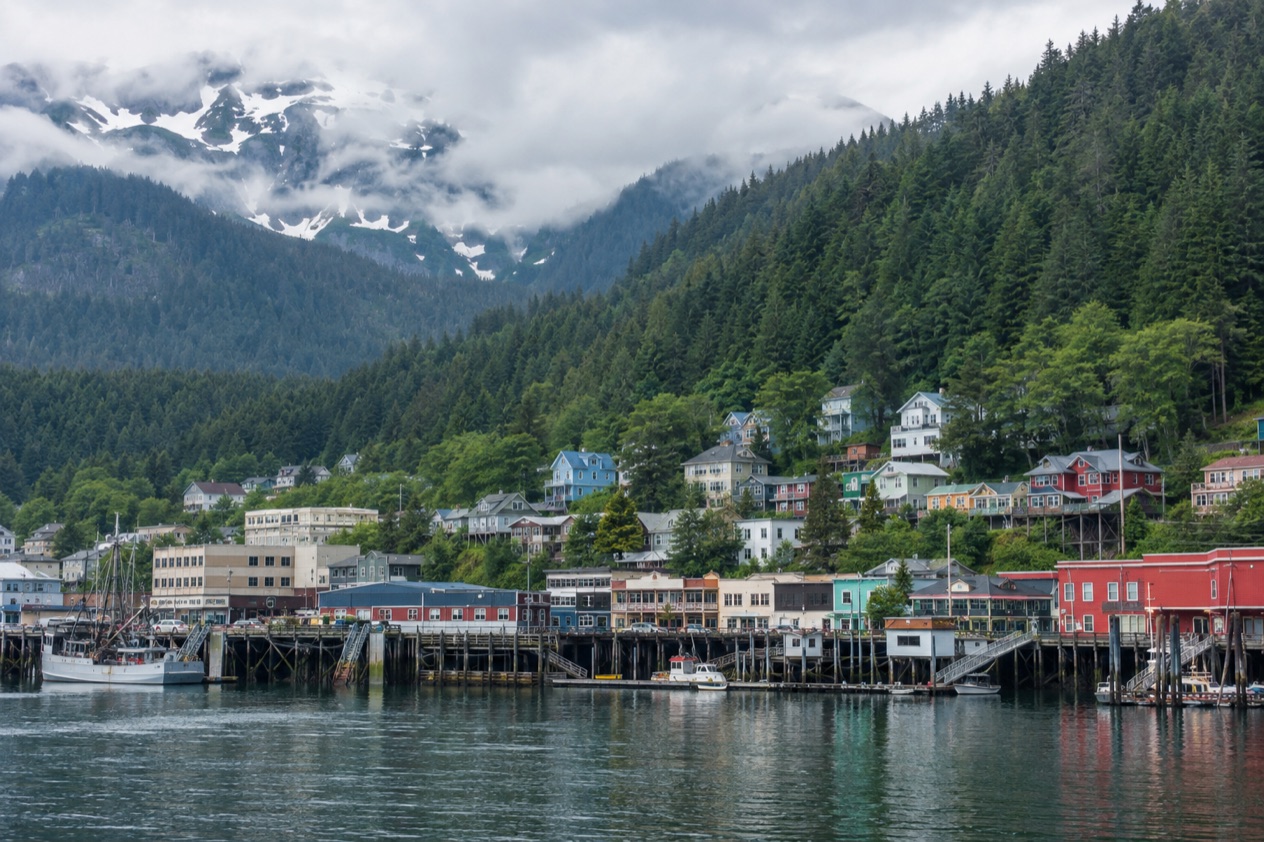
On a June evening in Juneau the light lingers over Gastineau Channel long after dinner, and downtown fills with people stepping off ships and heading for the tram or a glass of Alaskan beer. Return in the dark months and the same streets belong to residents, snow settles on the rooftops, and the legislature keeps the cafés buzzing with talk. Juneau sits between the water and the Tongass rainforest, with a busy summer, a soaked early fall and a quiet winter, and each suits a different kind of traveler.
When is the best time to visit Juneau?
Wildlife viewing stretches wider than that, since bears, bald eagles and humpback whales are most likely to turn up from April through November.
If sightseeing is the goal, June is the pick. It brings the longest evenings of the year and the fewest days with rain, improving the chances of good views.
July is warmer but wetter, and August tips further toward showers. Summer highs generally sit in the low-to-mid-60s, so a fleece and a rain shell are the real uniform, even on a bright day.
Wildlife and wilderness fans can stretch the trip into the shoulders. April and May bring long days and better chances of seeing wildlife, while September and October are the wettest months, when proper rain gear matters on the forest trails. The quiet months of winter, from December through February, trade scenery for atmosphere: short days, snow and a town that feels like a small capital rather than a cruise port.
Mendenhall Glacier is a place visitors can drive directly to, and wildlife tours can bring you close to sea lions, harbor seals and sea otters. Whatever the month, expect rain at some point, since Juneau counts around 230 days of precipitation in a year.
Juneau weather by month
Juneau runs from a cold, dark January to a mild, long-lit July, and the wettest stretch arrives in early fall rather than in winter.
| Month | Average high (°F) | Average low (°F) | Precipitation (in) | Days with precipitation | Daylight on the 15th |
|---|---|---|---|---|---|
| January | 33.1 | 23.8 | 6.02 | 13.4 | 7 h 04 min |
| February | 35.7 | 24.6 | 4.31 | 10.3 | 9 h 19 min |
| March | 39.2 | 26.6 | 3.67 | 10.9 | 11 h 41 min |
| April | 48.7 | 32.9 | 3.47 | 9.4 | 14 h 19 min |
| May | 57.6 | 40.3 | 3.51 | 9.0 | 16 h 42 min |
| June | 62.4 | 46.8 | 3.82 | 8.8 | 18 h 14 min |
| July | 64.0 | 50.1 | 5.14 | 11.6 | 17 h 39 min |
| August | 62.9 | 49.1 | 6.41 | 13.5 | 15 h 30 min |
| September | 56.1 | 44.1 | 9.15 | 17.0 | 12 h 56 min |
| October | 47.3 | 37.1 | 8.42 | 17.0 | 10 h 25 min |
| November | 38.3 | 29.2 | 6.54 | 14.3 | 7 h 56 min |
| December | 34.7 | 25.9 | 6.53 | 13.9 | 6 h 26 min |
Spring is the driest stretch, and June has the fewest rainy days of the year. From August the rain returns, and September and October are the wettest and grayest months, with rain on more days than not. Winter is not dry either. From November to March, much of the precipitation falls as snow, and the daily rhythm is one of wet flakes and slush rather than the summer pattern of passing showers.
What this changes in your suitcase is mostly layers. In summer a light waterproof jacket over a fleece covers most days.
In April and early fall add a warm hat and waterproof footwear, and from November through March plan on real winter gear, since highs hover near freezing and nights fall below it.
What is there to do in Juneau in each season?
Summer: long days from May to August
Summer is when Juneau does everything at once. The cruise ship season runs from May through September, and the waterfront is busy with arrivals.
Glacier Gardens shows off the rainforest with flower-draped upside-down trees and a golf-cart ride along a path through the forest to a view over Mendenhall Valley.
The Goldbelt Tram climbs from the cruise docks to the Mountain House, where there is a restaurant, a theater, a nature center and trailheads leading up and down Mount Roberts. The views take in the town and Gastineau Channel. With so much daylight in June, you can pair a morning on the water with an evening on the mountain and still have light left over.
Fall: rain, wildlife and the quiet town
Early fall is the wettest time of year, but it has its own pleasures. Wildlife viewing continues through November, so bears, eagles and humpbacks remain possible, and the forest is saturated with moisture and moss. This is a season for museum hours and slow meals, and the Walter Soboleff Building, home of Sealaska Heritage Institute, holds an ongoing cultural exhibit on its first floor that tells the story of the Tlingit, Haida and Tsimshian peoples.
By November the first real snow arrives, the days shorten sharply and the cruise crowds are gone. A day in the Mendenhall Valley or around the Auke Bay harbor, with a rain jacket and a thermos, feels very different from the summer version. Not every summer service continues into these months, so plan your days around what the town itself has to offer.
Winter and the spring thaw
Winter in Juneau is about the town. The legislature meets from January into April or May, so the capital has a purposeful buzz, and the Alaskan, the hotel and bar more than a century old in downtown, is a warm place to sit out a snowy afternoon.
The Alaskan Brewery gives the city its signature beer, and after a short, dim day a pint is the local answer. Daylight is brief in December and January, so keep outdoor plans modest.
Spring arrives in stages. March still brings snow, but by April the days stretch and the first bears, eagles and whales are possible, and by May the town greens up and the first ships return. It is a good moment for trails near town, since Juneau counts a large network of hiking paths, and for travelers who like a season in transition, with fewer people and fast-changing skies.
When is Juneau cheapest and least crowded?
When is Juneau least crowded? From May through September, thousands of visitors come ashore each day, and the daily total can reach 16,000 people or more. The waterfront, the tram base and the boat docks feel that surge most.
The peak weeks are the heart of summer, when long days and mild temperatures line up. That is when downtown is liveliest and the lines at popular stops are longest. The shoulder weeks at either end, late April and May, then September, give you a quieter pace while the wildlife season is still on and the town is awake.
For rooms and tours, the practical effect is simple: the busiest months are when everyone wants the same things, and the quiet months leave more space. Winter, from November to March, is the calmest time to visit, with a different set of rewards, namely snow, a working capital city and short, cozy days. Anyone who comes then should accept that some summer-oriented experiences are not the focus, and that the town itself is the draw.
Which months should you avoid in Juneau?
No month needs to be skipped outright, but December and January are the hardest for sightseeing, and September and October are the hardest for dry weather. The answer depends on what you came for.
December and January bring the shortest days, cold temperatures and the heaviest snowfall of the year, so views are limited and daylight is brief. If you come to see the glaciers, the rainforest and the water, these are the weakest months. If you come for a quiet capital and a cold-weather mood, they have their appeal.
September and October are the wettest, with rain on most days, and the light fades quickly. That suits travelers who accept rain as part of the rainforest, and who enjoy wildlife viewing, which continues through November. Anyone who needs clear skies for photographs is better off in spring or early summer.
Juneau has no road connection to the rest of Alaska or the Lower 48, so you arrive by air or sea. Flights from Seattle take about two and a half hours nonstop, and ferries of the Alaska Marine Highway System run regularly throughout Southeast Alaska from the terminal at Auke Bay. The cruise ships come from May through September, so outside those months the waterfront is quieter.
Festivals and events in Juneau through the year
Summer: Celebration and the long holiday weekends
The great gathering of the Juneau summer is Celebration, which welcomes thousands of Native people each June in even-numbered years. Tlingit, Haida and Tsimshian dance groups, in regalia, fill the town with song, drumming and processions, and the event is a living expression of cultures that have shaped this place for thousands of years. In the years when it falls, it is the strongest reason to plan a June visit.
Independence Day on July 4 is the other fixed date of the summer, and a small capital with this much water around it makes a festive backdrop for parades and fireworks. Summer is also the season of the cruise ships, whose daily arrivals give the waterfront a festival air of its own, with shops, music and the tram carrying people up the mountain.
Fall and winter: the wildlife tail, the holidays and the legislature
Autumn is a nature season more than a festival one. Halloween on October 31 brings costumed children through the downtown streets, a cheerful tradition in the middle of the gray and wet weeks.
December turns the town toward Christmas on December 25, with lights glowing through the early dark and gatherings that make the short days feel warm. From January the legislative session begins, lasting between 90 and 121 days, and the capital fills with lawmakers, staff and visitors who come to watch government at work.
Spring: the return of the wildlife season
April marks the start of the stretch from April through November when bears, bald eagles and humpback whales are most likely to be seen, and the lengthening days make it easy to get out. The legislative session winds down in April or May, and the first ships of the season arrive in May.
It is also a good season for Tlingit culture indoors, since the exhibit at Sealaska Heritage Institute welcomes visitors all through the year it is open. Spring suits travelers who like to see a place waking up, with snow still on the peaks, new green in the forest and the harbor starting to hum.
Sources
- NOAA NCEI, U.S. Climate Normals 1991-2020, monthly (https://www.ncei.noaa.gov/access/services/data/v1?dataset=normals-monthly-1991-2020&stations=USW00025309), station Juneau Intl Ap, elevation 16 feet, checked October 11, 2026
- Computed from the date and the latitude of the place (sunrise equation, solar elevation -0.833 degrees), October 11, 2026
- Travel Juneau (https://www.traveljuneau.com/), checked October 11, 2026
- Wikivoyage, Juneau (https://en.wikivoyage.org/wiki/Juneau), checked October 11, 2026
- Wikipedia, Juneau, Alaska (https://en.wikipedia.org/wiki/Juneau,_Alaska), checked October 11, 2026
- Wikipedia, Juneau International Airport (https://en.wikipedia.org/wiki/Juneau_International_Airport), checked October 11, 2026
- Goldbelt Tram, Juneau (https://mountrobertstramway.com/), checked October 11, 2026
- Glacier Gardens Rainforest Adventure, Juneau (https://www.glaciergardens.com/), checked October 11, 2026
- Wikipedia, Mendenhall Glacier (https://en.wikipedia.org/wiki/Mendenhall_Glacier), checked October 11, 2026
- Wikipedia, Mount Roberts Tramway (https://en.wikipedia.org/wiki/Mount_Roberts_Tramway), checked October 11, 2026
- Wikipedia, Tracy Arm (https://en.wikipedia.org/wiki/Tracy_Arm), checked October 11, 2026
- Wikipedia, Endicott Arm (https://en.wikipedia.org/wiki/Endicott_Arm), checked October 11, 2026
- Wikipedia, Admiralty Island (https://en.wikipedia.org/wiki/Admiralty_Island), checked October 11, 2026
- Wikipedia, Tlingit (https://en.wikipedia.org/wiki/Tlingit), checked October 11, 2026
- Sealaska Heritage Institute (https://www.sealaskaheritage.org/), checked October 11, 2026
- Wikipedia, Tongass National Forest (https://en.wikipedia.org/wiki/Tongass_National_Forest), checked October 11, 2026
- Wikipedia, Southeast Alaska (https://en.wikipedia.org/wiki/Southeast_Alaska), checked October 11, 2026
- Wikipedia, Climate of Alaska (https://en.wikipedia.org/wiki/Climate_of_Alaska), checked October 11, 2026
To plan your stay
- Things to Do in Juneau: Mendenhall Glacier, Mount Roberts Tram, Whale Watching and Day Trips
- Where to Stay in Juneau: Downtown, Mendenhall Valley and Auke Bay
- Juneau from Seattle: Nonstop Flight, Ferry from Bellingham and What to Do on Arrival
- Know Before You Go to Juneau: Weather, Getting Around, Bears and Local Customs