
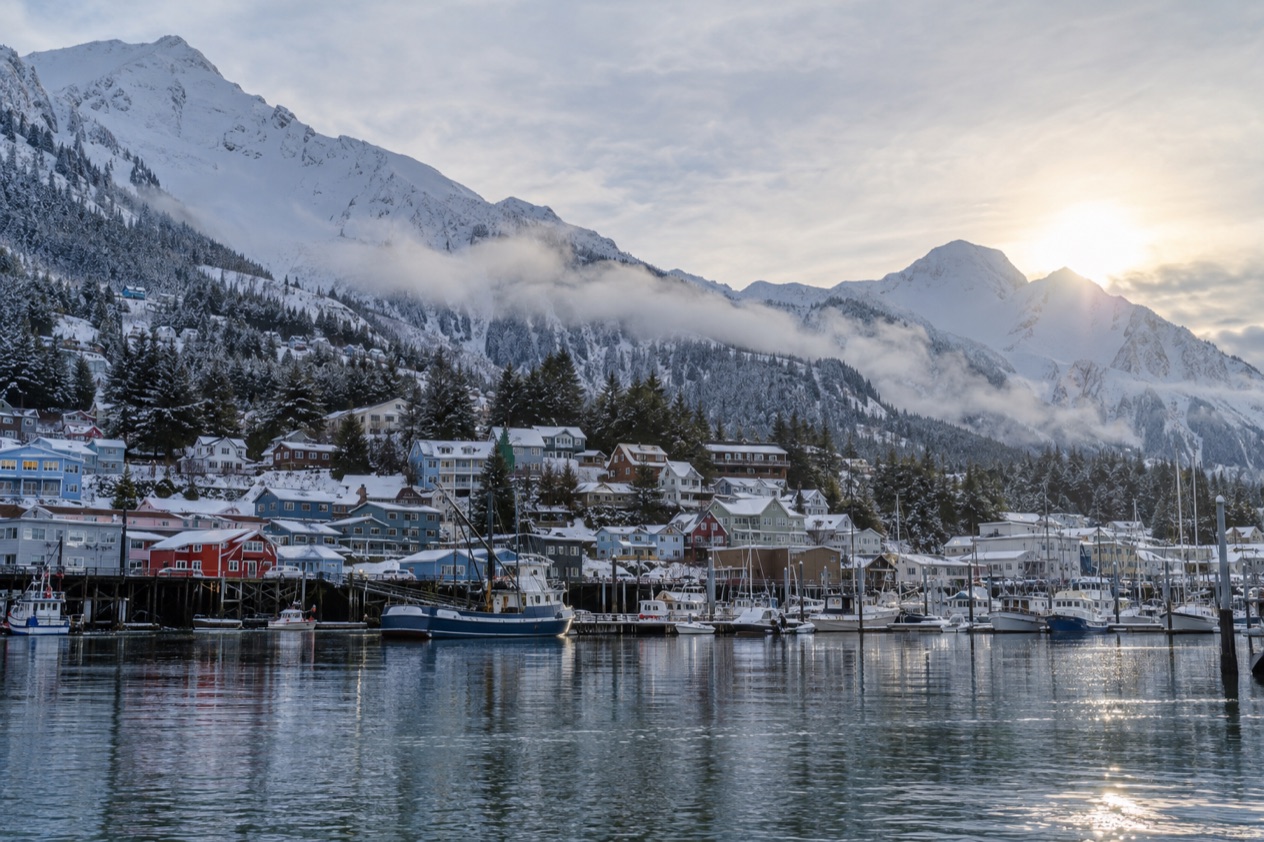
In April, Juneau wakes to the sound of fiddles tuning up in downtown halls while snow still clings to the mountain faces above Gastineau Channel. Gutters run with meltwater, the last gray patches of winter slump off the sidewalks, and the evenings stretch longer every week. It is the state capital in its in-between season, with the Alaska Folk Festival in town, glaciers to visit and a coastal rainforest slowly turning green.
What is the weather like in Juneau in April?
April in Juneau is cool, damp and brightening, a month when winter has loosened its grip but a jacket stays on all day.
| Month | Average high (°F) | Average low (°F) | Precipitation (in) | Days with precipitation | Daylight on the 15th |
|---|---|---|---|---|---|
| March | 39.2 | 26.6 | 3.67 | 10.9 | 11 h 41 min |
| April | 48.7 | 32.9 | 3.47 | 9.4 | 14 h 19 min |
| May | 57.6 | 40.3 | 3.51 | 9.0 | 16 h 42 min |
Afternoons are mild enough to walk around downtown with your jacket unzipped when the clouds break. Mornings and evenings bring a real chill, cold enough that puddles may stiffen overnight. Snow is mostly a March story, and in April it shows up as an occasional dusting that rarely lasts the day in town.
Rain comes as a soft drizzle or a gray, low-ceilinged day more often than as a downpour, and it falls on roughly one day in three. A waterproof shell with a hood matters more than an umbrella, and layers you can peel off handle the swings between a sunny street and a shaded trail.
The light is the quiet gift of the month. Days are long enough now to fit a full outing and still have time for a slow dinner, and on the clear evenings the sky stays pale over the channel well after supper. Cold water and cold air mean the shoreline is for looking, not for lingering.
What to do in Juneau in April
The big event of the month is the Alaska Folk Festival, which fills Juneau with fiddles, banjos, guitars and harmonies each April. Musicians from around the state gather in downtown halls, and the town takes on the feel of a long jam session where strangers end up singing along. If your dates line up, build a few evenings around it.
The rest of April has a local, unhurried mood. The Alaska State Capitol and the streets around it are busy with people who actually live here, coffee shops hold the same regulars all morning, and the sidewalks along South Franklin Street have room to stroll. Rain jackets are the uniform, and nobody apologizes for muddy boots.
Mendenhall Glacier and the valley
Mendenhall Glacier is the sight most people come for, a wide river of blue-white ice ending at a lake in the valley north of downtown. In April the setting is still wintry, with snow on the surrounding slopes and a stark, quiet look that the summer crowds never see. Cloud often sits low, and when it lifts the contrast of dark rock, white snow and glacial ice is striking.
Plan for cold air coming off the ice and for wet, soft ground if you walk the paths around the visitor area. Waterproof footwear is worth having.
The glacier pairs well with a clear morning, and it is a fine rainy-day outing too, since the mist gives the ice a moody look.
Downtown museums, totems and Tlingit heritage
Juneau sits in Tlingit territory, and the town is a good place to learn about the people whose homeland spans much of Southeast Alaska. Clan houses, carved poles and public art appear around downtown, and the Sealaska Heritage Institute’s Walter Soboleff Building is the place to see Tlingit, Haida and Tsimshian art and culture. The Alaska State Museum and the Juneau-Douglas City Museum cover gold mining, Native history and the quirks of a capital city that no road reaches.
These are the places to save for a drizzly afternoon, when the weather makes a walk less appealing. St. Nicholas Russian Orthodox Church, a small octagonal chapel on the hillside, is a quiet stop for its architecture and its link to the Russian past. Between visits, duck into a café for a hot drink and let the damp air wait outside.
Forest trails and the old mining valley
Behind downtown, the mountains rise straight up, and the old mining valley of Gold Creek holds the Perseverance Trail and the ruins of the Last Chance Basin. Check current trail conditions before setting out, and wear waterproof shoes. The woods are mostly spruce and hemlock, hung with moss, and the sound of meltwater is constant.
Treat any trail in April as wintry and wet, since conditions change fast between the waterfront and higher ground. Giving yourself a buffer of daylight, which April now provides, makes these outings more relaxing.
Tracy Arm and Admiralty Island
Tracy Arm is a narrow fjord about 45 miles from Juneau, cut deep into the Tongass National Forest off Holkham Bay. It is the heart of the Tracy Arm-Fords Terror Wilderness, which also includes the neighboring Endicott Arm. Sheer rock walls, waterfalls and floating ice are the draw, and glacier ice and wildlife are chances rather than promises.
Admiralty Island lies across the water and is home to the Kootznoowoo Wilderness, old-growth rainforest sheltering brown bears, bald eagles and Sitka black-tailed deer. Angoon, a Tlingit community on the island’s western coast, is its only settlement. Brown bears live here in large numbers, so the island is a place to admire from the water and from the air as much as from any trail.
Local food fits the cool weather. Look for halibut and salmon on menus, a bowl of chowder after a wet walk, and Alaska-brewed beer in the pubs downtown. Many people eat early here, so dinner conversations often center on what the mountains looked like that day.
A two-day itinerary for Juneau in April
Day 1 starts with a coffee downtown, then the walk through the waterfront streets while the town is still quiet and the air is at its coolest. Take in the Capitol, the totems and the small shops on South Franklin Street, and pause at the Alaska State Museum while the morning mist burns off. Lunch fits a bowl of chowder or a halibut sandwich in a casual spot near the harbor.
In the afternoon, head to Mendenhall Glacier, when the day is at its mildest and the daylight, over fourteen hours, leaves plenty of room. Wander the paths near the lake and watch the ice for its blue glow. Come back for an early dinner at a seafood restaurant, then see whether a folk festival performance is on for the evening.
Day 2 begins with the Walter Soboleff Building and the Tlingit art in the center of town, a good choice if the morning is gray. If the sky is clear, take a waterfront walk to enjoy the light on the channel. The Juneau-Douglas City Museum is the rain card, with indoor stories of gold mining and local life.
After lunch, explore downtown or take a waterfront walk while the light is still bright. Finish in a pub for local beer and a hot dinner, then catch more music if the festival is on. Save outdoor sightseeing for a clear day.
Is Juneau busy in April?
April is a quiet stretch in Juneau, more local than touristy, with a town that mostly belongs to its residents. The Legislature is usually in session through much of the month, so you may share cafés and sidewalks with lawmakers and staff as well as a handful of visitors.
The Alaska Folk Festival gives the calendar its liveliest week, and music venues feel crowded in the best sense. Away from the festival, trails, museums and the glacier area have a spacious, wintry calm. The long, bright evenings invite a leisurely pace, with no need to hurry between stops.
What to pack for Juneau in April
Pack for cool, wet weather that can swing from snow flurries to sunshine in an afternoon. Layers do the most work, and everything near your skin should dry quickly.
- A waterproof shell with a hood, because drizzle is more common than a heavy downpour.
- Waterproof, grippy boots for muddy trails and the melting snow around the glacier.
- A warm fleece or insulated middle layer for chilly mornings and evenings.
- A hat and gloves for the cold air coming off the ice.
- Binoculars for eagles along the shore and wildlife from the water.
- A small daypack to carry layers as the day warms up.
Good to know before you go
Juneau is the state capital, but no road links it to the rest of Alaska, so most people arrive by air or by water. The Alaska Marine Highway System offers a Sailing Calendar tool that shows ferry schedules in a monthly view, and a Sailing Search tool where you enter a port and a travel date. Both can be sorted by month, port or vessel.
Daylight is generous in April, so you can plan long outings, but the weather decides what is possible, and glacier and fjord days are best kept flexible. Check the forecast the evening before any outing outside town.
Juneau in April vs March and May
Moving the trip four weeks earlier brings a wintrier town. March is colder and snowier, with shorter days. The frosty air and the white mountains can be beautiful, though, and the town is even quieter.
Moving four weeks later brings a warmer, greener Juneau. May has no snow in the averages, the days are far longer, and the forest begins to show new leaves. The slightly higher temperatures make trails and waterfront walks more comfortable, and the long evenings leave time for after-dinner outings.
If you like folk music, quiet streets and a wintry look at the glacier, stay with April. If you want long days, green hillsides and a better chance of dry trail conditions, shift to May. If snow, frost and solitude appeal most, March is your month.
Is April a good time to visit Juneau?
Yes, for travelers who like cool weather, music and a town at its most local. April suits people who are happy in a rain jacket and who enjoy museums, the glacier and forest walks more than warm sunshine.
It is less suited to anyone who needs reliably dry days, high temperatures or fully green trails. The weather can turn gray and wet, and higher ground is still wintry. If you want long, warm evenings and open forest paths, choose a later month.
On arrival, walk the downtown waterfront first and see what the sky is doing, then fit the glacier or any boat outing to the clearest day. Look up the Alaska Folk Festival schedule and add an evening of live music. What makes April special here is the combination: snow still on the peaks, meltwater in the creeks, and a town singing and strumming its way into spring.
Sources
- NOAA NCEI, U.S. Climate Normals 1991-2020, monthly (https://www.ncei.noaa.gov/access/services/data/v1?dataset=normals-monthly-1991-2020&stations=USW00025309), station Juneau Intl Ap, elevation 16 feet, checked October 11, 2026
- Computed from the date and the latitude of the place (sunrise equation, solar elevation -0.833 degrees), October 11, 2026
- Alaska Department of Transportation, Alaska Marine Highway System, Schedules (https://dot.alaska.gov/amhs/schedules.shtml), checked October 11, 2026
- Wikipedia, Tracy Arm (https://en.wikipedia.org/wiki/Tracy_Arm), checked October 11, 2026
- Wikipedia, Endicott Arm (https://en.wikipedia.org/wiki/Endicott_Arm), checked October 11, 2026
- Wikipedia, Admiralty Island (https://en.wikipedia.org/wiki/Admiralty_Island), checked October 11, 2026
- Juneau International Airport (https://juneau.org/airport), checked October 11, 2026
- Wikipedia, Tlingit (https://en.wikipedia.org/wiki/Tlingit), checked October 11, 2026
- Wikipedia, Climate of Alaska (https://en.wikipedia.org/wiki/Climate_of_Alaska), checked October 11, 2026
To plan your stay
- Things to Do in Juneau: Mendenhall Glacier, Mount Roberts Tram, Whale Watching and Day Trips
- Where to Stay in Juneau: Downtown, Mendenhall Valley and Auke Bay
- Juneau from Seattle: Nonstop Flight, Ferry from Bellingham and What to Do on Arrival
- Know Before You Go to Juneau: Weather, Getting Around, Bears and Local Customs