
In Ketchikan, the morning begins with floatplanes lifting off the water and totem poles standing wet and dark among the spruce, while the ship slides past forested islands that seem to go on forever. Out on the Gulf of Alaska, the mood changes: the water in College Fjord turns milky green beneath walls of blue ice, and the ship goes quiet as the first glacier comes into view. Both routes end at the same Alaska you have imagined, but they get there by very different roads, and choosing between them shapes the whole trip.
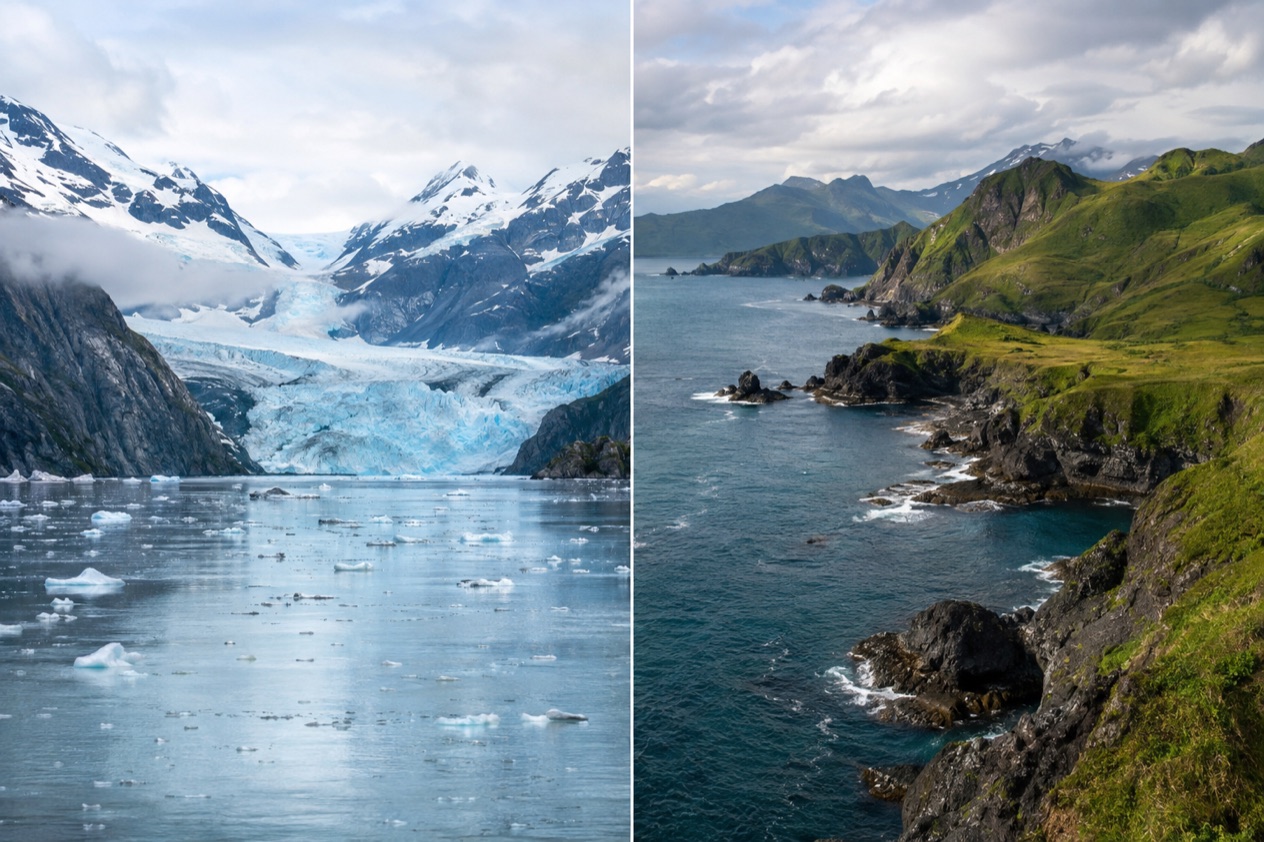
Which is better, the Inside Passage or the Gulf of Alaska?
The Inside Passage suits travelers who want a string of small, characterful towns, calm channels and a new port almost every day, while the Gulf of Alaska suits those who want big glaciers, open water and a clean path toward Denali and the interior. Neither is better in every way. The first is a trip about places you step off into, and the second is a trip about the landscape you pass through.
The Inside Passage follows sheltered waterways through Southeast Alaska, with Juneau, Sitka, Ketchikan, Skagway and Haines as its anchors. The Gulf route runs along the coast of Prince William Sound and the Kenai Peninsula, with Whittier and Seward as the gateways.
| Category | The Inside Passage | The Gulf of Alaska |
|---|---|---|
| Scenery | Forested islands, narrow channels, mountains rising from the water | Tidewater glaciers, fjords, ice-filled bays |
| Vibe | A different small town each day, with Native heritage and Gold Rush history | Fewer ports, more time with the landscape, a gateway to the interior |
| Things to do | Totem poles, historic streets, Mendenhall Glacier near Juneau, a Skagway rail excursion | College Fjord, Prince William Sound, Seward and Whittier, Denali by land |
| Wildlife | Whales, bald eagles, bears on the shore, sea lions, all as chances | Sea otters, seabirds, whales and harbor seals on the ice, all as chances |
| Weather | Wet, forested coast | Extremely wet at Whittier, with changeable coastal weather |
| Getting there | Departures from Seattle or Vancouver | Departures from Whittier or Seward, linked to Anchorage |
| Best for | First-timers who like towns and history | Glacier lovers and travelers adding a land tour |
If you cannot decide, remember that many itineraries blend the two, which is covered further down.
Scenery and wildlife
The Inside Passage is scenery at human scale. Alaska’s portion of it stretches about 500 miles from one end to the other, and it is threaded with islands, so the shoreline is rarely more than a short glance away.
Dark green spruce and hemlock crowd the water’s edge, waterfalls drop from the cliffs after rain, and low cloud often drifts through the trees like smoke. It is a landscape you watch from the rail with a coffee, and the ship usually feels calm because the water is sheltered.
Wildlife along this route is a matter of patience and chance. Humpback whales, bald eagles on the treetops, sea lions on buoys and brown or black bears along the shore are all possibilities, and none is guaranteed. The long northern daylight stretches the viewing hours, and the narrow channels bring the animals close enough to the ship that a pair of binoculars is a good companion.
The Gulf of Alaska is scenery on a grand scale. College Fjord, in the northern part of Prince William Sound, holds five tidewater glaciers, five large valley glaciers and dozens of smaller ones, and most of them carry the names of East Coast colleges.
Women’s colleges line the northwest side and men’s colleges the southeast, so a ship moving through the fjord is a floating lesson in Ivy League geography. Hubbard Glacier, which spans Wrangell–St. Elias National Park and Preserve in Alaska and Kluane National Park and Reserve in Yukon, adds another kind of drama. The ice at its foot is about 400 years old, a figure that makes the blue face look different when you know it.
Wildlife in the Gulf is again a chance, not a promise. Sea otters, seabirds and harbor seals resting on floating ice are the sorts of animals you may see, and whales sometimes surface in open water. The mountains are bigger here and the water is broader, so the animals are smaller in the frame and the glacier becomes the star.
For sheer wow, the Gulf of Alaska wins on glaciers. For a steady stream of forest, water and wildlife that is easy to watch from a deck chair, the Inside Passage is the better backdrop. A traveler who wants both should look closely at an itinerary that touches the two.
Things to do
Inside Passage days are built around ports. In Ketchikan, you walk the creekside boardwalks of Creek Street and look up at carved totem poles that reflect Tlingit, Haida and Tsimshian traditions.
In Sitka, the story is Russian America, with an onion-domed church standing in the middle of the main street and a harbor full of fishing boats. Juneau, the state capital, is reached only by water or air, and its streets climb straight into the mountains, with Mendenhall Glacier a short journey from downtown.
Skagway and Haines sit at the head of the Lynn Canal, the northernmost points of the Inside Passage. Skagway keeps its Klondike Gold Rush look, with wooden storefronts and a narrow-gauge railway that climbs into the mountains. Haines is quieter, the sort of place where you wander a waterfront and look for bald eagles. Food here leans on the water, so expect salmon, halibut and crab on many menus.
On the Gulf side, the day is about getting out on the water and into the landscape. Prince William Sound has its main port at Valdez, at the southern end of the Trans-Alaska Pipeline System, and smaller settlements including Cordova, Whittier and the Native villages of Chenega and Tatitlek.
Glacier cruising in the sound and in College Fjord is the headline. Holland America adds a glacier guarantee to its Alaska cruises: if your cruise does not include a glacier visit, you receive a Future Cruise Credit equal to 15% of your fare.
Seward is the other main door to the Gulf. The Alaska Railroad owns about 328 acres there, covering the train yards, the cruise ship terminal, the docks and the uplands, and the town is built around that working waterfront.
Whittier is stranger and more memorable: it is nicknamed The Town Under One Roof because almost all its residents live in one building, Begich Towers Condominium. It is a short place to pass through, but the setting, tucked at the head of the Passage Canal, is dramatic.
Many Gulf trips continue inland on a cruisetour. Princess places its Denali Princess Wilderness Lodge one mile from the entrance to Denali National Park. The Inside Passage rarely offers that kind of extension, so a traveler who dreams of the park and its great mountain will find the Gulf side the more natural launching pad.
Weather and the best time to go
Both routes are wet, and both reward a rain jacket more than an umbrella. Southeast Alaska, home of the Inside Passage, is a coastal rain forest, and the forest you admire from the ship owes its green to frequent rain. Mist hangs on the mountainsides, clouds lower and lift, and a gray morning can open into a bright afternoon. The mood is soft and moody rather than harsh.
The Gulf coast can be wetter still. Whittier has an extremely wet climate, with an average of 197.31 inches of precipitation a year, which makes it one of the rainiest places a cruise traveler is likely to pass through. Glaciers like to be photographed in sun, but rain and low cloud add their own drama to the ice, and a fjord in fog has a quiet, otherworldly feel.
As for timing, a season for a particular service is something to look up with the cruise line, since the sailing season, the lodge season and the railroad season are each set by the operator and none of them is a fixed rule for the whole route. What you can count on is the northern light: summer days are long, which gives you more hours on deck, while the shoulders of the season bring shorter days. Pack layers either way, because the cold air coming off a glacier can feel sharp even on a pleasant day.
One way to decide is by mood. If you picture soft light on green islands and rain-polished streets, the Inside Passage matches. If you picture bright blue ice under moving cloud, the Gulf is the stronger choice. In both cases, plan indoor options for a wet day, such as a museum in Sitka or Juneau, a long lunch of fresh seafood, or simply a seat by the ship’s big windows with a hot drink.
Getting there and getting around
The Inside Passage is a natural sheltered sea route of more than 1,000 miles from Seattle, Washington, northwest to Skagway, Alaska. That geography explains why many sailings begin in Seattle or Vancouver, and why the route reads naturally as a northward journey. Holland America, for one, departs from Seattle, Vancouver, Whittier or San Diego on Alaska cruises that run from 7 to 28 days, so the choice of port and length is wide.
Southeast Alaska is a region of 35,138 square miles whose largest cities are Juneau, Sitka and Ketchikan. Juneau had 32,255 inhabitants in the 2020 census. Within the region, the ship is the way you move from town to town, and once you are in port the towns are the kind you cover by wandering.
The Gulf of Alaska side uses Whittier and Seward as its gateways. Whittier lies about 58 miles southeast of Anchorage, which ties a Gulf sailing neatly to a flight into Anchorage. Seward handles over 200,000 people and all types of cargo through its railroad facilities each year, and the city has received a $45.7 million EPA grant to bring shore power to the Port of Seward.
Holland America cruisetours run from 9 to 17 days and depart from Seattle, Vancouver, Anchorage or Fairbanks. That range covers the typical shape of a Gulf trip, which pairs a sea voyage with days on land.
Princess describes its Mt. McKinley Princess Wilderness Lodge as 40 miles from Mt. McKinley and two hours south of the entrance to Denali National Park, a detail that shows how the land portion is spread out. Princess has also been voted Best Cruise Line in Alaska 22 times by the readers of Travel Weekly.
In short, the Inside Passage is a trip that starts and ends in the Pacific Northwest, with the ship doing the moving. The Gulf is a trip tied to Anchorage, with a wider choice of how to continue afterward, since the interior lies within reach of the same arrival airport.
Who should choose which
Choose the Inside Passage if you love towns, stories and a rhythm of port after port. It rewards people who like to step ashore and look at totem poles, historic streets and working harbors, who enjoy a coastline of forested islands, and who are happy to find glaciers as one chapter rather than the whole book. It also suits anyone who wants a departure from Seattle or Vancouver and likes the idea of following the long sheltered route northward to Skagway or Haines.
Choose the Gulf of Alaska if glaciers are your reason for going. College Fjord, Prince William Sound and the great ice of Hubbard Glacier are the sort of sights you cross an ocean for, and the Gulf is also the better starting point if you want to add Denali or Fairbanks to your trip. The pace is less about town-hopping and more about long hours looking at ice, water and mountains.
Combining the two is a natural idea. Alaska cruises that run for the longer end of the range can cover both regions, and cruisetours let you pair a sea voyage with land days.
A common shape is to sail one way through the Inside Passage and finish at a Gulf port, so you see towns, forest and ice in one trip. Look at the itinerary carefully to see which glaciers are included, since the glacier guarantee exists precisely because a glacier visit is not assured on every sailing.
Good to know before you go
Whatever route you pick, plan for rain and for layers, and keep binoculars handy for wildlife that may or may not appear. Ask your cruise line about the season of the land lodges and trains you plan to use, since each is set by its operator.
Treat every bear, moose or whale sighting as a bonus, and follow the instructions of park and cruise staff if you meet wildlife on land. Whittier, with its single building and its heavy rain, makes a good reminder that Alaska rewards flexibility.
Sources
- Wikipedia, Inside Passage (https://en.wikipedia.org/wiki/Inside_Passage), checked October 11, 2026
- Wikipedia, Southeast Alaska (https://en.wikipedia.org/wiki/Southeast_Alaska), checked October 11, 2026
- Princess Cruises, Alaska cruises (https://www.princess.com/en-us/cruise-destinations/alaska-cruises), checked October 11, 2026
- Holland America Line, Alaska cruises (https://www.hollandamerica.com/en/us/cruise-destinations/alaska-cruises), checked October 11, 2026
- Wikipedia, College Fjord (https://en.wikipedia.org/wiki/College_Fjord), checked October 11, 2026
- Wikipedia, Hubbard Glacier (https://en.wikipedia.org/wiki/Hubbard_Glacier), checked October 11, 2026
- Wikipedia, Prince William Sound (https://en.wikipedia.org/wiki/Prince_William_Sound), checked October 11, 2026
- Seward, cruise ship terminal (https://www.seward.com/maritime/dock-facilities/seward-cruise-ship-terminal/), checked October 11, 2026
- Wikipedia, Whittier, Alaska (https://en.wikipedia.org/wiki/Whittier,_Alaska), checked October 11, 2026