
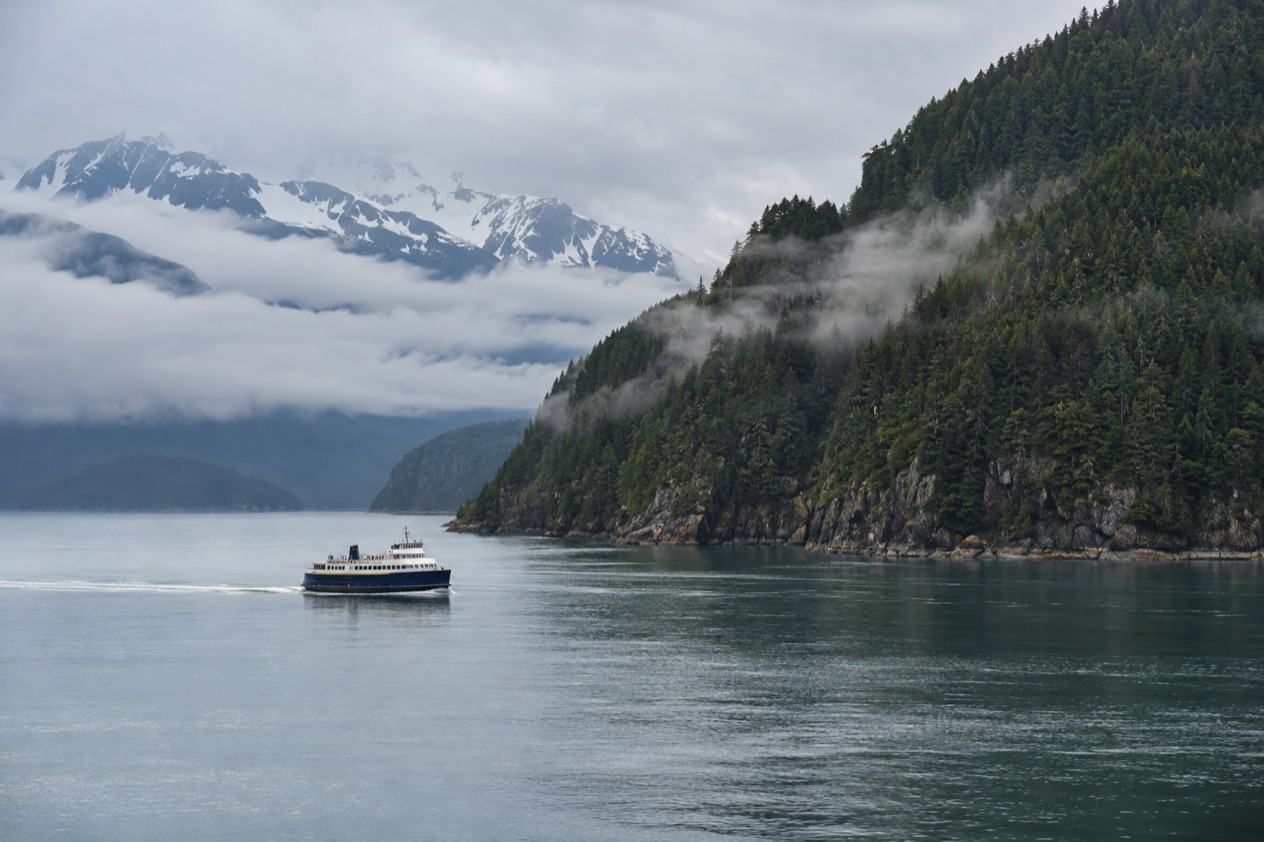
A ferry slides out of a fjord at dawn, the water flat as slate, and the first thing you notice is the smell of cedar and salt drifting off the dark green islands. Eagles sit on the pilings, a cloud hangs halfway down a mountain, and a small town of painted houses appears around the next bend. The Inside Passage is the sheltered water route of Southeast Alaska, a place for people who like to travel slowly by boat and who are happy to let the weather set the mood.
Where is the Inside Passage and what is it like?
The Inside Passage is a sheltered sea route that runs from Seattle, Washington to Skagway, Alaska, and its Alaska portion is Southeast Alaska, the long strip of islands, fjords and mountains along the state’s southeastern coast. Haines and Skagway sit at the head of the Lynn Canal, the northernmost points of the route. In between lie about a thousand islands and thousands of coves and bays, which is why so much of the travel here happens on the water.
Most of the region lies inside the Tongass National Forest, the largest national forest in the country, a landscape of islands, fjords, glaciers and the peaks of the Coast Mountains. The three largest towns are Juneau, Sitka and Ketchikan. Juneau is the state capital, and despite sitting on the mainland it can be reached only by boat or plane, which says a lot about how the region works.
The pace is set by tides, ferry schedules and clouds. Towns are small, with harbors full of fishing boats, totem poles standing near the waterfront, and trails that begin a few minutes from the main street. Southeast Alaska is also the only part of the state where the average daytime high stays above freezing through the winter, so the feel is of a damp, green coastal forest rather than a frozen north.
It suits travelers who like scenery, wildlife and quiet evenings in a harbor town. Humpback whales, orcas, bald eagles, brown and black bears and five species of salmon all live in the region, and you may see some of them on a boat or along a river. If you want nightlife, sunshine reliability or a road trip from town to town, the Inside Passage will feel different from that, because the roads stop at the water and the water is the way through.
What is there to do in the Inside Passage?
The big reasons to come are the water, the glaciers, the forest and the towns themselves, and what sets this coast apart from the rest of Alaska is that all of them sit within reach of one another by boat. Here the sea is a highway rather than a view.
Traveling by ferry or cruise ship
The Alaska Marine Highway is the state ferry system, with headquarters in Ketchikan. It links communities from Bellingham, Washington toward the Aleutian Islands, and in Southeast Alaska most communities receive ferry service through the year, with mainline vessels for the larger towns and day boats for the smaller ones.
Cruise ships work the same waters in a different style. Norwegian’s Alaska itineraries call at Skagway, Juneau, Icy Strait Point, Sitka and Ketchikan, among other ports, and a round-trip seven-day cruise from Seattle on that line visits Dawes Glacier, Juneau and Sitka. Holland America Line also sails Alaska, and its cruises offer access to Glacier Bay National Park and Preserve with National Park Service rangers and wildlife experts on board.
Glaciers and Tongass forest
Juneau is the easiest place on the passage to pair ice with forest. The Forest Service runs the Mendenhall Glacier Visitor Center there, which opened in 1962 as the first Forest Service visitor center in the nation, and it is a good place to learn how the ice shaped the valley before you walk toward it. Glacier Bay National Park and Preserve, also in Southeast Alaska, is the other great ice destination of the region.
In Ketchikan the Forest Service’s Southeast Alaska Discovery Center explains the rainforest, the Native cultures and the wildlife of the Tongass. Pair it with a stroll along the waterfront, where the town’s old buildings stand over the water, and you have a good first day in the region.
Wildlife on the water and the rivers
Humpback whales and orcas live in these channels, and bald eagles are a constant presence on trees and pilings. Brown and black bears roam the region, and salmon runs, with five species in all, draw wildlife to the streams. These are chances, never guarantees, and a quiet hour on a ferry deck with binoculars can be as rewarding as any organized outing.
Small towns with their own character
Sitka, Ketchikan and Juneau each have a distinct feel, and Skagway and Haines sit at the head of the Lynn Canal at the northern end of the route. Walking a harbor, ducking into a café on a rainy afternoon and watching boats come and go is as much a part of the experience as any tour.
How many days do you need in the Inside Passage?
A week is a comfortable amount of time for a first visit, though a long weekend in one town gives you a real taste. The region is large, with land area covering a great stretch of coast, and moving between towns by boat takes time, so trying to do too much is the usual mistake.
Juneau suits a short stay because you can pair the Mendenhall Glacier Visitor Center and its surroundings with waterfront wandering in town. Ketchikan works equally well if you want the Southeast Alaska Discovery Center, a harbor stroll and an easy feel for the rainforest edge of town. Sitka is a good third choice for those who want a smaller, quieter place.
With a week, link two or three towns. The ferry can carry you between them, and the hubs of Ketchikan and Juneau give you good connection points to build around. Leave a day without plans in each place, because weather, tides and wildlife make the best moments unscheduled ones.
With more time, add Glacier Bay National Park and Preserve, or head to the head of the Lynn Canal to see Skagway and Haines. A cruise can compress this into seven days or stretch it much longer, since Holland America’s Alaska cruises range from 7 to 28 days. A cruisetour adds an inland leg that includes a stay at the Holland America Denali Lodge.
Where to stay in the Inside Passage
The main places to stay are the three biggest towns, Juneau, Sitka and Ketchikan, each with its own pace. Juneau suits travelers who want the most going on, since it is the capital and the largest of the three, with a glacier visitor center on its doorstep. It also puts you at a hub for ferry connections.
Ketchikan is a good fit if you want to be near the Southeast Alaska Discovery Center and the headquarters of both the ferry system and the Tongass National Forest. It is a town where the water and the forest meet the main street, and it is a natural first stop for people coming north from Bellingham or Seattle.
Sitka is smaller, with a population just over eight thousand, and suits those who prefer a quieter base. Ranger district offices of the Forest Service also operate in smaller communities such as Craig, Hoonah, Petersburg, Thorne Bay, Wrangell and Yakutat, a reminder that there is more to the passage than its three largest names.
Skagway and Haines, at the northern end of the route, are worth considering if you want to end your trip at the head of the Lynn Canal. For people the best answer is not a single base but a sequence: a few nights in one town, a ferry ride, then a few nights in the next.
How do you get to the Inside Passage and get around?
You get to the Inside Passage by boat or by plane, because there are no roads linking its towns to the rest of the country, and Juneau, the capital, is reachable only by boat or plane. Travelers arrive by cruise ship from Seattle, Vancouver or other ports, while others come by ferry from Bellingham, Washington.
The Alaska Marine Highway covers 3,500 miles of coastline and has 32 terminals in Alaska, British Columbia and Washington. You cannot sail from Bellingham to Dutch Harbor on a single boat, since the system is divided into three parts, and riders reach their destination through regional hubs in Ketchikan, Juneau, Whittier or Homer, sometimes using more than one vessel. The ferry is also one of the only ways to bring a vehicle between Alaska and the contiguous United States without going through international customs and immigration.
Passengers without vehicles must check in two hours before departure in Bellingham and Juneau, and one hour before at the other ports. Walk-on passengers may carry up to 100 pounds of hand-carried baggage, and animals travel on the car deck in an approved carrier or in a vehicle with an adult passenger. The proposed winter 2026/27 schedule does not include Prince Rupert.
Once you are in a town, the main way of getting around is on foot, since harbors, visitor centers and waterfronts sit close to each other in the places where visitors tend to stay. Between towns, the boat is the connection.
When is the best time to visit the Inside Passage?
The cruise and tour season is when visitors come, and Holland America and Norwegian both run their Alaska itineraries on this coast, so the towns are livelier when ships are in port. Specific dates for each cruise line or ferry vary, so the best answer for a given trip depends on the operator you choose.
What you can count on is the character of the region. Southeast Alaska is the one part of the state where winter daytime highs average above freezing, so the cold season is damp and gray rather than deeply frozen, and ferry service reaches most Southeast communities through the year. A visit outside the cruise months is quieter, with fewer ships in port, and the forest and the harbors feel more like the ordinary life of the towns.
Wildlife follows its own calendar. Whales, bears, eagles and the five species of salmon are all part of the region, and any of them may appear on a given day, but none can be promised. Plan around the experience you want most, whether that is the busy energy of cruise season or the calm of the quieter months, and let the weather be a part of the trip.
Good to know before you go
Cruise dining is included in the fare on almost all ships, while alcohol usually costs extra and most lines do not let you bring your own aboard. On the ferry, cabins cost extra and food is cafeteria-style. Bring layers and rain gear, since this is a rainforest coast, and let the tides and the boat schedules set your pace.
Sources
- Wikipedia, Inside Passage (https://en.wikipedia.org/wiki/Inside_Passage), checked October 11, 2026
- Wikipedia, Southeast Alaska (https://en.wikipedia.org/wiki/Southeast_Alaska), checked October 11, 2026
- Wikipedia, Alaska Marine Highway (https://en.wikipedia.org/wiki/Alaska_Marine_Highway), checked October 11, 2026
- Wikivoyage, Alaska Marine Highway (https://en.wikivoyage.org/wiki/Alaska_Marine_Highway), checked October 11, 2026
- Alaska Department of Transportation, Alaska Marine Highway System, Route guide (https://dot.alaska.gov/amhs/route.shtml), checked October 11, 2026
- Alaska Department of Transportation, Alaska Marine Highway System, Alaska Marine Highway System (https://dot.alaska.gov/amhs/index.shtml), checked October 11, 2026
- Wikipedia, Tongass National Forest (https://en.wikipedia.org/wiki/Tongass_National_Forest), checked October 11, 2026
- Wikipedia, Alaska Panhandle (https://en.wikipedia.org/wiki/Alaska_Panhandle), checked October 11, 2026
- Princess Cruises, Alaska cruises (https://www.princess.com/en-us/cruise-destinations/alaska-cruises), checked October 11, 2026
- Holland America Line, Alaska cruises (https://www.hollandamerica.com/en/us/cruise-destinations/alaska-cruises), checked October 11, 2026
- Norwegian Cruise Line, Alaska cruises (https://www.ncl.com/cruise-destinations/alaska-cruises), checked October 11, 2026
- Wikipedia, Cruise ship (https://en.wikipedia.org/wiki/Cruise_ship), checked October 11, 2026
- Wikipedia, Climate of Alaska (https://en.wikipedia.org/wiki/Climate_of_Alaska), checked October 11, 2026