
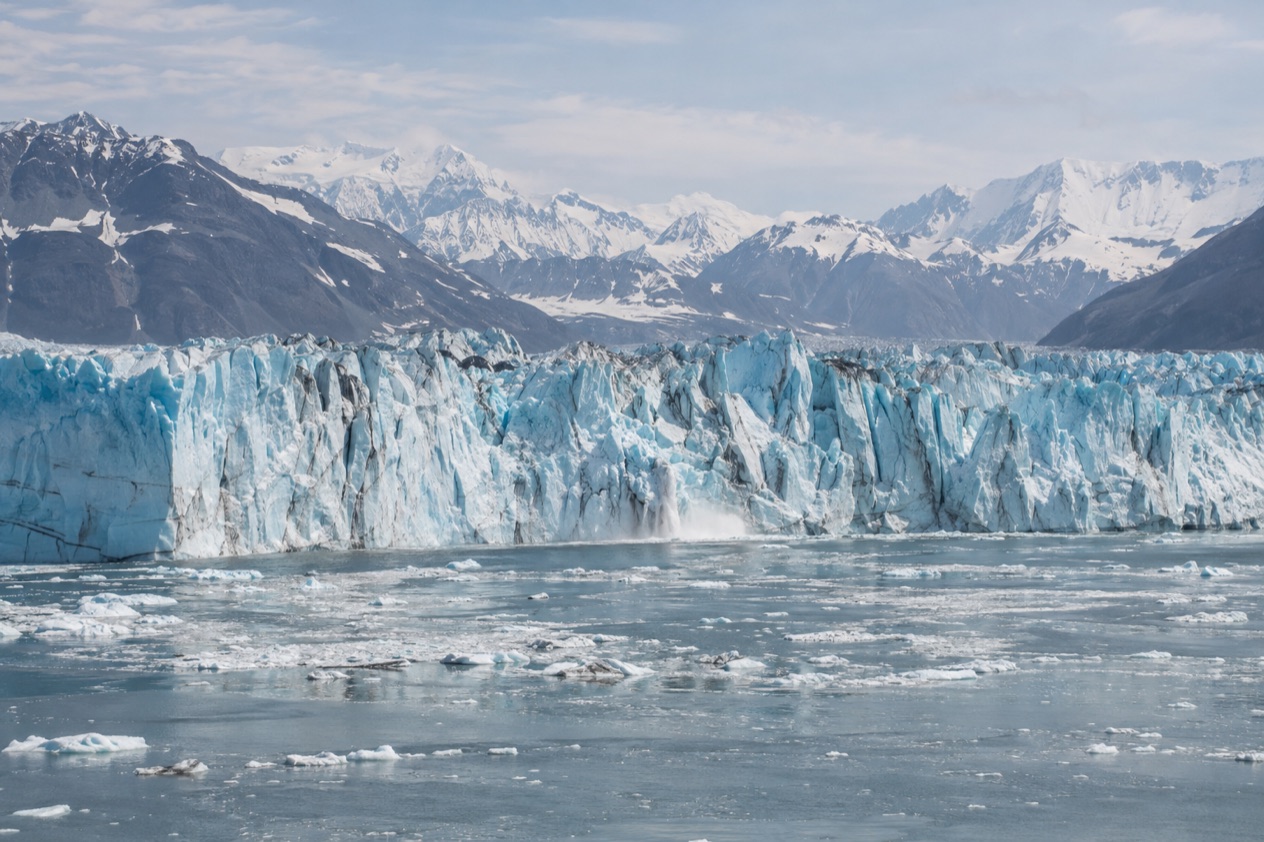
The first sign is often a sound, a flat crack like distant artillery, and then a slab of blue-white ice leans away from the face and drops into the bay. Hubbard Glacier fills the head of Disenchantment Bay with a wall of ice that runs from water level to far above the masts. It is a visit made from the water, a slow approach toward a glacier that keeps moving while many others pull back.
Is visiting Hubbard Glacier worth it?
Yes, for anyone who wants to see a living tidewater glacier at close range, and especially for travelers who like to watch something happen rather than simply look at a view. Hubbard is called the Galloping Glacier because it has advanced while other glaciers recede, and it is the longest tidewater glacier in North America. That reputation shapes the visit: you come to see a glacier that is still pushing forward into the sea.
What sets it apart from other glacier stops in Alaska is the scale of the face and the way it behaves. Hubbard routinely calves icebergs the size of a ten-story building, and the bay in front of it is a place where ships must stay back from the edge because newly calved ice can shoot up dramatically from below the surface.
Glacier Bay, College Fjord and the fjords at the ends of Tracy Arm and Endicott Arm all offer their own ice, but Hubbard is the one defined by that single enormous, restless face. If your idea of a glacier is a quiet, frozen landscape, this one will be louder and more alive than you expect.
It also suits people who like a trip with a sense of place around it. The glacier lies within Wrangell–St. Elias National Park and Preserve on the Alaska side, and on the other side of the border it belongs to Kluane National Park and Reserve in Yukon, Canada. You are looking at ice that spans two countries and two great protected landscapes.
What to see at Hubbard Glacier
The face of the glacier
The face is what you came for, a cliff of ice that the Celebrity Cruises description puts at the equivalent of 30 stories high. Up close the color changes from dirty white on the surface to a deep, almost electric blue in the cracks and along fresh breaks, where the ice is dense and has lost its trapped air. The surface is crevassed and folded, with towers and gullies that shift from one hour to the next.
Look at the waterline as well as the top. Brash ice, bergy bits and small floes gather at the foot of the face, and seals sometimes haul out on drifting ice in places like this, though that is a chance and never a promise. Let your eyes settle on one section of the face and wait. The calving rarely happens when you are looking at your phone.
Calving and the sound of moving ice
Calving is when a mass of ice breaks from the glacier and falls into the bay, and at Hubbard it happens routinely. Often you hear the crack before you see the fall, then a delayed roar as the ice hits the water and a swell spreads across the surface. Because newly calved icebergs can shoot up dramatically, ships keep their distance from the edge, which is why the view comes with a sense of respect for what the ice can do.
Small pieces fall constantly, a larger collapse may come at any moment, and every sound carries across the still water of the bay. Do not expect a performance on a schedule. The glacier decides.
The age of the ice
The ice you see at the foot of the glacier is about 400 years old, because that is how long it takes ice to travel the full length of Hubbard. The longest source of the glacier originates 76 miles from its snout, up in the mountains where snow piles up year after year and compresses into ice. What drops into Disenchantment Bay began as snowfall long before anyone alive was born.
It is a good thing to think about while you watch a berg bob past, since a floe the size of a car may be older than most of the buildings in the nearest towns. That slow journey from mountain to sea explains the glacier’s color, its cracks and its steady push into the water.
Disenchantment Bay and the surrounding mountains
Hubbard meets the sea in Disenchantment Bay, a name that suggests the disappointment of early explorers who hoped to find a passage and found a wall of ice. Today the bay is the setting for the whole experience, with the glacier at the head, mountains rising behind and icebergs of every size drifting across the water. In clear conditions the peaks of Wrangell–St. Elias stand over the scene and make the glacier look like one tongue of a much bigger icefield.
In low cloud the mood changes completely. The face may fade in and out of fog, sounds carry farther and the blue of the ice stands out against gray water. Both versions are worth seeing, and neither is better than the other.
Hours, tickets and rules
Hubbard Glacier is not a site with a gate and a ticket window. It is seen from the water of Disenchantment Bay, as part of a cruise or a cruisetour, and the experience belongs to the voyage that brings you there. The glacier itself sits within Wrangell–St. Elias National Park and Preserve and Kluane National Park and Reserve, two large protected areas, and the visit is shaped by the way ships approach it.
What a visit looks like depends on the ship or the program you travel with. Princess lists Hubbard Glacier in its Voyage of the Glaciers cruise, Holland America describes the glacier as one of the highlights of its Alaska sailings, and Royal Caribbean says its Alaska Cruisetours from Seward visit Hubbard. Each operator builds the glacier stop into its own itinerary, so the details of the day come from the cruise you choose.
The rule that matters at the glacier itself is the distance. In Disenchantment Bay, ships must keep their distance from the edge of the glacier because newly calved icebergs can shoot up dramatically. That is why you watch from the deck and never from close range, and it is the reason the view feels both near and respectfully far.
How to get to Hubbard Glacier
You reach Hubbard Glacier by sea, on a cruise or cruisetour that includes it. The glacier lies at the head of Disenchantment Bay, and the cruise lines that include it start their voyages from several different ports, so the route you take depends on the line and the itinerary you pick.
From Whittier (Anchorage)
Princess runs its Voyage of the Glaciers cruise between Anchorage (Whittier) and Vancouver, B.C. The route stops in Ketchikan, Juneau and Skagway, and its highlights include Glacier Bay National Park, Hubbard Glacier and College Fjord. Princess also offers one-way cruises from the Whittier (Anchorage) cruise port, so the glacier can be part of a northbound or southbound trip.
A Princess cruisetour adds a land portion to the 7-day Voyage of the Glaciers, with stays at wilderness lodges and travel on a glass-domed wilderness train. That makes Hubbard one stop in a longer journey that takes in the Alaska interior as well as the coast.
From Seward
Royal Caribbean states that its Alaska Cruisetours from Seward visit Hubbard Glacier. For Hubbard from Seward, the Royal Caribbean cruisetour is the one that names it.
From Seattle, Vancouver and other ports
Holland America Alaska cruises range from 7 to 28 days and depart from Seattle, Vancouver, Whittier or San Diego, and the line describes Hubbard Glacier as the longest tidewater glacier in North America. Its Alaska cruisetours range from 9 to 17 days and depart from Seattle, Vancouver, Anchorage or Fairbanks. If a Holland America Alaska cruise does not include a glacier visit, the line gives a Future Cruise Credit equal to 15% of the fare.
Princess also offers round-trip Alaska cruises from San Francisco, Los Angeles, Seattle and Vancouver. When you compare itineraries, look for Hubbard Glacier by name in the list of stops, since glaciers such as Glacier Bay, College Fjord and Dawes Glacier appear on other routes and are not the same place.
When to visit Hubbard Glacier
The glacier is a sight of the cruise season, and the moment that matters is the day your ship reaches Disenchantment Bay. Choose the itinerary first and the date follows. What the glacier does is largely independent of the calendar, since it calves routinely and the ice at its foot is always the old ice of centuries.
Within a cruise day, the face changes with light and weather. Clear conditions show the blue in the ice and the mountains behind, while cloud and fog give the scene a quieter, moodier look. Either way the sounds of cracking and falling ice are part of the experience, and a patient hour on deck is better than a quick glance.
Other moments on an Alaska cruise add to the season. Holland America suggests booking between early May and early June for the best chance of seeing orcas at play, which makes that stretch a good one if marine wildlife matters to you as much as the ice. In Haines, which Princess lists as a port, the Chilkat Bald Eagle Preserve sees thousands of bald eagles gather along the riverbanks each fall, a very different kind of spectacle on the same coast.
Wildlife is always a chance and never a promise. Orcas, eagles and seals may appear, and the glacier may calve a great deal or only a little, so go with curiosity rather than a checklist.
Tips for your visit
Give the glacier your full attention while the ship is in the bay. Calving comes in bursts and long pauses, and the people who see the biggest collapses are often the ones who stayed at the rail when others went inside. A pair of binoculars helps with the details of the face and the floating ice, and a camera with a good zoom helps with the distance the ships keep.
Combine Hubbard with the other ice on the route. Princess includes Glacier Bay National Park, a UNESCO World Heritage Site where park rangers come aboard to provide commentary, as well as College Fjord on the same Voyage of the Glaciers.
Holland America also describes privileged access to Glacier Bay with National Park Service Rangers and Wildlife Experts on board. College Fjord is home to tidewater and valley glaciers named for Ivy League schools, and it is a spot where you can see eight glaciers at once.
For smaller, more intimate ice, the North and South Sawyer Glaciers at the ends of Tracy Arm and Endicott Fjords are reachable only by small ship. Norwegian’s 7-day Seattle round-trip cruise visits Endicott Arm and Dawes Glacier, so it gives a different kind of glacier day than Hubbard.
The ports add their own pleasures. In Ketchikan you can walk Creek Street for local art, smoked salmon and souvenirs, see traditional dances at Saxman Native Village and visit a state historical park with ancient totem poles that teach about Alaskan culture. Juneau and Skagway round out the picture of the Inside Passage, and the glass-domed train and lodges of a cruisetour carry the trip inland toward Denali.
Good to know before you go
Hubbard Glacier is a visit from the water, so the practical details sit with the cruise or cruisetour that takes you there. The one firm point at the glacier is the distance ships keep from the face, a precaution because fresh icebergs can leap up from below. Treat the ice with the same respect from the deck, and let the glacier set the pace of the afternoon.
If you also want to know the name behind a familiar boat, the Alaska Marine Highway ferry MV Hubbard is named after the glacier, one of the day boat and shuttle vessels in the fleet alongside the MV Aurora, MV LeConte, MV Lituya and MV Tazlina. Alaska has over 27,000 glaciers, and Hubbard is the one that most clearly keeps galloping toward the sea.
Sources
- Wikipedia, Hubbard Glacier (https://en.wikipedia.org/wiki/Hubbard_Glacier), checked October 11, 2026
- Princess Cruises, Alaska cruises (https://www.princess.com/en-us/cruise-destinations/alaska-cruises), checked October 11, 2026
- Holland America Line, Alaska cruises (https://www.hollandamerica.com/en/us/cruise-destinations/alaska-cruises), checked October 11, 2026
- Norwegian Cruise Line, Alaska cruises (https://www.ncl.com/cruise-destinations/alaska-cruises), checked October 11, 2026
- Royal Caribbean, Alaska cruises (https://www.royalcaribbean.com/cruise-destinations/alaska-cruises), checked October 11, 2026
- Celebrity Cruises, Alaska cruises (https://www.celebritycruises.com/cruise-destinations/alaska-cruises), checked October 11, 2026
- Princess Cruises, Alaska wilderness lodges (https://www.princess.com/en-us/lodges), checked October 11, 2026
- Alaska Department of Transportation, Alaska Marine Highway System, Fleet (https://dot.alaska.gov/amhs/fleet.shtml), checked October 11, 2026