
THE ALGARVE · BEST TIME TO VISIT · 37.0° N
The Algarve sells itself as a year-round coast, and the thermometer nearly backs the claim: even December averages a high of 62.8°F at Faro. The water keeps a different calendar. It peaks in October at 67.3°F, months after the sun does, which is why a July beach day and a July swim are two separate propositions.
One number frames the rest. Faro records about 17.92 inches of rain in an average year, and 0.36 of that total falls across June, July and August combined. The winter half does all the work, with December alone at 3.54 inches and November at 2.97. Get the month right and this coast is close to weatherproof; get it wrong and you have booked a rainy beach.
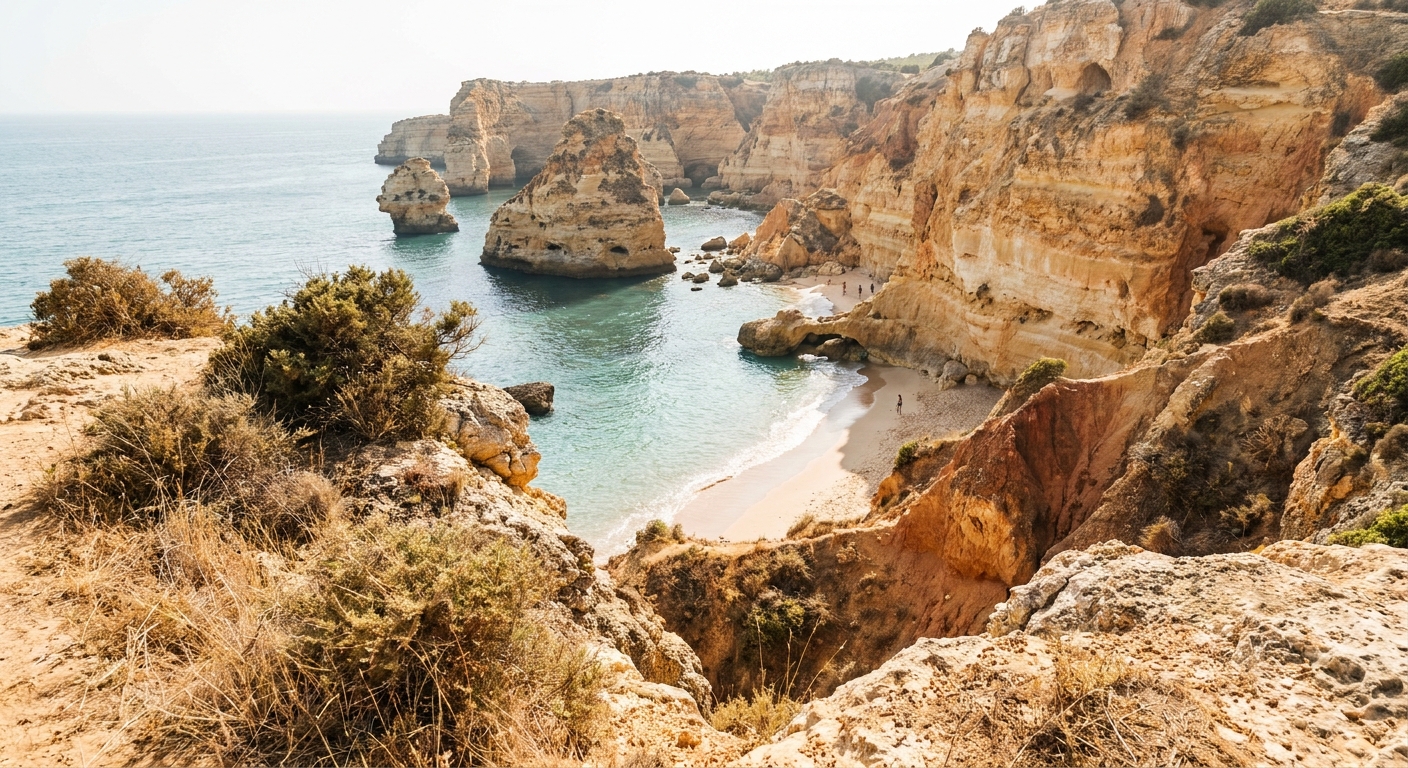
THE YEAR AT A GLANCE · THE ALGARVE
September is the best all-around month on this coast: 79.5°F days, sea at 65.4°F, rain on 1.9 days, and the August crush already loosening.
BEST MONTH: SEPTEMBER · WARMEST SEA: OCTOBER, 67.3°F · LOW SEASON: NOVEMBER TO FEBRUARY
Go for: a swimming window running June to November, a nearly rainless June through August, and May days that hold 14 hours 13 minutes of light.
Think twice before: booking a December beach week: 7.0 days of rain, 3.2 of them at 10 mm or more, and sunset at 5:17 p.m. on the 15th.
Normals: IPMA station 554, Faro, 1991–2020 · Sea: Open-Meteo Marine, 2015–2024 · full sources at the end
On this page
- The best month overall in the AlgarveSeptember, with its numbers
- Sea temperature month by monthJune to November above 65°F
- Which month to avoidDecember: 3.54 inches of rain
- The quiet months on the Algarve coastNovember through February
- Highs, lows, rain days and sea for all twelve monthsThe full table
- May or October: which shoulder month is betterLand in May, water in October
A word on geography before the figures. The Algarve runs roughly 150 km from the Spanish border at Vila Real de Santo António to Cape St. Vincent, and the official normals below are measured at a single station near Faro, 5 meters above the sea, at the eastern end of that line. They describe the beach towns well. They do not describe the Serra de Monchique behind the coast, which runs colder and considerably wetter.
Algarve weather month by month: highs, lows, rain and sea
| Month | Avg high | Avg low | Rain | Days ≥ 1 mm | Sea |
|---|---|---|---|---|---|
| January | 61.3°F | 46.9°F | 1.94 in | 6.0 | 62.0°F |
| February | 62.6°F | 47.8°F | 1.65 in | 5.4 | 61.3°F |
| March | 66.0°F | 51.4°F | 1.84 in | 5.6 | 60.9°F |
| April | 69.3°F | 54.3°F | 1.54 in | 5.3 | 63.5°F |
| May | 74.3°F | 59.0°F | 1.03 in | 3.8 | 63.4°F |
| June | 80.2°F | 64.0°F | 0.20 in | 0.8 | 66.9°F |
| July | 84.9°F | 67.3°F | 0.04 in | 0.2 | 66.8°F |
| August | 84.6°F | 67.8°F | 0.12 in | 0.2 | 66.8°F |
| September | 79.5°F | 64.9°F | 0.85 in | 1.9 | 65.4°F |
| October | 73.9°F | 60.4°F | 2.20 in | 6.0 | 67.3°F |
| November | 67.3°F | 53.4°F | 2.97 in | 6.6 | 65.3°F |
| December | 62.8°F | 49.5°F | 3.54 in | 7.0 | 63.4°F |
The year splits cleanly in two. From June through August the rain effectively stops, with July recording measurable rain on 0.2 days in an average year. From October the tap reopens, and November plus December together carry 6.51 inches, better than a third of the annual total. Temperature moves less than that suggests: 23.6°F separates the January high of 61.3°F from the July high of 84.9°F.
Two months do the switching. May lifts the average high 5.0°F above April, to 74.3°F, and cuts rain days from 5.3 to 3.8. October runs the same film backward: highs fall 5.6°F from September to 73.9°F, while days with at least 1 mm jump from 1.9 to 6.0. June then finishes what May began, dropping monthly rainfall from 1.03 inches to 0.20.
Which month is hardest depends on why you came. For anything involving water, it is December, the wettest month on the record at 3.54 inches with 3.2 days of heavy rain. For walking the cliff paths or the hills inland, it is July, when the average high reaches 84.9°F and the average low holds at 67.3°F, so the night gives very little back.
About the measurements themselves. The air figures are 30-year normals for 1991 to 2020, read off a real thermometer rather than a model grid cell. The rain-day counts use the Portuguese service’s own thresholds, 1 mm (0.04 inch) and 10 mm (0.39 inch), not the 0.10-inch line American climate tables draw, so the two sets of counts are not interchangeable. The sea column comes from a separate marine series averaged over 2015 to 2024.
When is the best time to visit the Algarve?
September, if you want one answer. The average high is 79.5°F, the average low 64.9°F, and the month records rain on 1.9 days out of thirty. The sea reads 65.4°F, within 1.4°F of its August value, and the 15th still delivers 12 hours 27 minutes of daylight, with sunset at 7:40 p.m. local time.
August is warmer on paper and harder in practice: 84.6°F against September’s 79.5°F, a gap of 5.1°F concentrated between noon and four, on a coast at its fullest while northern European schools are out. Going the other direction, October holds the warmest water of the year at 67.3°F but triples September’s rain days, 6.0 against 1.9, and adds 1.35 inches to the monthly total.
September also suits the coast’s geography, which stretches from Tavira and its salt pans in the east to Sagres at the southwestern corner, with Lagos in between. If the Algarve is one chapter of a longer trip, the national picture sits in when to visit Portugal, and 64.9°F evenings call for different luggage than July does, which the packing list covers.
When can you swim in the Algarve? Sea temperature month by month
By this series the water clears 65°F for six months, June through November: 66.9°F in June, 66.8°F in July and August, 65.4°F in September, 67.3°F in October and 65.3°F in November. It never reaches 70°F in any month. The other half of the year sits between March’s 60.9°F, the annual low, and April’s 63.5°F, which is Atlantic swimming in the technical sense: fine for a plunge, cold for an afternoon. Note where the peak falls, in October rather than August.
One caveat about that column. It is a mean of daily maxima over 2015 to 2024, meaning the warmest reading of each day averaged across ten years, not a 24-hour average, so it runs a shade above what greets you at eight in the morning. The figure also covers the coast as a whole rather than one bay. Read 67.3°F in October as the top of the range, not a guarantee for the cove you picked.
When is the Algarve quietest?
Quiet here is a calendar fact rather than a price claim. The low season runs from November to February, with a short holiday interruption around Christmas and New Year, and it ends when Easter starts refilling the beach towns. Nobody comes to this coast in January for the beach, and the weather explains why: 9 hours 57 minutes of daylight on the 15th, sunrise at 7:42 a.m. and sunset at 5:39 p.m.
What those months give you is a coast at conversational volume and the driest weather of the winter half. January’s 1.94 inches and February’s 1.65 add up to 3.59 inches, roughly what December delivers on its own, and February records rain on 5.4 days, fewer than October’s 6.0. Highs of 61.3°F and 62.6°F make the cliff walk between Carvoeiro and Benagil a sweater proposition rather than a coat one.
What they take away is the day itself and the water. Light is gone before six from November to February, which kills the idea of driving west after lunch and still seeing the cape. The sea reads 62.0°F in January and 61.3°F in February, on its way to the year’s low of 60.9°F in March. Cave boat trips run on weather windows instead of timetables in winter, and part of the seasonal restaurant map simply closes.
Which month should you avoid in the Algarve?
December, for anyone whose plan involves swimming, boats or long daylight. It is the wettest month at 3.54 inches, with rain on 7.0 days and 3.2 of those reaching 10 mm or more, against June’s 0.8 and 0.2. Daylight on the 15th runs 9 hours 41 minutes, the shortest of the year, and the sun is down at 5:17 p.m. The sea has slipped back to 63.4°F.
It is a poor beach month and a serviceable everything-else month. The average high of 62.8°F actually sits 0.2°F above February’s, and by the 1 mm count roughly 24 of the 31 days record no measurable rain at all. That 63.4°F water is essentially April’s 63.5°F, and warmer than anything March offers. For Faro‘s old town, the inland market towns and the hills, December costs you daylight and not much else.
Is the shoulder season worth it in the Algarve?
The shoulders are May and June on one side, September and October on the other. Measured against July’s 84.9°F, May runs 10.6°F cooler at 74.3°F and October 11.0°F cooler at 73.9°F. Rain follows the same shape: 3.8 days in May and 6.0 in October, against 0.2 in July. June barely qualifies as a shoulder at all, with 80.2°F highs and 0.8 rain days putting it closer to high summer than to spring.
Daylight is the underrated part of the deal. May 15 delivers 14 hours 13 minutes of light, only 32 minutes short of the June peak, with the sun up at 6:21 a.m. and down at 8:34 p.m. That buys a morning on the cliffs at Ponta da Piedade and an unhurried afternoon on the water, at temperatures where walking is a pleasure instead of a negotiation with the shade.
What the shoulder removes is water temperature on one side and reliability on the other. May’s sea reads 63.4°F, a full 3.4°F below August, so the air runs far ahead of the Atlantic: 74.3°F days over a 63.4°F swim. October reverses the problem. Its water is the warmest of the year at 67.3°F, but its 2.0 days at 10 mm or more are twenty times August’s 0.1, and 2.20 inches falls across the month.
So yes, with the sides swapped from what most people assume. Come in May for the land: long light, thin rain, cliffs at a walkable temperature. Come in late September or the first half of October for the sea, which is warmer then than at any point in July. If a single trip has to carry both, September splits the difference more cleanly than any other month at 79.5°F, 65.4°F water and 1.9 rain days.
The last word
Book the sea rather than the sun. The air peaks in July and the water three months later in October, and that lag is what most first trips here misread. One figure not yet spent: February nights average 47.8°F, colder than the picture the word Algarve puts in an American head, and the reason an unheated winter rental is a fair question to ask. Whichever month wins, the numbers above were read at Faro, and the far end of the coast writes its own weather.
Sources & data for this guide
- Monthly normals: highs, lows, precipitation and rain days · IPMA, Instituto Português do Mar e da Atmosfera, 1991–2020 climate normals, station 554 Faro, altitude 5.0 m · checked Sep 9, 2026
- Sea surface temperature, mean of daily maxima 2015–2024 · Open-Meteo Marine API · checked Sep 9, 2026
- Daylight, sunrise and sunset on the 15th of each month, converted to Europe/Lisbon · sunrise-sunset.org · checked Sep 9, 2026
- Rain-day counts use the Portuguese service’s thresholds of 1 mm (0.04 inch) and 10 mm (0.39 inch), not the 0.10-inch threshold of US climate tables · the two sets cannot be compared directly
- No price series is used on this page: low season is stated as a fact of calendar, never as a ranking of cost. Seasonal closures and boat-trip schedules are editorial observation · confirm with operators when you book