
By the time the last tour buses have stopped and the first snow has settled on the spruce, Denali turns quiet in a way the summer crowds never see. The park does not close.
It shifts to a slower routine built around the Murie Science and Learning Center, a plowed stretch of road, a kennel full of working sled dogs and a train that runs on weekends. Winter here means a smaller, simpler park, and it suits travelers who like their wilderness with room to breathe.
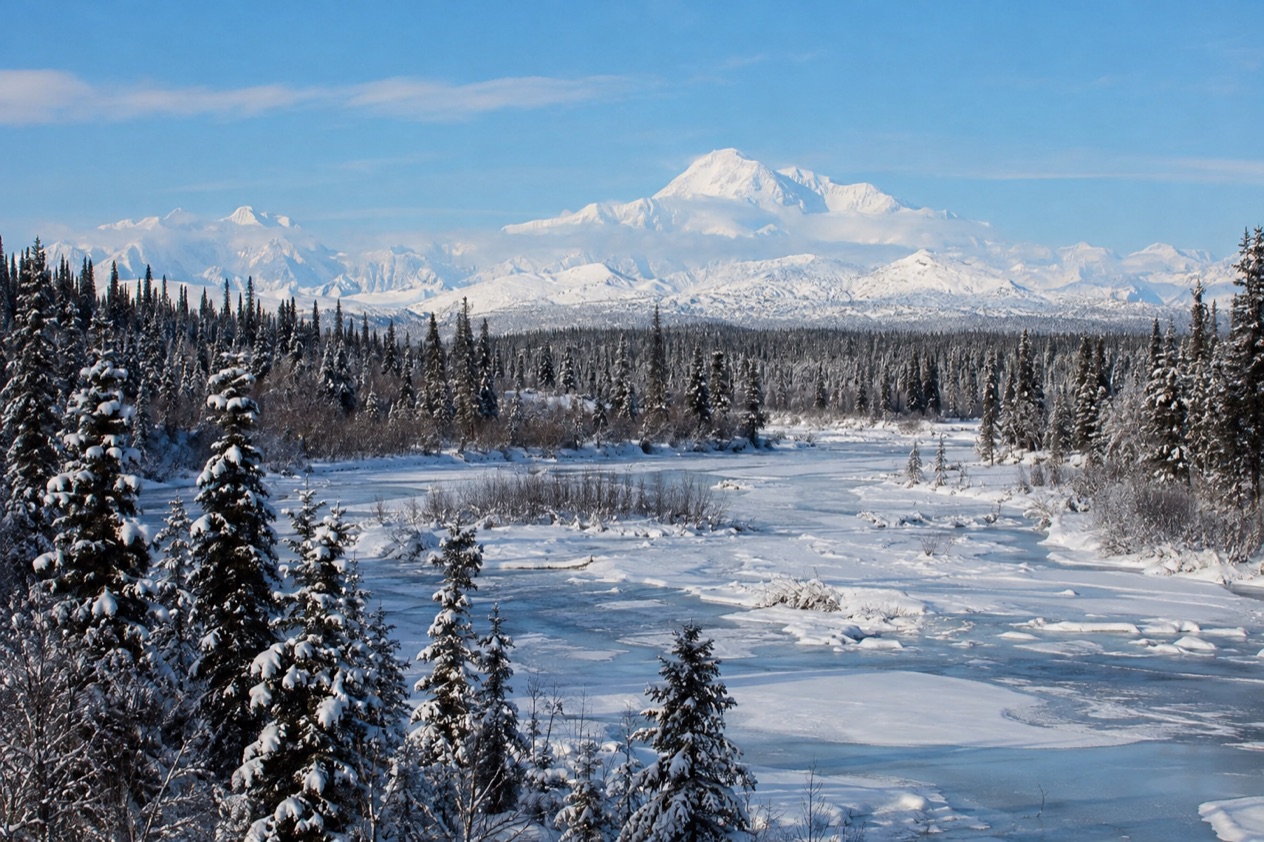
Is Denali National Park open in winter?
Yes, Denali National Park is open in winter, though with a much smaller set of services than in the bus-season months. The winter season runs from late September until early May, and during those months the park is organized around one small hub and one road that gets shorter as the snow deepens.
The Winter Visitor Center
The winter visitor center is the Murie Science and Learning Center, at mile 1.3 on the Denali Park Road. Inside, you can watch park films, browse the displays and pick up brochures and trail maps. Families can ask for Junior Ranger Activity Books, which gives children something to do on the days when the cold keeps everyone near the stove.
This is also where you borrow snowshoes and where backcountry permits are handed out. If you plan to hike anywhere, stop here first. Temporary wildlife closures can be in place for less than a day and may not show on the map, so the visitor center is the place to learn about them before you head out on a trail.
How far the park road goes
The park road changes shape with the seasons. After the transit buses stop running in fall (they end on the second Thursday after Labor Day), private vehicles can drive much farther than they can all summer, weather permitting.
Then the snow arrives, and the National Park Service plows only the first stretch, from the entrance to Park Headquarters. The road can also close at Mountain Vista or Park Headquarters at any time because of winter weather.
Spring runs the process in reverse. The road opens first to Savage River and then to Teklanika River, sometime in April or early May depending on snow.
Anywhere from a few miles to thirty of the road may be open to private vehicles in spring or fall, so expect the answer to change from week to week. Cyclists and pedestrians may travel on any part of the park road, with occasional temporary closures for wildlife activity.
| Time of year | Denali Park Road |
|---|---|
| Fall, after bus service ends | Open to Teklanika River (mile 30) for private vehicles, weather permitting, through October 15 |
| Once snow accumulates | Plowed only from the entrance to Park Headquarters (3 miles) |
| Any time in winter | May close at Mountain Vista (mile 13) or Park Headquarters (mile 3) because of weather |
| Spring | Opens to Savage River (mile 15), then to Teklanika River, in April or early May |
| May 20 | Transit buses begin; private vehicles restricted beyond Savage River |
Entrance fees and proof of payment
Entrance fees are required in winter as well. You can pay online ahead of time or in person at the entrance area, and at the Winter Visitor Center the payment must be by credit card, since cash is not accepted. Carry your park pass or proof of online purchase, on your phone or as a printed receipt, because a ranger may ask to see it.
The park sits in two different climates, split by the Alaska Range: a milder, wetter maritime influence on the south side and a colder, drier interior climate in the northern regions, where the entrance and the road are. That interior cold is real.
The record low at Park Headquarters is -54°F, set on February 5, 1999, and the deepest snow on the ground there reached 69 inches in February of 2022. Dress for a place that takes winter seriously.
What can you do in winter?
In winter you can snowshoe, bike the plowed road, meet the park’s sled dogs, watch films at the visitor center and head out overnight with a permit. The pace is slower than summer and most of the pleasure comes from being outdoors in a place that is quiet and covered in snow.
Snowshoeing and walking
Snowshoes and ice grippers are free to borrow at the Winter Visitor Center, which removes the need to bring your own. With them on, you can follow the trails from the center and the maps you pick up there into spruce forest, where the snow muffles every sound and the only tracks you cross may belong to hares, foxes or ravens.
Ask the rangers about wildlife closures before you set off. Because the park does not post every short closure on the map, a conversation at the desk is part of the plan. Bring layers, since the interior climate is cold, and keep in mind that no food is sold inside the park in winter, so pack what you need for the day.
Biking and walking the park road
Winter biking is allowed only on the Roadside Bike Trail and on the park road itself. The summer hiking trails are off limits to bikes. That makes the plowed section of road, with the snow banked high on either side, the natural place to ride or walk in the quiet season.
The road is open to cyclists and pedestrians along its whole length, even when it is closed to cars, though temporary closures for wildlife can occur. Beyond the plowed stretch, conditions are whatever the weather has left, so go only as far as your gear and the day allow.
Sled dog kennels and Murie Hall
The park’s sled dog kennels are the winter highlight for many visitors. The dogs are working animals that have long helped rangers patrol the park, and a visit lets you watch them in their home setting. The kennels welcome visitors on weekends only, except major holidays.
Murie Hall, next to the Murie Science and Learning Center, is an indoor picnic area with restrooms and a water bottle filling station. It is where you warm up and eat the lunch you brought, since there is nowhere to buy one in the park.
| Site | Open |
|---|---|
| Sled Dog Kennels | Saturdays and Sundays, 1 pm to 4 pm, except major holidays |
| Murie Hall (indoor picnic area) | Daily, late September through mid-April |
Overnight trips and camping
An overnight trip in the park in winter requires a backcountry permit, available at the Winter Visitor Center. Backpacking is possible year-round with a free backpacking permit, so the backcountry stays open to those who are well equipped and prepared for winter conditions.
For a simpler night out, the Bear Loop of Riley Creek Campground is open year-round, and camping there is free from mid-September to early May. It is a modest option, but it lets you sleep inside the park boundary in the quiet months without paying a campsite fee.
How do you get there in winter?
You get there by driving the George Parks Highway or by riding the Aurora Winter Train, which stops near the park on weekends. The park’s only road entrance is at Mile 237 of Alaska Highway 3, which is the same highway, and it lies 240 miles north of Anchorage and 120 miles south of Fairbanks.
Driving to the park
Winter driving here means planning around weather. The entrance sits on the highway between Anchorage and Fairbanks, and once you turn in you are limited to however much of the park road has been plowed or opened that week. Conditions can shift quickly, so treat any plan to go farther than the first stretch as flexible.
At the Denali Visitor Center, personal vehicles should park in lots 1, 2, 3 and 6. School buses use lots 4 and 5. The Alaska Railroad depot is a five-minute walk from the Denali Visitor Center, which is useful if you arrive by rail.
The Aurora Winter Train
The Aurora Winter Train runs between Anchorage and Fairbanks on weekends from mid-September to mid-May, with some mid-week departures as well. It heads to Fairbanks on Saturday and returns to Anchorage on Sunday. Along the way it stops at Wasilla, Talkeetna, Hurricane, Healy and Nenana.
South of Hurricane Gulch the train offers flagstop service along a stretch of roadless backcountry, and it stops as needed at Healy and Nenana before reaching Fairbanks. The schedule may vary with the number of stops. There is onboard dining, and on a clear day passengers may see Denali rising above the Susitna River.
Where to stay and eat nearby
Healy is the nearest year-round community, a small town 11 miles north of the park entrance, and some year-round accommodations stay open there. It is also the closest place for food, since no food is available inside the park in winter. Plan your meals around a stop in Healy before or after your day in the park.
If you prefer to stay inside the boundary, the free Bear Loop at Riley Creek Campground is the option the park keeps open through the cold months. Between Healy and the campground, the area gives you a base at either end of the budget range without leaving the park corridor.
Good to know before you go
Bring your own food and a credit card, because nothing is sold in the park and the entrance fee cannot be paid in cash. Plan around the road, which may close at Mountain Vista or Park Headquarters whenever the weather turns.
The summer season runs from mid-May to mid-September, and full bus service along the length of the Denali Park Road is set to resume in 2027 with the completion of the Pretty Rocks bridge. In winter, the park is yours to take at a slower speed.
Sources
- National Park Service, Denali National Park & Preserve, plan your visit: winter activities (https://www.nps.gov/dena/planyourvisit/winter-activities.htm), checked October 11, 2026
- National Park Service, Denali National Park & Preserve, plan your visit: shoulder season (https://www.nps.gov/dena/planyourvisit/shoulder-season.htm), checked October 11, 2026
- National Park Service, Denali National Park & Preserve, plan your visit: conditions (https://www.nps.gov/dena/planyourvisit/conditions.htm), checked October 11, 2026
- National Park Service, Denali weather and climate (https://www.nps.gov/dena/learn/nature/climate.htm), checked October 11, 2026
- Alaska Railroad, Aurora Winter (https://www.alaskarailroad.com/ride-a-train/our-trains/aurora-winter), checked October 11, 2026
- National Park Service, Denali National Park & Preserve, plan your visit: directions (https://www.nps.gov/dena/planyourvisit/directions.htm), checked October 11, 2026
To plan your stay
- Best Time to Visit Denali National Park: Summer Buses, Fall Road, Winter Quiet and Weather by Month
- Where to Stay in Denali National Park: Park Entrance, Healy, Backcountry Lodges and Campgrounds
- Denali National Park from Anchorage: the Parks Highway, the Denali Star Train and Park Shuttles
- Know Before You Go to Denali National Park: Fees, Bus Season, Weather and Bears