
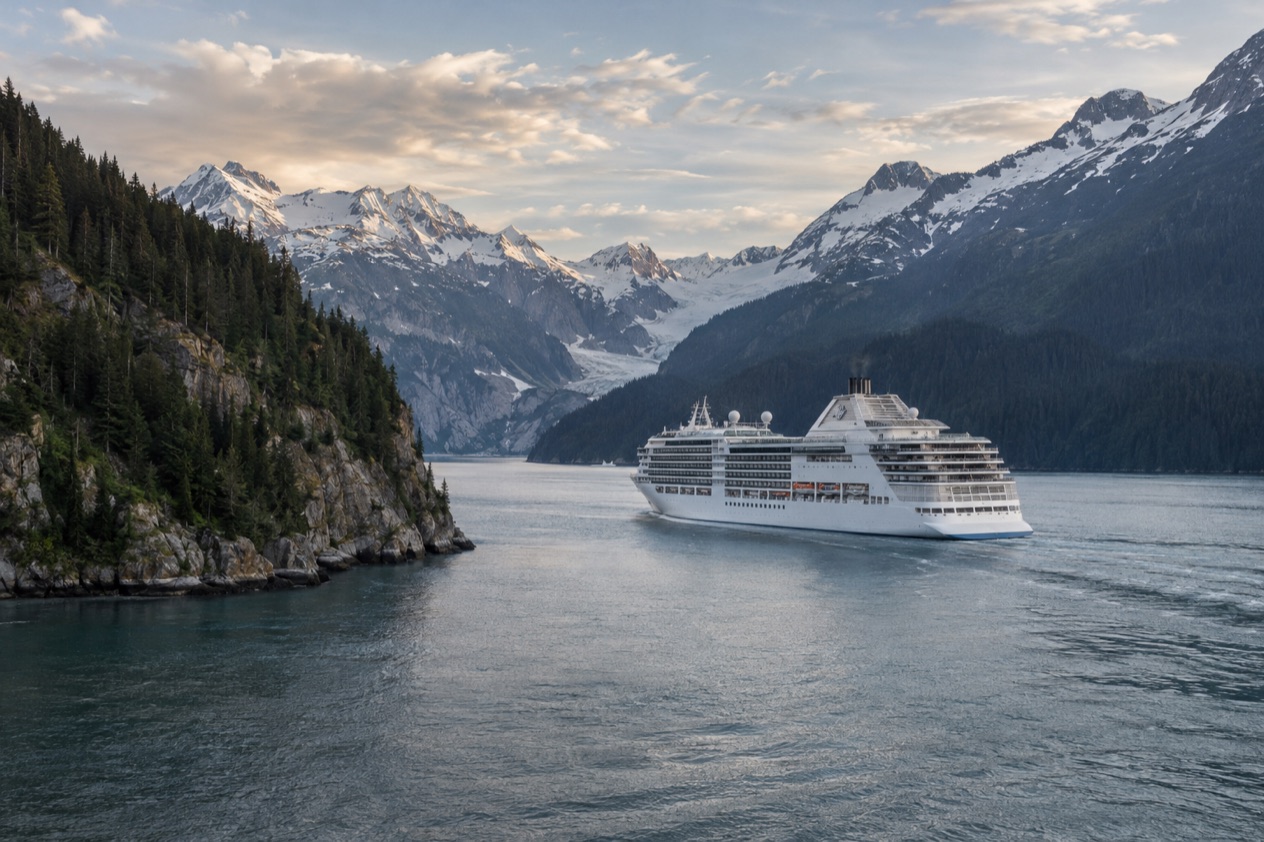
A cruise passenger stands at the rail in Sitka Sound, looking at spruce-covered islands and a town that seems to grow straight out of the forest, and wonders what to do with a day here. Sitka answers with a mix of Tlingit and Russian history, a rain forest park, a sanctuary for injured birds, and cold water where whales and otters may turn up. This is a rundown of those outings, which ones belong to the land and which to the water, and what to settle before choosing.
Sitka is a town of layers, and the excursions follow them. You can spend a day on stories carved in cedar, on a bishop’s house with a samovar-era feel, or on the wild edge of the Tongass.
What shore excursions are there in Sitka?
Sitka National Historical Park, the Russian Bishop’s House and the Alaska Raptor Center offer three different ways to explore the town’s history, forest and wildlife rehabilitation work. Each one shows a different side of the town, and they pair well because they are all rooted in the same place and the same history.
Sitka National Historical Park
This is the one stop that gathers the whole story of Sitka under tall trees. The park’s totem pole collection has an unusual story, and the poles stand among spruce and hemlock in a temperate rain forest. The park also reaches the tidelands, where sea stars and crabs live, and the river called Kaasdahéen (Indian River).
The visitor center holds artifacts, and many of them are owned by Tlingit clans and are still used for ceremonial purposes. That changes how you look at the cases: these are living objects and not relics, and the right response is quiet attention. Hiking trails run in and around the park, so a visit can be a stroll among the poles or a longer walk into the trees.
The park is Alaska’s oldest national park unit, and kids of all ages can become Junior Rangers here. For families, that gives a visit a purpose beyond looking, with questions to answer and a badge at the end. It suits travelers who like their history outdoors and slow.
The Russian Bishop’s House
The Russian Bishop’s House at 501 Lincoln Street is a historic house museum and a National Historic Landmark, built in 1841–43. It was the home and administrative center of Ivan Veniaminov, the first Bishop of Alaska. Today it is a unit of Sitka National Historical Park, run by the National Park Service, and it shows how the Russian presence in Alaska looked from inside a household and a church community.
The house is open to the public on ranger-guided tours. There are museum exhibits, and the furnished second floor shows Russian activities in Alaska through rooms rather than through labels alone. A guide turns the building from a handsome old structure into a place where people worked, prayed, taught and received visitors. It is a good match for anyone who prefers a story told by a person to one read from a panel.
The Alaska Raptor Center
The Alaska Raptor Center is a sanctuary in the Tongass National Forest in Sitka. It takes in birds each year and releases birds each year, so the place is about recovery as much as display. Eagles are the birds most travelers hope to see up close, and a sanctuary like this is where that wish meets the reality of why a wild bird ends up needing help.
The center depends on its supporters. Visitors can volunteer, donate, adopt a raptor, attend the annual gala, or shop, and an adoption makes a thoughtful souvenir because it sends something back to the birds. The 2026 gala features auction items and a chance to mingle with supporters, which tells you the center has a community around it and not only a gate.
Which are on the water, which on land?
The park, the Russian Bishop’s House and the Raptor Center are all on land, while whale and sea otter watching happen on the water of Sitka Sound. The split is useful for planning a day, because it separates outings built around history and forest from those built around the chance of seeing wildlife.
On land: history, forest and birds
The land outings are the most reliable in feel, because the poles, the house and the sanctuary are fixed places with something definite to see. Together, these land stops bring Tlingit cultural heritage, Russian history, forest and raptor rehabilitation into the day.
The trails in and around the park carry you into the rain forest, where the towering spruce and hemlock close overhead. The tidelands bring a different scene, with sea stars and crabs among the rocks when the water pulls back. It rewards a slow pace, and it works as a quiet counterweight to a ship full of people.
On the water: Sitka Sound
Sitka Sound is the body of water at the town’s door, ringed by Baranof Island and Kruzof Island and open to the Pacific Ocean. In the early 19th century it was a major locus of the maritime fur trade, and that history is bound up with sea otters, whose pelts drove the trade. Looking out over the sound today, you are looking at the same water where that story was written.
Sea otter numbers have rebounded in places thanks to an international hunting ban, conservation efforts and reintroduction programs. Humpback whales are known for breaching and other surface behavior. They migrate between feeding areas toward the poles and breeding areas near the equator, and the North Pacific holds an estimated 21,000 of them.
An adult humpback is roughly 46 to 56 feet long, so a whale surfacing near a boat is a large thing indeed. Wildlife sightings are never guaranteed. Go with that expectation and a quiet morning on the sound becomes a pleasure either way.
What should you know before you book?
Before you go, decide whether you want to focus on history, forest or birds. Sitka’s best outings are about listening and looking, so the questions to ask are less about thrills and more about how each stop treats what it shows.
Match the outing to the kind of day
If you care most about culture and history, the park and the Russian Bishop’s House form a natural pair, one telling Tlingit and the other Russian chapters of the same town. If birds are what you came for, the Raptor Center stands on its own. If you want wildlife on the water, think of Sitka Sound as a place of chances, with otters and whales as possibilities.
Families with children have a clear match in the Junior Ranger program at the park. Travelers who prefer to move have the hiking trails in and around it. The house, by contrast, is seen on a ranger-guided tour, so it suits people who like to follow a guide through rooms and listen.
Respect what you see
The artifacts in the park’s visitor center are owned by Tlingit clans and are still used for ceremonial purposes, so they deserve the manners you would show in any place where objects are alive in community use. The same spirit applies on the trails and at the totem poles, which are part of a cultural story and not simply photo subjects.
At the Raptor Center, the way to honor the work is to understand it as a sanctuary, where birds are admitted and released. Supporting it is open to visitors through volunteering, donating, adopting a raptor, attending the gala or shopping, so an outing there can end with a small act of help.
Wildlife on the water has rules
Regulations on whale watching vessels include restrictions on how close the boats can get to the whales. That is good news for the animals, and it shapes the experience: a sighting is made from a respectful distance, and a breach seen from afar is still a thrill. Do not expect a whale to be brought to you.
Sea otters carry their own history. Programs in the late 1960s and early 1970s moved otters from Alaska to Vancouver Island, Washington and Oregon, and the Oregon effort failed, which shows how fragile such recoveries are. Seeing an otter in Sitka’s waters is a small reminder of how much conservation has changed the picture since the fur trade era.
Good to know before you go
Sitka’s excursions reward unhurried travelers, because most of what matters here is quiet: a pole in the mist, a guide in a historic house, a bird returning to the wild, a fin on the sound. Keep a day flexible for the weather of a rain forest town, and leave room to stand still at one stop rather than rushing through three.
Carry curiosity and respect in equal parts, since many of the objects and places you meet are part of living Tlingit and community life. Whatever you choose, end with the Tongass trees around you, spruce and hemlock, and the water of the sound beyond them.
Sources
- National Park Service, Sitka National Historical Park, plan your visit: things2do (https://www.nps.gov/sitk/planyourvisit/things2do.htm), checked October 11, 2026
- Alaska Raptor Center, Sitka (https://www.alaskaraptor.org/), checked October 11, 2026
- Wikipedia, Russian Bishop%27s House (https://en.wikipedia.org/wiki/Russian_Bishop%27s_House), checked October 11, 2026
- Wikipedia, Sitka Sound (https://en.wikipedia.org/wiki/Sitka_Sound), checked October 11, 2026
- Wikipedia, Sea otter (https://en.wikipedia.org/wiki/Sea_otter), checked October 11, 2026
- Wikipedia, Humpback whale (https://en.wikipedia.org/wiki/Humpback_whale), checked October 11, 2026
To plan your stay
- Alaska Cruise in May: Port Weather, Whales and Glaciers, and the Cruise Lines
- Alaska Cruise Ports: Ketchikan, Skagway, Sitka, Icy Strait Point and Where Cruises Start
- How Much Does an Alaska Cruise Cost?: Cruise Lengths, What's Included and Extras
- Alaska Cruise in June: Weather, Ports, Wildlife and Glaciers