
On a cruise morning in Sitka, the town wakes to the sound of a ship’s horn echoing off the mountains of Baranof Island, and the first passengers step ashore into damp, spruce-scented air. This is a small town with a Russian past, a Tlingit heritage that is still very much alive, and a rain forest at its edge. Cruise passengers reach it by ship, and a free shuttle carries them from the dock into the center.
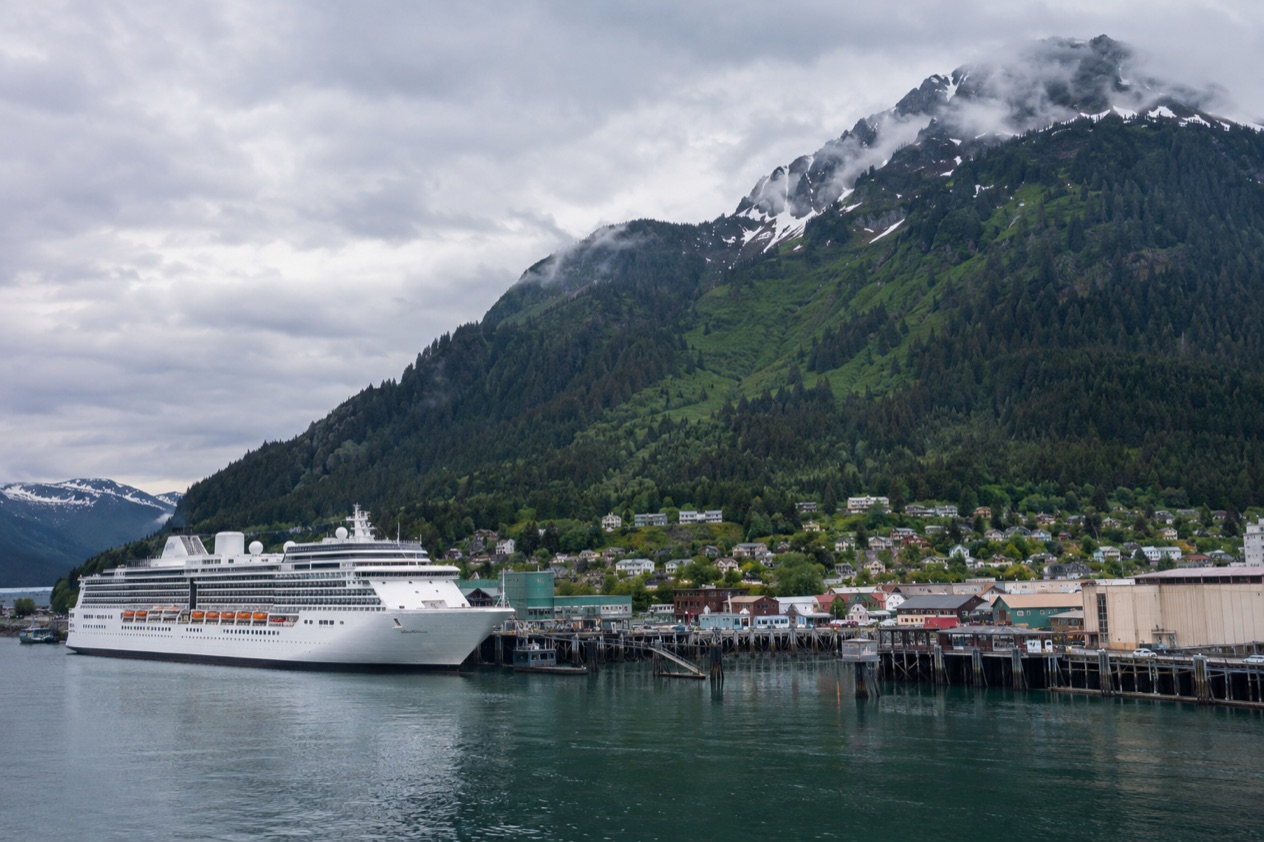
How do cruise ships reach Sitka?
Ships reach Sitka by sea, because the town sits on Baranof Island and can be reached only by air and by water. There is no road to it from anywhere else in Alaska, which gives a cruise call a particular feel: you arrive the way the town has always been approached, from the water, with forested slopes rising straight from the shore.
Cruise passengers land at Old Sitka Dock. Harrigan Centennial Hall is the natural starting point for the day, since the town’s main sights are gathered around the center and you can plan the rest of your hours from there.
| Link | Detail |
|---|---|
| Old Sitka Dock to Harrigan Centennial Hall | Free shuttle bus, about 15 minutes |
| Access to Sitka | Air and sea only |
| Alaska Marine Highway ferries | Year-round passenger and vehicle service |
The shuttle into town
The shuttle is the link between the dock and the downtown streets, and it costs nothing. It drops you at Harrigan Centennial Hall, a community hall in the middle of town, so you step off already within reach of the waterfront streets, shops and historic buildings.
Because the dock is separate from the town, think of the shuttle as the start of your day rather than a detour.
Ferries and the wider picture
Not everyone arrives on a cruise ship. Alaska Marine Highway ferries serve Sitka year-round for passengers and vehicles, which makes the town part of the Inside Passage network of coastal routes. For a cruise traveler this simply explains why the harbor feels like a working town and not only a tourist stop.
Sitka’s oceanic climate is worth keeping in mind as you step off the ship. Rain is abundant here, and the town sees a great deal of it over a year, so the damp air on the dock is entirely typical. The mean annual temperature is mild by Alaska standards, with the warmest month, August, averaging well above the chill of January.
| Climate in Sitka | Value |
|---|---|
| Average annual precipitation | 131.74 inches |
| Average seasonal snowfall | 33 inches |
| Mean annual temperature | 45.3 °F |
| Coldest month mean (January) | 36.4 °F |
| Warmest month mean (August) | 57.2 °F |
What is within reach of the landing?
Once the shuttle leaves you at Harrigan Centennial Hall, downtown Sitka offers a cluster of historic sites, a national park unit and a wildlife stop, all tied to the story of the town. The Russian and Tlingit threads run through nearly everything you see, and the town has 22 buildings and sites listed in the National Register of Historic Places.
Russian Bishop’s House
The Russian Bishop’s House stands at 501 Lincoln Street, a historic house museum and National Historic Landmark built in 1841 to 1843. It was the home and administrative center of Ivan Veniaminov, the first Bishop of Alaska, and parts of it later served as a schoolhouse. The National Park Service restored it, and it is now a unit of Sitka National Historical Park.
Inside, museum exhibits show Russian activities in Alaska, and the furnished second floor lets you see how the household was arranged. The house is open to the public on ranger-guided tours, so you move through it with a guide who can explain what the rooms were used for.
Sitka National Historical Park
Sitka National Historical Park is a protected area in town and Alaska’s oldest national park unit. Its visitor center displays many artifacts that are owned by Tlingit clans and are still used for ceremonial purposes, a reminder that these are living objects and not only museum pieces.
Outside, the park gives you a temperate rain forest of towering spruce and hemlock, tidelands where sea stars and crabs can be found, and Kaasdahéen, the Indian River. The totem pole collection has an unusual story of how it came to be, and there are hiking trails in and around the park. Kids of all ages can become Junior Rangers.
Fortress of the Bear and the Alaska Raptor Center
Two wildlife stops round out the town. Fortress of the Bear is a bear sanctuary in Sitka, and the Alaska Raptor Center is a sanctuary in the Tongass National Forest that takes in and releases birds each year. Visitors can support the center by volunteering, donating, adopting a raptor or shopping.
| Site | Open |
|---|---|
| Fortress of the Bear (summer) | Daily 9AM–5PM |
| Fortress of the Bear (winter) | Friday–Saturday 10AM–3PM |
| Russian Bishop’s House | Ranger-guided tours |
The Ride bus
Sitka also has a local bus, The Ride, with three lines named Green, Red and Blue. It operates Monday to Friday from 6:30AM to 6:30PM. It does not run on New Year’s Day, Memorial Day, Labor Day, Alaska Day, Thanksgiving Day or Christmas Day.
Which excursions leave from Sitka?
The excursions tied to Sitka in what we can describe are the ones built around its sites: the ranger-guided tour of the Russian Bishop’s House, time in Sitka National Historical Park, a visit to the Alaska Raptor Center and a stop at Fortress of the Bear. Each is centered on the town itself and its surroundings in the Tongass National Forest.
A history morning downtown
A natural pairing is the Russian Bishop’s House and the national park visitor center. The first gives you the Russian chapter through its exhibits and furnished upper floor, while the second shows the Tlingit side through clan-owned artifacts still used in ceremony. Together they cover the two cultures that shaped Sitka.
From the visitor center you can continue into the rain forest on the park’s trails, among spruce and hemlock, or down to the tidelands, where sea stars and crabs may be seen. The totem poles are part of the same grounds, and their collection has a story worth hearing from the rangers.
Wildlife stops
The Alaska Raptor Center and Fortress of the Bear offer a different kind of outing, built around animals. The raptor center is set in the Tongass National Forest and works with birds it admits and releases each year, so what you learn there is tied to real rescue work.
Sitka in autumn: Alaska Day
Sitka’s annual Alaska Day Festival is a week-long event with a reenactment ceremony of the signing of the Alaska purchase, interpretive programs and other activities. The first recorded festival was held in 1949. The Ride bus does not run on Alaska Day, which is worth remembering if your call falls then. The Greater Sitka Chamber of Commerce, founded on December 21, 1903 as the first Chamber of Commerce in Alaska, lists upcoming events on its website, a place to look for what is happening around your date.
Good to know before you go
Sitka’s weather is wet for much of the year, so the rain forest setting is part of the experience and the ground and air are often damp. Fortress of the Bear changes its hours between summer and winter, and The Ride bus skips several holidays, including Alaska Day, so a call near one of those dates changes what is open or running. The free shuttle from Old Sitka Dock to Harrigan Centennial Hall remains your simplest link to the center of town.
Sources
- Greater Sitka Chamber of Commerce (https://www.sitkachamber.com/), checked October 11, 2026
- Wikipedia, Sitka, Alaska (https://en.wikipedia.org/wiki/Sitka,_Alaska), checked October 11, 2026
- Wikivoyage, Sitka (https://en.wikivoyage.org/wiki/Sitka), checked October 11, 2026
- National Park Service, Sitka National Historical Park, plan your visit: things2do (https://www.nps.gov/sitk/planyourvisit/things2do.htm), checked October 11, 2026
- Alaska Raptor Center, Sitka (https://www.alaskaraptor.org/), checked October 11, 2026
- Wikipedia, Russian Bishop%27s House (https://en.wikipedia.org/wiki/Russian_Bishop%27s_House), checked October 11, 2026
To plan your stay
- Alaska Cruise in May: Port Weather, Whales and Glaciers, and the Cruise Lines
- Which Side of the Ship for an Alaska Cruise: Glacier Bay, Inside Passage Routes and Balcony Choices
- How Much Does an Alaska Cruise Cost?: Cruise Lengths, What's Included and Extras
- Alaska Cruise in June: Weather, Ports, Wildlife and Glaciers