
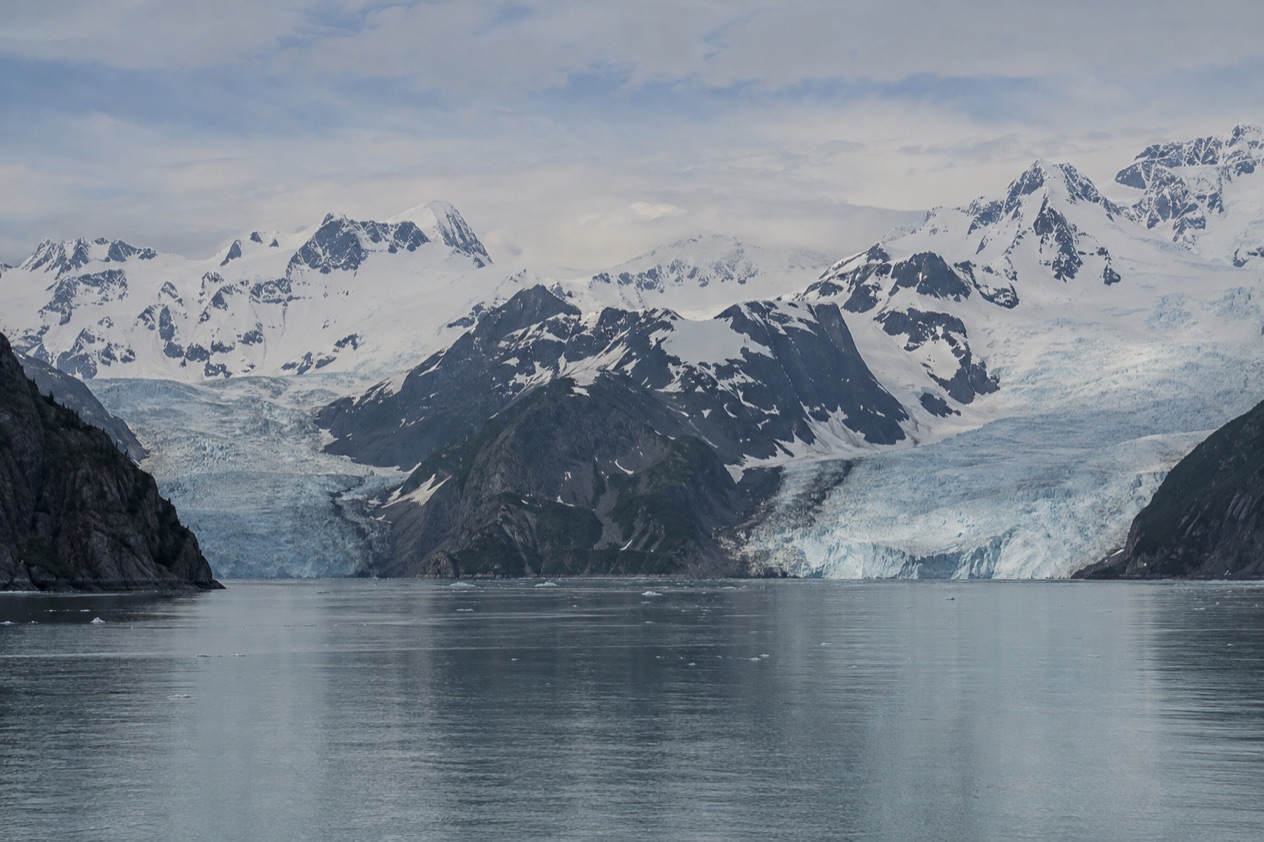
The ship slows, the engines drop to a murmur, and the walls of the fjord close in, hung with ice that spills down from the mountains toward the water. College Fjord is a visit made from the deck of a ship, in the northern part of Prince William Sound, and it suits travelers who want a day of tidewater ice and a good story to go with it.
Is visiting College Fjord worth it?
Yes, if glaciers are the reason you came to Alaska, and especially if you like a place that comes with a story. The fjord holds five tidewater glaciers, which end in the water, along with five large valley glaciers and dozens of smaller ones. Holland America describes it as a spot where you can see eight glaciers at once, so the visit is about looking from one ice face to the next rather than fixing on a single one.
What sets it apart from the other ice-filled corners of Prince William Sound is the naming. Most of the glaciers carry the names of renowned colleges, with women’s colleges on the northwest side and men’s colleges on the southeast side.
Other glaciers in the sound, such as Columbia, Surprise and Harriman, were named by the same expedition but do not border the fjord. Here the names make a tidy map you can read as you glide past: Vassar, Smith, Wellesley on one side, Harvard, Yale and Williams on the other.
It is not a town or a trailhead. You do not wander ashore, order lunch and linger. The visit belongs to a cruise or a glacier cruise in the sound, and its pleasure is slow looking, a camera, a warm layer and a spot at the rail.
What to see at College Fjord
The glaciers named for colleges
The list reads like a campus directory: Amherst, Barnard, Bryn Mawr, Downer, Harvard, Holyoke, Smith, Vassar, Wellesley, Williams and Yale, plus Baby, Crescent and others. Some are tidewater glaciers, with a face that meets the water, and others are valley glaciers that flow down from the high ground. Seen together they show how different ice can look in a single fjord, from broad blue-white faces to narrow tongues sliding between rock.
Look for the texture of the ice: crevasses, dirty bands of rock carried along the surface, and the pale blue where the ice is dense. Where a glacier reaches the water, you may hear a crack or a low rumble, and sometimes chunks break off into the fjord. That is a chance, never a promise, so keep watching a glacier face for a while rather than glancing and moving on.
The story of the names
The fjord was discovered in 1899 during the Harriman Expedition, and the glaciers were named then. The party included a Harvard professor and an Amherst professor, and they gave many glaciers the names of elite colleges. Princeton is missing from the map. According to Bruce Molina, author of Alaska’s Glaciers, the expedition members took great delight in ignoring it.
It is a small, human detail in a landscape that otherwise feels vast, and it is worth keeping in mind while you scan the shoreline. The expedition also named glaciers nearby, including Dartmouth, Barry and Cataract, so the sound carries a whole cluster of names from that same voyage.
Prince William Sound around you
The fjord sits in a convoluted coastline of islands and inlets, many holding tidewater glaciers, and most of the land around the sound belongs to the Chugach National Forest, the second largest national forest in the country. Montague, Hinchinbrook and Hawkins Islands form the principal barrier islands of the sound.
The sound has a long human history too. James Cook entered it in 1778 and first called it Sandwich Sound, before it was renamed for Prince William Henry. Valdez, Cordova, Whittier and the Alaska Native villages of Chenega and Tatitlek are the settlements on its shores. The sound also remembers hard moments, among them the 1964 Good Friday tsunami and the 1989 Exxon Valdez spill, which shaped how people here think about the water.
Hours, tickets and rules
College Fjord is not a gated site with a ticket window and posted hours. It is a stretch of water and ice that you reach as part of a cruise, so what you pay for is the voyage, and your itinerary decides when the ship is in the fjord. Princess lists College Fjord among the Alaska cruise ports it serves, alongside Skagway, Juneau, Ketchikan, Valdez, Icy Strait Point and Haines.
One itinerary that includes it is the Voyage of the Glaciers cruise, which travels from Anchorage (Whittier) to Vancouver, B.C. It stops in Ketchikan, Juneau and Skagway, and it takes in Glacier Bay National Park, Hubbard Glacier and College Fjord. The same cruise can be combined into a cruisetour with an overland stay at wilderness lodges and a ride on a glass-domed wilderness train.
For the glaciers on your day, the useful question is which line and which sailing you are on, since that is what puts you in the fjord. The details of what happens on board belong to your cruise operator.
How to get to College Fjord
Princess offers one-way cruises from the Whittier (Anchorage) cruise port, and its Voyage of the Glaciers cruise starts there on the way to Vancouver, B.C. Holland America also describes the fjord as part of its Alaska glacier experience.
Getting to Whittier by train
The Alaska Railroad’s Glacier Discovery Train runs from Anchorage to Girdwood, Whittier, Portage, Spencer and Grandview. It stops briefly at the resort town of Girdwood before continuing to Whittier, and at Whittier the train travels through a mountain tunnel and provides a connection for a glacier and wildlife cruise in Prince William Sound.
The train covers much of the same route as the Coastal Classic, with an added turn off the main line to Whittier and a turnaround point at Grandview. Onboard services include a Wilderness Café snack bar, baggage service in Anchorage, non-smoking cars and wheelchair access. The cruise connection is the point here, so match the train to your sailing before building a plan around it.
Other ways into the sound
Princess also sails round-trip Alaska cruises from San Francisco, Los Angeles, Seattle and Vancouver, and one-way cruises from Whittier. Valdez, the largest port on the sound and the southern terminus of the Trans-Alaska Pipeline System, is another port on the sound. Cordova and the villages of Chenega and Tatitlek sit along the same water.
When to visit College Fjord
The honest answer is that you visit when your cruise gets there. The fjord is part of specific itineraries, such as the Voyage of the Glaciers, and a service we cannot place in a month is not one to count on. Pick your sailing first, and the fjord comes with it.
What you can plan is the way you spend that stretch of the day. Choose your spot on deck before the ship enters the fjord, since the glaciers sit on both sides, the women’s colleges on the northwest and the men’s on the southeast. Stand on the side that suits the names you most want to read, then cross over once the ship has turned.
Light and weather will do much of the work. A gray, low sky can make the blue in the ice look deeper, and clear air lets you see the high valley glaciers feeding the fjord. Either way, the water is cold, so this is a visit for watching, not swimming. Wildlife is a chance, not a promise, so treat any bird or seal as a bonus.
Tips for your visit
Bring binoculars if you have them, a camera with a good zoom, and a layer you can put on and take off. The ice sits at the water’s edge, and the deck can feel cold even on a bright day. A guide to the glacier names, even a photo of the list on your phone, turns the fjord from a view into a game of matching names to faces.
Plan the visit as a part of a longer trip. Travelers pair it with other stops from the same sources: Glacier Bay National Park, where Princess is among the few cruise lines authorized to enter and park rangers come aboard to give commentary, Hubbard Glacier, and the ports of Ketchikan, Juneau and Skagway.
In Ketchikan, a state historical park has totem poles that teach about Alaskan culture. In Haines, the Chilkat Bald Eagle Preserve sees thousands of bald eagles gather along the riverbanks each fall.
Before or after the sound, the Glacier Discovery Train offers more ice on land. At Portage, passengers may disembark to visit the Alaska Wildlife Conservation Center, home to black and brown bears, moose, caribou, wood bison and more.
At Spencer Glacier, a 1.3-mile gravel path leads to Spencer Lake and views of the glacier, and rafting, hiking and kayaking around the glacial lake are offered as day trips. Staying on the train gives views of Bartlett Glacier and Trail Glacier along the Placer River Valley.
On the return, passengers from Grandview and Spencer may leave the train at Portage for a reserved motorcoach transfer to Alyeska Resort in Girdwood or Anchorage Depot, saving about 2 1/2 hours of travel time. Wheelchair access is listed among the train’s onboard services.
Good to know before you go
College Fjord is seen from a ship, so your costs and conditions come from the cruise you choose. The water is cold and the glaciers are for looking at, and the land around the sound is mostly part of the Chugach National Forest. Barry Arm, a nearby fjord in the sound, drew a scientific warning in 2020 about a landslide and tsunami risk, a reminder that this is an active landscape. Take the story with you: the fjord was named by an expedition that left Princeton out, and the ice still carries those names today.
Sources
- Wikipedia, College Fjord (https://en.wikipedia.org/wiki/College_Fjord), checked October 11, 2026
- Wikipedia, Prince William Sound (https://en.wikipedia.org/wiki/Prince_William_Sound), checked October 11, 2026
- Princess Cruises, Alaska cruises (https://www.princess.com/en-us/cruise-destinations/alaska-cruises), checked October 11, 2026
- Alaska Railroad, Glacier Discovery (https://www.alaskarailroad.com/ride-a-train/our-trains/glacier-discovery), checked October 11, 2026
- Holland America Line, Alaska cruises (https://www.hollandamerica.com/en/us/cruise-destinations/alaska-cruises), checked October 11, 2026
- Princess Cruises, Alaska wilderness lodges (https://www.princess.com/en-us/lodges), checked October 11, 2026