
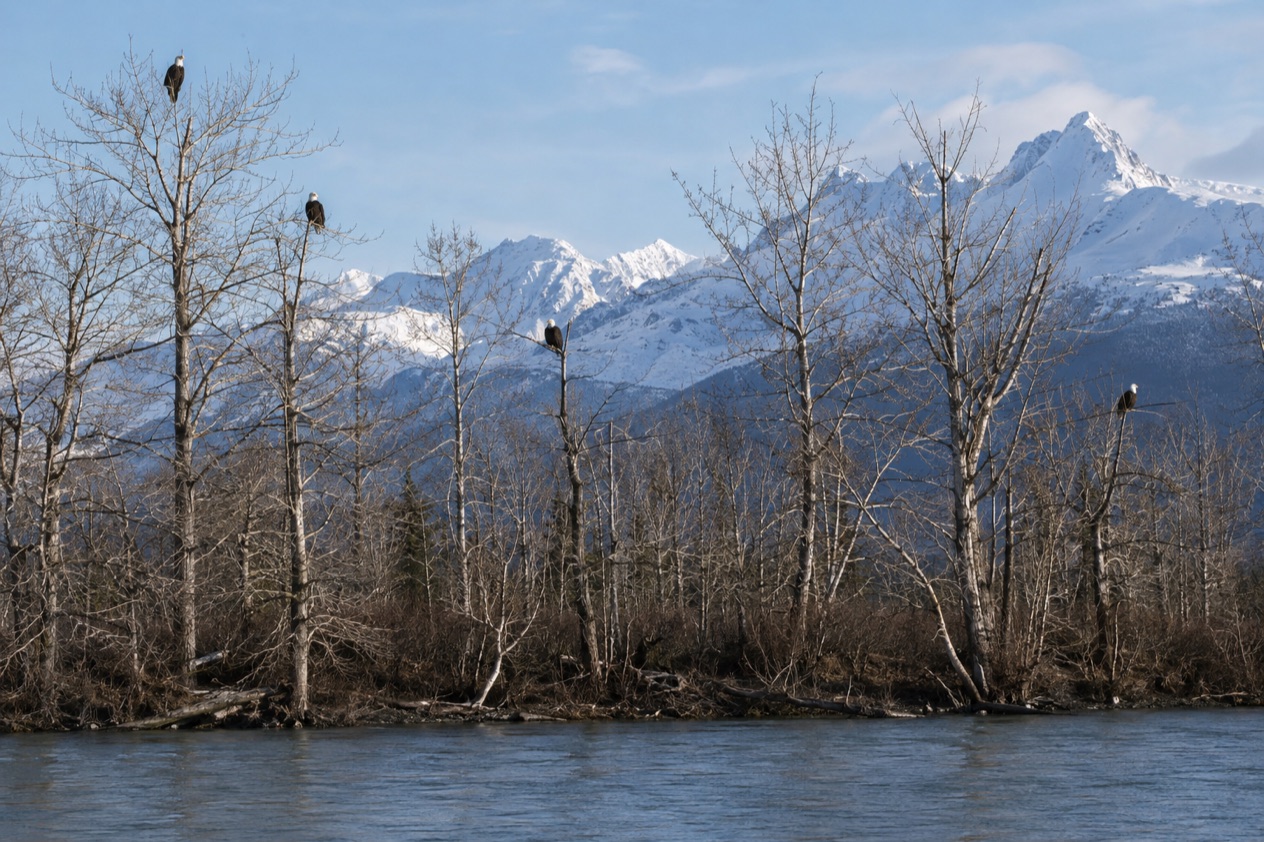
Along the Chilkat River outside Haines, bald eagles sit in bare cottonwoods like dark fruit, shifting on their branches, dropping to the gravel bars and squabbling over salmon carcasses. The first thing you notice is how many there are, and how little they seem to mind the people lining the road. The Alaska Chilkat Bald Eagle Preserve is a state park and wildlife refuge, and a visit here is about watching birds in their own working landscape, from the roadside and the river edge, mostly in the cold months.
Is visiting the Alaska Chilkat Bald Eagle Preserve worth it?
Yes, if you like watching wildlife more than ticking off sights, and especially if you are willing to come to Haines outside the summer rush. The preserve is for birders, photographers, slow travelers and anyone who wants to see a national bird in numbers that feel almost unreal.
What sets it apart from other eagle spots in Alaska is the scale of the gathering. Sitka has its Alaska Raptor Center, where you see eagles up close in a care setting, and Ketchikan is a gateway to Tongass National Forest, where eagles turn up among bears and wolves.
Here the birds are wild and simply everywhere, drawn to one river valley, and the preserve is home to the world’s largest concentration of bald eagles. Many tourists come to Haines in summer, but the eagle show belongs to the season from October to February, so the visit has a very different mood from the cruise-ship town of July.
The preserve itself is big, covering 49,320 acres, mostly along the Chilkat River with sections along the Klehini and Tsirku rivers. It is a place of river flats, mountains behind them and tall conifers on the slopes, and the eagles share it with the fish that feed them.
What to see at the Alaska Chilkat Bald Eagle Preserve
The Fall Congregation along the Chilkat River
The star of the preserve is the annual Fall Congregation, when up to 4,000 bald eagles have been observed along the river. Thousands gather along the riverbanks each fall, and the Haines area as a whole sees more than 3,500 of them between October and February. They perch in trees, stand on gravel bars, wheel overhead and squabble over the fish left in the river.
Look for the color differences. Watch the quiet moments too, when dozens sit hunched and still, and the sudden bursts when one takes off with a catch and others give chase.
Haines Highway viewing stretch
The Haines Highway from miles 12 to 18 is a popular viewing location for bald eagles in the preserve. Following that stretch, the road runs beside the river, and the birds often sit in the trees and on the flats within sight of the pullouts. It is an easy kind of wildlife watching in the sense that the birds come to you, though what you see depends on the day, the weather and the fish.
Binoculars or a long lens make a real difference here. Scan the tops of bare trees first, then the water’s edge and the gravel bars, and then the sky, because eagles are often in all three at once. Stop and wait a while at one spot before moving on, since the action tends to come in waves.
The Eagle Council Grounds
At 19 mile on the Haines Highway sit the Eagle Council Grounds, where much of the Bald Eagle Festival takes place. The name fits the scene, with eagles gathered in groups as if in conference. The festival is a five-day celebration in mid-November, and the same grounds are part of the story of the preserve in the weeks around it.
The year-round residents and what they eat
Between 200 and 400 bald eagles live in the preserve year-round, so a visit outside the peak still has a chance of eagles. In Southeast Alaska, fish make up about two thirds of the eagles’ year-round diet, and they prey largely on pink salmon and coho salmon, with sockeye more locally. That explains the river valley’s pull in fall, when spawning fish bring the birds together.
Eagles in the region nest mostly in Sitka spruce, followed by hemlocks, so tall old conifers are worth a glance as well. A big, messy stick nest high in a spruce is a good sign you are looking at eagle territory.
Hours, tickets and rules
The preserve is a stretch of river valley and highway rather than a single gate with a ticket booth, and what structures your day is the season of the eagles and the dates of local events. The eagle gathering belongs to the cold months, and the town’s other big dates fall at very different times of year.
| Event or site | When |
|---|---|
| Fall eagle gathering, Haines area | October to February |
| Bald Eagle Festival, mostly at the Eagle Council Grounds, 19 mile Haines Highway | Five days in mid-November |
| Southeast Alaska State Fair, Haines | Four days, last weekend of July |
Fort William H. The preserve is a state park and wildlife refuge, which tells you what kind of place it is: the birds come first, and you watch them on their terms.
How to get to the Alaska Chilkat Bald Eagle Preserve
Everything starts from Haines, a small port community on the shores of the Lynn Canal, the state’s longest fjord. The preserve lies near town and along the Haines Highway, and the viewing stretch is on that same road, from miles 12 to 18. The Eagle Council Grounds are at 19 mile.
By air, Haines Airport is on the Haines Highway, about 4 miles west of town. Its one air carrier is Alaska Seaplanes, serving Skagway and Juneau, and those are the only scheduled commercial flights.
By sea, the Haines State Ferry Terminal is about 4 miles north of town, and Haines is also a port of call for cruise ships, with about 20 calls per season, mainly from Holland America Line. During cruise ship dockings, a shuttle bus runs every 30 minutes from the Port Chilkoot Dock to several attractions and back.
By road, Haines is connected to the North American highway system by the Haines Highway, which travels northwest 39 miles to the Canadian border and continues to a junction with the Alaska Highway at Haines Junction, Yukon. That road is the only road access to Haines from the rest of the continent, so driving in means crossing through Canada.
When to visit the Alaska Chilkat Bald Eagle Preserve
The eagle season runs from October to February, and that is the answer for travelers. The annual appearance of the birds in the preserve occurs in those months, when Haines has the largest concentration of bald eagles in the world. Within that stretch, the Fall Congregation is the main draw, and mid-November adds the Bald Eagle Festival, five days of programs mostly at the Eagle Council Grounds.
If you come in summer, the eagles are still there. A few hundred live in the preserve all year, and you may see them around the river and the town. But the crowds of birds belong to the cold season, while summer belongs to the cruise visitors and, in late July, to the Southeast Alaska State Fair, four days of festivities on the last weekend of the month.
Time of day is up to you and the weather. Pick a spot along the highway, give it some time, and come back at a different hour if the first visit is quiet. Eagles shift with the light, the fish and the river, so a second look often shows something the first one missed.
Tips for your visit
Bring binoculars or a camera with a long lens, since the birds may be across the river or high in the trees. Plan to stay put rather than rush from stop to stop, because eagle watching rewards patience.
In town, Fort William H. Seward was Alaska’s first U.S. Army fort, built in 1902 in the gold rush era and declared a National Historic Landmark in 1978. Some of its structures are open to the public as businesses and restaurants, which makes it a natural place for a meal or a wander after the river.
Kroschel Wildlife Center, about 30 miles northwest of Haines on the Haines Highway, offers guided tours to see over 15 species of Alaskan wildlife, including grizzly bear, wolf, moose, lynx, fox, reindeer, porcupine, snowy owl and wolverine. It pairs well with a day of eagles for anyone who wants to see more animals in one outing.
Families will find that the eagles hold children’s attention best in short bursts, so a few stops along the highway work better than one long stand. Photographers should know the birds are often at their most active when the fish are, and that watching the whole scene, not just one bird, makes better pictures.
Good to know before you go
Haines is a small town, and the nearest hospital reachable by road is Whitehorse General Hospital in Whitehorse, Yukon, approximately 4.5 hours away. Haines Airport and the ferry terminal each sit a few miles from town, so plan your arrival and departure around them. The eagle season falls in the colder part of the year, so expect a winter-leaning trip rather than a summer one, and treat the birds as wild animals you watch from a respectful spot.
Sources
- Wikipedia, Chilkat Bald Eagle Preserve (https://en.wikipedia.org/wiki/Chilkat_Bald_Eagle_Preserve), checked October 11, 2026
- Wikipedia, Haines, Alaska (https://en.wikipedia.org/wiki/Haines,_Alaska), checked October 11, 2026
- Wikivoyage, Haines (https://en.wikivoyage.org/wiki/Haines), checked October 11, 2026
- Wikipedia, Bald eagle (https://en.wikipedia.org/wiki/Bald_eagle), checked October 11, 2026
- Princess Cruises, Alaska cruises (https://www.princess.com/en-us/cruise-destinations/alaska-cruises), checked October 11, 2026
- Holland America Line, Alaska cruises (https://www.hollandamerica.com/en/us/cruise-destinations/alaska-cruises), checked October 11, 2026
- Royal Caribbean, Alaska cruises (https://www.royalcaribbean.com/cruise-destinations/alaska-cruises), checked October 11, 2026
- Celebrity Cruises, Alaska cruises (https://www.celebritycruises.com/cruise-destinations/alaska-cruises), checked October 11, 2026
- National Park Service, Yukon-Charley Rivers National Preserve, plan your visit: publicusecabins (https://www.nps.gov/yuch/planyourvisit/publicusecabins.htm), checked October 11, 2026