
At first light along the Belize River, a deep, rolling roar rises from the treetops and carries across the water. It is a howler monkey troop announcing the morning, and locals call these animals baboons. Belize packs jaguar forest, wide lagoons full of wading birds and a zoo of native animals into a small country, and each of them rewards a trip of its own.
What wildlife can you see in Belize?
You can see an unusually wide range of animals in Belize: howler monkeys, tapirs, five species of wildcat, crocodiles, snakes and almost 600 species of birds. Wildlife here is defined in law as any undomesticated mammal, reptile, bird or amphibian, along with its eggs, nests and parts. The Forest Department enforces that protection. The habitats are just as varied, from the northern Yucatan area to wetlands, moist broadleaf forest and small cayes along the coast.
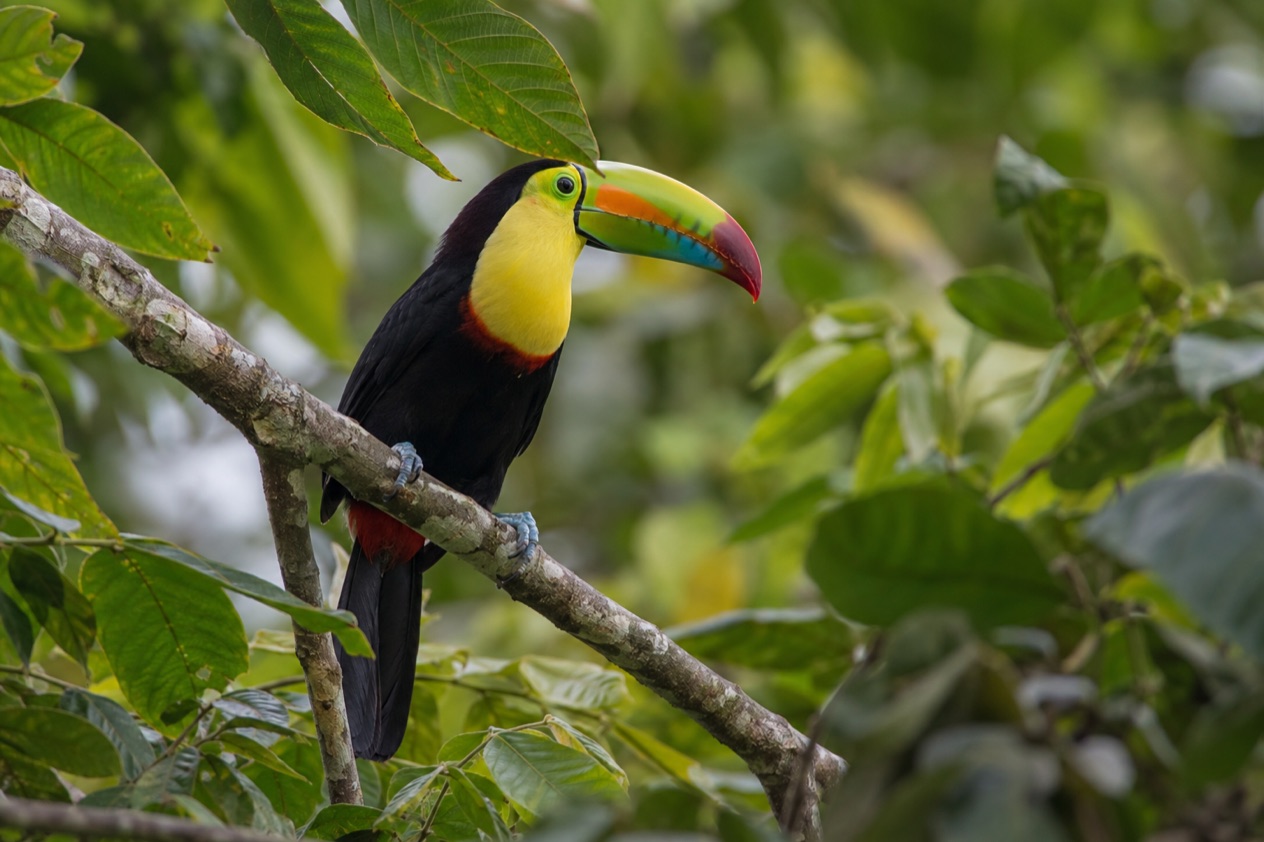
The national bird is the keel-billed toucan, with its huge rainbow-striped bill, and the national animal is the Central American tapir. Both are worth looking for, though the tapir is a shy forest animal that most travelers meet at the zoo rather than on a trail. Jaguars, pumas, ocelots, margays and jaguarundis make up the five wildcats, and the jaguar is the one that gives Belize its reputation among wildlife lovers.
Birds and the birding calendar
Birders of every level find something here, because the habitats change so quickly from one stretch of road to the next. Mangrove edges, lagoon shallows, broadleaf forest and coastal cayes each have their own cast of species, so a single trip can add many birds to a life list.
Several counts give the calendar some shape. The Central American Waterbird Census runs between mid-January and mid-February at five locations.
The Great Backyard Bird Count follows in mid-February as a four-day event that invites watchers of all ages to build a real-time snapshot of bird populations. In October and November, the Urban Bird Watch takes place on weekends at twelve locations, making those months a good time to join in.
Lagoons, wading birds and the dry season
The Crooked Tree Lagoon system is considered one of the best birding destinations in Belize, especially in the dry season. As the water recedes, fish concentrate in the shallows, and wading birds gather to feed on them, among them the Jabiru Stork. The scene is quiet and patient: long legs, still water and the occasional sudden strike.
If you come outside the dry season, the lagoon still shows its character as the largest wetland in Belize, with open water, marsh edges and a wide sky. Pair it with a visit to the baboon sanctuary on the Belize River for a trip centered on birds and monkeys.
Howler monkeys and forest cats
The Yucatán black howler monkey is the animal people most often hear before they see. Its call is a dense, throaty roar that can fill a whole valley. Along the lower Belize River, troops move through the riverside trees, and the same landscape supports Baird’s tapir, jaguar, puma and Morelet’s crocodile.
In the south, Cockscomb is the jaguar’s stronghold. You may see tracks, scat or the shape of a forest that feels made for a big cat, while an actual sighting remains a matter of chance. Go for the whole forest, its birds, its streams and its quiet, and treat a jaguar as a bonus.
Where are the reserves and sanctuaries?
The main wildlife destinations sit in the center and south of the country and on the wetlands north of Belize City: Cockscomb Basin, Crooked Tree, the Community Baboon Sanctuary and the Belize Zoo. Each protects something different, and together they give a rounded picture of Belizean wildlife.
Cockscomb Basin Wildlife Sanctuary
Cockscomb Basin Wildlife Sanctuary lies in the Stann Creek District of south-central Belize, off the Southern Highway about 20 miles south of Dangriga Town. It was designated a wildlife sanctuary in 1984 and established in 1986 as the first protected area for the jaguar, which is why it is recognized internationally as the world’s first jaguar preserve. The Belize Forest Department and the Belize Audubon Society operate it.
The name comes from the Cockscomb Mountain ridge, whose outline resembles a rooster’s comb and can be seen from the coastal plain. The sanctuary covers two adjacent basins: the West Basin drained by the Swasey Branch and the East Basin, the upper watershed of South Stann Creek.
The entrance fee is collected at Maya Center Village, and the protected area itself is six miles down an unpaved road. A local taxi from Maya Center makes that run.
| Site | Admission (non-nationals) | Admission (Belizeans) |
|---|---|---|
| Cockscomb Basin Wildlife Sanctuary | BZD 10 | BZD 2.50 |
| Crooked Tree Wildlife Sanctuary | BZD 8 | BZD 2 |
Crooked Tree Wildlife Sanctuary
Crooked Tree lies 33 miles north of Belize City and straddles the boundary between the Belize and Orange Walk districts. It was gazetted on December 8, 1984, as the first wildlife sanctuary designated by the Government of Belize, and in 1998 it became the country’s first Ramsar site. It protects an estimated 37,985 acres of wetland.
What you come for is the water and the birds that live on it. The lagoon system is the largest wetland in Belize, and its shallows, marsh and surrounding trees give wading birds room to feed and nest. It suits anyone who likes to sit still and watch.
Community Baboon Sanctuary
The Community Baboon Sanctuary follows the lower Belize River in the Belize District, about 31 miles northwest of Belize City. It was set up in 1985 to conserve the Yucatán black howler monkey, through a partnership between the American primatologist Dr. Robert Horwich and Fallet Young, a landowner in Bermudian Landing. It spans over 12,800 acres.
What makes it unusual is that it is run by the people who live there. Landowners from seven villages in the Belize River Valley (Bermudian Landing, Big Falls/St. Paul’s Bank, Willows Bank, Double Head Cabbage, Isabella Bank, Scotland Halfmoon and Flowers Bank) manage their private land through a voluntary pledge system. Alongside the howlers, the sanctuary supports tapir, jaguar, puma, Morelet’s crocodile and over 200 bird species.
The Belize Zoo
The Belize Zoo and Tropical Education Center sits at Mile 29 on the Western Highway, 29 miles west of Belize City. It opened in 1983 and moved to its current site in 1991, and it covers 29 acres.
More than 175 animals of about 48 species live here, all native to Belize. They are former pets, donated animals, injured animals that were rehabilitated, animals born at the zoo or transfers from other zoological facilities.
This is where you can see the tapir up close, along with all five Belizean wildcats and almost 20 species of native mammals. Snakes on display include the imperial boa, the tropical ratsnake and the Fer-de-lance, and the zoo cares for 17 bird species, while almost 280 wild species have been reported on the grounds.
Night tours can be arranged to watch crepuscular and nocturnal animals such as tapirs, jaguars, margays, kinkajous, crocodiles, peccaries and howler monkeys. There is also an encounter inside the jaguar exhibit with Junior Buddy, a trained jaguar.
How can you visit responsibly?
Visit responsibly by treating the law as the baseline and the sanctuaries as the guide: stay with places that protect habitat, pay the entrance fees that support them and leave animals, eggs and nests where you find them. Belizean law defines wildlife broadly, so eggs, nests and parts are covered along with live animals.
Choose places that protect habitat
Forest cover in Belize declined from 74.4% in 1980 to 60.3% in 2014, and that loss is the background to every reserve described above. Entrance fees at Cockscomb and Crooked Tree put money and attention behind land that stays wild.
The National List of Critical Native Species includes 11 critically endangered species, 31 endangered species and 63 vulnerable species. The Wildlife Conservation Program of the Forest Department is responsible for meeting Belize’s obligation to maintain its threatened species, under the Convention on Biological Diversity.
Keep wild animals wild
Parrots show why this matters. In 2016, the government closed the amnesty period for registering parrots already in captivity and began prohibiting the ownership of newly captured baby parrots under the National Captive Wildlife permit program. The message to travelers is simple: never buy or take a wild animal, an egg or a part of one.
The Belize Zoo shows the other side of the story. Its animals are rescued, donated or born there, so a visit gives a close look at native species without anything having been taken from the forest.
Join the counting
Birdwatching can be more than a hobby here. The Urban Bird Watch on weekends in October and November, the Central American Waterbird Census from mid-January to mid-February and the Great Backyard Bird Count in mid-February all turn visitors’ sightings into data about bird populations. Joining one is a direct way to help.
Good to know before you go
The U.S. State Department rates Belize Level 2, “Exercise increased caution”, because of crime, and says the south side of Belize City has historically had the highest concentration of violent crime.
The Atlantic hurricane season runs from June 1 to November 30, so wildlife trips during those months fall inside it. Entrance fees for the sanctuaries are quoted in Belize dollars (BZD), so keep that in mind when you plan what to carry. Cockscomb’s last six miles are unpaved, and the sanctuary is open from 8:00am to 4:30pm.
Sources
- Wikipedia, Wildlife of Belize (https://en.wikipedia.org/wiki/Wildlife_of_Belize), checked October 11, 2026
- Belize Audubon Society, Cockscomb Basin Wildlife Sanctuary (https://belizeaudubon.org/cbws/), checked October 11, 2026
- Belize Audubon Society, Crooked Tree Wildlife Sanctuary (https://belizeaudubon.org/ctws/), checked October 11, 2026
- Wikipedia, Community Baboon Sanctuary (https://en.wikipedia.org/wiki/Community_Baboon_Sanctuary), checked October 11, 2026
- Wikipedia, Belize Zoo (https://en.wikipedia.org/wiki/Belize_Zoo), checked October 11, 2026
- The Belize Zoo, The animals (https://www.belizezoo.org/the-animals/), checked October 11, 2026
- Wikipedia, Cockscomb Basin Wildlife Sanctuary (https://en.wikipedia.org/wiki/Cockscomb_Basin_Wildlife_Sanctuary), checked October 11, 2026
- Belize Audubon Society, Birding (https://belizeaudubon.org/birding/), checked October 11, 2026
- U.S. Department of State, Belize Travel Advisory, Level 2, March 11, 2026 (https://travel.state.gov/), checked October 11, 2026
- NOAA National Hurricane Center, Climatology (https://www.nhc.noaa.gov/climo/), checked October 11, 2026