
Long before you spot a monkey, you hear one. A deep, rolling roar drifts out of the treetops along the Belize River, a sound far bigger than the animal that makes it. The Community Baboon Sanctuary is a stretch of riverside forest and farmland where local families protect the black howler monkey, which Belizeans call the baboon. It is a visit about wildlife and about the people who chose to share their land with it.
Is visiting the Community Baboon Sanctuary worth it?
Yes, if you want to see wildlife in the setting where people and animals actually live side by side, and especially if monkeys in the canopy are the draw. The sanctuary suits travelers who like a village visit as much as a wildlife outing, and anyone curious about how conservation works when it is run by the neighbors rather than by a park authority.
What sets it apart from the other nature stops in the Belize District is its structure. There is no single fenced reserve here. The sanctuary is a patchwork of private land belonging to families in seven Belize River Valley villages, and each landowner has pledged voluntarily to protect the forest corridors the monkeys use.
You are walking through working communities, with gardens, farms and riverbanks, and the monkeys travel along the same strips of trees. The idea began with an American primatologist and a local landowner, and it has become a model that other places study.
It also differs from the zoo and wildlife sanctuaries elsewhere in the district. Crooked Tree is known for its lagoons and birds, and the Belize Zoo shows animals in enclosures. Here the monkeys are wild and move freely, so a sighting is a chance, never a promise. Some visitors are rewarded within minutes, others spend longer listening and scanning the leaves. That uncertainty is part of the appeal.
What to see at the Community Baboon Sanctuary
The main attraction is the monkey, but the visit is wider than a single animal. The sanctuary offers guided tours, wildlife viewing and cultural activities across its participating villages, so a day can mix forest walking, riverside scenery and village life.
The black howler monkeys
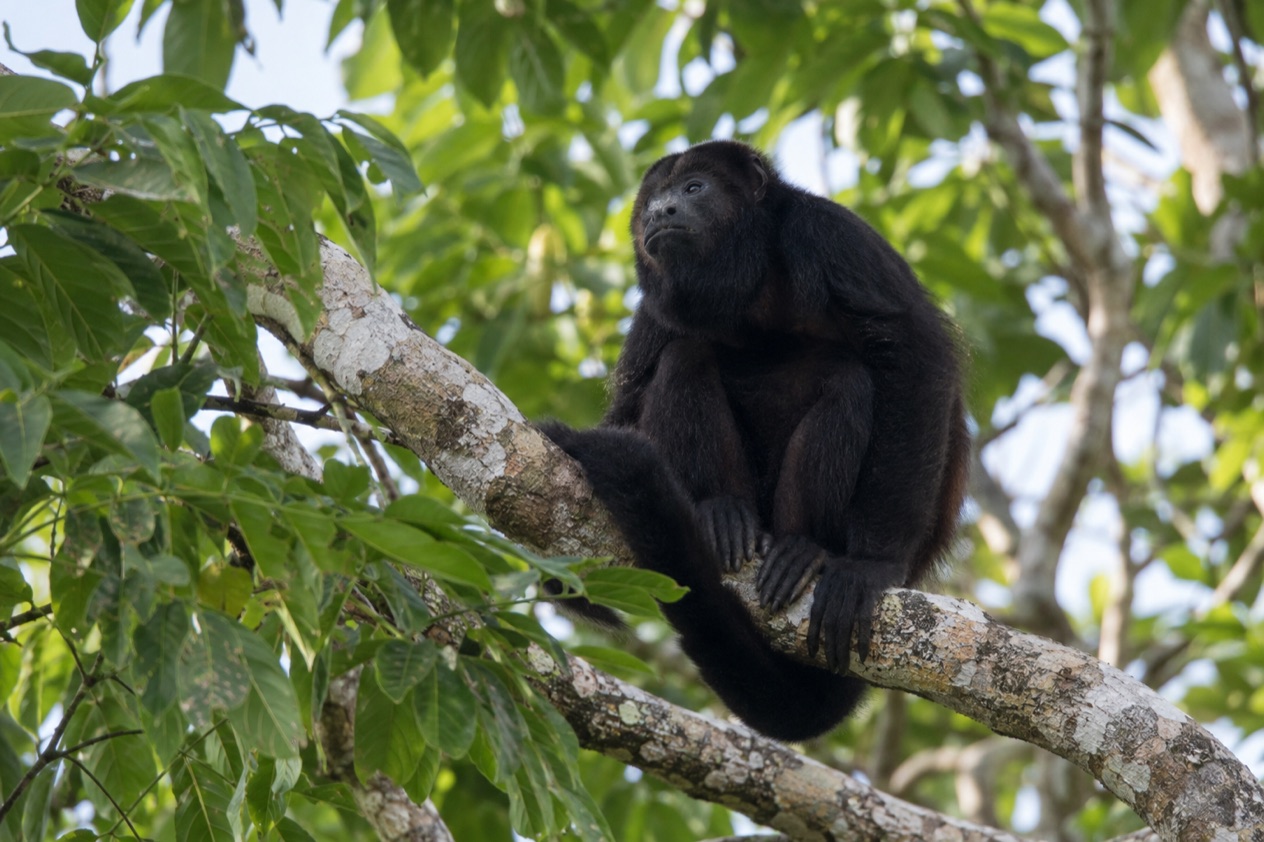
The Yucatán black howler is the reason the sanctuary exists. These are heavy, dark-furred monkeys that live in family groups high in the trees and feed mostly on leaves and fruit. They tend to move slowly, often resting for long stretches, which helps when you are trying to pick one out against a wall of green. Males are the ones that roar, and the sound can carry a long way through the forest.
The population has grown a great deal since the sanctuary began, from roughly 800 animals to more than 3,500 by 2017. Some family groups were later moved to the Cockscomb Basin to repopulate that area, so monkeys born here helped restore a forest far to the south.
When you look up and find a troop, you are looking at the result of that long effort. Keep your eyes on the upper branches and your ears open, because the roar often tells you where to look before your eyes do.
Bermudian Landing and the seven villages
Bermudian Landing is the village most closely tied to the sanctuary’s story, since it was the home of the landowner who started the project with the primatologist. The other participating villages are Big Falls/St. Paul’s Bank, Willows Bank, Double Head Cabbage, Isabella Bank, Scotland Halfmoon and Flowers Bank. Their names alone sketch a map of the river valley, and they give the visit a sense of travel from one riverside community to the next.
The cultural side of a visit comes from these places. Expect small settlements rather than resort towns, with houses set among fruit trees and pastures, and the river never far away. It is a quiet, rural Belize, a world away from the cayes, and the people you meet are often the same families who made the pledge to protect the forest.
The Women’s Conservation Group
The Community Baboon Sanctuary Women’s Conservation Group was formed in 1998 to support the sanctuary’s management and to bring local communities, women in particular, into its work. In 2017 it received the United Nations Equator Prize for combining conservation with poverty reduction and sustainable development.
For a visitor, this matters because it explains who benefits when you come. The sanctuary is meant to give local households a reason to keep the forest standing, and tourism is part of how that works. Meeting the people behind it, and hearing how a protected area can also support a village, is often what travelers remember along with the monkeys.
Birds and other wildlife along the river
Beyond the howlers, the sanctuary’s forests and riverbanks support Baird’s tapir, jaguar, puma and Morelet’s crocodile, along with more than 200 bird species. The big cats and the tapir are elusive animals and a sighting should not be expected. Birds are the more realistic reward, and the edges of the forest and the water along the Belize River are good places to watch for them.
The Belize River is the longest river in the country, and here it gives the area its character, with slow brown water and tall trees leaning over the banks. Looking for a crocodile on the bank or a bird on a branch pairs naturally with the search for monkeys, and it makes the walk worth taking even when the troop is quiet.
Hours, tickets and rules
The Community Baboon Sanctuary is not a single gated site with one front desk. It spreads across private land in seven villages and is run by the community through a voluntary pledge system, so a visit is built around guided tours and the activities the villages offer rather than a turnstile and a ticket booth.
That shapes how you think about the day. The forest belongs to local families, and the monkeys are wild, so there is no feeding schedule or show to arrive for. What you do is walk, watch and listen with someone who knows the territory, then spend time in the villages that make up the sanctuary.
Because the land is private and shared, treat every path as a favor from the owner. Stay with your guide, keep to the routes you are shown, and leave fruit trees, fences and crops as you found them. The same courtesy applies to the animals, which are best watched from below and at a distance.
How to get to the Community Baboon Sanctuary
The sanctuary lies along the lower Belize River in the Belize District, about 31 miles northwest of Belize City. That makes Belize City the natural starting point on the map, since it is the capital of the district and the largest city in the country.
The villages that make up the sanctuary sit along the river, with Bermudian Landing among them. Scotland Halfmoon, Flowers Bank, Isabella Bank, Double Head Cabbage and Willows Bank are all named on the district’s list of mainland villages, so they are part of the same Belize River Valley landscape you are heading into rather than isolated outposts.
If you are staying on Ambergris Caye or Caye Caulker, the two main tourism areas of the district, the sanctuary is a mainland excursion, away from the sea and into river country. The district stretches from those islands to the mainland villages, so the contrast between a day on the water and a day under the forest canopy is part of what makes the trip appealing.
The Belize Zoo, listed as 30 miles west of Belize City, and the Crooked Tree and Monkey Bay Wildlife Sanctuaries are other nature stops within the same district. Reading them together gives you a sense of where the sanctuary sits among the places that draw wildlife lovers inland.
When to visit the Community Baboon Sanctuary
The monkeys live here all year, so there is no month when they leave, and the sanctuary can be visited in any season. What changes is the feel of the landscape and the rest of your trip, rather than the presence of the animals themselves.
One date to keep in view is the Atlantic hurricane season, which runs from June 1 to November 30. A trip in those months falls inside it, and a tropical system can bring heavy rain to the river valley as it can to anywhere in Belize. Outside those months you are outside the official season.
As for the time of day, howler monkeys are known for their roars, which are often heard around dawn and carry across the forest. If you are staying nearby, listening for that sound is one of the most atmospheric ways to begin a day. Later, the animals tend to rest in the trees, which can make them easier to find than you might expect, since they are not constantly on the move.
If you are timing the visit around a longer Belize itinerary, it pairs well with days spent elsewhere in the district. Mixing a morning in the river villages with time on the cayes gives the trip a balance between forest and reef.
Tips for your visit
Bring what you would for any walk in the tropical forest: shoes you do not mind getting dirty, a hat, and water. Binoculars make a real difference here, because the monkeys and the birds are often high above you and a pair brings them close without disturbing them.
A camera with a good zoom helps as well, though the best moments can come when you simply stop and watch. A howler troop shifting from branch to branch, or a mother with a young one clinging to her, is worth more of your attention than a photo of it. Go slowly and quietly, since noise from the ground only makes the animals harder to see.
Plan the visit as a chance to learn as well as to look. The tours offered across the villages include cultural activities, and talking with the people who live here adds the story behind the forest: how a community decided to protect a species, and what that has meant for the families involved.
Combine the sanctuary with other nature stops in the district if you have time. The Belize Zoo, the Crooked Tree and Monkey Bay Wildlife Sanctuaries and the Maya ruins of Altun Ha are all in the Belize District, and together they make a varied theme of wildlife and ancient history. For families, the appeal is the chance to see wild monkeys in their own trees, and children often enjoy the roars.
Good to know before you go
The U.S. State Department rates Belize Level 2, “Exercise increased caution”, because of crime, and says the south side of Belize City has historically had the highest concentration of violent crime.
The sanctuary sits in the Belize District, which observes Central Standard Time, UTC -6. If your trip falls between June and the end of November, remember that this is the Atlantic hurricane season, and keep your plans flexible. Beyond that, the visit is about slowing down, listening for the roar in the trees and spending time in villages that have made the monkeys their shared project.
Sources
- Wikipedia, Community Baboon Sanctuary (https://en.wikipedia.org/wiki/Community_Baboon_Sanctuary), checked October 11, 2026
- Wikipedia, Belize District (https://en.wikipedia.org/wiki/Belize_District), checked October 11, 2026
- U.S. Department of State, Belize Travel Advisory, Level 2, March 11, 2026 (https://travel.state.gov/), checked October 11, 2026
- NOAA National Hurricane Center, Climatology (https://www.nhc.noaa.gov/climo/), checked October 11, 2026