
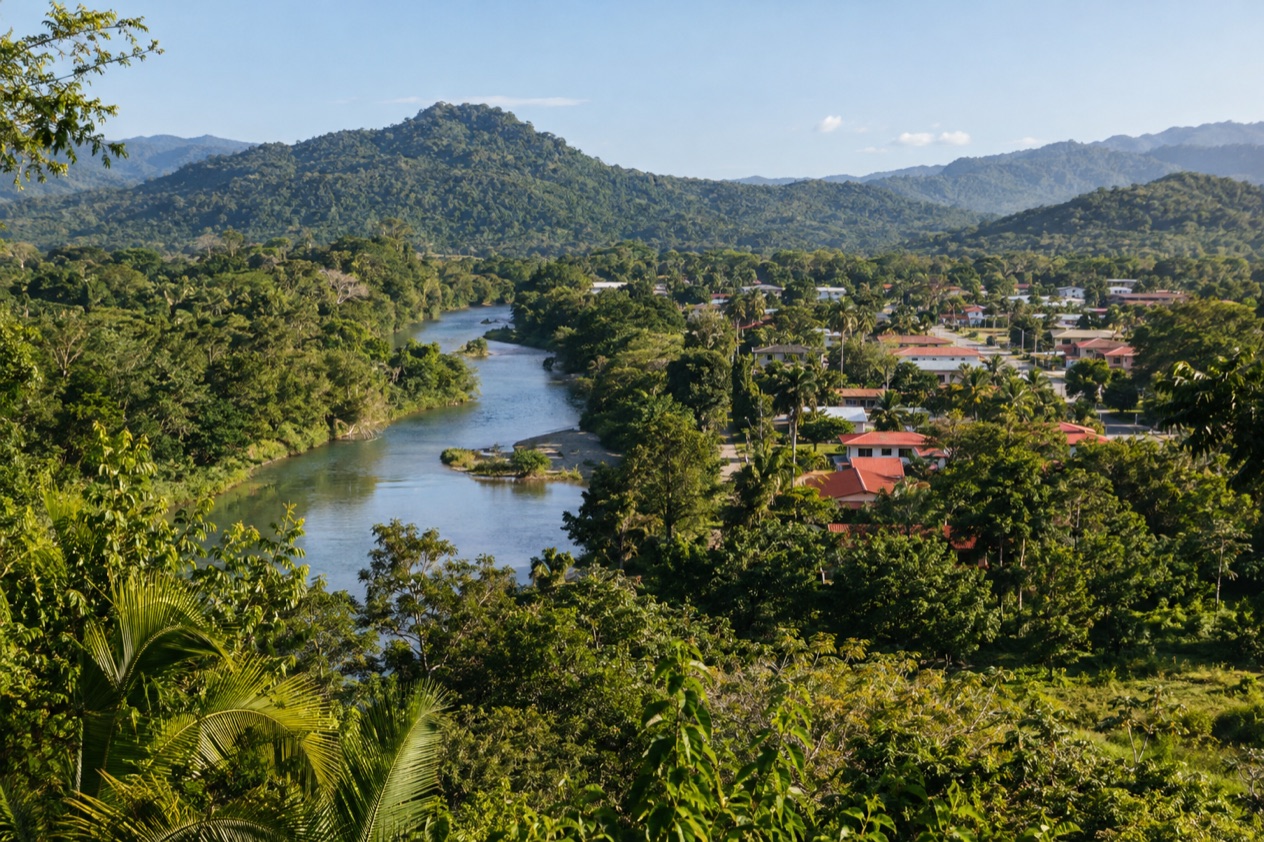
In March, the hills around San Ignacio turn dry and golden at the edges, and the Saturday market by the Macal River is full of people choosing mangoes, tomatoes and tortillas still warm from the comal. The days stretch a little longer, and the Maya temples stand over a landscape that glows in the sunshine. It is a month for ruins, river outings and long evenings on a porch in the Cayo District.
What is the weather like in San Ignacio and the Cayo District in March?
March is warm, bright and mostly dry, with daylight growing a few minutes every day and rain that shows up only now and then. The days feel like the start of the hot stretch of the year.
| Month | Daylight on the 15th |
|---|---|
| February | 11 hours 38 minutes |
| March | 12 hours 5 minutes |
| April | 12 hours 35 minutes |
In Belize City, highs average about 86°F in March, with lows in the low 70s and few days of measurable rain. That gives a general sense of the season along this part of the country, and the Cayo District follows the same dry-season calendar, with hills, river valleys and forest that catch the sun and stay green near the water.
What this means on the ground is simple. Long, light-filled days suit the Maya sites and the rivers, and the extra daylight since February gives you room for an early start and a late return without hurrying. The forest is still green along the riverbanks, though the open pastures and hillsides look drier than they do in the rainy months, and the dust on the roads is part of the season.
Dress for sun first. Light cotton or quick-drying shirts, a hat, and sunscreen make more difference than any rain jacket, though a thin shell is useful for the odd shower. Evenings in town are pleasant for sitting outside with a cold Belikin or a glass of fresh lime juice, and a light layer is enough once the sun is down.
What to do in San Ignacio and the Cayo District in March
The month has one public holiday that matters here: National Heroes and Benefactors Day, on March 9. It began as Baron Bliss Day, in honor of an Englishman who left his fortune to what was then British Honduras.
Expect closed offices and banks and a slower town, with families out on the riverbanks and in the parks. Regattas and horse races are the traditional way the day is marked in Belize, so ask locally what is on in town.
Beyond the holiday, March is a month for being outdoors. The dry season is when the Maya sites of the Cayo District are most comfortable to explore, when the rivers are clear and when a long day away from town does not have to end early. The Saturday market in San Ignacio is the weekly event, with produce, street food, crafts and a crowd of locals, Mennonite farmers and travelers.
Xunantunich and the Mopan River
Xunantunich sits on a ridge above the Mopan River, very close to the Guatemala border, and its core holds six plazas surrounded by more than 26 temples and palaces. The tallest structure rises above the forest canopy and the river valley.
The site is about 70 miles west of Belize City, in the Cayo District. Walking between the plazas, you notice the shade of the big trees, the carved friezes and the birds in the canopy. March mornings give the best light for photographs, and the grass of the plazas is dry underfoot. Bring water and a hat, because the open plazas have little cover.
Cahal Pech, Caracol and the other Maya sites
Cayo holds several pre-Columbian Maya sites besides Xunantunich: Caracol, Cahal Pech, Actun Tunichil Muknal, Baking Pot, Lower Dover and El Pilar. Cahal Pech is the one that sits right at the edge of San Ignacio, a hilltop palace complex with courtyards you can wander between. Caracol lies deeper in the forest and is the one for travelers who want a longer day among big pyramids and howler monkeys.
El Pilar and Baking Pot are quieter, spread among trees and pastures, and suit those who like ruins with fewer people around. The dry weather of March means dusty tracks but few muddy surprises, and the forest sounds, from toucans to cicadas, make the walk part of the visit.
Market food, rivers and the Mennonite farm stands
Food in the Cayo District is built on what the farms bring in: stewed chicken with rice and beans, fry jacks at breakfast, tamales, johnnycakes, fresh cheese and peanuts. Mennonite farmers sell produce, cheese and baked goods in the region, and the Saturday market is the place to taste it all. Orange and lime juices, cacao and local honey are easy to find.
The Macal and Mopan rivers shape town life. Choose these for the green corridors along the banks, the iguanas on the branches and the sound of water, rather than for any promise of swimming.
Border life is part of the area too. Benque Viejo del Carmen, the westernmost town in Belize, sits right on the Guatemalan border across from Melchor de Mencos, and its streets show the Spanish-speaking side of Cayo, with bakeries, small shops and a different rhythm from San Ignacio.
A two-day itinerary for San Ignacio and the Cayo District in March
Day 1 starts at Xunantunich while the light is soft and the plazas are quiet. Climb through the site, take in the views over the Mopan River valley and the nearby border hills, then head back toward town for a late lunch of stew chicken or a plate of tamales at a simple local spot.
In the afternoon, walk the center of San Ignacio, with its shops, bakeries and the river nearby, and rest through the hottest hours. Come evening, sit outside for dinner and watch the town slow down.
Day 2 begins with Cahal Pech on its hill above town, which is close enough to visit early, before the heat builds. Spend the middle of the day around the market or on a river outing, with fresh juice and a light lunch in town. If a shower or a gray hour moves in, use it for browsing craft shops, cafés and the bakeries.
Finish the day with a slow dinner, perhaps tasting local cacao, honey or a Belizean rum, and enjoy the evening air. A late sunset gives you time for one more stroll through the streets before the night settles over the valley.
Is San Ignacio and the Cayo District busy in March?
March is a lively month in the Cayo District, because the dry season brings travelers to the ruins and rivers, but it is not a month of crowds everywhere. Popular sites like Xunantunich draw more visitors in the morning, while quieter ones such as El Pilar and Baking Pot stay calm.
The holiday on March 9 can make the town feel busier for a day, with locals out and about, and many offices closed. Around Holy Week, which moves each year and sometimes falls in late March or April, local families travel and rooms may be harder to find. It is a good habit to book early for those holiday weeks, and a little later for the quiet weeks around them.
Restaurants in San Ignacio are generally relaxed, and the market on Saturday is the busiest hour of the week, with the best produce going early. Lodges outside town, among the hills and rivers, give a quieter experience for those who prefer to be among trees rather than in the center.
What to pack for San Ignacio and the Cayo District in March
Pack for sun, dust and walking. The days are warm and dry, so lightweight clothing is the base, with a few items chosen for the ruins and the rivers.
- Light, breathable shirts and shorts, for the warm days and the open plazas.
- A wide-brimmed hat and sunscreen, because the Maya sites offer little shade on the plazas.
- Sturdy walking shoes, for stone steps and dusty trails.
- Sandals or water shoes, for river outings.
- A refillable water bottle, for long days among the ruins.
- A thin rain shell, for the occasional shower.
Good to know before you go
The U.S. State Department rates Belize Level 2, “Exercise increased caution”, because of crime, and says the south side of Belize City has historically had the highest concentration of violent crime.
March falls well before the Atlantic hurricane season, which runs from June 1 to November 30. The month has one public holiday, National Heroes and Benefactors Day on March 9, so plan for closures that day. Cayo is a district in the west of Belize, bordered by Guatemala, and San Ignacio is its capital, which makes the town a practical base for the ruins around it.
San Ignacio and the Cayo District in March vs February and April
Moving the trip to February gives slightly shorter days and a bit more chance of rain, with the same green riverbanks and a cooler feel in the air. It is a good choice if you prefer milder temperatures for climbing temples and walking long trails.
April brings longer days and warmer weather, with the landscape drier and the sun stronger. Holy Week often falls around then, so the town can be busier and more festive, with local families traveling. The ruins are still open to explore, though the heat asks for earlier starts.
March sits in the middle. Travelers who want the balance of warmth and comfortable daylight, plus the March 9 holiday, will like it. Those who prefer a cooler feel might choose February, and those who want the longest days and the holiday atmosphere might lean toward April.
Is March a good time to visit San Ignacio and the Cayo District?
Yes, March suits travelers who want dry days, clear light and time among Maya ruins and rivers. It works well for those who like to start early, spend the day outdoors and end with a relaxed dinner in town.
Those who dislike heat or dust might prefer another month, since the open plazas and the dry hillsides ask for hats, water and patience. On arrival, a walk through San Ignacio and a stop at the market give a feel for the place before you head to the sites. What makes March in Cayo memorable is the combination of dry roads, bright plazas and the smell of fresh food at the market, with the Mopan and Macal rivers running beside it all.
Sources
- sunrise-sunset.org, sunrise and sunset calculated for the 15th of the month, checked October 11, 2026
- NOAA NCEI, GHCN-Daily station BHM00078583 (Philip S. W. Goldson International Airport, Belize City), normals 1991-2020 computed from the daily record (https://www.ncei.noaa.gov/access/services/data/v1?dataset=daily-summaries&stations=BHM00078583), checked October 11, 2026
- Wikipedia, Public holidays in Belize (https://en.wikipedia.org/wiki/Public_holidays_in_Belize), checked October 11, 2026
- Belize Tourism Board, Sargassum resource (https://www.belizetourismboard.org/tourism-resources/sargassum-resource/), checked October 11, 2026
- Belize Fisheries Department, Gladden Spit and Silk Cayes Marine Reserve (https://fisheries.gov.bz/gsscmr/), checked October 11, 2026
- Belize Fisheries Department, Regulations (https://fisheries.gov.bz/regulations/), checked October 11, 2026
- Wikipedia, Benque Viejo del Carmen (https://en.wikipedia.org/wiki/Benque_Viejo_del_Carmen), checked October 11, 2026
- Wikipedia, Melchor de Mencos (https://en.wikipedia.org/wiki/Melchor_de_Mencos), checked October 11, 2026
- Wikipedia, Mennonites in Belize (https://en.wikipedia.org/wiki/Mennonites_in_Belize), checked October 11, 2026
- Wikipedia, Cayo District (https://en.wikipedia.org/wiki/Cayo_District), checked October 11, 2026
- Wikipedia, Xunantunich (https://en.wikipedia.org/wiki/Xunantunich), checked October 11, 2026
- Wikipedia, Climate of Belize (https://en.wikipedia.org/wiki/Climate_of_Belize), checked October 11, 2026
- U.S. Department of State, Belize Travel Information, Entry and exit requirements (https://travel.state.gov/), checked October 11, 2026
- U.S. Department of State, Belize Travel Advisory, Level 2, March 11, 2026 (https://travel.state.gov/), checked October 11, 2026
- NOAA National Hurricane Center, Climatology (https://www.nhc.noaa.gov/climo/), checked October 11, 2026
To plan your stay
- Things to Do in San Ignacio and the Cayo District: Maya Ruins, Caves, Rivers and Local Food
- Where to Stay in San Ignacio and the Cayo District: Riverside Lodges, Town Stays and the Mountain Pine Ridge
- San Ignacio and the Cayo District from Belize City: Distance, Bus, Rental Car and Day Trips
- Know Before You Go to San Ignacio and the Cayo District: Entry, Money, Getting Around and Health