
Before sunrise on a Belizean flat, the water lies pale and still, and a tailing fish pushes a small V across the surface while a guide poles the skiff without a sound. Out past the shallows the mangrove islands darken against the sky and frigatebirds start their day. Belize offers this kind of fishing from island resorts, atoll waters and old fishing villages, and the right base depends on whether you want the flats, the reef edge or a working harbor.
What fishing lodges are there in Belize?
Fishing stays in Belize gather around three kinds of places: a small island resort beside the reef, the flats and creeks of an atoll, and a village whose whole economy rests on the sea. Each gives a different picture of the same water, and together they explain why anglers keep coming back to this coast.
The island resort is the quiet, self-contained option, a place where you wake to the sound of the sea and not much else. The atoll is the wild one, a maze of shallow flats, mangrove channels and lagoons. The village is where you see what fishing means to the people who do it for a living, from the boats on the shore to the catch that ends up in local kitchens.
The island resort on the Cocoplum chain
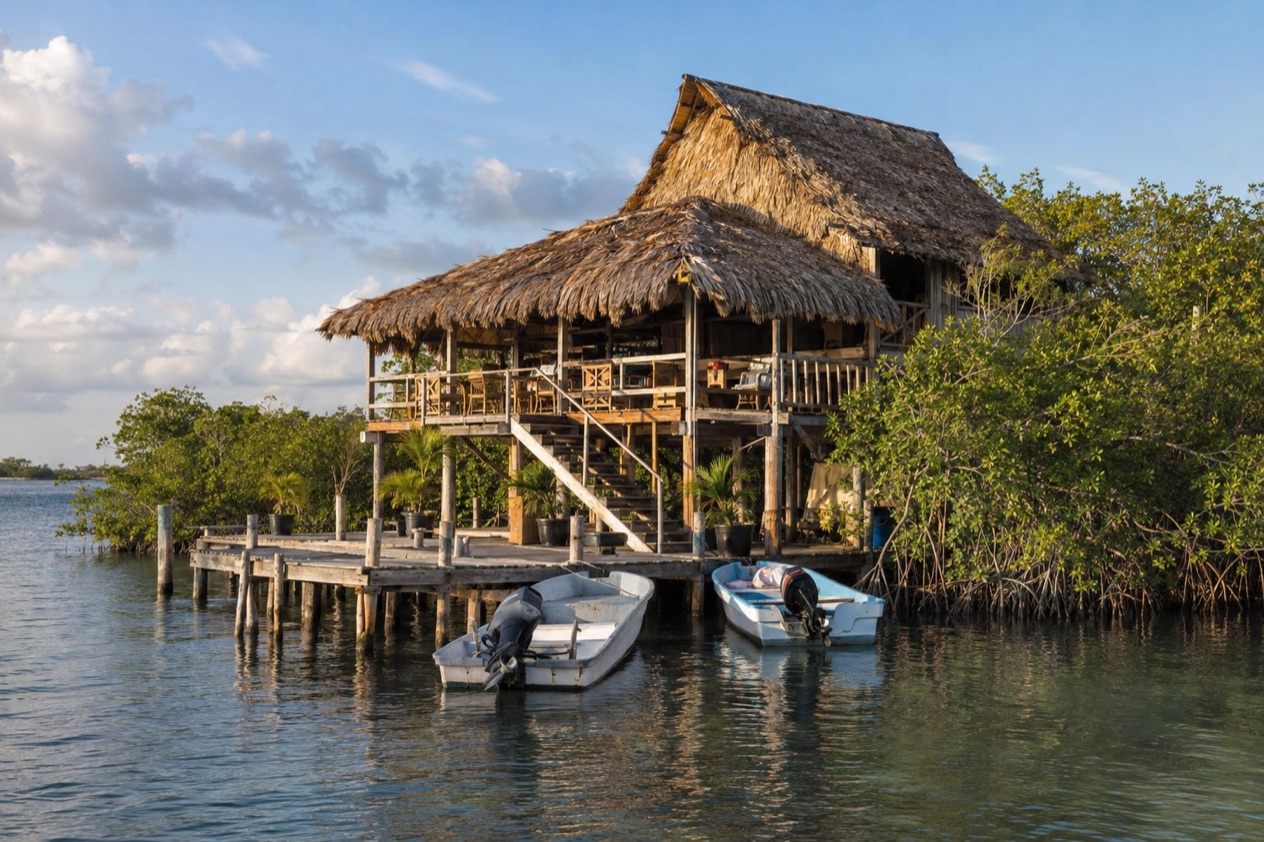
Thatch Caye Resort sits on a 12-acre island in the Cocoplum chain, inside the northern boundary of the protected South Water Marine Reserve. It is an all-inclusive property, and the plan covers local liquors, from Belizean rum to the coconut rum poured at the bar. Rooms have air-conditioning along with wall and ceiling fans.
The island runs on its own power, drawn from solar panels, wind generators and deep cycle batteries. Rooms have no TV, phone or Wi-Fi, so the evening belongs to the lounge, the deck and the stars. For an angler, that means the day ends with tackle put away and nothing buzzing in your pocket.
The flats and creeks of an atoll
Turneffe Atoll is the largest coral atoll in Belize and in the Mesoamerican Barrier Reef System, and its land and seascape is a network of productive flats, creeks and lagoons. More than 150 mangrove islands and higher cayes with savanna and littoral forest dot the water. This is the kind of country where flats fishing is done, and where birds, turtles and the occasional manatee or dolphin share the same shallows.
The atoll was declared a marine reserve in November 2012, and the Turneffe Atoll Sustainability Association has co-managed its day-to-day operations since the Fisheries Department appointed it the following year. Anglers fish within that framework of protection, and the rules on what may be kept are part of the experience.
A village built on the catch
Sarteneja is the largest fishing community in Belize and its second largest village, with a population estimated at 3,500 in 2016. Its economy rests primarily on lobster, conch and finfish. Mestizo refugees fleeing the Caste War of Yucatán founded the modern village in the middle of the nineteenth century, and the sea has fed it since.
Sarteneja is also one of the very last places in the Caribbean where wooden fishing vessels and sailboats are designed and crafted entirely by hand. Walking along the shore, you see hulls in various stages of work, which tells you more about Belizean fishing than any brochure.
Where are they?
The fishing places sit along the length of the Belizean coast, from the far north on the Sarteneja Peninsula to the cayes off the south-central shore and the atoll off Belize City. Each lies in a different kind of water, so the geography decides what your days look like.
South-central cayes near Dangriga
Thatch Caye lies 9 miles from Dangriga in south-central Belize, and about 2 miles from the second largest reef in the western world. That placement matters. The reef is close, the island is small, and the surrounding water belongs to a marine reserve, so the setting is one of clear shallows, coral and open sea in every direction.
Dangriga is a Garifuna town, and its culture of drumming, cassava bread and seafaring runs deep along this stretch of coast. A stay on the nearby caye puts you within reach of that world, even if the island itself feels apart from it.
Turneffe Atoll, off Belize City
Turneffe Atoll lies southeast of Ambergris Caye and Caye Caulker, 20 miles from Belize City. It is one of three atolls of the Belize Barrier Reef, along with Glover’s Reef and Lighthouse Reef, and it stretches roughly 30 miles in length and 10 miles in width. That is a lot of water to explore.
At the northern end stands Mauger Caye with its lighthouse, while the southern end has a smaller aid to navigation on Caye Bokel. Between them lie the flats, mangrove islands and lagoons that make the atoll such a rich habitat. At least three known fish spawning aggregation sites have been identified here, which is part of why the reserve exists.
The Sarteneja Peninsula in the north
Sarteneja lies on the Sarteneja Peninsula, approximately forty miles by road from Orange Walk Town. It is near the privately owned Shipstern Conservation and Management Area, which gives the trip a second layer for anyone who also wants to look at birds and forest. The name comes from the Maya Tza-ten-a-ha, which means water between the rocks.
The village carries the memory of Hurricane Janet, which passed directly over northern Belize as a Category 5 storm in 1955. Its southern edge struck Sarteneja, and storm surge put the village under 8 to 10 feet of water. The Atlantic hurricane season runs from June 1 to November 30, so the calendar is worth a glance when you plan a coastal stay.
What do they offer?
They offer water, quiet and a close look at a fishery that Belize protects with care. The details differ from place to place, but the common thread is a setting where the sea is the main event and the rules shape how you take part in it.
Island comforts without the usual screens
At Thatch Caye Resort, shower and sink water comes from rain and desalination and is fine for brushing teeth and washing. Each room has a 5-gallon container of drinking water, and bottled water is on sale in the Coco Lounge. Wi-Fi and a TV are available only in that lounge.
Electricity is 110V with the same plug style as North America, so your chargers work without an adapter. One habit to learn quickly is that no paper products go into the toilets. Everything goes into the trash bin, which housekeeping empties daily. Service charge is included in all rates and activities, and tipping at 10 to 15 percent is customary in Belize, at your discretion.
Catch and release on the flats
Bonefish, tarpon and permit are protected in Belize and may only be caught and released as sport fishing. Possession is illegal. That rule shapes the style of the sport here: you fight the fish, admire it in the water, and let it go.
Other limits protect the reef itself. It is illegal to take, buy, sell or possess parrotfish and tangs, the grazers that keep coral clean. Whale sharks and nurse sharks may not be taken or killed. These rules apply across the country, from the atoll flats to the cayes of the south.
Seasons and sizes for the table
If you plan to eat what the sea provides, the closed seasons and size limits decide what is on the menu at any given time. They apply to all of Belize, and they explain why lobster is off the plate for part of the year and conch for another.
| Species | Closed season | Size rule |
|---|---|---|
| Lobster | March 1 to June 30 | Carapace at least 3 inches, tail weight at least 4 ounces |
| Nassau grouper | December 1 to March 31 | Total length between 20 and 30 inches |
| Conch | July 1 to September 30, or when the catch quota is met | Shell at least 7 inches, market clean weight at least 3 ounces, fillet at least 2.75 ounces |
The working side of fishing
In Sarteneja, fishing is a livelihood, and the regulations show how it is organized. Commercial fishing requires a valid Fisherfolk and Fishing Vessel License, and every commercial vessel carries color coding for its fishing area. Captains submit catch log data, and licenses expire on December 31.
A vessel must also hold a seaworthiness certificate from the Belize Port Authority. None of this is paperwork for visitors, but it tells you that the boats you see along the shore operate inside a system built to keep the fishery going.
Good to know before you go
The U.S. State Department rates Belize Level 2, “Exercise increased caution”, because of crime, and says the south side of Belize City has historically had the highest concentration of violent crime.
The Atlantic hurricane season runs from June 1 to November 30, so a stay on a low island or along the northern coast falls partly inside it depending on the month. Fishing seasons for lobster, grouper and conch change through the year, and the protected species stay catch and release in every month. Tipping at 10 to 15 percent is customary, and island rooms may have no TV, phone or Wi-Fi, so plan for a few days offline.
Sources
- Thatch Caye Resort, FAQ (https://www.thatchcaye.com/faq), checked October 11, 2026
- Belize Fisheries Department, Regulations (https://fisheries.gov.bz/regulations/), checked October 11, 2026
- Belize Fisheries Department, Licenses (https://fisheries.gov.bz/licenses/), checked October 11, 2026
- Wikipedia, Sarteneja (https://en.wikipedia.org/wiki/Sarteneja), checked October 11, 2026
- Wikipedia, Turneffe Atoll (https://en.wikipedia.org/wiki/Turneffe_Atoll), checked October 11, 2026
- U.S. Department of State, Belize Travel Advisory, Level 2, March 11, 2026 (https://travel.state.gov/), checked October 11, 2026
- NOAA National Hurricane Center, Climatology (https://www.nhc.noaa.gov/climo/), checked October 11, 2026
To plan your stay
- Cayo Espanto: Private Island Villas, Getting There and What Is on Site
- Chaa Creek Belize: The Lodge, the Macal River, Rainforest Trails and Day Trips
- Hamanasi Resort Hopkins: Rooms, Reef and Rainforest Tours, and Where It Sits on the Coast
- Belize Overwater Bungalows: Thatch Caye, Where to Stay and How to Get There