
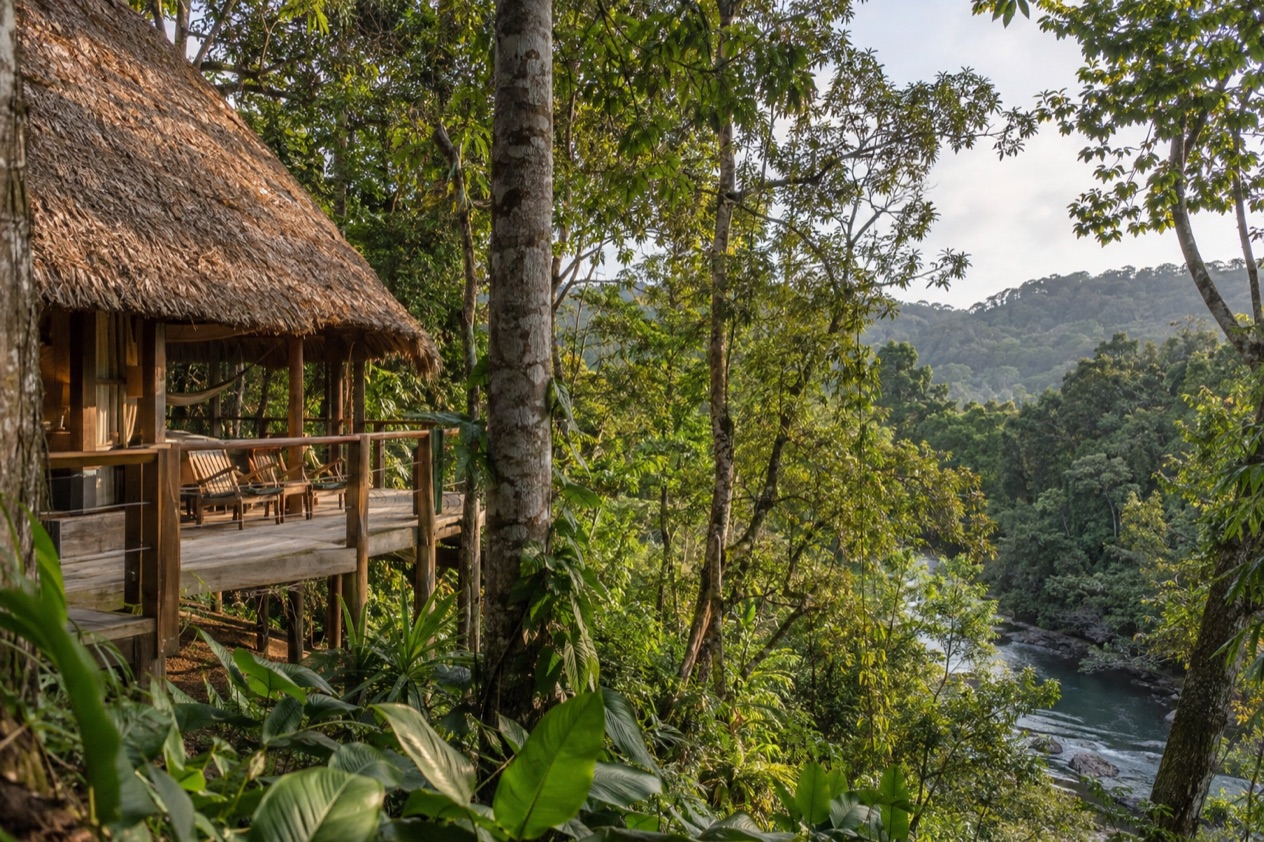
Before breakfast at a rainforest lodge in Belize, the first sound is birdsong, followed by the soft push of a canoe paddle on a river bend. Thatched roofs, hammocks and trails that start at your door set the rhythm of the day. Eco lodges in Belize sit in the Cayo District, in the Mountain Pine Ridge Reserve and on the beach near Hopkins, and the stay is built around the land around them.
What are the eco lodges in Belize?
Eco lodges in Belize are small resorts built within forest, river or coastal land, where the property itself is part of the stay and some of what you pay supports conservation and nearby communities. The idea is to sleep close to the nature you came to see, with guides, trails and local food that connect you to the place.
The word covers a wide range. Some lodges are rustic, some have private plunge pools, and some have thatched rooms decorated with Guatemalan textiles. What they share is a setting that does most of the talking: a river, a mountain reserve, a stretch of beach backed by forest. Each of the three below shows a different side of the idea.
The Lodge at Chaa Creek
Founded in 1981, the Lodge at Chaa Creek is one of Belize’s first eco-resorts, and it sits on the banks of the Macal River in western Belize. It spreads across a 500-acre private nature reserve with miles of rainforest trails, so the grounds feel more like a small park than a hotel garden.
Rooms run from the rustic Belize Rainforest Retreat to the Ix Chel Luxury Rainforest Villas, which have private Jacuzzis and plunge pools. Meals draw on organic produce from the lodge’s own Maya organic farm, with fresh bread from its bakery. Five percent of room revenue goes to environmental and community projects through the Chaa Creek Cares initiative.
Blancaneaux Lodge
Blancaneaux Lodge sits in the Mountain Pine Ridge Reserve. Francis Ford Coppola bought the property in the early 1980s, and it opened to the public in 1993. It has 20 rooms, all thatched-roof dwellings with Guatemalan décor.
The scenery is the draw: waterfalls tumble into turquoise pools above the jungle canopy. From this remote mountain setting, guests can explore the ancient Maya civilization, which gives the stay a sense of depth beyond the view from the porch.
Hamanasi Adventure and Dive Resort
Hamanasi sits on the beach south of Hopkins village, between the Maya Mountains and the Caribbean Sea. It was the first beach resort in Belize to be Green Globe Certified, and it holds that ethic in small rules: only reef safe sunscreens on the property and during all tours, and no touching plant or animal life while diving and snorkeling.
Guests are also told not to take souvenirs from nature or archeological sites. A weekly green hour lets visitors hear what the Green Team has been working on, and through Pack for a Purpose you can bring school, medical or pet supplies for Hopkins and nearby villages.
Where are they?
The lodges in this theme are spread across three landscapes of Belize: the Macal River valley in the Cayo District, the Mountain Pine Ridge Reserve and the coast near Hopkins. Each place gives a different version of the same idea, so the choice is really about which kind of scenery you want waking you up.
Cayo District: the Macal River and Chaa Creek
Chaa Creek is a tributary of the Macal River in the Cayo District in western Belize, and the lodge takes its name from it. The area is near the site of an ancient Maya settlement, and the history is part of the landscape rather than a side trip. Xunantunich was a Maya city in the Belize River valley in the Late and Terminal Classic periods, and at its peak the region around it had a population of nearly 200,000.
A community in the Chaa Creek catchment basin, east of Xunantunich’s center, remains largely unexcavated. For a guest, that means the hills around the lodge hold a layered past, which the lodge’s naturalists often weave into walks. Chaa Creek also offers combined beach and rainforest vacation packages with partner resorts at Ambergris Caye and Placencia, a way to pair the river valley with the coast.
Mountain Pine Ridge
Blancaneaux Lodge is in the Mountain Pine Ridge Reserve, a mountain setting that feels removed from everything else on the map. The lodge is known for waterfalls dropping into turquoise pools above the canopy, so the sound of water is part of the stay.
With only 20 rooms, it is a small address. Arriving here is as much about the setting as about the room, and the ancient Maya world is close enough to explore from the lodge.
Hopkins and the southern coast
Hamanasi occupies 45 acres of beachfront property with a private nature preserve, on the beach south of Hopkins village. It has four eco zones on site: Beachfront, Littoral Forest, Pond and Savannah, plus gardens. That mix means a short wander can take you from sand to forest to open grassland.
Farther down the southern road lies Cockscomb Basin Wildlife Sanctuary, recognized internationally as the world’s first jaguar preserve. It is off the Southern Highway, approximately 20 miles south of Dangriga Town.
By vehicle, turn off at Maya Center Village, about 20 minutes after joining the Southern Highway from the Hummingbird Highway. Buses from Belize City to Punta Gorda Town can stop at Maya Center Village on request, and the journey takes about 3.5 hours. From the fee collection point at Maya Center Village, the protected area itself is six miles down an unpaved road, and a local taxi from the village to the sanctuary costs BZD 40.00 one-way.
| Site | Open | Admission (non-nationals) |
|---|---|---|
| Cockscomb Basin Wildlife Sanctuary | 8:00am to 4:30pm | BZD 10 |
What do guests do there?
Guests walk, paddle, ride, watch birds, learn about plants and Maya history, and then rest in a hammock. The lodges organize the days around the land, so most activities begin from the property itself.
Trails, canoes and horses at Chaa Creek
At Chaa Creek, guided walks and horseback rides on the rainforest trails are led by licensed naturalists who share insights about biodiversity and Maya history. Canoeing on the Macal River means drifting through jungle scenery with birdsong and wildlife for company. Naturalist guides also lead hikes and medicinal trail walks, with a focus on conservation and community connection. Guides and wranglers on the team include David, Yoni, Teddy, Seleni and Leonso.
Within the reserve you find the Natural History Centre, the Butterfly Farm and the Rainforest Medicine Trail, and the Hilltop Spa offers treatments with valley views. The activity list runs long: bird watching tours, Belize Rainforest RTV Safari Tours, a medicinal plants trail, hiking, an organic farming tour, a Creatures of the Night tour, an open hearth hands-on culinary experience and even a treasure hunt.
Beach, kayaks and the Lookout at Hamanasi
Hamanasi puts the sea and the forest side by side. Guests can use kayaks, stand-up paddleboards and bicycles to explore the area around the resort, and beach chairs, hammocks and beach towels are provided. The saltwater infinity pool gives you another place to settle in.
The Great House holds the lobby, reception, gift shop, restaurant, library and bar. You can climb to the Lookout on top of it for panoramic views of the Caribbean and the Maya Mountains, a good spot to see the two landscapes the resort sits between. The resort’s dive and snorkeling outings come with the no-touch rule for plant and animal life.
Waterfalls and Maya history from Blancaneaux
At Blancaneaux, the waterfalls tumbling into turquoise pools are the scene you return to, and the remote mountain setting is the starting point for exploring ancient Maya civilization. The thatched rooms with Guatemalan décor make the lodge itself part of the experience.
Giving back while you stay
Many guests take part in the lodges’ community work. At Chaa Creek, the Pack-a-Pound program provides disadvantaged Belizean school children with personal school supplies. At Hamanasi, Pack for a Purpose lets you bring backpacks and school supplies for children in Hopkins and nearby villages, medical supplies for the Hopkins clinic and pet supplies for the Hopkins Belize Humane Society. A bag of notebooks tucked into your luggage becomes part of the trip, and the weekly green hour at Hamanasi is a chance to hear how the resort’s conservation work is going.
Good to know before you go
The U.S. State Department rates Belize Level 2, “Exercise increased caution”, because of crime, and says the south side of Belize City has historically had the highest concentration of violent crime.
The Atlantic hurricane season runs from June 1 to November 30, so a trip in the autumn months falls inside it. At Hamanasi, bring reef safe sunscreen, since it is the only kind allowed on property and during all tours. If you plan to visit Cockscomb Basin, the entrance fee for Belizean nationals is BZD 2.50, while non-nationals pay the fee shown with the sanctuary hours, and the unpaved road to the protected area is part of the journey.
Sources
- Hamanasi Adventure and Dive Resort, sustainability (https://www.hamanasi.com/sustainability/), checked October 11, 2026
- Chaa Creek, about (https://chaacreek.com/about-chaa-creek/), checked October 11, 2026
- Chaa Creek, explore (https://chaacreek.com/explore-chaa-creek/), checked October 11, 2026
- The Coppola Hideaways, Blancaneaux Lodge (https://thecoppolahideaways.com/resort/blancaneaux-lodge), checked October 11, 2026
- Hamanasi Adventure and Dive Resort, the resort (https://www.hamanasi.com/belize-resort/), checked October 11, 2026
- Wikipedia, Chaa Creek (https://en.wikipedia.org/wiki/Chaa_Creek), checked October 11, 2026
- Belize Audubon Society, Cockscomb Basin Wildlife Sanctuary (https://belizeaudubon.org/cbws/), checked October 11, 2026
- U.S. Department of State, Belize Travel Advisory, Level 2, March 11, 2026 (https://travel.state.gov/), checked October 11, 2026
- NOAA National Hurricane Center, Climatology (https://www.nhc.noaa.gov/climo/), checked October 11, 2026
To plan your stay
- Cayo Espanto: Private Island Villas, Getting There and What Is on Site
- Chaa Creek Belize: The Lodge, the Macal River, Rainforest Trails and Day Trips
- Hamanasi Resort Hopkins: Rooms, Reef and Rainforest Tours, and Where It Sits on the Coast
- Belize Overwater Bungalows: Thatch Caye, Where to Stay and How to Get There