
In September, green, blue and red ribbons appear in the shop windows of the Placencia Peninsula, and school children rehearse marching songs for the national holidays. Drums carry across the water from Garifuna kitchens at dusk, and the sea stays as warm as it gets all year. It is the rainy, storm-watching part of the Belize calendar, and for travelers who want the Caribbean at a local pace, it comes with parades, reef trips and long evenings on the sand.
What is the weather like in Placencia in September?
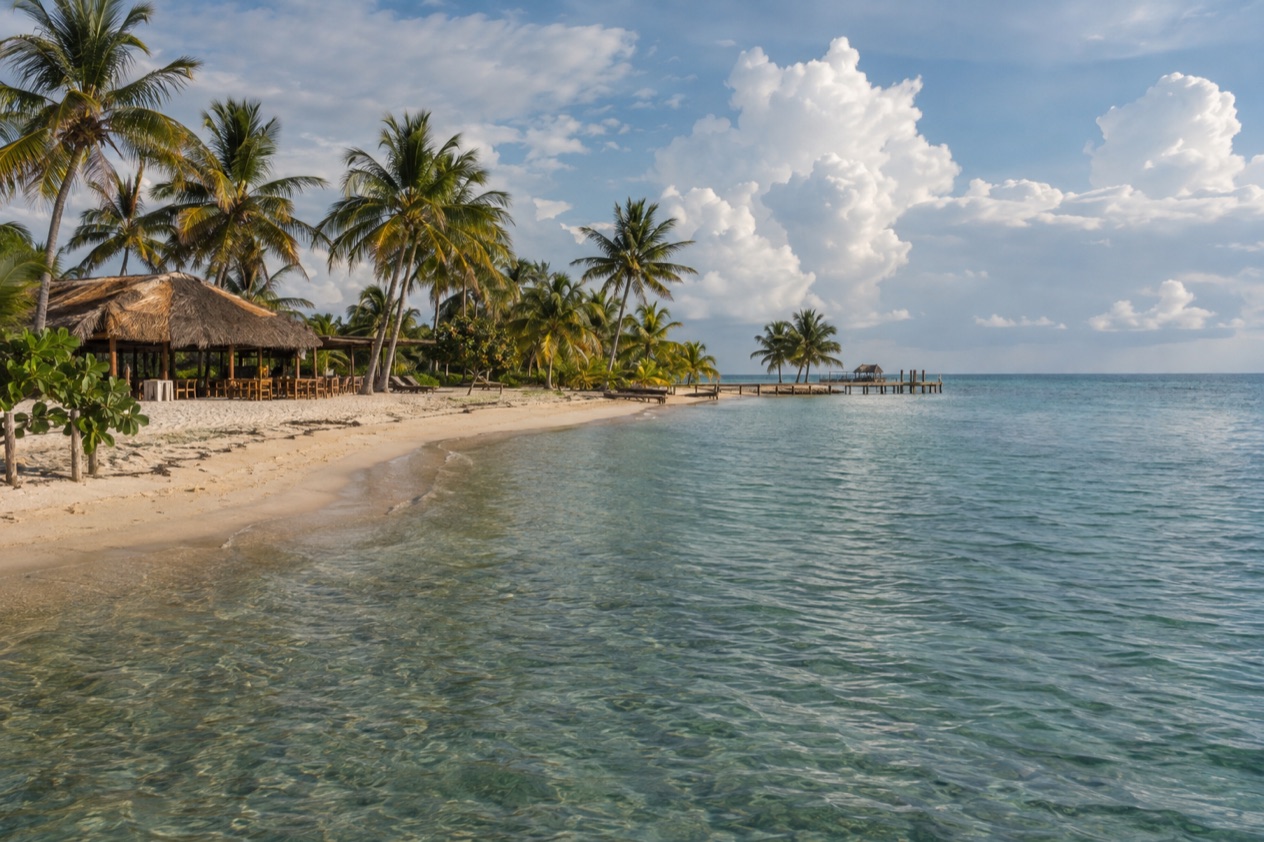
September in Placencia is hot, humid and wet, the kind of month when the sea is at its warmest and the sky can turn from bright to gray within a morning. The sea and the light shape the days here, and both are steady.
| Month | Sea at Placencia (°F) | Daylight on the 15th (hours and minutes) |
|---|---|---|
| August | 87.6 | 12 h 43 min |
| September | 88.8 | 12 h 15 min |
| October | 87.1 | 11 h 48 min |
In Belize City, highs average about 90°F in September, and rain falls on a good share of the days of the month. Plan a Placencia September around that: this is a month for light, quick-drying clothes and a flexible schedule rather than a rigid one.
The daylight is generous, with the sun leaving the sky a little earlier than it did in the summer months. That leaves a long stretch of light for the beach, the sidewalk through the village and a late dinner outside once the sun is down.
September also sits at the heart of the Atlantic hurricane season, which runs from June 1 to November 30 and peaks around September 10. Travelers keep an eye on the forecast the way locals do. Hurricane Keith, which formed in September 2000, is one of the storms that left its mark on Belize, and the season is part of how people here think about the month.
Can you swim in Placencia in September?
The sea is warm enough for a long, unhurried swim, close to 89°F in September, the sort of water you enter without flinching and leave only when your fingers wrinkle.
Beyond the village beach, two protected places draw swimmers, snorkelers and divers out from Placencia. Laughing Bird Caye National Park is a small island 12 miles off the coast of Placencia village, in the Stann Creek District, a national park declared in 1991.
Gladden Spit and Silk Cayes Marine Reserve lies 22 miles off the coast and covers about 25,980 acres. It protects the spawning aggregation site where whale sharks congregate, as well as the Silk Cayes, which carry the reserve’s tourism value.
Seaweed is a fact of Caribbean life. Sargassum, a brown algae, floats in sometimes mile-long clumps and gives off a rotten-egg smell when it washes onto a beach, so a given morning on the sand may look different from the one before.
What to do in Placencia in September
The month belongs to Belize’s national celebrations. Two dates anchor September, and between them the whole country is in a festive mood, with flags, music and food on every street. On the Placencia Peninsula, that mood mixes with the ordinary rhythm of a fishing village that also welcomes visitors.
The September celebrations
Saint George’s Caye Day falls on September 10 and commemorates the 1798 Battle of St. George’s Caye.
Independence Day arrives on September 21 and marks the day in 1981 when Belize, once British Honduras and renamed in 1973, was granted independence by Great Britain. Expect flags in the national colors, school groups in uniform and the kind of community gatherings where everyone seems to know the cook.
These are good days to eat where Belizeans eat. Look for rice and beans with stewed chicken, fry jacks at breakfast and fresh fish from the morning’s catch, plus a cold local beer or a glass of sorrel or other fruit drink in the evening.
Seine Bight and the Garifuna side of the peninsula
Seine Bight is a village on the Placencia Peninsula in the Stann Creek District, north of Placencia village and 2.5 miles south of Maya Beach Village. At the 2010 census the village counted 1,310 people, and the largest group was Garifuna, at 71.2 percent. That gives the place its own character: Garifuna cooking, drumming and language are part of daily life here, and the village is where visitors can learn about a culture that Belize celebrates every November 19.
A September visit pairs well with the national holidays, since community events and music tend to gather around them. Look for hudut, the Garifuna dish of fish in coconut broth with mashed plantain, and for cassava bread, which has been made by hand in this community for generations.
Laughing Bird Caye and Gladden Spit
With the warmest sea of the year, a day on the water is the natural thing to do in September. Laughing Bird Caye is a small island park that gives snorkelers and swimmers a patch of reef to explore, and Gladden Spit and Silk Cayes Marine Reserve offers the open-water edge of the barrier reef, where the seafloor drops away and divers look for larger marine life.
Both are reached by boat from Placencia, and both are easier to enjoy with a flexible mind. September is storm season, so plans shift with the weather, and the boat trip you hoped for on Tuesday may become Wednesday’s instead. Bring a sense of humor and a good book for the dock.
Back on land, the village sidewalk runs along the sand, lined with small shops, open-air restaurants and bars. Evenings here mean slow walks, ice cream, a drink with your feet in the sand and music coming from somewhere nearby. Rainy afternoons are for coffee, craft stalls and the covered porches of beachfront cafés.
A two-day itinerary for Placencia in September
Day 1 stays on the peninsula. Start with a breakfast of fry jacks, eggs and fresh fruit at a village café, then walk the sidewalk through Placencia village while the light is soft. The shops and small galleries along the way are good for a browse, and the beach is there for a first swim in water as warm as it gets all year.
Lunch is a plate of stewed chicken or grilled fish at a casual beachfront spot. In the afternoon, head north to Seine Bight to meet the Garifuna side of the peninsula, with its drumming and cassava bread. Come back to the village for the evening, since the day lasts a little over twelve hours and there is plenty of light left for a sunset on the sand. Dinner is seafood at a table outside.
If the weather turns, a rainy afternoon fits the village well: spend it in a café, in the craft shops or at a bar with a view of the water, and take the walk later. Day 2 is for the sea. Choose between Laughing Bird Caye National Park, 12 miles off the coast, and Gladden Spit and Silk Cayes Marine Reserve, which lies farther out and protects a spawning aggregation site. Either way, take your mask, a hat and a towel, and leave the morning free for the boat.
Return to the village for a late lunch of seafood, then keep the afternoon loose. The evening can follow the same pattern as the night before, or it can go to the national celebrations if your visit falls near September 10 or 21. Finish with a last beach walk, and a rum punch if the mood strikes.
Is Placencia busy in September?
September has a local, holiday feel rather than a crowded one, with the national celebrations bringing Belizean families into the mix alongside visitors. The village keeps its small-town pace, and the beach, the restaurants and the sidewalk have room.
The two holidays are the days to think about. Saint George’s Caye Day and Independence Day shape where people gather and what is open, and the days around them tend to have a festive buzz. Plan your boat days and your big dinners around them, so you can enjoy the celebrations rather than discover them by accident.
Because September is also the center of the hurricane season, many travelers choose their dates with flexibility in mind. Book the parts of the trip you care most about first, such as your room and your reef outing, and leave the rest open, so you can shift a boat day when the sky changes. A relaxed plan suits the month better than a tight one.
Restaurant tables in the village are generally easy for a quiet evening, and the holiday dates bring a little more activity. The reef outings are the thing to arrange early in your stay, since they depend on a boat and on the weather.
What to pack for Placencia in September
Pack for warm water, wet afternoons and long evenings outside.
- A light rain jacket or poncho, for the showers that come with the season
- Quick-drying clothes, since humid air keeps everything damp
- Swimsuits and a mask, for the reef outings and the warm sea
- A wide-brimmed hat and sunscreen, for hours on the water
- Insect repellent, for evenings on the sand
- Sandals that dry fast, for the village sidewalk and the beach
Good to know before you go
The U.S. State Department rates Belize Level 2, “Exercise increased caution”, because of crime, and says the south side of Belize City has historically had the highest concentration of violent crime.
September falls inside the Atlantic hurricane season, which runs from June 1 to November 30, with the peak around September 10. An average season brings 14 named storms, 7 of them hurricanes, so the forecast is worth a glance before you travel and during your stay.
The two national holidays, on September 10 and September 21, shape the calendar, and it is sensible to expect a festive mood and some changes in what is open on those days. Sargassum can wash up on the beaches at times, a brown algae with a strong smell, so a morning on the sand can look different from the day before.
Placencia in September vs August and October
Moving four weeks earlier brings August: a sea just a touch cooler, the longest daylight of the three months and fewer rainy days in Belize City. The national holidays are not yet here, so the festive mood of September is missing. Moving four weeks later brings October: the sea cools slightly, the days shorten by about half an hour, and the rain returns more often, with the most rainfall of the three months in Belize City.
The hurricane season frames all three months, since most activity occurs between mid-August and mid-October. The season runs to the end of November, so it does not end in October either.
Choose September if the national celebrations and the warmest sea appeal to you. Shift to August if you want the longest days and a lighter rain pattern, and to October if you prefer a quieter feel and do not mind a wetter stretch. For reef outings, the sea is warm in all three.
Is September a good time to visit Placencia?
Yes, for travelers who want warm water, local color and a relaxed pace, and who can take a rainy afternoon in stride. September suits people who like to watch a community celebrate, who enjoy the sea more than the schedule, and who do not mind adjusting a plan when the sky changes.
It is a weaker fit for anyone who wants a fixed itinerary or a guaranteed dry stretch, since this is the middle of the storm season. Those travelers may prefer a different month.
On arrival, settle into the village first, walk the sidewalk and find the spot where you will eat on your first night. Then decide which reef outing you want, Laughing Bird Caye or the Gladden Spit reserve, and keep a day in reserve for the weather. What stays in memory from September here is the combination: the warmest sea of the year, the drums of Seine Bight at dusk, and the green, blue and red of the national colors hanging over a village that otherwise runs on fishing boats and slow evenings.
Sources
- Open-Meteo Marine API, average 2015-2024, checked October 11, 2026
- sunrise-sunset.org, sunrise and sunset calculated for the 15th of the month, checked October 11, 2026
- NOAA NCEI, GHCN-Daily station BHM00078583 (Philip S. W. Goldson International Airport, Belize City), normals 1991-2020 computed from the daily record (https://www.ncei.noaa.gov/access/services/data/v1?dataset=daily-summaries&stations=BHM00078583), checked October 11, 2026
- Wikipedia, Public holidays in Belize (https://en.wikipedia.org/wiki/Public_holidays_in_Belize), checked October 11, 2026
- Wikipedia, Garifuna Settlement Day (https://en.wikipedia.org/wiki/Garifuna_Settlement_Day), checked October 11, 2026
- NOAA National Hurricane Center, Climatology (https://www.nhc.noaa.gov/climo/), checked October 11, 2026
- Wikipedia, Hurricane Hattie (https://en.wikipedia.org/wiki/Hurricane_Hattie), checked October 11, 2026
- Wikipedia, Hurricane Keith (2000) (https://en.wikipedia.org/wiki/Hurricane_Keith_(2000)), checked October 11, 2026
- Wikipedia, Hurricane Dean (https://en.wikipedia.org/wiki/Hurricane_Dean), checked October 11, 2026
- Wikipedia, Hurricane Lisa (2022) (https://en.wikipedia.org/wiki/Hurricane_Lisa_(2022)), checked October 11, 2026
- Wikipedia, Hurricane Earl (2016) (https://en.wikipedia.org/wiki/Hurricane_Earl_(2016)), checked October 11, 2026
- Wikipedia, Hurricane Iota (https://en.wikipedia.org/wiki/Hurricane_Iota), checked October 11, 2026
- Belize Tourism Board, Sargassum resource (https://www.belizetourismboard.org/tourism-resources/sargassum-resource/), checked October 11, 2026
- Wikipedia, Seine Bight (https://en.wikipedia.org/wiki/Seine_Bight), checked October 11, 2026
- Belize Fisheries Department, Gladden Spit and Silk Cayes Marine Reserve (https://fisheries.gov.bz/gsscmr/), checked October 11, 2026
- Wikipedia, Gladden Spit and Silk Cayes Marine Reserve (https://en.wikipedia.org/wiki/Gladden_Spit_and_Silk_Cayes_Marine_Reserve), checked October 11, 2026
- Wikipedia, Silk Cayes (https://en.wikipedia.org/wiki/Silk_Cayes), checked October 11, 2026
- Wikipedia, Laughing Bird Caye (https://en.wikipedia.org/wiki/Laughing_Bird_Caye), checked October 11, 2026
- Wikipedia, Climate of Belize (https://en.wikipedia.org/wiki/Climate_of_Belize), checked October 11, 2026
- U.S. Department of State, Belize Travel Information, Entry and exit requirements (https://travel.state.gov/), checked October 11, 2026
- U.S. Department of State, Belize Travel Advisory, Level 2, March 11, 2026 (https://travel.state.gov/), checked October 11, 2026
To plan your stay
- Things to Do in Placencia: Reef Days, Whale Sharks, Garifuna Culture and Where to Eat
- Where to Stay in Placencia: The Village, Seine Bight, Beachfront Resorts and How to Choose
- Placencia from Belize City: Flights, Rental Cars and What Waits on the Peninsula
- Know Before You Go to Placencia: Entry Rules, Money, Health and Getting Around