
On market mornings in Punta Gorda, farmers spread out produce along Front Street, Maya artisans lay out baskets and carvings, and the smell of fried fish drifts in from the waterfront. Past the edge of town the road runs into rainforest, cacao farms and villages where Q’eqchi’ and Mopan Maya families have lived for generations. This is the southernmost corner of Belize, a place for travelers who want culture, chocolate and jungle more than a beach resort.
Where is Punta Gorda and the Toledo District and what is it like?
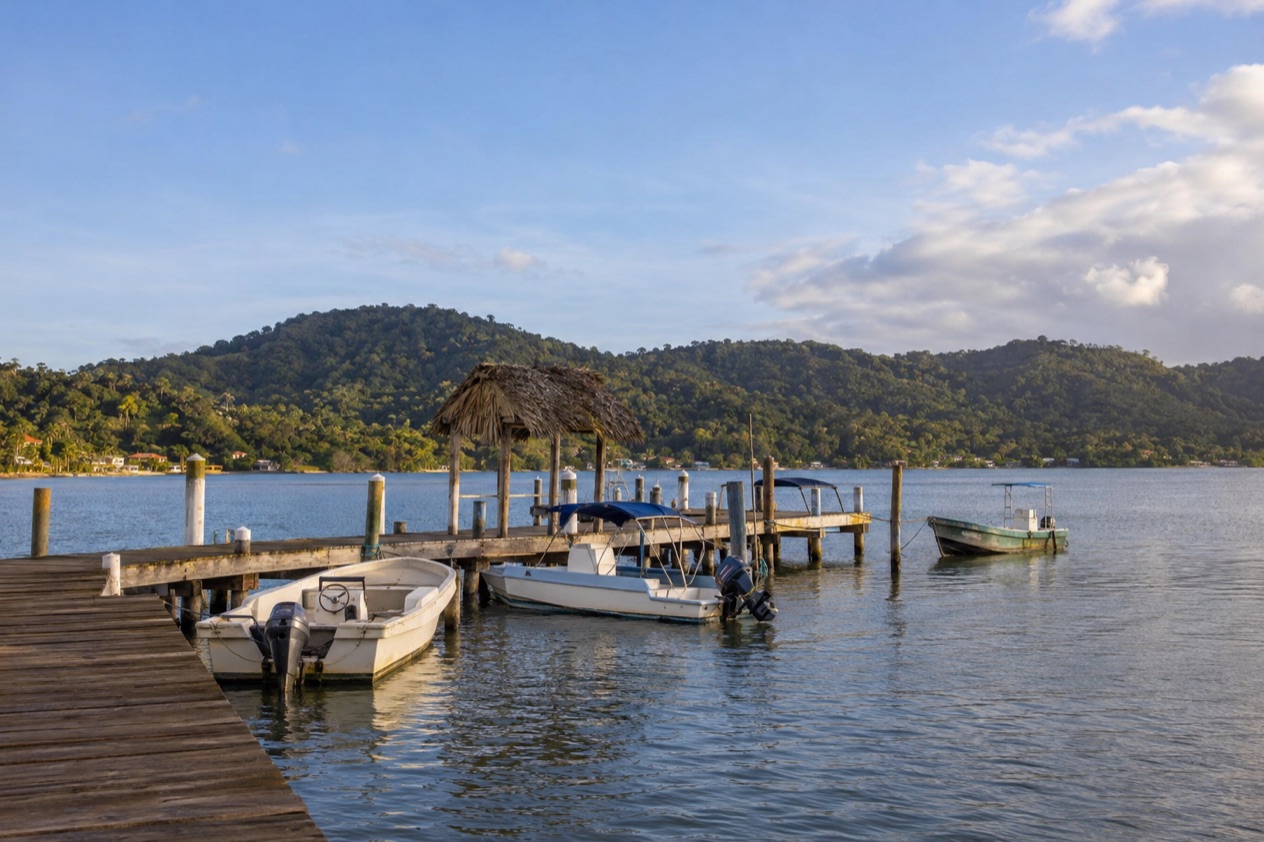
Punta Gorda is the southernmost town in Belize and the capital of the Toledo District, which borders Guatemala to the west and south, with the Sarstoon River forming the southern boundary. Toledo is the least populated district in the country, and its landscape runs from a coastal plain and offshore cays up into rainforest and cave country. Locals call the town P.G., and it works as the gateway to everything around it.
The town itself is small, low and close to the water, sitting only about fifteen feet above sea level. It began as a fishing village and took on a new life in 1823, when Garifuna emigrants from Honduras settled here.
That history still shows in the town’s mix of people: Garifuna, Mestizo, Q’eqchi’ and Mopan Maya, Creole and East Indian families all live side by side. On some Sundays, the Garifuna Mass at St Peter Claver Parish Church fills the morning with Garifuna hymns, and it is one of the most moving things you can hear here.
The pace is unhurried. Fishing and agriculture drive the local economy, and the town feels like a working place that happens to welcome visitors, not a place built around them. Travelers who like to meet people, eat what the farms grow and spend days in villages and ruins will feel at home. Those who want a long stretch of resort sand, nightlife or a packed schedule of organized activities may find it too quiet.
Beyond town, the district is a patchwork of Maya villages, Garifuna communities such as Barranco (the southernmost Garifuna village in Belize) and the Creole coastal village of Monkey River Town in the north. San Antonio, the largest Maya village in the district, has waterfalls nearby. Each of these places has its own character, and together they give the district a texture that the busier north of the country does not have.
What is there to do in Punta Gorda and the Toledo District?
The reasons to come are Maya culture, ancient sites, chocolate, and wild country of caves and coastal wetlands. Toledo is different from its neighbors to the north because the sea is not the main attraction: the land and the people are.
Maya villages and village stays
Near Punta Gorda you can stay overnight in traditional Maya houses and spend time with local Maya people. You eat caldo and corn tortillas, hear how families farm and cook, and see daily life up close. It is a quiet, human kind of travel, and the memory of a shared meal often outlasts any monument.
San Antonio, the largest Maya village in the district, is a natural stop for anyone curious about the area, and its waterfalls add a bit of scenery. Come with an open schedule, because village visits go at the pace of the village.
Ruins: Lubaantun and Nim Li Punit
Lubaantun lies northwest of Punta Gorda, close to the village of San Pedro Columbia. Its structures are mostly built of large stone blocks laid without mortar, using black slate rather than the limestone typical of the region, which gives the place a look quite unlike other Maya sites. Archaeologists also found a large collection of miniature ceramic objects here, one of the site’s distinguishing features.
Nim Li Punit sits north of town beside the village of Indian Creek. Its name is Kekchi Maya for Big Hat, after the large headdress carved on one of its stelae, and the site is known for its elaborately carved stelae. Step-pyramids rise around three plazas, and the place was home to a large population in the Classic Period.
| Site | Open |
|---|---|
| Lubaantun | Every day, 8:00 am to 5:00 pm, including Sundays and public and bank holidays |
Cacao country and market days
Chocolate is the district’s signature. Every May, Punta Gorda hosts the Toledo Cacao Festival, celebrating the history and production of chocolate, and the Chocolate Festival, with chocolate and wine, also takes place in the district that month. If you are here at another time, the cacao story is still part of village visits and farm life.
On Wednesdays and Saturdays, the market on Front Street shows off produce from farmers and handicrafts from local Maya artisans. It is the easiest way to see the district’s farming and craft traditions in one walk, and a good place to pick up a basket or a carving.
Caves, coast and manatees
Toledo has extensive cave networks, and some of the largest cave systems in the world are found near Punta Gorda. Offshore, Port Honduras Marine Reserve stretches from Monkey River to beyond the Rio Grande and reaches out to sea. It was established in 2000 to help the West Indian manatee, and it holds coastal and tidal wetlands, coral reef, sea-grass and mangrove, and is valued as a fish nursery.
How many days do you need in Punta Gorda and the Toledo District?
Three or four days is a comfortable stay, and a week lets you slow down and see the district properly. Toledo rewards time, because the best things here are spread out and the experiences, from village stays to market mornings, are not meant to be rushed.
In a short stay, spend a morning in Punta Gorda itself: walk the waterfront, see the port on Fort Street and, if it is a Wednesday or Saturday, browse the Front Street market. Add one ruin, either Lubaantun with its mortarless black-slate blocks or Nim Li Punit with its carved stelae. If your visit falls on an alternate Sunday, the Garifuna Mass at St Peter Claver Parish Church is a lovely start to the day.
With more time, add the second ruin and an overnight in a Maya village, where you can eat caldo and corn tortillas and spend time with local families. A visit to San Antonio and its waterfalls fits well here, as does time with cacao growers if you are around in May for the festival.
A week lets you reach the quieter edges of the district: the Garifuna village of Barranco in the far south, Monkey River Town on the northern coast and the waters of Port Honduras Marine Reserve. Caves and wild country can fill further days. Nothing here is a checklist, and the district suits travelers who like to stay put for a few nights and let the days unfold.
Where to stay in Punta Gorda and the Toledo District
The two main choices are the town of Punta Gorda and the villages of the district. Staying in town puts you close to the waterfront, the Front Street market, the port and the Garifuna Mass, and it suits travelers who want a base with shops, restaurants and the ease of a small town. It is also the district’s main transportation point, so day trips start here.
Staying in a Maya village is the other path. Near Punta Gorda you can sleep in traditional Maya houses, share meals and learn how local families live, which suits travelers who care more about people and culture than about amenities. Villages near the ruins, such as San Pedro Columbia close to Lubaantun and Indian Creek beside Nim Li Punit, put you next to the sites.
The coast offers a third flavor. Monkey River Town, a Creole coastal village in the north of the district, and Barranco, the southernmost Garifuna village in Belize, each have their own community feel. Choose by what you want to wake up to: a harbor town, a Maya village or a coastal settlement.
How do you get to Punta Gorda and the Toledo District and get around?
You can reach Punta Gorda by air or by road. The Punta Gorda Municipal Airstrip serves domestic flights from Maya Island Air, and the town is the main point of transportation for people traveling to, from or through the Toledo District. As a seaport, it also has a port on Fort Street in the eastern part of town.
Once in town, the center is small, and the waterfront, market and church sit close together. For the sights outside, you need to cover some distance. Lubaantun is northwest of Punta Gorda and, once there, is reached by automobile and has a small visitors’ centre. Nim Li Punit lies to the north, beside Indian Creek.
The district is spread out, with its villages, ruins and coast on different sides of town, so plan your days around one direction at a time. Punta Gorda is where trips begin and end, which makes it a convenient base whichever way you head.
When is the best time to visit Punta Gorda and the Toledo District?
May is the month with the most to see, because the Toledo Cacao Festival fills Punta Gorda with the history and flavor of chocolate and the Chocolate Festival, with chocolate and wine, takes place in the district. If you love food and culture, that is the month to aim for.
For weather, the Belize City record gives a sense of the seasons. In Belize City, January highs average in the low 80s with about ten days of rain, while July highs reach the upper 80s with nearly twelve rainy days. Warm temperatures run all year, so your choice depends more on what you want to see than on the thermometer.
The Atlantic hurricane season runs from June 1 to November 30, so those months carry that background. Market days on Wednesdays and Saturdays, and the alternate-Sunday Garifuna Mass, run through the year, and the ruins keep their daily hours.
Good to know before you go
The U.S. State Department rates Belize Level 2, “Exercise increased caution”, because of crime, and says the south side of Belize City has historically had the highest concentration of violent crime.
Punta Gorda is a small town, and the district is rural, so plan your day around its villages and its market days. The Belize dollar is the national currency. Travel in the district is slower than on the northern cayes, and the reward is the people you meet, from market vendors to the families who host overnight stays.
Lubaantun welcomes visitors every day, including Sundays and public holidays, with ticket categories for residents and non-residents and by age. The Atlantic hurricane season runs from June 1 to November 30, which is worth remembering when you pick your dates.
Sources
- Wikipedia, Punta Gorda, Belize (https://en.wikipedia.org/wiki/Punta_Gorda,_Belize), checked October 11, 2026
- Wikivoyage, Punta Gorda (Belize) (https://en.wikivoyage.org/wiki/Punta_Gorda_(Belize)), checked October 11, 2026
- Wikipedia, Toledo District (https://en.wikipedia.org/wiki/Toledo_District), checked October 11, 2026
- Wikivoyage, Toledo District (https://en.wikivoyage.org/wiki/Toledo_District), checked October 11, 2026
- Belize Port Authority, Punta Gorda port (https://portauthority.bz/belize-port-facilities/punta-gorda-port/), checked October 11, 2026
- Tropic Air, Punta Gorda (https://www.tropicair.com/punta-gorda/), checked October 11, 2026
- Maya Island Air, Punta Gorda flights (https://www.mayaislandair.com/belize-flights-punta-gorda/), checked October 11, 2026
- Wikipedia, Lubaantun (https://en.wikipedia.org/wiki/Lubaantun), checked October 11, 2026
- Wikipedia, Nim Li Punit (https://en.wikipedia.org/wiki/Nim_Li_Punit), checked October 11, 2026
- NICH ticketing, Lubaantun (https://ticketing.nichbelize.org/product/lubaantun/), checked October 11, 2026
- NICH ticketing, Nim Li Punit (https://ticketing.nichbelize.org/product/nim-li-punit/), checked October 11, 2026
- Belize Fisheries Department, Port Honduras Marine Reserve (https://fisheries.gov.bz/phmr/), checked October 11, 2026
- Wikipedia, Climate of Belize (https://en.wikipedia.org/wiki/Climate_of_Belize), checked October 11, 2026
- NOAA NCEI, GHCN-Daily station BHM00078583 (Philip S. W. Goldson International Airport, Belize City), normals 1991-2020 computed from the daily record (https://www.ncei.noaa.gov/access/services/data/v1?dataset=daily-summaries&stations=BHM00078583), checked October 11, 2026
- U.S. Department of State, Belize Travel Advisory, Level 2, March 11, 2026 (https://travel.state.gov/), checked October 11, 2026
- NOAA National Hurricane Center, Climatology (https://www.nhc.noaa.gov/climo/), checked October 11, 2026