
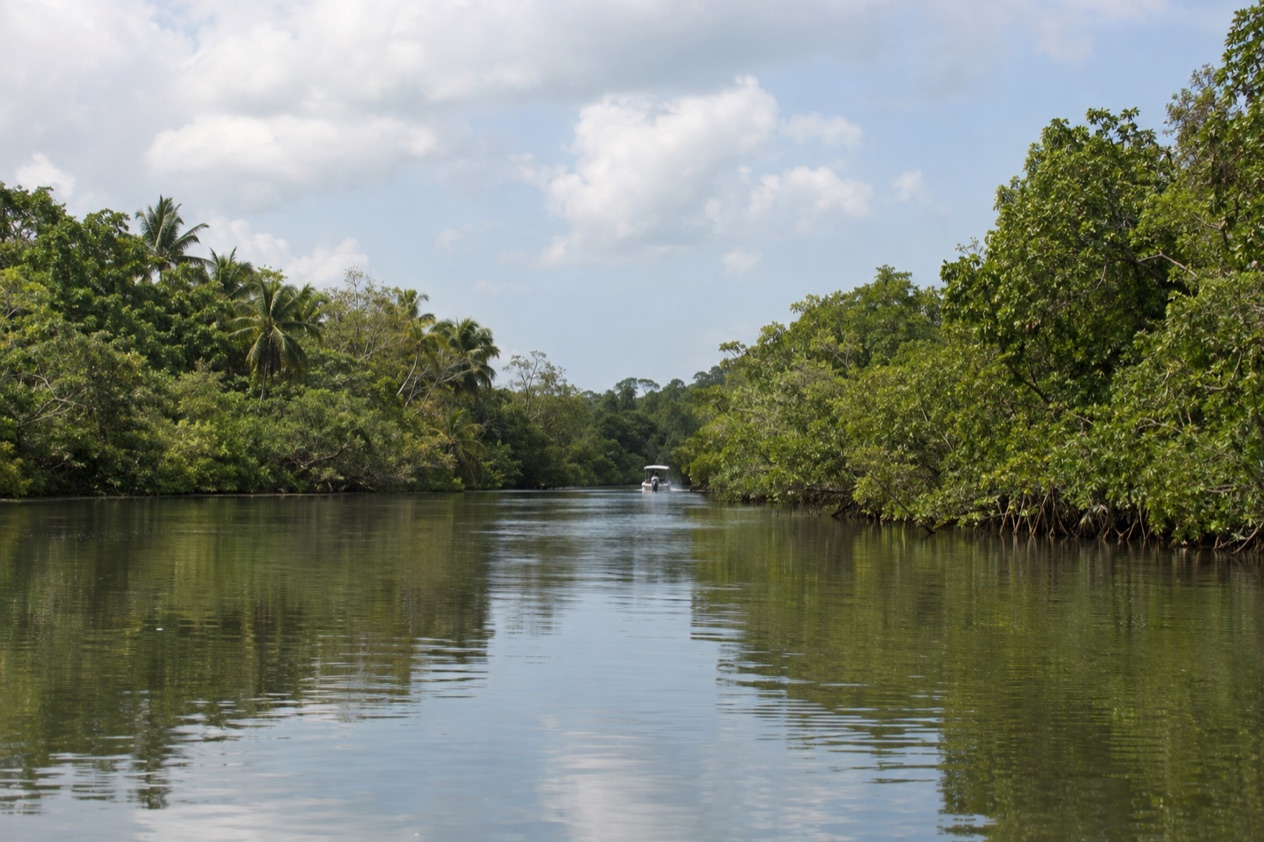
The first sound is often not a bird but a deep, rolling roar that seems far too big for the trees it comes from. It is a black howler monkey announcing its territory, and it carries across the water long before you see the animal. The Monkey River runs into the Caribbean at the southern edge of Belize’s Toledo District, and a visit here means a trip up a slow, green river with a guide, looking up into the canopy for troupes of howlers and everything else that lives along the banks.
Is visiting the Monkey River worth it?
Yes, if you like wildlife watching on the water more than ticking off monuments, and especially if you are staying around Placencia or in the southern part of the country and want a nature outing built around a river rather than a trail or a reef. It suits people who enjoy sitting still, scanning branches and listening, and it suits anyone curious about a small Belizean village that lives from fishing and ecotourism.
What sets it apart from other wildlife outings nearby is the combination. Cockscomb Basin Wildlife Sanctuary is a forest destination, and the Placencia Lagoon is a shallow wetland of manatees, rays and mangroves explored by canoe or kayak.
The Monkey River is a proper river, with a village at its mouth where guides are easy to find, and with howler monkeys that have a remarkable story. Their numbers were badly reduced by a hurricane and have come back strongly, so several troupes are now seen along the banks. Seeing them is a chance, never a promise, but the odds are good enough that guides build the whole trip around it.
There is also a human side. Monkey River Town is a tiny place, home to about 200 people in 2011, where most of the day’s business is boats, fish and visitors heading upriver. You arrive in a working village, not a resort.
What to see at the Monkey River
Black howler monkeys in the canopy
The howlers are the reason most people come. They are heavy, dark animals that spend much of their time resting in the upper branches, often in family groups, and they move slowly compared with other monkeys. Look for dark shapes among the leaves, a dangling tail, or a branch that sways with no wind.
Researchers from the University of Calgary, led by Dr. Mary Pavelka, study the monkey population here year-round, which tells you how much attention these troupes receive. Your guide will usually know where the groups have been feeding and resting, so follow their pointing finger rather than scanning blindly. Binoculars and a patient eye make a real difference.
The river, its banks and its birds
Beyond the monkeys, the river itself is the show. Mangroves crowd the lower reaches, then the banks give way to taller forest where branches lean far over the water.
Guides take visitors up the river to see the howlers and other wildlife, and what that other wildlife turns out to be changes from one outing to the next. Herons stand at the edges, kingfishers flash from perch to perch, and lizards sit on branches above the current.
Take time to look at the small things as well: roots in the mud, bromeliads on the trunks, the way the light falls through the leaves onto brown, slow-moving water. Wildlife sightings are never guaranteed, but the setting rewards anyone willing to go quietly and look closely.
Monkey River Town
The village sits on the southern shore of the river mouth, facing the Caribbean. Its main occupations are fishing and ecotourism, and you feel both as soon as you arrive: boats pulled up along the water, guides waiting near the landing, and a small cluster of houses behind. There are two small hotels in the village and a nearby fishing resort reached by a five-minute sea trip.
The village has a history of hard knocks from the sea. A recent government project installed a botan seawall to halt erosion on the southern foreshore, a reminder that this community lives right at the edge of the water.
The river mouth and Port Honduras Marine Reserve
Where the river meets the sea, the scene opens out. Port Honduras Marine Reserve, in the southern coastal waters of Belize, stretches from the Monkey River to beyond the Rio Grande and extends out to sea. Standing at the river mouth, you are at the northern edge of that protected stretch of coast, a mix of mangrove, shallow water and open Caribbean.
This is a place to look at rather than to plan around. The bend of the river, the line where brown water meets blue, and the fishing boats coming and going give the visit a sense of place that stays with you after the monkeys have faded into the leaves.
Hours, tickets and rules
A Monkey River visit is a guided outing from the village, not a gated site with a ticket booth and a posted schedule. Guides can be easily found at Monkey River village, and that is the practical starting point: you meet your guide, board a boat and head upriver to look for howler monkeys and other wildlife. Several hotels in the region also offer the trip as an add-on, and Hamanasi, for example, lists a Monkey River Adventure among its additional rainforest adventures.
Because the outing is arranged through guides and lodges rather than a single operator, what you pay and when you go depend on whom you go with. The sentences of any trip description you are given are the place to look for what is included, and nothing about the river itself requires a ticket window.
One rule concerns the water around the village. In Belize’s internal waters, using a gill net to take fish from the shorelines of the Monkey River or Placencia, within five miles eastward into the sea, is prohibited. It is a fishing regulation rather than a visitor rule, but it tells you something about how seriously this stretch of coast is managed, and it sits alongside the protection of Port Honduras Marine Reserve just offshore.
How to get to the Monkey River
Monkey River Town lies in the Toledo District, at the southern side of the river mouth, and there are two ways in: by road and by sea. A road from the Southern Highway was built in the late 1980s, running through orange groves and jungle to the village car park. It linked the village to the outside world for the first time by land, though much travel is still by sea, and the sea route remains a real part of how people and visitors reach the village.
Most travelers base themselves in Placencia, in the Stann Creek District, and from Placencia town you can explore Monkey River, Cockscomb Basin or sail to the southern cayes. Placencia sits at the southern tip of an 18-mile peninsula, with Placencia Airport serving the village, so it works naturally as a starting point for southern Belize outings, including this one.
Hamanasi, which offers the Monkey River Adventure as part of its rainforest program, is another base from which the trip is arranged. Whichever route you take, the final leg is the same: you arrive at the village, find your guide near the water, and the river begins right there.
When to visit the Monkey River
The howlers live along the river all year, and the researchers who follow them work year-round, so there is no season in which the monkeys go away. That makes the Monkey River a flexible choice, something to slot into a southern Belize stay whenever your dates fall, rather than a trip tied to a single window.
What you should keep in mind is the calendar of the sea. The Atlantic hurricane season runs from June 1 to November 30, and this village knows what that means. A trip planned inside those months should stay flexible, since a river outing and a coastal village are both exposed to weather coming off the Caribbean. Outside those dates, you are simply planning around your own schedule.
Think also about what else the months offer nearby. Between the spring months, whale sharks pass Gladden Spit near Placencia around the full moon, and visitors who want that outing pair it naturally with a river day. Placencia also hosts its Lobster Fest, an Arts Festival and Easter Week celebrations, so a Monkey River day can be the quiet, green counterpart to a lively village stay.
Tips for your visit
Bring binoculars if you own a pair, and a camera with a zoom lens, because the monkeys sit high. In Placencia, visitors are advised to bring repellent and sunscreen, and eco-friendly versions if they plan to snorkel or dive near the reefs. A river trip puts you under the same sun, so the sunscreen advice carries over.
Guides are easy to find in the village itself, so there is no need to arrive with every detail settled. Talk with your guide about what you hope to see, whether monkeys, birds or the river itself, and let them steer the pace. Keep your voice low on the water, since a quiet boat sees more.
Combining the river with other southern Belize outings
The Monkey River fits well alongside the other nature outings reached from Placencia. Cockscomb Basin Wildlife Sanctuary is a day trip from Placencia, and the Maya sites of Nim Li Punit and Lubaantun, in the Toledo District, are day trips from the peninsula. Pairing a river day with a forest day or a ruins day gives a stay in the south real variety.
Back in Placencia, the Placencia Lagoon offers birding by canoe or kayak, with manatees, dolphins and rays among the wildlife, and the barrier reef lies offshore for snorkeling and diving. The village’s concrete Sidewalk runs most of its length, lined with businesses, and ends at the seashore, a good place to wander after a day on the river. The tap water in Placencia is drinkable, piped from an artesian well on the mainland.
Staying near the river
If you would rather sleep close to the river, Monkey River Town has two small hotels, and a fishing resort a five-minute sea trip away. Staying in the village means you see the place after the day visitors have gone, when the boats are tied up and the community returns to its own rhythm of fishing and ecotourism.
Families and travelers with limited mobility should talk through the boat boarding and the village landing with their guide or hotel before committing, since those details depend on the operator. What the river itself offers, a slow look at wildlife from the water, is a gentle idea of a day out.
Good to know before you go
The U.S. State Department rates Belize Level 2, “Exercise increased caution”, because of crime, and says the south side of Belize City has historically had the highest concentration of violent crime.
Monkey River Town is a small village, so plan your spending around what you need before you arrive, and expect the simple, local feel of a place that lives from fishing and visitors. Belize prices things in Belize dollars, but the amounts for your own trip come from the guide or lodge you book with.
The village carries a vivid memory of Hurricane Iris, which made landfall here on October 9, 2001, as a Category Four storm with 145 mph winds, demolishing most homes and destroying the banana crop. The howler monkeys have come back strongly since then, and the village has rebuilt, but the story is a good reminder that this coast sits in the path of the Atlantic hurricane season, which runs from June 1 to November 30.
Sources
- Wikipedia, Monkey River Town (https://en.wikipedia.org/wiki/Monkey_River_Town), checked October 11, 2026
- Wikipedia, Placencia (https://en.wikipedia.org/wiki/Placencia), checked October 11, 2026
- Wikivoyage, Placencia (https://en.wikivoyage.org/wiki/Placencia), checked October 11, 2026
- Belize Fisheries Department, Port Honduras Marine Reserve (https://fisheries.gov.bz/phmr/), checked October 11, 2026
- Belize Fisheries Department, Regulations (https://fisheries.gov.bz/regulations/), checked October 11, 2026
- Hamanasi Adventure and Dive Resort, rainforest adventures (https://www.hamanasi.com/belize-rainforest-adventures/), checked October 11, 2026
- Tropic Air, Placencia (https://www.tropicair.com/placencia-plj/), checked October 11, 2026
- U.S. Department of State, Belize Travel Advisory, Level 2, March 11, 2026 (https://travel.state.gov/), checked October 11, 2026
- NOAA National Hurricane Center, Climatology (https://www.nhc.noaa.gov/climo/), checked October 11, 2026