
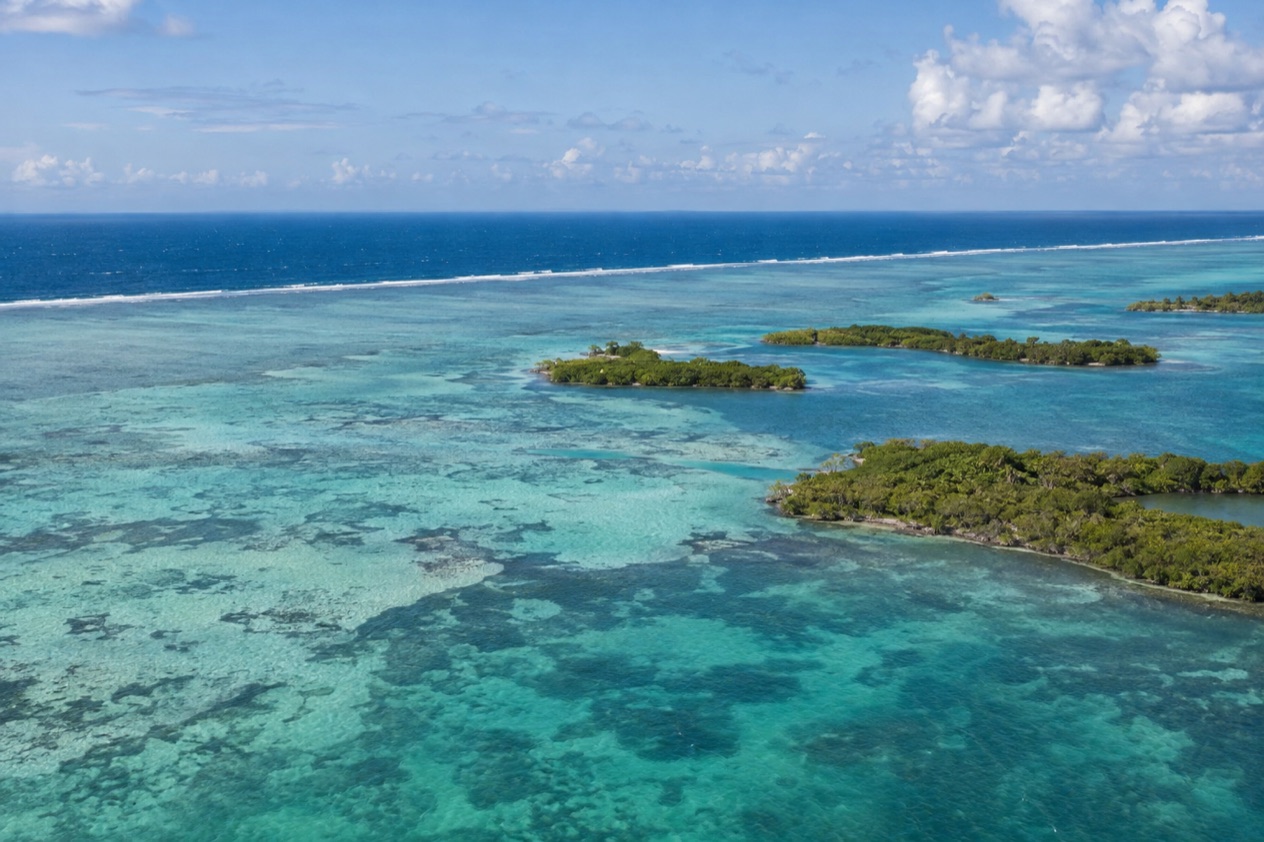
From the boat, the Great Blue Hole is a disc of deep indigo set in the pale turquoise of Lighthouse Reef, so round it looks drawn with a compass. Out here there is no beach and no dock, only a ring of reef and the open sea around it. Diving the Great Blue Hole is a day on the water at the heart of a protected atoll, for divers who want to drop beside the edge of an ancient sinkhole.
Is visiting diving the Great Blue Hole worth it?
Yes, if you are a certified diver who wants to see one of the most talked-about dive sites in the Caribbean, and also if you are a traveler who simply likes the idea of reaching a natural wonder by boat. The primary focus of the site is diving the sinkhole itself, and it is the reason the boats go out.
What sets it apart from the other reefs of Belize is the shape and the story. The hole is a circle 1,043 feet across and 407 feet deep, a drowned limestone cave that once stood dry before the sea rose.
Stalactites inside it tell of formation over many thousands of years. Discovery Channel ranked it number one on its list of The 10 Most Amazing Places on Earth in 2012, and it belongs to the Belize Barrier Reef Reserve System, a UNESCO World Heritage Site.
It is also different from a typical colorful reef dive. The wall of the sinkhole is dramatic rather than crowded with coral, and the pleasure lies in the scale, the ledges, the stalactites and the sense of hanging over deep blue.
Visitors generally pair it with Half Moon Caye, where the same trip adds birds, a beach and reef walls, so the day has more than one mood. Lighthouse Reef itself is considered one of the best developed and healthiest reefs in the Caribbean.
What to see at diving the Great Blue Hole
The site is a circular marine sinkhole near the center of Lighthouse Reef, a small atoll out beyond the mainland. The Blue Hole Natural Monument includes no land, so everything you see happens on the water or beneath it.
The reef rim and the edge of the hole
The rim supports a community of coral and tropical fish. The shallow reef edge sits at roughly 16 feet, then slopes gradually to about 33 feet before dropping to a near-vertical cliff into the dark center. Snorkelers can look down over this edge too, as divers and snorkelers both report sightings here.
Look for groupers, squirrelfish, angelfish, butterflyfish and midnight parrotfish along the rim. Turtles are reported by divers and snorkelers, among them green, hawksbill and loggerhead. Sharks include nurse, Caribbean reef and blacktip, and occasional visitors include great hammerheads, an endangered species, along with lemon and bull sharks.
Ledges, stalactites and the deep layers
Inside, the hole is classic karst limestone, formed in at least four stages before the sea rose. Those stages left ledges at about 69, 161 and 299 feet. The stalactites hanging in the cave date from the Pleistocene, and their analysis points to formation episodes stretching back 153,000 years.
Far below, a December 2018 submarine expedition found a layer of hydrogen sulfide at about 300 feet. Beneath it the water is dark, without oxygen and devoid of life. That depth is the reason the deep part of the hole is a story to read about rather than a place most of us will ever see.
Half Moon Caye, the usual second stop
Trips to the Blue Hole generally include Half Moon Caye. It has a rare surviving atoll siricote forest on its western half and a rookery of magnificent frigatebirds, plus a nesting colony of about 4000 red-footed boobies. The caye was set aside as a crown reserve in 1928 to protect those birds.
Visitors can take part in birding, camping, diving, snorkeling and picnicking. Loggerhead, green and hawksbill turtles have all been recorded nesting on the southeast-facing beach. Nearby dives include Half Moon Caye Wall, Angelfish Wall, Elkhorn Forest, Tarpon Caves and Eagle Landing, where divers may find parrotfish, eagle rays, Queen Conch and stingrays.
Hours, tickets and rules
The monument is open during daytime hours, and the fee depends on whether you are a Belizean national or not. Half Moon Caye has its own, lower fee, charged per day.
| Site | Open | Admission |
|---|---|---|
| Blue Hole Natural Monument | 8:00am to 4:30pm | BZ$2.50 nationals, BZ$60 non-nationals |
| Half Moon Caye Natural Monument | 8:00am to 4:30pm | BZD 2.50 per day nationals, BZD 20 per day non-nationals |
The Blue Hole Natural Monument has no visitor facilities other than mooring buoys provided for dive boats, and its mooring capacity is 370 gross tons. Mariners are required to contact Half Moon Caye park rangers on VHF Channel 16 before hitching onto a mooring or anchoring within the Half Moon Caye and Blue Hole Natural Monuments.
How to get to diving the Great Blue Hole
You reach the Great Blue Hole by boat with a tour operator. Operators depart from San Pedro, Caye Caulker, Hopkins and Placencia, and from resorts within the Turneffe and Lighthouse Reef atolls.
The hole lies near the center of Lighthouse Reef, an atoll in the Caribbean Sea, about 43 miles from the mainland and Belize City by one description and about 50 miles southeast of Belize City by another. Half Moon Caye, the usual second stop, is 55 miles east of Belize City. The same operators serve it, and tour operators are the most common way to get there.
Lighthouse Reef is a long, narrow atoll, about 22 miles from north to south and 5 miles wide, enclosing a shallow sandy lagoon. The Blue Hole sits within it, so your base matters only for where the boat leaves from. Staying at a resort on the atoll itself is another way in, since those resorts also run trips.
When to visit diving the Great Blue Hole
The monument is open from 8:00am to 4:30pm, so every visit falls within the daylight window, and the boats work to that rhythm. A morning start fits the way these trips are generally put together, with the hole and Half Moon Caye in one outing.
The Atlantic hurricane season runs from June 1 to November 30, which covers the second half of the year. That matters for anyone planning an offshore trip in those months, because the atoll sits out in open water. Outside those dates, the season is over for the calendar, though sea conditions still vary from day to day.
Birders may want to think about Half Moon Caye, where frigatebirds and red-footed boobies nest, and turtle lovers about its southeast beach, where three turtle species have been recorded nesting. For the Blue Hole itself, the sinkhole is the draw whatever the month, and the day is about being there when the boat is.
Tips for your visit
Plan for a day built around two stops, the sinkhole and Half Moon Caye, since visitors generally include both. Bring your dive certification if you plan to go down, and a mask and snorkel if you would rather look from the surface, as snorkelers also report sightings here.
Think of the Blue Hole as a place of looking. There is no land, no building and no facility, so what you carry is what you have, and the boat is your base. The monument offers nothing but mooring buoys for dive boats.
On Half Moon Caye you can bring a picnic, as picnicking is among the activities there, and take time for the birds. Camping is also among the activities, for those who want more than a single day on the caye. Other dive sites on the atoll, such as Long Caye Aquarium, Silver Caves, Tres Cocos and West Point, are worth asking your operator about.
Despite its protection, Lighthouse Reef suffers from uncontrolled fishing and tourism, so choose operators who respect the reserve and the mooring buoys. Because the Blue Hole has no land, there is nothing here for mobility or for small children to walk around on, and the visit is a boat-based one.
Good to know before you go
The U.S. State Department rates Belize Level 2, “Exercise increased caution”, because of crime, and says the south side of Belize City has historically had the highest concentration of violent crime.
The fees for both monuments are charged in Belize dollars and are shown in the table of fees earlier on the page. The hole is deep, and its lower reaches hold a layer of hydrogen sulfide, so the deepest part is not a place for casual exploration. The Atlantic hurricane season runs through November 30, which is worth remembering for any trip booked late in the year.
Sources
- Wikipedia, Great Blue Hole (https://en.wikipedia.org/wiki/Great_Blue_Hole), checked October 11, 2026
- Belize Audubon Society, Blue Hole Natural Monument (https://belizeaudubon.org/bhnm/), checked October 11, 2026
- Wikipedia, Lighthouse Reef (https://en.wikipedia.org/wiki/Lighthouse_Reef), checked October 11, 2026
- Belize Audubon Society, Half Moon Caye Natural Monument (https://belizeaudubon.org/hmcnm/), checked October 11, 2026
- U.S. Department of State, Belize Travel Advisory, Level 2, March 11, 2026 (https://travel.state.gov/), checked October 11, 2026
- NOAA National Hurricane Center, Climatology (https://www.nhc.noaa.gov/climo/), checked October 11, 2026