
On a Gulf Coast morning, the Galveston seawall fills with gulls and the long white shapes of ships tied up at the pier, and someone in a Texas kitchen is asking whether one of them might end in Belize. The honest picture has two halves: the ships that leave Galveston, and the two very different ports where cruise travelers meet Belize. Put side by side, they let a Texas traveler see how a Gulf departure and a Belizean call fit together.
Which Belize cruises leave from Galveston?
Two big names sail from the Port of Galveston, Disney Cruise Line and Royal Caribbean International, and the seven-day cruises that leave the port cover Caribbean itineraries. That is the departure side of the story. Belize enters it through its two cruise ports, Fort Street Tourism Village in Belize City and the Harvest Caye Port in the south of the country, each described further down.
Galveston makes sense for a lot of Texas households for a simple reason: you can begin a cruise vacation without flying anywhere first. Disney’s presence there lets families start a Disney vacation without going to Florida, and that changes the whole feel of the first morning, with car seats and strollers heading to the pier instead of an airport.
Disney Cruise Line and Royal Caribbean
Disney Cruise Line sails from Galveston with Texas families in mind. Royal Caribbean International also offers cruises from the Port of Galveston, and one of its Oasis-class ships, Allure of the Seas, has a terminal of its own there. If you are weighing a Belize stop, look at the itinerary of each sailing, because a Caribbean route is not automatically a Belize route.
What you can picture is the departure day itself: a ship the size of a small neighborhood alongside the pier, a long line of travelers with sun hats and carry-on bags, and a sense that the Gulf is about to open in front of you. The Gulf is also close, which shapes the first hours of the trip.
The port behind the ships
The Port of Galveston is the oldest port in the Gulf of Mexico west of New Orleans, and it marked its 200th anniversary in October 2025. It is self-sustaining and receives no taxpayer funding. Its two dedicated cruise terminals are not used for conferences or corporate events, so the buildings are given over entirely to ships and passengers.
From the pier the open Gulf is about 9.3 miles away, roughly half an hour of sailing, so the ship is in blue water soon after the lines are cast off. For a Belize-bound cruiser that means the first sea day starts early, with the Texas shoreline fading behind you.
How do you get to the cruise terminal in Galveston?
You arrive at one of the port’s two dedicated cruise terminals, and the one you use depends on your ship. Terminal 3 serves Royal Caribbean’s Oasis-class Allure of the Seas exclusively, so a traveler on that ship heads there, while passengers on other ships follow the terminal named in their cruise documents.
Check-in at most Port of Galveston cruise terminals opens around 10:30 to 11:00 a.m., and boarding typically begins between 11:00 a.m. and noon. In practice that makes embarkation day a late-morning affair rather than a dawn scramble, which is easier on families who have driven in from Houston, Austin or farther away.
Being dropped off at the terminal
The port charges an access fee for private operators who enter the cruise terminal area to pick up or drop off passengers. If a friend, a rideshare operator or a hired car is bringing you, that fee belongs in the conversation before the trip. It applies to the operator entering the terminal area, not to you as a passenger.
The mood at the curb is its own small scene. Suitcases come out of trunks, kids stare up at the funnel, and the sea air carries a hint of salt and diesel. Taking a moment to find the right terminal before the doors open makes the whole thing calmer.
Fog and the return to port
Galveston differs from other U.S. cruise ports in one way that matters at the far end of a trip. Fog can affect the port, particularly in late December, January and February, and it can delay a ship’s return. If your cruise falls in those months, treat the last morning as flexible and avoid tying it to a tight onward connection.
A ship held back by fog usually means a slow, quiet arrival with the shoreline emerging from gray. It is part of the character of a Gulf winter, and a good reason to leave breathing room around the end of the cruise.
Where do the ships stop in Belize?
Cruise passengers meet Belize at two ports, Fort Street Tourism Village in Belize City and the Harvest Caye Port in the south, and they could hardly be more different. Cruise ships first dropped anchor in Belizean waters in 1991, and the country has been a Caribbean port of call ever since.
Fort Street Tourism Village, Belize City
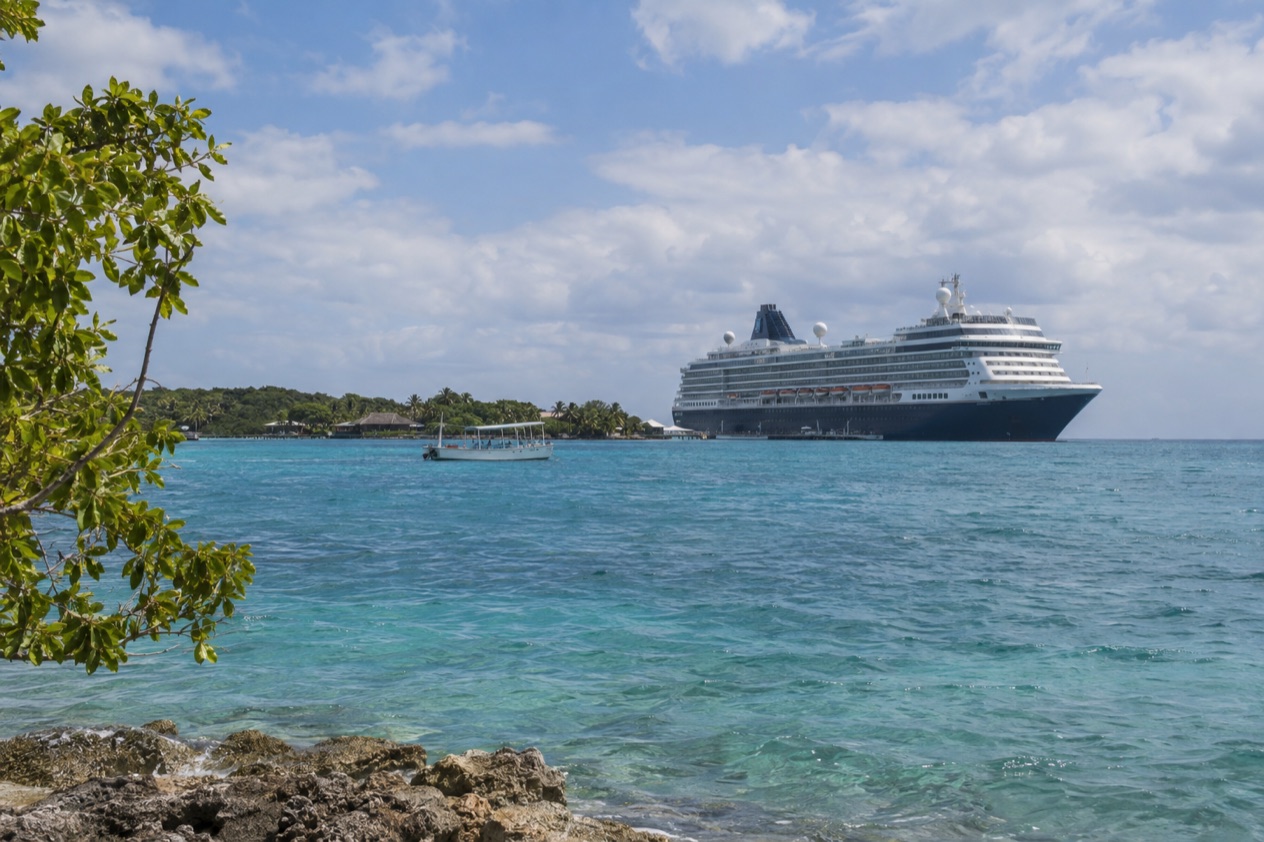
Fort Street is a tender port, meaning ships anchor offshore and passengers ride small boats to land. The trip from ship to shore takes approximately 15 minutes. The village sits at the mouth of Halouver Creek, on the northern bank in Belize City, on about two acres of land.
On arrival you walk into a compact complex of courtyards with snack bars, local stores with duty-free shopping, restaurants and live local entertainment. It works as a first taste of the city, with music in the air and a counter where you can try something local before choosing what to do next.
Harvest Caye Port
Harvest Caye is a private island in southern Belize owned by Norwegian Cruise Line, and its port sits on the southern end of the island. It was the first port in Belize to let cruise vessels dock rather than requiring tenders, so there is no boat transfer between the ship and the pier.
The island’s wildlife exhibitions include a blue morpho butterfly house, a gentle stop for anyone who likes to watch bright wings drift between leaves. Because the island is privately owned, the experience stays on the island itself, in contrast to the city setting of Fort Street.
What do you need to board?
What matters at the Galveston pier is proof of identity and citizenship that will also get you back into the United States, and the rules differ slightly by how you arrive back. By air, U.S. citizens present a valid U.S. passport, a Trusted Traveler Program card (NEXUS, SENTRI or FAST), a U.S. military identification card when traveling on official orders, or a U.S. Merchant Mariner document for official maritime business.
By sea or land, the list is longer. U.S. citizens can present a valid passport, a Passport Card, an Enhanced Driver’s License, a Trusted Traveler card, a military identification card on official orders, a Merchant Mariner document for official maritime business, a Form I-872 American Indian Card or an Enhanced Tribal Card. A cruise that begins and ends in Galveston returns by sea, so that is the list that applies on the way home.
Children and permanent residents
U.S. and Canadian citizen children under 16, or under 19 if traveling with a school, religious or youth group, need only present a birth certificate or other proof of citizenship when entering by land or sea. Children are required to present their own passport when traveling by air, and the Indian or tribal card cannot be used for air travel.
Lawful permanent residents of the United States still need a valid Permanent Resident Card to enter the country, and a passport is not required for that purpose. Sorting these papers into one folder before leaving home makes the check-in line much calmer.
Alcohol and cigarettes on the way home
Since 2014 the Texas Alcoholic Beverage Commission has collected taxes from cruise passengers returning to the Port of Galveston on any alcohol and cigarettes bought onboard or in foreign ports. A bottle brought home from Belize therefore falls under that rule, so it is worth remembering when you browse the duty-free shops at Fort Street.
Good to know before you go
The U.S. State Department rates Belize Level 2, “Exercise increased caution”, because of crime, and says the south side of Belize City has historically had the highest concentration of violent crime.
Passengers entering or leaving Belize must declare currency exceeding US$10,000. The Atlantic hurricane season runs from June 1 to November 30, and a Galveston sailing in those months falls inside it.
Fog, by contrast, is the winter concern at the Texas end of the trip. For Belize City itself, keep to the busy, lit waterfront of Fort Street Tourism Village, which was built for visitors, and use the ship’s own information for anything beyond it.
Sources
- Port of Galveston, cruise (https://www.portofgalveston.com/cruise), checked October 11, 2026
- Wikipedia, Port of Galveston (https://en.wikipedia.org/wiki/Port_of_Galveston), checked October 11, 2026
- Belize Tourism Board, Cruise licensing (https://www.belizetourismboard.org/licensing/cruise/), checked October 11, 2026
- Belize Port Authority, Fort Street Tourism Village port (https://portauthority.bz/belize-port-facilities/fort-street-tourism-village-port/), checked October 11, 2026
- Belize Port Authority, Harvest Caye port (https://portauthority.bz/belize-port-facilities/harvest-caye-port/), checked October 11, 2026
- Wikipedia, Harvest Caye (https://en.wikipedia.org/wiki/Harvest_Caye), checked October 11, 2026
- Philip S. W. Goldson International Airport (Belize), FAQ (https://www.pgiabelize.com/about-us/faq/), checked October 11, 2026
- Philip S. W. Goldson International Airport (Belize), Quick facts (https://www.pgiabelize.com/passenger-info/quick-facts/), checked October 11, 2026
- U.S. Customs and Border Protection, Western Hemisphere Travel Initiative (https://www.cbp.gov/travel/us-citizens/western-hemisphere-travel-initiative), checked October 11, 2026
- U.S. Department of State, Belize Travel Advisory, Level 2, March 11, 2026 (https://travel.state.gov/), checked October 11, 2026
- NOAA National Hurricane Center, Climatology (https://www.nhc.noaa.gov/climo/), checked October 11, 2026
To plan your stay
- Best Time for a Belize Cruise: Dry Season, Hurricane Season and Month-by-Month Weather
- Belize Shore Excursions: Altun Ha, Lamanai, Nohoch Che'en and Flights Over the Great Blue Hole
- Fort Street Tourism Village: Belize City's Cruise Port, What Is Inside and How Passengers Reach It
- Harvest Caye Belize: Norwegian's Private Island, the Dock and What to Do Ashore