
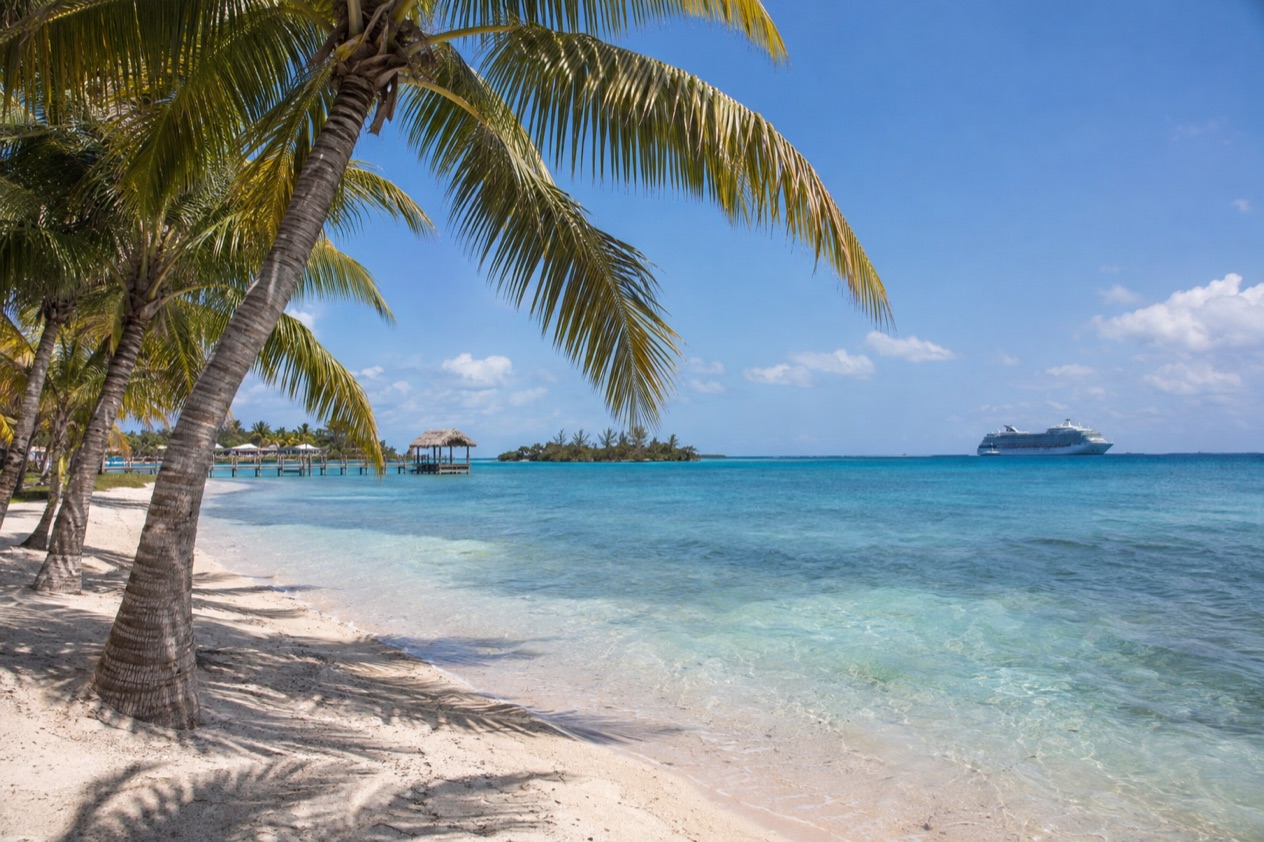
A ship slides alongside a pier in southern Belize, and instead of waiting for a tender, passengers simply walk down the gangway onto a small island of palms, a pool and a beach. That is Harvest Caye, a private island in the Stann Creek District that belongs to Norwegian Cruise Line. It is a stop for Norwegian passengers rather than a place you reach by your own means, and it is a very different kind of Belize day from the one you get in Belize City.
What is Harvest Caye?
Harvest Caye is a private island in southern Belize, owned by Norwegian Cruise Line and built as a cruise destination with its own pier, pool, beach and nature area. It sits in the Stann Creek District, the southeastern part of the country, and the port itself lies on the southern end of the island.
What sets the port apart in the history of Belize cruising is the dock. Harvest Caye Port is the first port in Belize where cruise vessels dock instead of anchoring offshore and sending passengers in by tender.
For anyone who has stood in a tender line elsewhere in the Caribbean, that changes the rhythm of the morning: you step off the ship and you are already on the island. The port facility is ISPS compliant, which is the international security standard for ports that receive ships.
The island and its setting
The island is small and organized around the visitor who has a single day ashore. Instead of a town, you find a purpose-built landscape: a large pool, a beach, bars and eateries, and an enclosed nature area with birds and butterflies.
Palms and tropical gardens give it the look of a resort more than of a Belizean village, and that is the point. It is a place to settle in with a drink and a view of the water.
Because it is private, Harvest Caye does not have Belizean streets, markets or neighborhoods. If what you want is the everyday country, with its Garifuna drumming, Creole kitchens and village life, that happens on the mainland of the Stann Creek District, not on the island itself.
Why it matters for Belize cruising
Cruise ships first dropped anchor in Belize’s waters in 1991, and for decades the standard picture was a ship offshore and passengers ferried in. It also shifted cruise traffic toward the southern end of the coast, close to Placencia and the villages of the Stann Creek District.
The island has also had its share of debate. On May 23, 2017, personnel from Harvest Caye, accompanied by Edgar Correa of the Belize Forestry Department, removed a juvenile Scarlet Macaw from Belize Bird Rescue to add to the island’s wildlife exhibits. The episode is part of the story of how the island’s animal displays came to be, and it is the kind of detail that explains why many Belizeans follow what happens on the caye closely.
Which cruise line goes to Harvest Caye?
Only Norwegian Cruise Line goes to Harvest Caye. The Belize Tourism Board describes the cruise port in the southern Stann Creek District as catering only to Norwegian Cruise Line passengers, and the line owns the island outright.
That exclusivity shapes everything about the visit. Passengers from other lines call elsewhere in Belize, so a Norwegian itinerary is the way onto this island, and a day here belongs to a ship’s schedule rather than to an independent traveler’s plans. The port even lists a Norwegian address for inquiries, with its own telephone line and a website at www.nclhltd.com, which tells you whose island it is.
How it differs from the Belize City port
The other familiar cruise stop in the country is the Fort Street Tourism Village Cruise Port in Belize City, a tender port where the trip from ship to shore takes approximately 15 minutes. It has several courtyards, snack bars, restaurants, live local entertainment and local stores with duty-free shopping.
Set side by side, the two give a clear choice of character. Fort Street is a city landing built around shopping and a first taste of local music. Harvest Caye is an island day built around water, shade and wildlife. Passengers who sail with Norwegian are the only ones who can see the second, and ships of other lines see the first or other ports of call.
Finding the cruise calendar
The Belize Tourism Board publishes a free BTB Cruise App, available on Google Play and the iOS App Store, which lets you view the cruise schedule. It is a handy way to see which days ships are expected in port, a useful detail if you are staying on the mainland nearby and want to know when the coast will be busier with visitors in port.
If you are a cruise passenger, your own itinerary from the line is the thing that tells you which day Belize falls on. The app is more a window onto the wider calendar than a booking tool.
What can you do at Harvest Caye?
At Harvest Caye you can spend the day at a large pool and a beach, try zip-lining and water sports, wander through an enclosed nature area with birds and butterflies, and settle in at the bars and eateries. The island is laid out so that a day passes between sun, water and a cold drink.
Pool, beach and water sports
The center of the island is its water. A large pool sits near the beach, with the bars and eateries close at hand, so the day tends to move between the two: a stretch under the palms, a drink in the shade, a turn in the water. The beach looks out on the Caribbean on Belize’s southern coast, where the sea takes on the soft turquoise that makes people book a cruise in the first place.
Water sports are part of the offering, and zip-lining adds a more energetic option for anyone who wants to see the island from above the tree line. As with any activity on a private island, the details of what is offered on a given day come from the line and its ship, so the shore excursion list in your cruise materials is the place to look.
The nature area and the butterfly house
The enclosed nature area is where Harvest Caye puts its wildlife on show, with birds and butterflies in a setting meant to be walked slowly. The wildlife exhibitions include a blue morpho butterfly house, and the blue morpho is the one to look for: its wings flash an electric blue when open and fold to a dull brown when closed, so the butterfly seems to blink in and out of sight as it drifts between flowers.
Scarlet Macaws are part of Belize’s wild birdlife, and the island’s displays of birds tie into that national story. It is a gentle stop for anyone traveling with a family or anyone who prefers looking at animals to riding a zip line, and it pairs naturally with a long, unhurried lunch afterward.
Eating, drinking and lingering
Bars and eateries are spread through the island, and the mood is that of a beach club: cold drinks, something to eat, a chair with a view. Rum punch and a cold local beer such as Belikin are the kinds of things you will find in many Belizean beach bars, and it is a good moment to try them if the menu offers them.
With a pool, a beach, a nature area and a dock all in one place, the choice on Harvest Caye is less about where to go than about how to divide your time. A walk through the butterflies in the first part of the day, the water after that and a last drink near the pier make a natural shape for an island day.
What do you need to know before you go ashore?
Before you go ashore, you need to know that Harvest Caye is a private island run by Norwegian Cruise Line, so your way in is through your ship, and that the mainland of southern Belize lies beyond it. Plan your day around what the island offers and around what you want to see of the country.
A private island, a real country
The island is a controlled setting, and it is owned by the cruise line, so it gives you a sample of Belize’s coast rather than of the country’s daily life. Belize itself is richer than the caye suggests. The Stann Creek District, where the island sits, is home to Dangriga, the district capital, formerly known as Stann Creek Town, and to the Garifuna village of Hopkins, whose tourism has grown quickly in recent years.
The Garifuna are descendants of a group of African slaves who escaped two shipwrecked Spanish slave ships near St. Vincent in 1635, and their music, drumming and cassava bread are among the cultural treasures of this stretch of coast. Reading about them before you arrive adds depth to a day that is otherwise spent on a private beach.
Placencia and the rest of the district
Placencia is a small village on the Placencia Peninsula in the Stann Creek District, with resorts, guest houses, hotels and white sandy beaches. Its Sidewalk is a concrete pedestrian-only path that runs most of the length of the village and ends at the sea, lined with businesses. Snorkeling, diving, kayaking and saltwater fly fishing are all part of what the village offers.
In the spring and early summer, around the full moon, whale sharks pass Gladden Spit near Placencia, one of the great wildlife events of the Belizean coast. The barrier reef lies off this coast, and Laughing Bird Caye is a National Park and World Heritage Site. Further inland, the Cockscomb Basin Wildlife Sanctuary holds Victoria Peak, the second highest point in Belize at 3,670 feet.
What the numbers say about cruise visitors
The Belize Tourism Board reports that the share of cruise passengers who disembark is 80 percent, while for crew members it is 15 percent. That shows how most of a ship’s passengers choose to go ashore, which means the pier and the island will be lively whenever a ship is in.
The tour purchasing rate among disembarked cruise passengers in Belize is 60 percent, well above the Caribbean average of 35 percent. In other words, passengers here are keen to book organized outings, which fits a country whose appeal lies as much in its reef, forests and villages as in any single beach.
Good to know before you go
The U.S. State Department rates Belize Level 2, “Exercise increased caution”, because of crime, and says the south side of Belize City has historically had the highest concentration of violent crime.
The Atlantic hurricane season runs from June 1 to November 30, and southern Belize has felt it before: Hurricane Iris struck the south on October 8, 2001, with 145 mph winds and damaged nearly 95 percent of the buildings in Placencia. A cruise itinerary in those months can change with the weather, and that is part of sailing in the Caribbean.
If you extend your stay on the coast, Placencia has water you can drink, plumbed in from an artesian well on the mainland. Bring sunscreen and repellent, and consider eco-friendly versions if you plan to snorkel or dive near the reefs.
Sources
- Belize Port Authority, Harvest Caye port (https://portauthority.bz/belize-port-facilities/harvest-caye-port/), checked October 11, 2026
- Wikipedia, Harvest Caye (https://en.wikipedia.org/wiki/Harvest_Caye), checked October 11, 2026
- Belize Tourism Board, Cruise licensing (https://www.belizetourismboard.org/licensing/cruise/), checked October 11, 2026
- Wikipedia, Placencia (https://en.wikipedia.org/wiki/Placencia), checked October 11, 2026
- Wikivoyage, Placencia (https://en.wikivoyage.org/wiki/Placencia), checked October 11, 2026
- Wikipedia, Stann Creek District (https://en.wikipedia.org/wiki/Stann_Creek_District), checked October 11, 2026
- U.S. Department of State, Belize Travel Advisory, Level 2, March 11, 2026 (https://travel.state.gov/), checked October 11, 2026
- NOAA National Hurricane Center, Climatology (https://www.nhc.noaa.gov/climo/), checked October 11, 2026
To plan your stay
- Best Time for a Belize Cruise: Dry Season, Hurricane Season and Month-by-Month Weather
- Fort Street Tourism Village: Belize City's Cruise Port, What Is Inside and How Passengers Reach It
- Altun Ha from the Belize City Cruise Port: the Jade Head, the Temple Pyramids and the Road North
- Belize City Cruise Port: Fort Street Tourism Village, Tender Landings and What to Do Ashore