
MIAMI · AUGUST · 25.8° N
August is the month Miami’s thermometer and its price tags move in opposite directions. The official gauge at Miami International puts the average high at 90.7°F and the average low at 77.7°F, with 9.58 inches of rain spread across roughly thirteen wet days. Offshore, the water sits at 88.3°F. Hotel rates, meanwhile, are in their annual trough.
The trade is straightforward once you know the shape of the day: mornings belong to the beach, afternoons belong to the storm, and evenings hold light until nearly eight. City logistics that don’t change with the calendar, from the $2.25 Metrorail ride to which beach lots are cheapest, live in getting around Florida.
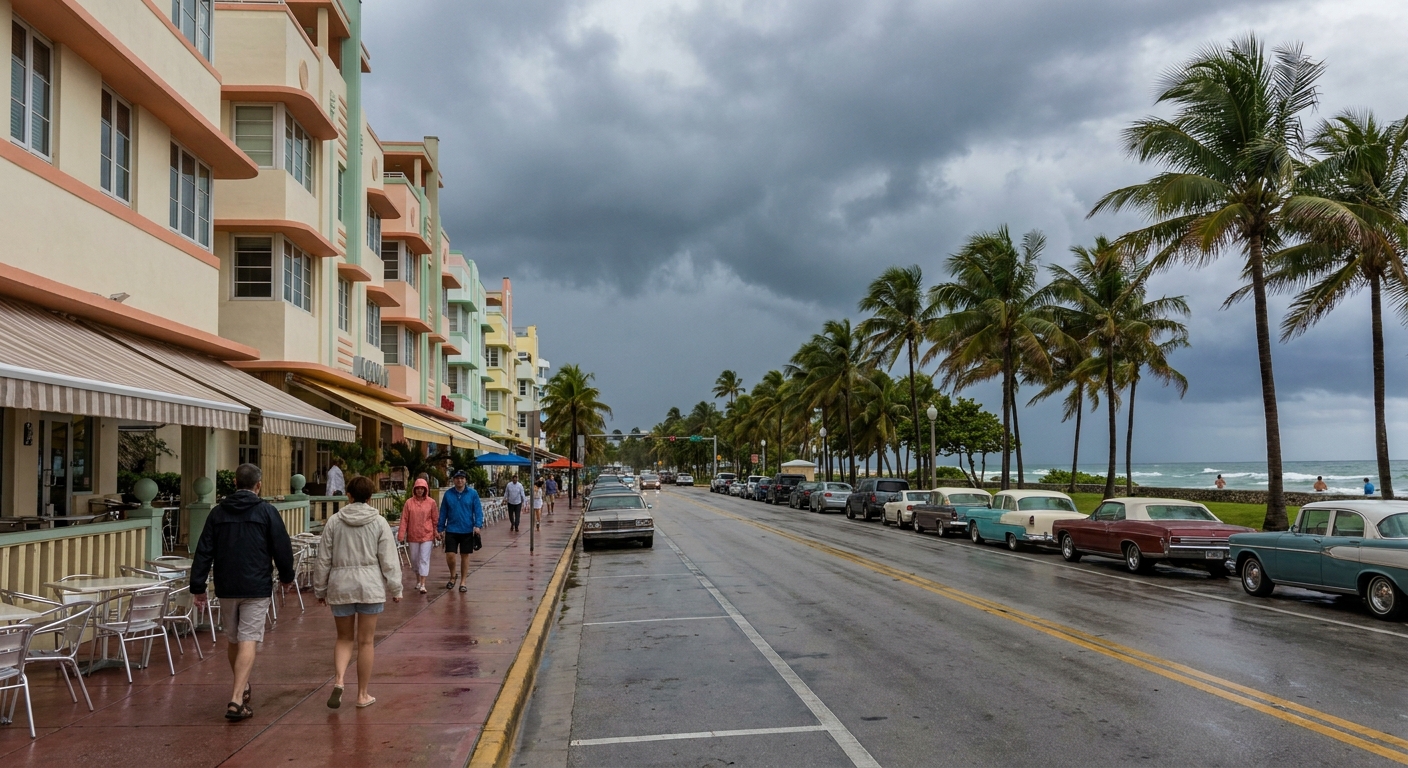
THE MONTH AT A GLANCE · MIAMI IN AUGUST
August hands you the warmest of the three summer sea readings (88.3°F) and the softest hotel rates of the year, then charges for both with 90.7°F afternoons, 9.58 inches of rain and a place inside the hurricane window.
AVG HIGH 90.7°F · AVG LOW 77.7°F · 9.58 IN OF RAIN · SEA 88.3°F · 13H 04M OF DAYLIGHT
Go for: swimming at 88.3°F, the year’s lowest room rates, free museum evenings (PAMM, Thursdays 5 to 9 p.m.) and usable light until 7:57 p.m.
Think twice before: booking nonrefundable or planning long midday walking: 13.3 days a month record 0.10 inch or more, and 2.9 of them record a full inch.
Climate: NOAA NCEI 1991-2020, station USW00012839 · Sea: Open-Meteo Marine · Tax: Florida Dept. of Revenue · full sources at the end
On this page
- Average highs, lows and rain days90.7°F and 13.3 wet days
- Sea temperature for swimming88.3°F, and what the figure measures
- Hotel prices and crowd levels in AugustThe annual rate trough, plus 12% tax
- What’s open, and at what priceVizcaya, PAMM, Lummus Park
- A two-day plan around the stormsThe hour-by-hour August itinerary
- August vs July and September in MiamiThree months of rain, heat and sea
- Is August a good month to go?The verdict, and the month to shift to
One fact colors everything that follows. NOAA’s National Hurricane Center dates the Atlantic season June 1 to November 30, with a September 10 peak and most activity between mid-August and mid-October. August sits inside that window, which is why refundable rates matter more here than they do in March.
Miami weather in August: average highs near 91°F and 13.3 rain days
| Measure | August normal (1991-2020) |
|---|---|
| Average high | 90.7°F (32.6°C) |
| Average low | 77.7°F (25.4°C) |
| Total precipitation | 9.58 in |
| Days with 0.10 in or more | 13.3 |
| Days with 1.00 in or more | 2.9 |
| Daylight on Aug 15 | 13h 04m |
These numbers come from one place: NOAA’s National Centers for Environmental Information, monthly normals for 1991-2020 at station USW00012839, the gauge at Miami International Airport. The distinction is worth a sentence, because an official station record and a grid-cell reanalysis are not interchangeable. The station reads an average high of 90.7°F, an average low of 77.7°F and 9.58 inches of rain for the month.
Those 9.58 inches arrive in installments, not in a gray week. An average August records 0.10 inch or more on 13.3 days, and a full inch or more on 2.9 of them. Practically, that is a wet hour rather than a wet day: heat and humidity of 85 to 90 percent build through the morning, the thunderstorm breaks in the afternoon, and the sidewalks are drying before dinner.
The day-night gap is only 13 degrees, and it changes what goes in the bag. Nothing in an August night calls for a jacket, since the low averages 77.7°F. What you do want is a packable rain shell for the afternoon, a second shirt because the first one will be finished by noon, and one light layer for restaurants that treat air conditioning as a competitive sport.
Light is generous but no longer at its June maximum. On August 15 the sun rises at 6:52 a.m. and sets at 7:57 p.m. local time, giving 13 hours 4 minutes of daylight (sunrise-sunset.org, converted from UTC). That puts the beach’s best hour before nine and the second-best after six, with maybe twenty more minutes of usable sky after sunset (est.).
Can you swim in Miami in August? Sea temperature and what 88.3°F feels like
The sea surface off Miami averages 88.3°F in August, from the Open-Meteo Marine API over 2015-2024. Read the fine print on that figure: it is the mean of daily maxima, so it runs a shade warmer than a 24-hour average would. Call it the afternoon water rather than the dawn water, and you have it right.
At that temperature there is no gasp and no acclimatization minute. Children stay in for an hour without going blue, and adults who normally hate cold water discover they have no complaints left. The catch is that the sea offers almost no cooling: with air lows of 77.7°F, you come out of the water at roughly the temperature you went in. Lummus Park, the free beach fronting Ocean Drive between 5th and 15th Streets, is open around the clock with lifeguards, restrooms and picnic tables.
On wind and swell we have nothing to sell you. The marine dataset behind that 88.3°F reads surface temperature, not wave height, and we would rather say so than dress up a surf forecast. What is documented is the season: August falls inside the busiest half of the hurricane calendar, and the statewide season page lays out how that risk is distributed month by month.
How busy is Miami in August? Crowds, hotel prices and the 12 percent room tax
In the city’s price year, August sits at the bottom. Market data relayed by local operators puts Miami hotel rates at their lowest from August through October and their highest from February through April, which is the mirror image of the calendar most visitors assume. That is a market trend rather than an official statistic, but it tracks the weather: statewide the wet season runs May through October, and South Florida’s warm, dry stretch is December to April.
What that changes for booking is the lead time and the cancellation policy. Two or three weeks ahead is usually enough for a decent Collins Avenue room in August (est.), against the months-out scramble a March trip demands. Spend the flexibility you save on a refundable rate, because the peak of the hurricane season lands on September 10 and August is already inside the active window.
Then come the additions to the quoted rate. Miami-Dade County levies a 6.0 percent transient rental tax, filed and paid alongside the 6 percent state sales tax, so plan on about 12 percent on top of the nightly figure (Florida Department of Revenue, form DR-15TDT). Miami Beach hotels commonly stack a resort fee above that, and published amounts diverge sharply by source and category, from roughly $25 on average to $35 or even $95 at individual properties. Our cost guide breaks the layers apart.
There is one line where paying more genuinely changes an August trip: the pool. A room with water and shade on site turns the 2 p.m. storm hour from a loss into a nap, and it costs less in August than the same room costs in March. Getting around, by contrast, barely needs money: the Miami Beach trolley is free, 8 a.m. to 11 p.m., seven days a week on five routes, roughly every 20 minutes.
Things to do in Miami in August: Vizcaya, PAMM’s free Thursdays and the free trolley
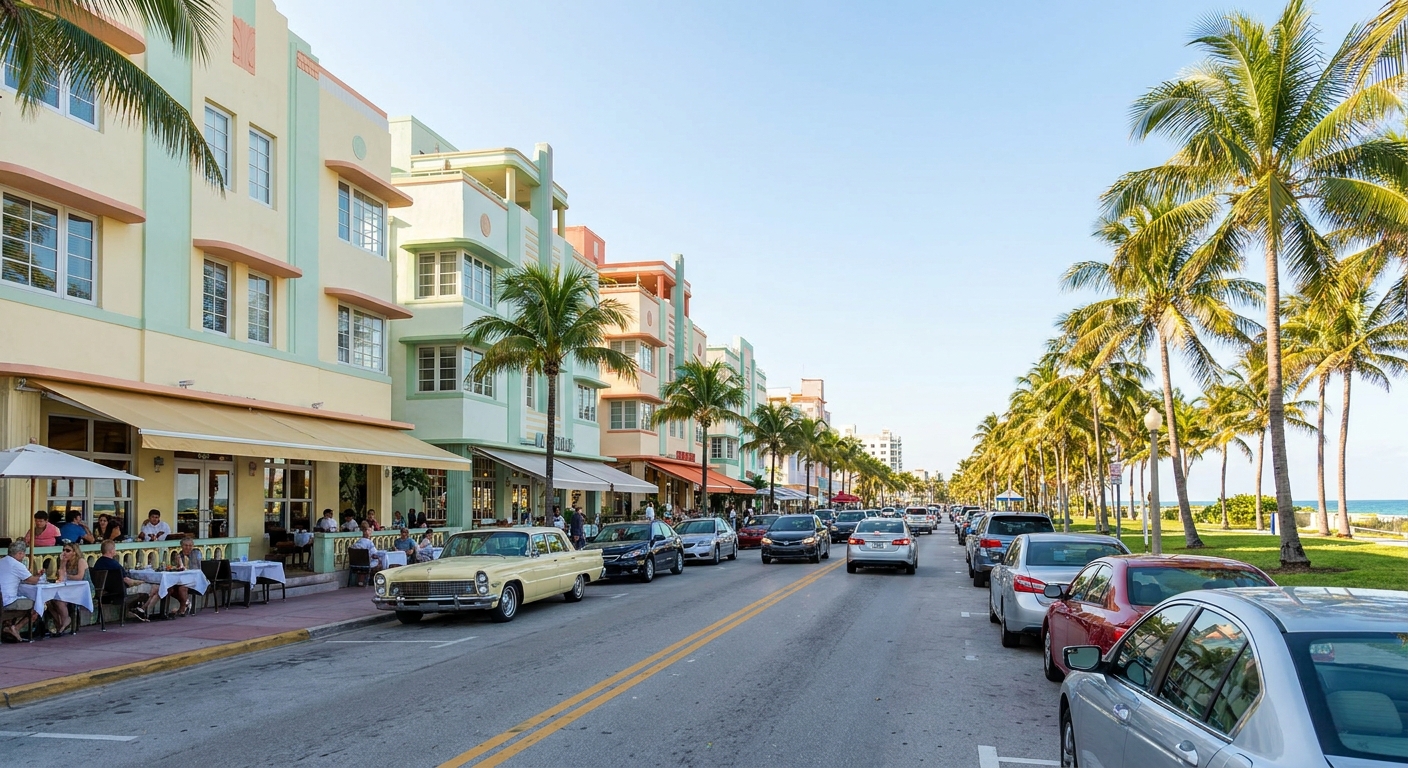
August is the one month that pairs the warmest of the three summer sea readings (88.3°F, against 88.2°F in July and 87.8°F in September) with rates inside the August-to-October trough. Long light helps too: sunset at 7:57 p.m. on the 15th means a full beach evening after the storm has cleared, which a February visit at the same latitude cannot give you.
Vizcaya Museum and Gardens opens Wednesday to Monday at 9:30 a.m. with last admission at 4:30 p.m., and closes on Tuesdays. Adult admission is $20 while restoration work continues, down from a usual $25, with children 6 to 12 at $5 and under-6 free. It stands in north Coconut Grove, inside the City of Miami rather than in Coral Gables, which is a separate municipality with its own government. The Metrorail Vizcaya station is a few minutes’ walk, and a single ride is $2.25.
The free list is longer than August’s budget deserves. The Perez Art Museum Miami costs nothing from 5 to 9 p.m. every Thursday and nothing at all on the second Saturday of the month, with art-making from 11 a.m. to 3 p.m. The Metromover is free across Downtown and Brickell, with cars every 90 seconds at rush hour and every three minutes off-peak. South Pointe Park is free to enter, though its lot starts at $2 an hour and charges a $20 flat rate on weekends and public holidays.
Two days in Miami in August: itinerary and afternoon thunderstorm timing
Day one. Sunrise is at 6:52 a.m., so be on the sand at Lummus Park by 7:30 while the air is still short of 85°F, and swim first. Ride the free trolley up Collins after breakfast, then take the Metrorail to Vizcaya for the 9:30 a.m. opening ($20 adult, closed Tuesdays) and be out of the gardens before the heat peaks. Keep 2 to 4 p.m. indoors and air-conditioned. If it is a Thursday, PAMM is free from 5 to 9 p.m. Finish on the water at sunset, 7:57 p.m.
Day two. Start with the mainland while it is bearable: Wynwood and Little Havana are City of Miami neighborhoods, and the free Metromover covers Downtown and Brickell between them. Swim at midday from South Pointe Park, where the lot runs $2 an hour on a weekday and a $20 flat rate on a Saturday. If the sky turns into one of the month’s 2.9 inch-plus days, the plan does not collapse: PAMM’s second Saturday is free all day, Vizcaya’s indoor rooms take an hour, and the trolley runs until 11 p.m.
Miami in August vs July and September: rain, heat and sea temperature
| Measure | July | August | September |
|---|---|---|---|
| Average high | 90.6°F | 90.7°F | 89.0°F |
| Average low | 77.5°F | 77.7°F | 76.9°F |
| Precipitation | 7.36 in | 9.58 in | 10.22 in |
| Days with 0.10 in or more | 11.1 | 13.3 | 13.1 |
| Sea surface (daily maxima) | 88.2°F | 88.3°F | 87.8°F |
On heat, the three months are effectively tied: 90.6°F in July, 90.7°F in August, 89.0°F in September, all from the same NOAA station and the same 1991-2020 period. Rain is where they separate. July gets 7.36 inches over 11.1 wet days, August 9.58 inches over 13.3, and September 10.22 inches over 13.1. The water follows the same gentle arc, peaking at 88.3°F in August and easing to 87.8°F by September.
Shift four weeks earlier and you buy back two inches of rain and two dry days for an identical afternoon high, which is the case July makes. Shift four weeks later and you lose almost two degrees of afternoon heat and half a degree of sea warmth, but you land on the September 10 statistical peak of the hurricane season, as the September page spells out. August is the compromise between the two, and it is priced like one.
Is August a good time to visit Miami?
Yes, if your Miami is mostly horizontal and mostly wet: swimmers, families who want a pool and a beach twenty minutes apart, and travelers whose budget picks the dates. The 88.3°F water and the year’s softest rates are a real combination. No, if you walk cities at midday, if you cannot book refundable, or if the trip includes serious time outdoors inland, since the Everglades are at their least rewarding under wet-season heat and mosquitoes.
If the answer is no, the month to prefer is anywhere in December to April, South Florida’s warm dry stretch. The gap is not subtle at the same gauge: January records 1.83 inches of rain against August’s 9.58, and the whole statewide argument is set out in when to visit Florida. You will pay for it, because February to April is exactly when Miami’s rates top out.
What no other month matches: water at 88.3°F, thirteen hours of daylight, and a Collins Avenue room priced as though nobody wanted it.
The last word
Settle one question before you book anything: can your two days be built around a 2 p.m. storm? If yes, August is a bargain with a warm sea attached. If no, move the trip and pay February’s prices without complaining. And skip the rental car either way. Metrorail and Metrobus cap at $5.65 a day for unlimited rides, route 150 runs from the airport across the Julia Tuttle Causeway for $2.25 with luggage racks aboard, and the Miami Beach trolley costs nothing at all. That parking money buys a room with a pool.
Sources & data for this guide
- August normals: high 90.7°F, low 77.7°F, 9.58 in · NOAA NCEI monthly normals 1991-2020, station USW00012839 (Miami International Airport) · checked Sep 8, 2026
- Rain-day counts: 13.3 days at 0.10 in or more, 2.9 days at 1.00 in or more · same NOAA normals · checked Sep 8, 2026
- July and September figures in the comparison table · same NOAA station and same 1991-2020 period, not estimates · checked Sep 8, 2026
- January (1.83 in) and June (10.51 in) rainfall used for contrast · same NOAA normals · checked Sep 8, 2026
- Sea surface 88.3°F, mean of daily maxima 2015-2024 · Open-Meteo Marine API · checked Sep 8, 2026. The same source gives 88.2°F for July and 87.8°F for September.
- Daylight of 13h 04m and sun times on Aug 15 · sunrise-sunset.org, 10:52 and 23:57 UTC converted to America/New_York · checked Sep 8, 2026
- Hurricane season dates and the September 10 peak · NOAA National Hurricane Center · checked Sep 8, 2026
- 6.0% Miami-Dade transient rental tax, filed with the 6% state sales tax · Florida Department of Revenue, form DR-15TDT · checked Sep 8, 2026
- Vizcaya hours, Tuesday closure and $20 adult admission during restoration · vizcaya.org · checked Sep 8, 2026
- PAMM free Thursday evenings (5 to 9 p.m.) and free second Saturdays · pamm.org · checked Sep 8, 2026
- Lummus Park, South Pointe Park and Crandon Park access and parking rates · City of Miami Beach and Miami-Dade Parks · parking rates change without notice · checked Sep 8, 2026
- Transit: $2.25 single fare, $5.65 daily cap, free Metromover, free trolley, route 150 airport express · Miami-Dade County and City of Miami Beach · checked Sep 8, 2026. Metromover hours differ between sources, 5:30 a.m. to 10 p.m. per Miami-Dade and 5 a.m. to midnight elsewhere: we give both rather than pick one.
- Rate seasonality (lowest August to October, highest February to April) and Miami Beach resort fees are market signals, not official statistics. Published resort fees range from about $25 on average to $35-95 by property, so we quote the range and never a single figure.