
FLORIDA · BEFORE YOU GO · TWO TIME ZONES
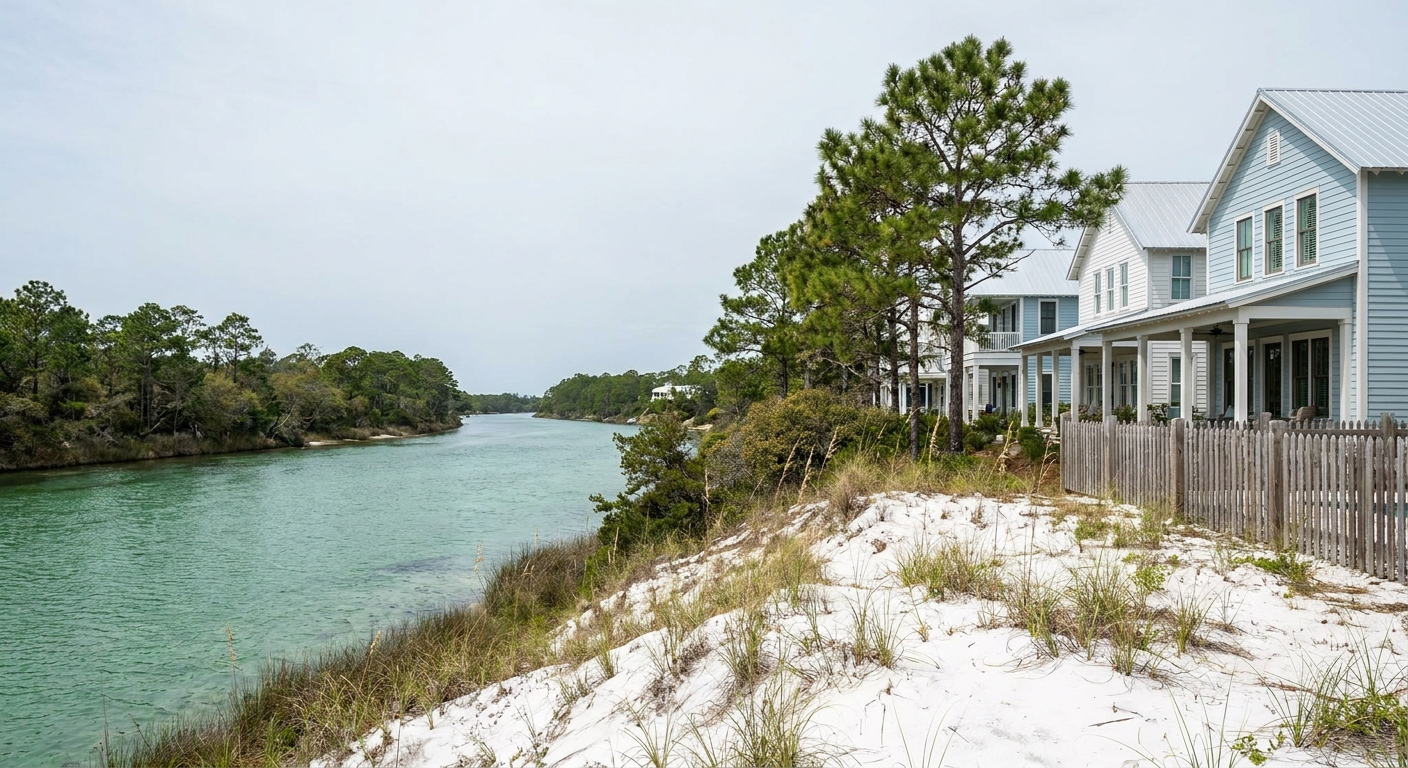
Two things catch out first-time visitors to Florida, and neither one is visible from the road. One is a time zone boundary running down the middle of a Panhandle river, which puts the beaches of 30A a full hour behind Orlando. The other is a survey line on the sand, roughly where the high tides average out, separating public wet sand from dry sand that may belong to the house behind it.
Both are written down. The first sits in a paragraph of the Code of Federal Regulations, the second in a 2018 amendment to the Florida Statutes. Neither has a sign. Add a lodging tax that changes at a city limit, five beach flags nobody is obliged to fly, and a REAL ID rule in force since May 2025, and the surprises stop being surprises.
BEFORE YOU GO · FLORIDA
Check three things before you book: which time zone your beach keeps, whether the dry sand at your rental is public, and what the county adds to the 6% state sales tax on the room.
TWO TIME ZONES · 67 COUNTIES · HURRICANE SEASON JUN 1 – NOV 30 · REAL ID SINCE MAY 7, 2025
Go for: winter warmth without a passport, and a set of rules that are all public record: the time zone text, the beach line, the county tax sheet.
Think twice before: booking a September beach week non-refundable, or assuming the sand in front of a Gulf rental is open above the high-water mark.
Time zone: 49 CFR 71.5(f) · Beaches: Florida Statutes s. 163.035 · Taxes: Florida Dept. of Revenue DR-15TDT · full sources at the end
On this page
- Is Florida in one time zone?Eastern and Central, split at the Apalachicola
- Are Florida beaches public?The mean high-water line, and what a posted sign means
- What do the beach flag colors mean?Five flags, and why purple flies with another
- Florida sales tax and hotel taxes6% state, plus 0% to 7% county lodging tax
- Do Florida toll roads take cash?All-electronic tolls and the rental company’s fee
- Difference between Miami and Miami BeachThree separate cities in one county
- Alligator safety rules in FloridaThe FWC’s four instructions and the hotline
- Best time to visit and what to packHurricane dates, summer humidity, and when rates drop
- Do I need a REAL ID to fly to Florida?The May 7, 2025 rule and the $45 fee
Most of what catches a first-time visitor out is written down somewhere official: in the Code of Federal Regulations, in the Florida Statutes, on a Department of Revenue rate sheet. None of it is posted at the airport. Which Florida to pick in the first place, and how the seven of them differ in pace and price, sits in the state orientation.
Florida time zones: Eastern and Central, and where the line falls
| Place | Time zone | When it is 3 p.m. in Orlando |
|---|---|---|
| Miami, Key West | Eastern | 3 p.m. |
| Orlando, Tampa | Eastern | 3 p.m. |
| Tallahassee | Eastern | 3 p.m. |
| Port St. Joe (Gulf County) | Eastern | 3 p.m. |
| Panama City Beach | Central | 2 p.m. |
| 30A, Walton County | Central | 2 p.m. |
| Destin, Pensacola | Central | 2 p.m. |
Florida keeps two clocks. Everything east and south of one boundary runs on Eastern time, and the western Panhandle runs on Central, a full hour behind. Pensacola, Destin and the 30A beaches of Walton County are Central. Tallahassee, further west than Tampa, is Eastern, which is the detail that undoes people who assume the split follows the map rather than a river.
The boundary is fixed in federal regulation, 49 CFR 71.5(f), and it reads like a canoe route. From the southwest corner of Georgia it reaches the midpoint of the Apalachicola River below Jim Woodruff Dam, follows the middle of the main channel south to the Jackson River, runs west along the center of the Jackson to the Intracoastal Waterway, west again along the Waterway to the west line of Gulf County, then south along that county line to the Gulf of Mexico.
So Port St. Joe, inside Gulf County, keeps Eastern time while Panama City Beach one county west does not. The damage is small and constant: a dinner reservation made on the wrong clock, a rental counter that shuts an hour earlier than expected, a boarding time you read as local when it was not. Drive from Orlando to the 30A beaches and you gain that hour on the way out; the leg that costs you is the return, an hour later than the map promised.
Are Florida beaches public? The mean high-water line and private dry sand
The line that decides who may sit where is not the fence, the boardwalk or the row of umbrellas. It is the mean high-water line, the average reach of the high tides. Wet sand below it is sovereign land held by the state, and it is public. Dry sand above it can be private property, owned by the house or the condominium sitting on the dune behind it.
Since 2018, Florida Statutes s. 163.035(2) has barred a city or county from adopting or keeping any rule that opens dry sand above that line on the basis of customary use, unless a court has affirmed it first. Getting there takes a formal notice of intent adopted at a public hearing, naming the specific parcels, naming the specific uses claimed, and listing every source of evidence the government would rely on. Then it goes to a judge. Parcel by parcel.
On a Gulf beach the result looks like this: a crowded strip along the water, a posted sign twenty feet up the slope, and chairs on the dry sand that belong to somebody. No argument is winnable at that sign, and the person who put it there may well be right. Move the towel down toward the wet sand, or walk to a numbered public access and start again from there.
Where the sand itself is a park, the question never arises: on a state, county or municipal beach park the public owns the parcel above the line as well as the wet sand under it. The friction lives on residential Gulf stretches, where the houses sit on the dune and the accesses are numbered rather than obvious. Booking beside a named public beach park, Siesta Key being the busiest example, settles the matter before you pack.
Florida beach flags and rip currents: flag colors and how to escape a rip current
| Flag | What it means |
|---|---|
| Double red | Water closed to the public |
| Red | High hazard |
| Yellow | Medium hazard |
| Green | Low hazard, exercise caution |
| Purple | Dangerous marine life, flown alongside another flag rather than in place of it |
Five colors, one statewide code. Purple is the one people misread: it reports dangerous marine life, and it goes up beside whatever hazard flag is already flying instead of replacing it, so purple under red means both things are true at once. Green carries its own small trap. It reads as low hazard and exercise caution, which is not the same message as safe.
The program set out in Florida Statutes s. 380.276 is open to any government with jurisdiction over a public beach, lifeguards or none. Open, not compulsory. A stretch of sand can legally fly nothing at all, and plenty of them do. An empty flagpole, or no flagpole in sight, tells you nothing whatsoever about the water that morning.
That gap matters because since 1979, rip currents have claimed more lives in South Florida than every other weather hazard combined, hurricanes, tornadoes and lightning included. The National Weather Service instruction, word for word, is to swim parallel to the shore, or to float beyond the breakers and then swim in. Nobody wins by swimming straight back at the beach. Water conditions and the rest of the caution list get full treatment in our Florida safety guide.
What things cost in Florida: 6% sales tax, county lodging tax and the total you pay
| Charge | Rate |
|---|---|
| State sales tax | 6% statewide |
| County transient rental tax | 0% to 6%, filed and paid with the state sales tax |
| Counties levying none | Five |
| Miami-Dade | 6% · 4% in Surfside and Bal Harbour |
| Miami Beach | 7%, the only 7% on the state schedule |
| Monroe County (the Keys) | 5% |
| Walton County (30A) | 5% in five listed ZIP codes, 2% elsewhere |
Lodging tax here is a county tax, and sometimes a city one on top. It runs from 0% to 6% depending on which line the room sits behind, five counties charge nothing at all, and the single 7% rate on the state schedule belongs to Miami Beach. All of it is filed and paid alongside the 6% state sales tax, which is why the rate you agreed to and the total on the folio are two different numbers.
Since May 12, 2025, the FTC rule on unfair or deceptive fees has required short-term lodging to show the total price up front, mandatory resort fee included. Three categories may stay outside that headline figure: government charges, shipping, and genuinely optional extras. Taxes are government charges. Two listings at the same advertised price can therefore land three points apart at checkout, one on Miami Beach at 7% and one in Surfside at 4%, half a mile apart on the same barrier island. What a Florida trip costs runs the arithmetic across a full week.
Driving in Florida: all-electronic tolls, rental car fees and drive times
Large stretches of the toll network are all-electronic. The Homestead Extension of Florida’s Turnpike, the road between Miami and Florida City that most Keys and Everglades trips use, has no cash booths on it. A rental car without a transponder gets photographed at the gantry, the bill reaches the rental company, and the company adds a service fee of its own on top of the toll itself.
Distances read short and drive long. The Overseas Highway covers 113 miles from Florida City to Key West, four hours with no stops and six to eight with the ones you will want, mile markers counting down from about 126 to zero. In the Everglades, the three entrances and the interior Flamingo Visitor Center each sit at least an hour’s drive from one another, so a day at the park means choosing one door. The road-trip routes are built around that spacing.
One question at the rental counter earns its keep: how is the transponder billed, per day of the rental or only on days I use a toll road, and what is your service fee on a toll paid by plate? Answers vary by company, and over a week the difference is real money rather than loose change. Getting around Florida handles the rest of the driving decisions.
Miami vs Miami Beach vs Coral Gables
Miami, Miami Beach and Coral Gables are three distinct municipalities of Miami-Dade County, each with its own city government and its own parking rules. A room advertised as Miami may sit downtown or in Brickell, and from there every beach morning is a causeway crossing in each direction, twice a day, in traffic. Coral Gables is inland too, leafy and low-rise, around twenty minutes from the water on a clear run (est.). Our Miami guide and the where-to-stay page sort out which name puts you where.
Alligators in Florida: safety rules for visitors
Alligators are found in all 67 Florida counties, inland and coastal, rural and suburban. The Fish and Wildlife Conservation Commission gives visitors four short instructions: never feed an alligator, keep your distance, keep pets leashed and away from the water, and swim only in designated swimming areas during daylight hours. For an animal behaving as a nuisance, the state hotline is 866-FWC-GATOR, which dials as 866-392-4286.
The airboat is where you go to look for one on purpose. The unplanned meeting happens on the bank of a golf course pond, in a drainage canal beside a suburban sidewalk, or over a boardwalk railing within sight of the parking lot. Fresh water and the low-light hours are the common factors, which is also why the leash instruction does more work on a normal trip than the distance one. The Everglades guide covers the viewing that is deliberate rather than accidental.
Florida hurricane season and summer heat: what to pack, and the cheapest months
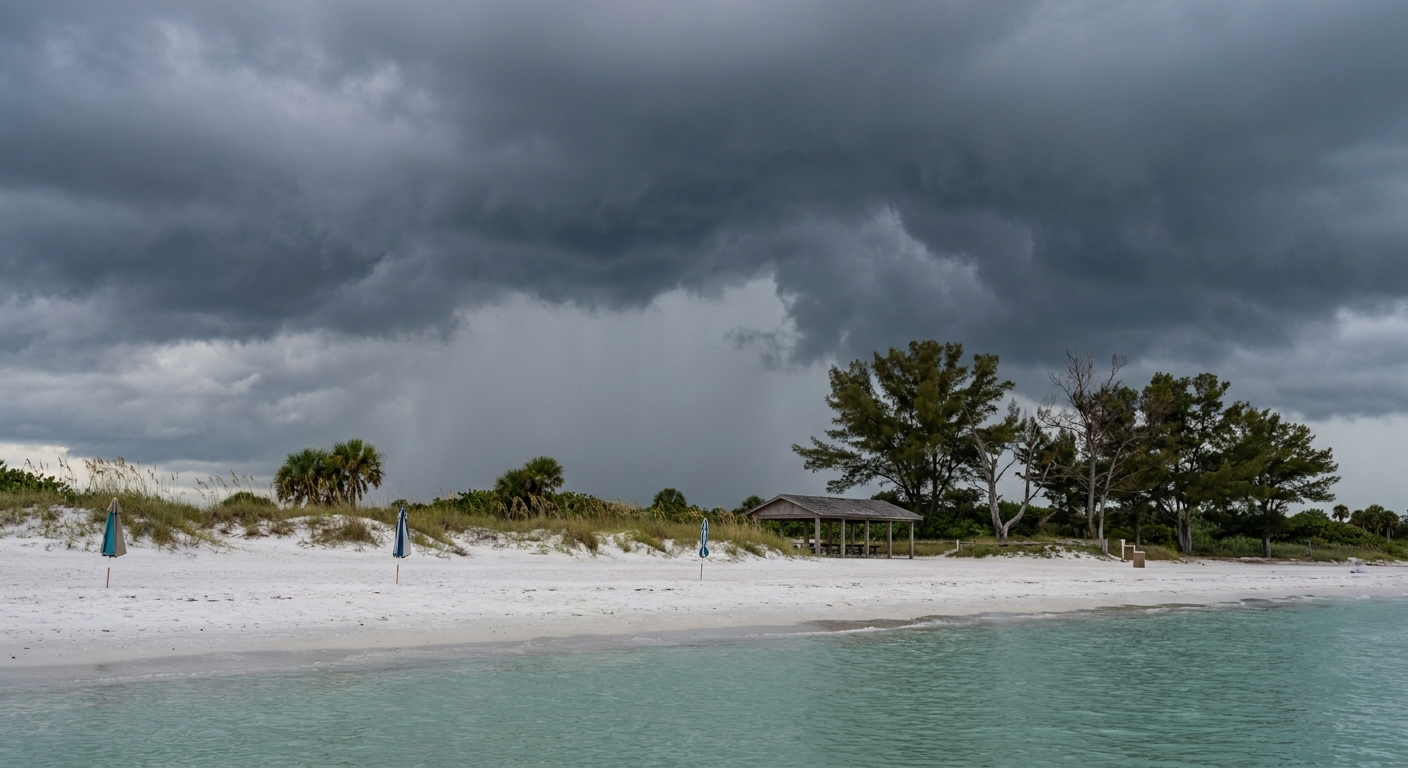
The Atlantic hurricane season runs June 1 to November 30. Its statistical peak falls on September 10, with most activity between mid-August and mid-October. A named storm during your particular week remains unlikely, but the odds are not flat across the calendar, and that is the whole argument for a refundable rate in the fall. The month-by-month verdict takes it season by season.
Summer in South Florida means highs around 90°F with humidity between 85 and 90 percent, and the humidity is the part visitors underestimate. Afternoon thunderstorms arrive on a near-daily schedule, loud and heavy and short, after which the heat closes back over the parking lot. Mornings are the usable hours in those months, and a pool stops counting as a luxury.
Rates run against the weather. Hotel prices in Florida sit lowest from August to October and highest from February to April, so the cheapest weeks are the stormiest and the most expensive ones are the driest. Naming the trade out loud helps: a February beach week at peak rates with near-certain sun, or an October one at a discount with a cancellation policy you have read.
All of which packs a specific bag. A rain shell rather than an umbrella, because the storms come with wind. Long sleeves that breathe, for the mosquito hours at either end of the day. A second pair of shoes, since the first pair will be wet. Layers for the ferocious indoor air conditioning, a Florida climate in its own right. And more sun protection than looks reasonable, reapplied, because white Gulf sand reflects half of it back at you.
If one budget line deserves the upgrade, it is the refundable rate between mid-August and mid-October. Paying that difference on a room you can cancel is the only way to buy back a hurricane-season week, and it usually costs less than moving a flight you booked cheap. Everything else, the ocean view, the resort with four pools, the larger rental car, improves the trip by degrees rather than saving it.
REAL ID for domestic flights: the May 7, 2025 rule
REAL ID enforcement began on May 7, 2025. To board a domestic flight, or to enter certain federal facilities, a traveler now needs a REAL ID compliant credential or one of the accepted alternatives, and a US passport is on that list, which is worth remembering for a trip that never leaves the country. Anyone who reaches the checkpoint without an acceptable form of identification pays a $45 fee. Compare your license against the TSA’s list at home, well before the drive to the airport.
The last word
Of everything here, the two choices that shape a Florida week are which coast and which clock, and both get made at the booking stage, not at the gate. Look up the county before you pay for the room, note the tax the county adds to the state’s 6%, and park where the beach access carries a number. Then remember that the $35 you hand over at an Everglades entrance is valid for seven consecutive days at all of them, which is the only sensible way to visit a park whose doors sit an hour apart.
Sources & data for this guide
- Eastern and Central boundary, full text · 49 CFR 71.5(f), Code of Federal Regulations · checked Sep 8, 2026
- Customary use, mean high-water line and the judicial declaration · Florida Statutes s. 163.035 · checked Sep 8, 2026
- Uniform beach warning flag program, participation not compulsory · Florida Statutes s. 380.276 and Volusia County Beach Safety · checked Sep 8, 2026
- Rip current fatalities since 1979 and the escape instruction · National Weather Service, Miami forecast office · checked Sep 8, 2026
- Transient rental tax rates by county · Florida Department of Revenue, form DR-15TDT · checked Sep 8, 2026 · the discretionary county sales surtax is a separate line we did not verify rate by rate
- Total-price disclosure in effect since May 12, 2025 · Federal Trade Commission, rule on unfair or deceptive fees · checked Sep 8, 2026
- REAL ID enforcement date, accepted alternatives and the $45 fee · Transportation Security Administration · checked Sep 8, 2026
- Alligators in all 67 counties, the four instructions and the hotline · Florida Fish and Wildlife Conservation Commission · checked Sep 8, 2026
- All-electronic tolling, Homestead Extension of Florida’s Turnpike · Florida’s Turnpike Enterprise · checked Sep 8, 2026
- Everglades entrance spacing and the $35 vehicle fee, valid 7 consecutive days · National Park Service · checked Sep 8, 2026
- Hurricane season dates and the September 10 peak · NOAA National Hurricane Center · checked Sep 8, 2026
- One point we cut on purpose: the 2020 state preemption often described as voiding Key West’s oxybenzone sunscreen ban. The sources we found flag its legal status as contested, and we could not read the codified text at a primary source, so it is not on this page.
- Packing advice and the county-versus-coast reasoning are editorial. Tax rates, flag practice and park fees change · verify before you book.