
As morning breaks in Samara, fishermen haul their boats onto the sand, dogs wander the tide line, and the earliest surf students head with their boards toward the Nicoya Peninsula’s softest waves. By evening the same beach turns into a long strip of open-air restaurants, with tables set close to the water and music drifting out of the bars. The town is small, yet each area has its own rhythm, and the one you pick decides whether you wake to the sound of the surf or the sound of the street.
What is the best area to stay in Samara?
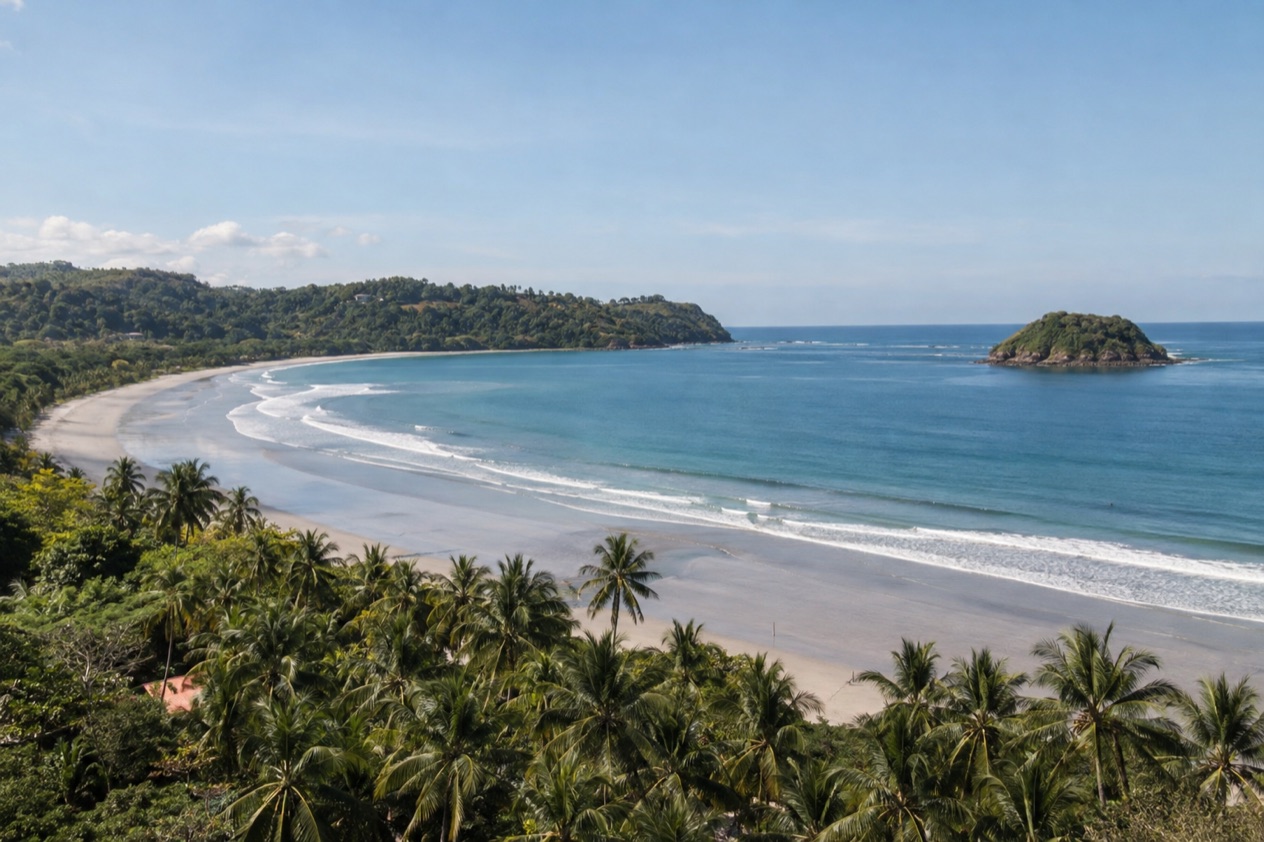
For a first visit, the stretch where the town center meets the beach is the best choice, because restaurants, surf schools, small shops and the sand are all within walking distance. Travelers who want the beach above everything else should look at the beachfront itself, while those who prefer quiet, space and a view do better at the far ends of the bay or up on the hillside.
Budget travelers usually do best a few streets back from the water, where guesthouses, hostels and simple rooms sit among local homes. Families tend to like the beachfront and the blocks right behind it, since the bay is wide and shallow and a reef and an island offshore help soften the waves. Nightlife in Samara is relaxed rather than wild, and it clusters near the center, so staying close to it means a short walk home.
The areas differ less in what they offer than in what they trade away. Close to the center you get convenience, food and company, and you give up some silence in the evening.
At the edges of the bay you get birdsong, space and a slower morning, and you walk or ride a bit farther for dinner. Almost nobody here is far from the sea, so the real question is how much of the town you want outside your door.
Season matters too. The dry months bring sunny days and a busy beach, while the green season brings heavier rain, lusher hills and quieter streets. January is a dry month with very little rain, and by July and October rain falls on almost every day, often heavily. A room with a covered terrace, good drainage and a place to dry towels counts for more in the wet months than a view.
Last, think about how you plan to spend your days. If your schedule leans toward surf lessons, kayaking, horseback rides or outings to nearby beaches such as Playa Carrillo, a spot in the center means less driving and an easy walk back for a midday rest.
If your plan is mostly to read, swim and watch the light change, a quieter base gives you more of what you came for.
The best areas to stay in Samara
The town center
The center is where Samara feels like a real town. Small supermarkets, bakeries, surf shops, tour desks and sodas (the simple local restaurants serving a plate of casado, rice and beans with a protein and salad) sit side by side, and the main street leads straight to the sand. Mornings start with coffee and fruit, afternoons with a stroll past the shops, and evenings with a choice of tables that never requires a car.
Lodging here runs from hostels and family guesthouses to boutique hotels, apartments with kitchens and small inns built around a garden or a pool. It suits first-time visitors, solo travelers, couples who want an easy base and anyone who likes to walk everywhere. Walking is the way to get around, and a bicycle covers the rest.
The trade-off is noise. Bars, motorbikes and late dinners make some rooms livelier than others, so ask for a room away from the street or at the back of the property. In the wet months, a pool or a covered porch helps a lot, because you will spend some afternoons indoors.
The beachfront
Rooms right on the bay put the whole show at your doorstep: the curve of the sand, the island offshore, the early surfers and the sunset light. This is the area for travelers who want to step from the room to the water and who will happily trade a bit of privacy for the view. The shallow, wide bay is one reason families and beginner surfers favor Samara, since the waves here tend to be gentle.
Expect boutique hotels, small beach inns, apartments and a few larger properties with pools, restaurants and lounge chairs under the palms. Because everything is in the middle of the action, evenings can be lively, and the sound of music from beach restaurants carries on some nights. Light sleepers should ask which side of the property the rooms face.
One caution applies to every beach in the region. Rip currents pose a serious danger and claim the lives of several American visitors each year, while most beaches lack lifeguards on duty and any signs warning you about hazardous water. Even on a bay known for gentle water, ask your hotel or a local surf school how the sea is that day, and keep children within arm’s reach.
The quiet ends of the bay
Toward either end of the beach, the town thins out into palm trees, gardens and low houses, and the pace drops. Mornings are for birds and long walks on wide sand, and the sound at night is mostly the surf. This is the choice for couples, writers, families with young children who nap in the afternoon and anyone who wants Samara without the Saturday-night buzz.
Lodging tends toward small boutique hotels, villas, bungalows and apartments, often with a pool and a garden in place of a lobby. Check how you would get into town for dinner before booking. In the rainy season the walk back after dinner can be wet, so a flashlight and a rain jacket are useful.
The tip here is to look at how far each property really sits from the restaurants you want. A place that sounds close on a map can be a longer walk on a dark road than it seems, and the beach path is not always lit at night.
The hillside and the road toward Playa Carrillo
Behind the town, the land rises into green slopes, and a handful of villas, eco-lodges and hotels take advantage of the height with ocean views, breezes and a canopy full of birds. Toward the south, the road leads to Playa Carrillo, a beach many visitors take as a day trip. Staying in this direction means a more spread-out, rural feel, with long stretches of road between the places you will want to visit.
This area suits travelers who have a vehicle or are comfortable with taxis, and who care more about a view, a pool and a quiet porch than about walking to dinner. Villas and apartments are common, and they work well for groups or longer stays. Ask the property how to reach it before you book.
The hills are greener in the wet months. They are also a good fit for guests who plan to spend a lot of time at the property itself, because a day by the pool with a view of the bay is half the point.
Samara areas compared
| Area | Best for | Feel | Getting around |
|---|---|---|---|
| Town center | First visit, budget, solo travelers, nightlife | Lively, walkable, close to restaurants and surf schools | On foot, by bicycle |
| Beachfront | Families, beach lovers, couples | Open sea views, steady beach life, some evening music | On foot along the sand |
| Quiet ends of the bay | Couples, young children, slow mornings | Peaceful, green, palm-lined | Walking, bicycle or short taxi ride |
| Hillside and road toward Playa Carrillo | Groups, longer stays, view seekers | Rural, breezy, spread out | Car, ATV or taxi |
The main trade-off is between beach and local life. On the sand you wake to the sea and watch the day move along the water, but the town center, a few streets back, is where bakeries open early, where residents shop and where the evening meal feels less staged. Staying in between, a block or two from the beach, gives you both without much compromise.
Quiet and nightlife pull in opposite directions. The more a spot sits within earshot of the bars, the easier it is to step out for a drink, and the harder it is to sleep with the windows open. If you want both, ask the property about street noise and whether the rooms have air conditioning or good fans.
Convenience and space work the same way. The center puts everything within reach, while the hillside and the far ends give you room, a pool of your own and a view, but you plan your meals and your rides. For most first-time visitors, the center and the beachfront are the simplest and most rewarding choices, and the edges are better for a second stay.
Finally, weigh your travel style against the season. In the green months, when rain falls on most days, walking to dinner is easier from the center than from a hillside villa. In the dry months, a hillside or a far-end setting can feel idyllic, with long evenings outdoors and cool air after sunset.
How to choose your hotel in Samara
Samara is mostly a town of small hotels, guesthouses, villas and apartments rather than large all-inclusive resorts. If a package with meals, drinks and a pool is what you want, you will find fewer of them here than in other parts of Costa Rica, and many properties sell a room with breakfast instead. In a place where dining out is one of the joys, that fits perfectly, whether you start with gallo pinto (rice and beans fried together, the classic Costa Rican breakfast) or end the day with fresh fish.
Think about whether you want to cook. Apartments and villas with kitchens help families and longer stays, since the small supermarkets in town stock the basics, and fruit stands appear along the roads. A room with a refrigerator is a small thing that changes how you spend a morning with children, who often want snacks before the beach.
Beachfront or a few blocks back is the next choice. On the sand you get views, sound and ease, with sand in the room and more evening noise to match. Back from the beach, you often get a bigger room, a pool, a quieter night and a short walk to the water. Both are good, and the second often brings more value for the same kind of room.
Samara sits on an open bay on the Pacific, so that question does not shape this choice. What does matter is the sea itself.
The bay is known for calm, shallow water protected by a reef and an island, yet conditions change with the tide and the day, and rip currents are a real hazard in the region. Ask each property what the water has been doing and which part of the beach staff and locals prefer.
Families and accessibility
Families usually do best in a place close to the beach with a pool, shade and a kitchen or at least a refrigerator. The bay is gentle enough that many families send older children to a beginner surf lesson, and the town offers kayaking and horse riding on top of that. Choose a property with a fence or a gate around the pool if children are small, and keep them within arm’s reach on the beach.
Accessibility takes extra questions. Sandy paths, steps, uneven sidewalks and steep driveways are common, so ask whether a room is on the ground floor, how many steps lead to the entrance and how far the property is from the street. A message to the hotel with specific questions usually gets a clearer answer than the listing does.
Festivals, peak weeks and wet months
Small towns fill quickly when the calendar gets busy. The dry months, with sunny days and very little rain in January, are the popular time, along with holiday weeks, when the best rooms near the beach go first. Book earlier for those periods, and expect a calmer town and a wider choice of rooms in the green season.
The wet months bring a different Samara. By July and especially October, rain falls on nearly every day, and some days it is heavy, which changes the best kind of room: a covered terrace, a hammock that stays dry, good ventilation and a restaurant on site for when the roads are muddy. The hills turn bright green, and the beach is quieter.
What to check before you book
- Where the room sits in relation to the street and the beach bars, since noise is the most common complaint in a small town.
- Whether the property has air conditioning or only fans, which matters on warm nights when the windows stay closed against rain or music.
- How you will get from the airport to the property, and whether the hotel can arrange the transfer.
- How far the walk to dinner is, and whether the road is lit and paved.
- Whether there is a pool, a kitchen, parking or a safe in the room, depending on what you plan to do.
- What the sea is doing, and where the property’s staff suggest swimming.
Transfers deserve a moment’s thought. Samara is a small beach town on the Nicoya Peninsula, and the trip in is part of the vacation, so ask the property how guests usually arrive and what the roads are like. A hotel that answers clearly and quickly is often one that runs well in other ways too.
Good to know before you go
The U.S. State Department rates Costa Rica Level 2, ‘Exercise increased caution,’ due to crime; it says petty crime is common throughout Costa Rica and that violent crime also affects tourists, including armed robbery, homicide and sexual assault.
In town, most things are within walking distance, and small shops, restaurants and tour desks handle the daily needs of travelers. Keep a little cash for small purchases and sodas, and carry only what you need to the beach.
Sources
- Open-Meteo / ECMWF ERA5, normals 1991-2020 computed for the grid cell at 9.8814N 85.5262W, checked October 8, 2026
- U.S. Department of State, Costa Rica Travel Information, Safety and security (https://travel.state.gov/content/travel/en/international-travel/International-Travel-Country-Information-Pages/CostaRica.html), checked October 8, 2026
- U.S. Department of State, Costa Rica Travel Advisory, issued April 1, 2026 (https://travel.state.gov/content/travel/en/traveladvisories/traveladvisories/costa-rica-travel-advisory.html), read via the State Department open data API on October 8, 2026