
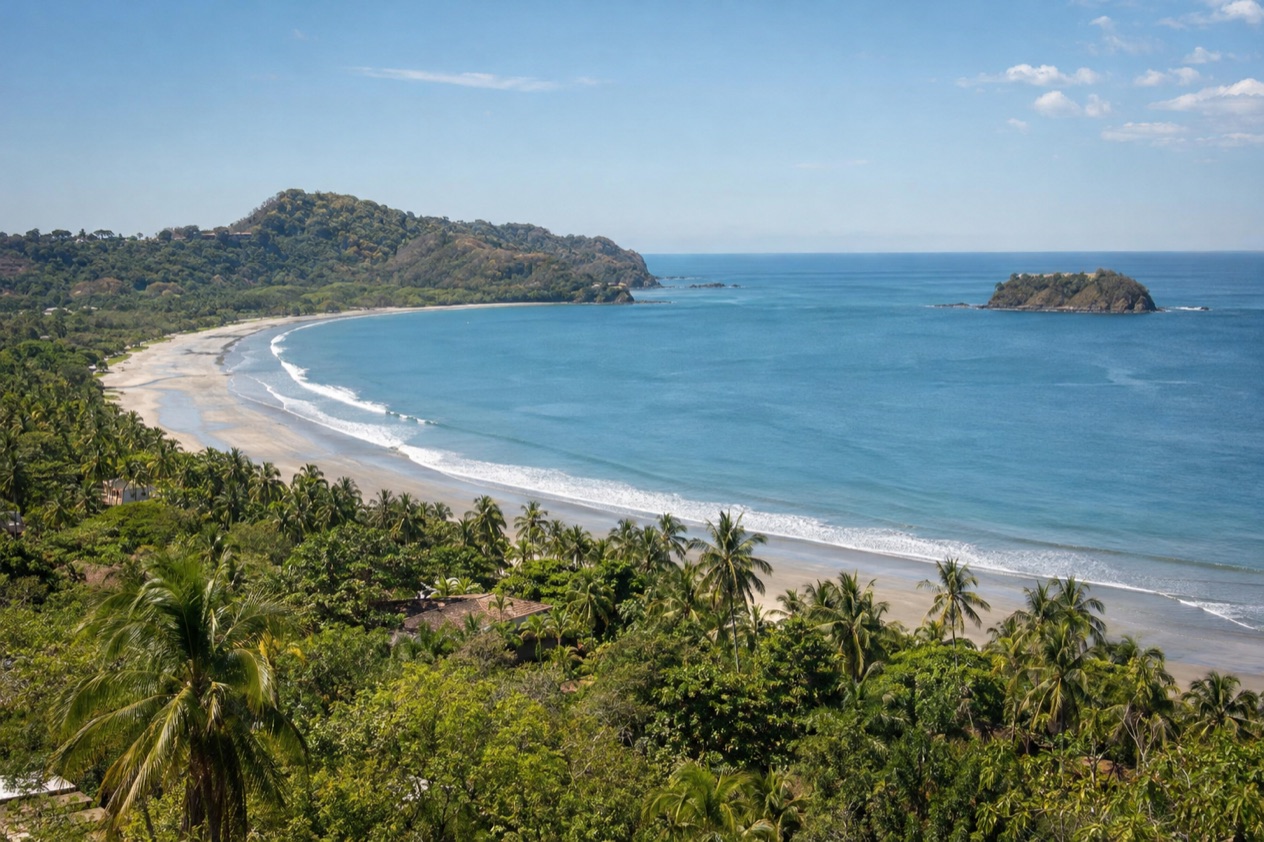
In the dry months, Samara wakes to hard blue skies and the sound of horses being led down to the sand, while fishing boats rock behind the reef and the island that shelter the bay. When the rains arrive, the hills of the Nicoya Peninsula turn a deep green, afternoons end in drumming downpours, and the beach town slows to a murmur. Samara is a small, easygoing place on the Pacific side, and which half of the year you pick changes what your days look like.
When is the best time to visit Samara?
December through April is the best time for most travelers, when mornings are bright, the afternoons are hot and the rain mostly stays away. That is the dry season of the Pacific side, and it is when Samara looks like the postcard: a wide curved bay, a sea that reads as flat and glassy near the reef, and long evenings on the sand.
For the beach and the water, the dry months are the obvious choice. The bay is protected by a reef and an island offshore, so the water near the shore is usually calm and shallow, and that is why first-time surfers and families favor the gentle waves here.
Kayaking, horse riding on the beach and day trips to nearby beaches such as Playa Carrillo all work best when the sky is clear and the trails are firm. February and March are the hottest weeks, so plan your walks for early morning and late afternoon and leave the middle of the day for shade and the sea.
For quiet, greenery and lower prices, the rainy months have their own appeal. Mornings are often bright, the surrounding hills are lush, and the beach is nearly empty of other visitors.
The rain usually arrives in the afternoon and can be heavy, so you do the active things early and spend the late hours on a porch or in a café. Expect some days that stay gray from start to finish, especially from September through October.
Families should know that the dry season is also the busiest, and March brings spring break crowds that make the town louder, with more people on the beach and in the restaurants. If you travel with children and want a calmer pace, early December, January after the holidays, or the weeks around late April are gentler. The shoulder months of April and November mix sunshine with regular showers, and they suit travelers who want green hills without giving up beach time.
Samara weather by month
Samara is warm all year, and what changes from month to month is the rain, not the temperature.
| Month | Average high (°F) | Average low (°F) | Rain days | Sea (°F) |
|---|---|---|---|---|
| January | 88.7 | 75.3 | 1.3 | 85.1 |
| February | 90.8 | 75.9 | 1.0 | 85.6 |
| March | 91.5 | 76.7 | 2.7 | 86.9 |
| April | 89.4 | 77.2 | 10.9 | 87.0 |
| May | 85.5 | 76.7 | 24.4 | 88.0 |
| June | 84.2 | 76.1 | 26.8 | 85.9 |
| July | 84.3 | 75.7 | 25.4 | 85.8 |
| August | 84.1 | 75.7 | 26.7 | 85.8 |
| September | 83.3 | 75.4 | 28.3 | 86.0 |
| October | 82.7 | 75.1 | 28.4 | 85.5 |
| November | 83.6 | 75.0 | 18.3 | 83.3 |
| December | 85.6 | 74.9 | 5.5 | 84.4 |
The year divides into two clear halves. From December to March, rain is rare, the days are hot and the nights are warm enough to eat outside in a T-shirt. April is the turning point, with showers appearing more often.
From May to October the rain falls on nearly every day, usually as an afternoon downpour rather than an all-day drizzle, and the heat eases a little because the cloud cover keeps the afternoons softer. November is the long goodbye to the green season, with more dry hours each week, and by December the skies are largely clear again. Nights stay warm in every month.
What is there to do in Samara in each season?
December to April: beach days and open skies
The dry season is the time for everything that needs a clear sky. Mornings are for the beach walk to the far end of the bay, a lesson on the gentle waves, or a kayak trip toward the island. Horse riding along the sand is a local favorite, best done early before the heat builds.
Day trips are at their easiest now. Playa Carrillo, a short hop from town along a curve of palms, makes a good change of scene.
Sunsets over the bay draw the whole town to the sand, with surfers, dog walkers and families sharing the same stretch. Between January and the end of May, wildfires are common in Guanacaste and the north, so you may see smoke or burned hillsides on a drive inland.
May to October: the green season
When the rain settles in, Samara becomes a place for early starts. Mornings can be sunny and warm, and that is the time for a swim, a surf lesson, a hike through the green hills behind town or a guided nature walk, which is how most visitors see monkeys and birds. By midafternoon the sky turns heavy, and the day shifts to cooking classes, long lunches and a hammock.
This is also the season for nature. Sea turtles come ashore to nest on beaches along the Nicoya coast during the rainy months, and the green season is when the forest is loudest with frogs and birds at dusk. Leave the long beach-hopping days and anything that depends on a clear horizon for the dry season, and bring a light rain jacket and shoes that dry fast.
November and the winter holidays
November is a shoulder month, still wet in places but with more and more bright mornings. The hills are at their greenest, the crowds have not yet arrived, and the sea is a little cooler than in the months before. It suits travelers who want a quieter town and are happy to plan around a late-day shower.
By Christmas and New Year, the dry season is back and the town fills with visitors from Costa Rica and abroad. Restaurants run full tables, the beach is busy at sunset, and the whole bay feels festive. If you want that mood, book well ahead, and if you want something calmer, the first weeks of December or the end of January offer the same sunshine with more room.
When is Samara cheapest and least crowded?
The quietest stretch runs from about May through October, when the rain keeps most visitors away and the town has plenty of rooms and empty sand. Within that stretch, September and October are the calmest, with restaurants thinning out and some small businesses taking a break. Rooms are easier to find, and you rarely need to plan far ahead.
The busiest weeks are the ones when people from the United States are on vacation. Christmas and New Year fill the town, as does Holy Week, which moves every year and falls in March or April. March has the spring break crowds as well, and you feel them in the bars, on the beach and on the road into town. Peak-season rates apply at those times, and the best places sell out early.
A good compromise is the edge of the dry season. Late November, early December and the weeks after Easter bring mostly sunny days with softer crowds.
In July and early August, when school vacations in the Northern Hemisphere are in full swing, a number of families arrive, but the town stays easygoing compared with the winter peak. If you want empty beaches and flexible reservations, travel in the green months and plan your outdoor time for the morning.
Which months should you avoid in Samara?
No month is truly off-limits, but September and October are the hardest if you came for the beach, because rain falls on nearly every day and the sky is often gray for hours.
The Atlantic hurricane season runs through the wet months, and while Samara is on the Pacific side, it can still feel the effect of tropical systems as days of heavy rain. If you travel then, give your plans some slack and keep your itinerary loose.
The opposite problem comes in the hottest weeks. February, March and April bring the highest temperatures, and the midday sun is intense. Between January and the end of May, wildfires are common in Guanacaste and the northern region, so you may meet smoke or dry, burned slopes. Neither is a reason to skip the dry season, but it is a reason to plan activities for the cooler hours and drink plenty of water.
When can you swim in Samara?
The sea stays warm in every month of the year, but whether it is safe to swim depends on daily conditions. The water is warmest in the late dry season and the early rains, and slightly cooler in November and December, though still comfortable without a wetsuit.
The bay is the draw. Its reef and island offshore take much of the force out of the swell, so the water near shore is usually calm and shallow, and that is why the waves are known as gentle.
In the dry season the water tends to be clearer and the beach is best for long walks and sunset swims. In the rainy months, rivers and runoff can cloud the water after a downpour, and the surf sometimes builds.
The water can shift without warning, and rip currents pose a serious threat, leading to multiple drownings among U.S. tourists annually. Most beaches do not have lifeguards or warnings about unsafe conditions, so ask the hotel or a surf school about the day’s conditions, follow flags where there are any, and never swim alone. Children should always be within arm’s reach.
Festivals and events in Samara through the year
Winter holidays and Holy Week
Christmas and New Year are the biggest social moments of the year in Samara. Families gather on the beach, restaurants serve special dinners, and the bay fills with music in the evening. December 25 is a public holiday and the town is lively but relaxed, with the beach still the center of everything.
Holy Week moves every year, falling in March or April. Costa Ricans take the days off to travel to the coast, so Samara fills with local families, and the beach turns into a long picnic with music, grilled food and kids wading, floating or playing at the edge of the water. Book ahead if you plan to be here then, and expect a busy, festive atmosphere rather than a quiet one.
Fiestas of the green season
July 25 commemorates the Annexation of the Party of Nicoya to Costa Rica, and Guanacaste marks it with folk dances, marimba music and traditional food. Samara lies in Guanacaste province, so the day is felt locally, and you may find a parade, a dance or a school performance wherever you are on the peninsula.
Independence Day on September 15 brings school marches and, usually the evening before, children carrying handmade paper lanterns through the streets. It is a small, local, family event rather than a spectacle, and it is a good chance to see the town without visitors. Dishes like gallo pinto, a rice and bean mix, and casado, a plate with rice, beans, plantain and a main, appear on every menu, and the smaller, family-run places are where you taste them best.
Nature seasons: turtles and whales
Sea turtles nest along the Pacific coast of the Nicoya Peninsula, mostly during the rainy months, and the beaches near Ostional to the north are known for mass nestings. Seeing them is a chance, not a promise. Go with a guide rather than on your own.
Humpback whales pass along Costa Rica’s Pacific coast in two seasons, one in the early months of the year and another in the second half. Boat trips out of the area sometimes spot them, along with dolphins, but nothing is guaranteed. Calm mornings in the dry months give the best conditions on the water, though sightings are never guaranteed.
Sources
- Open-Meteo / ECMWF ERA5, normals 1991-2020 computed for the grid cell at 9.8814N 85.5262W, checked October 8, 2026
- Open-Meteo Marine API, average 2015-2024, checked October 8, 2026
- sunrise-sunset.org, sunrise and sunset calculated for the 15th of the month, checked October 8, 2026
- U.S. Department of State, Costa Rica Travel Information, Safety and security (https://travel.state.gov/content/travel/en/international-travel/International-Travel-Country-Information-Pages/CostaRica.html), checked October 8, 2026
- U.S. Department of State, Costa Rica Travel Advisory, issued April 1, 2026 (https://travel.state.gov/content/travel/en/traveladvisories/traveladvisories/costa-rica-travel-advisory.html), read via the State Department open data API on October 8, 2026