
Rain drums on the lodge roofs before dawn in Tortuguero, howler monkeys answer it from the treetops, and by first light the canals are steaming and the herons are already working the banks. Rain falls here in every month, so the year is shaped less by wet and dry than by what is nesting on the beach and how many boats share the water. This is a village of sand lanes and rainforest that you reach only by boat or small plane, and each season gives it a different mood.
When is the best time to visit Tortuguero?
The best time to visit Tortuguero is February through April for the driest stretch of the year, or July through October if seeing green turtles nest is the point of the trip. Neither window is rain-free, because the Caribbean side gets rain all year, but the early spring months bring the fewest wet days and the most open skies for boat tours.
For the beach and the sea, the answer is mostly about walking and watching rather than swimming. February to April gives the best chance of dry sand underfoot, long mornings and a sea that is warm without being stormy. The August to October turtle months are different: you come at night, with a licensed guide, and you accept that the days will be gray and damp in exchange for one of the great wildlife encounters in the country.
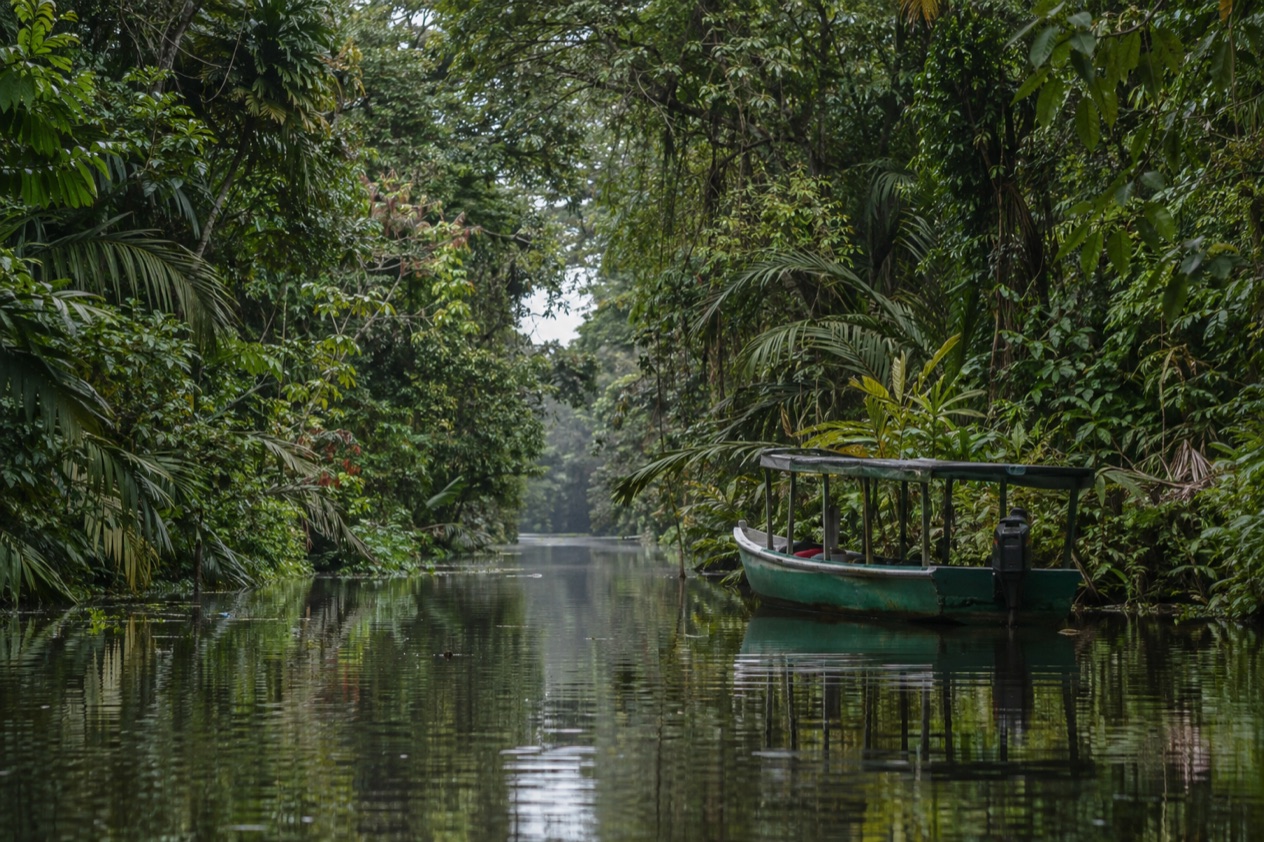
For sightseeing by canal, early morning is the real prize in any month. Canal tours offer chances to see caimans, herons, kingfishers and monkeys throughout the year. The drier months make for more comfortable hours in an open launch, while the wetter months make the forest louder, greener and often quieter on the water.
For budget and quiet, the wet shoulder months of May, June and early September tend to be the calmest. Lodges are less full, the canals are less busy and a wet morning feels like part of the place rather than a ruined plan.
Families should know that March brings U.S. spring break, and the lodges and the village lanes fill with groups. Children who love animals do well in any month, but a family that wants a slower pace will find it outside the school-break weeks.
Tortuguero weather by month
Tortuguero is warm all year, and the real difference between months is how much rain falls and how often.
| Month | Average high (°F) | Average low (°F) | Rain days | Sea (°F) |
|---|---|---|---|---|
| January | 80.0 | 71.2 | 16.0 | 82.3 |
| February | 80.9 | 71.5 | 11.8 | 81.9 |
| March | 81.9 | 72.4 | 11.1 | 83.0 |
| April | 83.3 | 73.9 | 11.6 | 84.4 |
| May | 83.4 | 74.4 | 24.2 | 86.2 |
| June | 83.1 | 74.4 | 26.8 | 86.5 |
| July | 82.1 | 73.8 | 28.6 | 85.0 |
| August | 83.0 | 73.8 | 27.6 | 85.6 |
| September | 83.5 | 74.0 | 25.6 | 87.1 |
| October | 82.7 | 73.7 | 26.8 | 86.5 |
| November | 80.8 | 73.0 | 24.4 | 84.4 |
| December | 80.1 | 71.9 | 20.8 | 82.6 |
The year has a clear shape. February, March and April are the lighter months, with showers on roughly one day in three and the most sun. In May the rain arrives in earnest and stays through the autumn, with nearly every day bringing at least a passing downpour.
July is among the wettest months, and November tops it with the heaviest rain of the year, often in long gray spells. December and January ease back, but rain still falls on most days, usually as steady showers rather than bright dry weather. Temperatures barely move, so you pack for humidity and rain, not for cold.
What is there to do in Tortuguero in each season?
February to April: the lighter months
These are the best months for canal boats. Mornings are often bright, the light on the water is good for photography, and you can spend hours drifting past hanging vines while spider monkeys, howlers and capuchins move through the canopy. Birders have a field day with herons, kingfishers, anhingas and the occasional toucan. Lodges run guided walks on forest trails and kayak outings that are pleasant when the rain eases.
Leatherback turtles nest earlier in the year than the green turtles, so this stretch can overlap with some of their season. The sighting is never guaranteed, but a night walk with a licensed guide is the way to try. Save the long beach walks for the cooler hours of morning, and remember that the surf here is strong and the beach is for watching, not for a casual swim.
May to September: the green months
The forest at this time of year is thick, loud and dripping. Frogs call after dark, the canals run high and the lodges are quieter. Rain jackets and quick-drying clothes matter more than anything else you pack, and a boat tour in a steady drizzle can be one of the best hours of the trip, because the animals do not stop for weather and the crowds stay away.
From about July the green sea turtles begin to come ashore, and the nesting season builds through the following months. The night patrol is led by licensed guides, who take small groups along the beach in the dark. In the daytime, visit the village, walk the lane of small shops and cafés, and look for a lodge that serves rice and beans cooked in coconut milk, a Caribbean specialty you will want more than once.
October to January: turtles, long rain and the holidays
October still belongs to the green turtles, and it is a good month for a trip built around nesting. November is the wettest month. It suits travelers who like moody forest and have flexible plans.
December and January bring the winter holidays and a lift in visitors. The rain eases, though it never disappears, and cold fronts to the north can send gray, windy days down the coast. Plan for a canal trip in Tortuguero National Park, a village walk and a slow lodge afternoon with a book, and leave the long beach plans for another time of year.
When is Tortuguero cheapest and least crowded?
Tortuguero is quietest in the wet months, mainly May, June and the early weeks of September. Lodges have more open rooms, canal boats carry fewer people, and the village lanes feel like a village again. Guides have more time to linger when a monkey or a sloth shows up, and you may have a stretch of beach to yourself.
The busiest weeks follow the U.S. school calendar and the holidays. Christmas and New Year fill the lodges, and the days around them are the hardest to book. Spring break in March brings groups and families, and Easter week, which moves from year to year, draws Costa Ricans on vacation as well as visitors from abroad. Summer break from late June into August also brings more travelers, especially families.
The turtle season complicates the picture, since the green turtles arrive in the middle of the wet months. Travelers who want nesting plus fewer people should look at the edges of the season, in July or in October, when interest is real but the lodges are not full. Rooms tend to be easier to find outside the holiday weeks, and lodge packages that include meals and tours are the usual way to stay, so a quiet week often feels like a quiet week at the table too.
Which months should you avoid in Tortuguero?
No month needs to be avoided outright, but November is the hardest for anyone who wants dry hours, and the peak holiday weeks are hardest for anyone who wants quiet. November brings the heaviest rain of the year, and it often comes in multi-day spells that make boats slower and trails muddier. Pack for it or pick another month.
The Atlantic hurricane season runs from June 1 to November 30, and Tortuguero sits on the Caribbean side. The peak comes in mid-September, with most activity from mid-August to mid-October. A tropical system in the wider region can mean stormy seas, delayed boats and extra rain, so a flexible schedule and travel insurance are sensible for a trip in that window.
Sargassum, the brown seaweed that drifts across the Caribbean, can pile up on beaches from spring into summer. It is often the first disappointment of a beach trip, and no stretch of coast is guaranteed to be spared. In Tortuguero the beach is mostly for walking and nesting turtles, so seaweed matters less here than at a resort, but expect some in the warm months.
Heat is steady rather than extreme, with humid afternoons in the spring and summer months. Winter cold fronts to the north can bring gray, windy days from December into February, with showers and a choppier sea. They rarely ruin a trip, but they do change what you do, so keep a rain jacket handy and an indoor plan for the afternoon.
When can you swim in Tortuguero?
The sea is warm enough for swimming in every month, but the beach itself is not the place for it, because the surf is strong and rip currents are very dangerous. In winter the water feels like the low 80s and in early autumn like the upper 80s, which is bathtub warm. That warmth is part of why the beach feels inviting, but the temperature is not the question here.
Along Costa Rica’s coast, lifeguards and alerts about dangerous water are rare at most beaches, and Tortuguero’s wide Caribbean shoreline, exposed to the open sea, is just the same. Most beaches do not have lifeguards or warnings about unsafe conditions, and rip currents are very dangerous. Most visitors treat it as a place to walk at dawn, to look for turtle tracks and to watch the surf, and they cool off in a lodge pool instead.
In every season, the beach is better for walking than for swimming. The wetter months bring rougher water, more driftwood and sometimes seaweed. In every month, ask your lodge about the day’s conditions before going near the water, and take any warning seriously.
Festivals and events in Tortuguero through the year
Winter holidays and Easter week
Christmas and New Year are the main celebrations of the winter. The village is small, so the mood is homey rather than grand, with lights strung along lodge porches, music in the evenings and special meals in the dining rooms. Many Costa Rican families travel at this time, so you will hear Spanish at the next table as often as English.
Easter week, called Semana Santa, falls in March or April depending on the year, and it is the other peak for domestic travel. Expect a busy village and lodges that fill early. The best plan is to book well ahead, spend mornings on the canals when the boats are lighter and keep afternoons slow.
Nature seasons: green turtles and leatherbacks
The turtles are the real calendar of Tortuguero. From roughly July through October, green sea turtles head to shore to nest, with activity climbing to its height as summer winds down and fall begins. Leatherbacks nest earlier in the year, so spring visitors have a chance at them. Neither sighting is a promise, and some nights simply bring nothing.
Night walks to see turtles are done with a licensed guide. You walk the beach, wait, and when a turtle is found you watch from a respectful distance as she digs, lays and covers her nest. Wear dark clothing, bring a rain jacket and expect to be tired and happy afterward.
Local fiestas and village life
Beyond the big dates, village life follows church days, school events and the rhythm of the boats. Independence Day in mid-September brings school parades and flags across Costa Rica, and small communities like this one join in with their own modest marches.
The village is also where Caribbean cooking shows up, with coconut rice, plantains, fresh fish and sweet bread on the table. Wander the lane in the late afternoon, stop at a small soda for a meal and talk to the guides, many of whom grew up here and can tell you what is happening on the beach this month.
Sources
- Open-Meteo / ECMWF ERA5, normals 1991-2020 computed for the grid cell at 10.543N 83.502W, checked October 8, 2026
- Open-Meteo Marine API, average 2015-2024, checked October 8, 2026
- sunrise-sunset.org, sunrise and sunset calculated for the 15th of the month, checked October 8, 2026
- U.S. Department of State, Costa Rica Travel Information, Safety and security (https://travel.state.gov/content/travel/en/international-travel/International-Travel-Country-Information-Pages/CostaRica.html), checked October 8, 2026
- NOAA National Hurricane Center, Climatology (https://www.nhc.noaa.gov/climo/), checked October 8, 2026
- U.S. Department of State, Costa Rica Travel Advisory, issued April 1, 2026 (https://travel.state.gov/content/travel/en/traveladvisories/traveladvisories/costa-rica-travel-advisory.html), read via the State Department open data API on October 8, 2026
To plan your stay
- Things to Do in Tortuguero: Canal Boats, Turtle Nesting, Rainforest Walks and Caribbean Food
- Where to Stay in Tortuguero: Village, Beachfront and Canal Lodges
- Tortuguero National Park: Turtle Nesting, Canal Boat Tours, Hours and How to Get There
- Tortuguero in January: Canal Boat Trips, Rain Showers and Rainforest Wildlife