
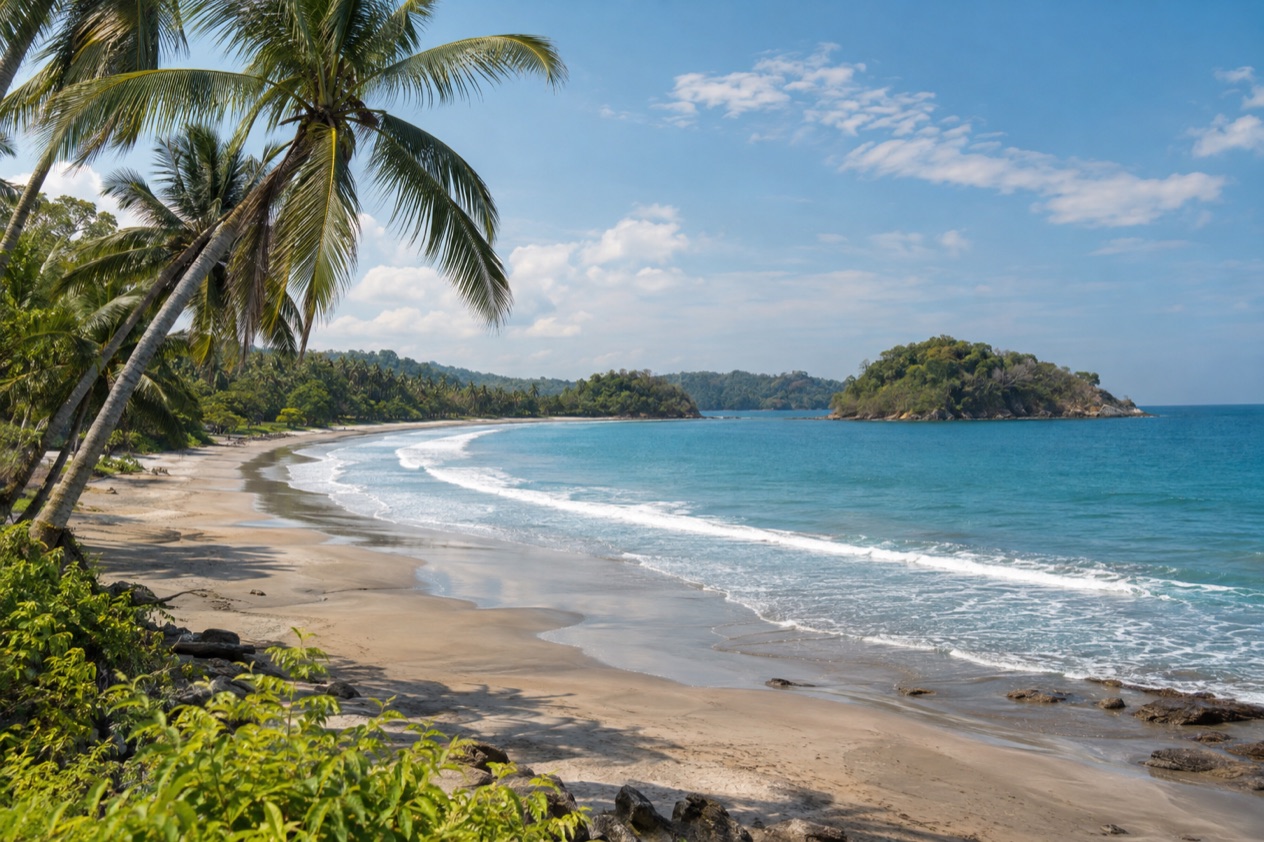
Early in the morning the beach at Samara belongs to dog walkers, a few fishermen dragging their boats up the sand and surf instructors laying out boards in a row beneath the almond trees. By nine, horses are plodding along the waterline and the first kayaks are slipping out toward the island. This is a small, easygoing beach town on the Pacific side of the Nicoya Peninsula, made for families, beginner surfers and anyone who likes to walk from breakfast to the sea in flip-flops.
Where is Samara and what is it like?
Samara sits on the Pacific coast of the Nicoya Peninsula, in the northwest of Costa Rica, on a wide, curved bay with a reef and a small island sheltering the water in front of town. It is a village that grew into a beach resort without losing its scale. Most of what you need is within a short walk of the sand: restaurants with tables under palms, surf shops, bakeries, small hotels and a handful of grocery stores.
The pace is slow and the mood is relaxed. Days here follow the tide and the light.
People surf or swim in the morning, eat a long lunch, nap through the hottest hours and gather on the beach again for sunset, when the bay turns orange and the island becomes a dark silhouette. Evenings are low-key, with dinner at a beachfront table, a drink at a casual bar and perhaps live music in the high season.
The bay is the reason Samara has such a loyal following with families. The water is usually shallow and gentle close to shore, which makes it a favorite for children, for swimming lessons and for people who have never stood on a surfboard. The reef offshore breaks up the larger swell, so the waves that arrive tend to be soft and rolling rather than punchy.
Samara will suit you if you want a beach holiday with a little activity and plenty of ease: a place where you can rent a board, book a horse ride, then do nothing at all. It is less suited to travelers who want nightlife, big-resort amenities or a long list of museums and sights.
There are no grand monuments here. The attractions are the bay itself, the nearby beaches, and Costa Rican staples such as gallo pinto, casados and ceviche, all enjoyed at an unhurried pace.
A word on the sea. Conditions change with the tides and the season, and Samara’s water is often friendly, but rip currents are a real danger along this coast and most beaches in Costa Rica have no lifeguards. Ask local instructors or your hotel about the day’s conditions before you wade in, especially at beaches outside the sheltered bay.
What is there to do in Samara?
The big reasons to come are the gentle waves for learning to surf, the activities that work with the calm bay, and the string of nearby beaches that make easy day trips. What sets Samara apart from busier surf towns along the Pacific is the scale and the softness of the water: you can spend a whole week here and never feel you have to keep up with anyone.
Learning to surf on the bay
Samara is one of the friendliest places on this coast to stand up on a board for the first time. The waves are often small and rolling, and the beach is wide, but conditions still require care.
Families often sign up together, with children and parents in the same group. Experienced surfers may find the bay a little tame and head out to other breaks along the coast instead. A rash guard and plenty of sunscreen are worth bringing, since the tropical sun is strong even on cloudy mornings.
Kayaking and horseback riding
With the bay so protected, kayaking is a natural fit. Paddlers glide out toward the island in the morning, when the water is usually at its stillest, and often spot pelicans, frigatebirds and fish flickering below the surface. Kayaking is one of the activities offered in Samara.
Horseback riding is the other classic. Riders follow the beach and sometimes cut inland through pastures and forest edges, with the best light at sunrise or late afternoon. It suits people who like a slow, scenic outing more than a thrill ride. Wear closed shoes and long pants if you can, and expect to be a little sandy by the end.
Day trips to nearby beaches
Samara makes a comfortable base for exploring the coastline. Playa Carrillo, a graceful crescent lined with coconut palms, is the most popular outing and a lovely place for a long beach day with a picnic or a seafood lunch. Other beaches along this stretch of the peninsula have their own character, some wide and wild, others tucked into rocky coves.
Part of the fun is the contrast. One beach is lively with surfers, the next nearly empty except for a few locals and a stray dog. Bring water, a hat and a way to carry out your trash, because services can be thin outside town. Ask in Samara before swimming, since the calm of the home bay does not carry over to every beach.
How many days do you need in Samara?
A long weekend gives you a good taste of Samara, though a week lets the place do what it does best, which is slow you down. The town is small, so you will not run out of sights. What matters is how much time you want on the sand, in the water and on the day trips.
With a few days you can fit in a surf lesson, a morning kayak, a horse ride and one trip to Playa Carrillo, with long lunches in between. That is a satisfying rhythm for a short stay: one active thing in the morning, then rest, then the beach again around sunset. Arrive early enough on your first day to walk the bay and get your bearings before dinner.
With a week, you can stop planning. Take a second surf lesson once your legs remember what to do, explore more of the neighboring beaches, linger at a café with a book and add one or two longer outings. Slow travelers often find that the third or fourth day is when Samara really clicks, once they know which bakery has the best morning pastries and which beach bar has the best view.
If you have more time, combine Samara with another part of the Nicoya Peninsula or with a stop elsewhere in Guanacaste, so the beach stay becomes one chapter of a wider trip. Samara pairs well with a few quiet days at a neighboring beach town, or with a volcano and hot-springs stay in the north before or after the coast. Treat the transfers as part of the day, not as an afterthought, since the peninsula takes some effort to cross.
Rainy-season travelers should plan with flexibility. Mornings are often the best window for outdoor activities, and afternoons may bring downpours that make the most of a book, a long meal or a spa hour. Leave a spare day for weather and nothing will feel lost.
Where to stay in Samara
The best place to stay depends on how much you want to be in the middle of things. The center of town, right behind the beach, is the simplest choice: you can walk to restaurants, surf shops and the sand without a car.
It suits first-time visitors, families with small children and anyone who likes the convenience of stepping out for a coffee or a late dinner. Expect some evening noise from bars and street life.
Beachfront places along the bay put the water at your door. You wake up to the sound of waves, can take a swim before breakfast and often have a view of the island at sunset. These stays are popular for couples and families, and in the busy season they fill early. The trade-off is that you are closer to the activity of the beach, which many travelers consider part of the charm.
A little further out, along the edges of the bay and on the hillsides, you find quieter stays with more garden space, pools and sweeping views. These suit travelers who want peace and privacy and are happy to walk, bike or take a short ride into town for dinner. They are also a good match for groups or longer stays that call for more room and a kitchen.
Beyond Samara itself, nearby beach communities offer an even calmer pace, with only a few small hotels, simple restaurants and stretches of sand that rarely feel crowded. They suit surfers chasing different breaks, travelers who want to disappear for a few days and people with a car. If you rely on walking and want to be near the main beach and restaurants, stay in or close to the center.
Whichever area you choose, think about the season. In the green months, a place with good drainage, shaded outdoor space and a covered terrace makes afternoon showers part of the experience. In the dry months, air conditioning or good cross-breezes can matter more, since days are hot and the nights stay warm.
How do you get to Samara and get around?
Most visitors fly into one of two international airports. Daniel Oduber Quiros International (LIR), at Liberia in the northwest, is the closest airport for the Guanacaste beaches. Juan Santamaria International (SJO), near San Jose in the Central Valley, is the other main gateway and often has more flight options. From either one, the rest of the trip is by road to the Nicoya Peninsula.
Others rent a car for the freedom to explore nearby beaches at their own pace.
If you drive, allow daylight for the trip and build in time for slower stretches. Public buses connect the main towns of the region and are a budget option for those with flexible schedules.
Once in Samara, the best way to get around is on foot. The center is compact, and the beach, restaurants, shops and tour operators sit within easy walking distance of one another. Many visitors never need a vehicle during their stay. Bicycles are a pleasant way to reach the edges of the bay, especially in the cooler morning hours.
For the neighboring beaches, you have several choices. Ask your hotel about arranging rides, particularly for evening plans or early surf mornings.
If you plan to visit several beaches or head inland to a park or viewpoint, a car or a private driver saves time and lets you start early, before the day heats up and the afternoon clouds roll in. If you only plan to stay in town and do a couple of tours, you can easily go without wheels.
When is the best time to visit Samara?
The best months are December through April, the dry season on this part of the Pacific coast. January is a good example, with hot, sunny days in the high 80s, almost no rain and a sea that stays in the mid-80s, warm enough to swim for as long as you like. April is even hotter and a little sticky, with the first signs of the rains arriving, but mornings are still bright and the beach is most inviting.
From about May to November the land turns green and the rain returns, usually in the afternoon. By July showers fall on most days, though they are often short and the mornings can still be pleasant.
October is the wettest of these months, with rain on nearly every day, heavy downpours that can last for hours and a more subdued town. Many surf schools and restaurants run at a slower pace, and some businesses may close for part of the season.
The tradeoff is atmosphere. The green season brings lush hillsides, fewer visitors and a calm that many travelers love. It is a good time for reading, long meals and unhurried walks on an empty beach between showers.
The dry months bring the crowds, especially in the holiday weeks around Christmas, New Year and Easter, when rooms book far ahead and restaurants fill up. If you want the sunniest weather, aim for the shoulder of the dry season, such as late January or March, and reserve early.
Good to know before you go
The U.S. State Department rates Costa Rica Level 2, ‘Exercise increased caution,’ due to crime; it says petty crime is common throughout Costa Rica and that violent crime also affects tourists, including armed robbery, homicide and sexual assault.
Costa Rica’s currency is the colón, but U.S. dollars are widely accepted in tourist areas, and many hotels, tours and restaurants quote prices in dollars, often handing back change in colones. Keep an eye on your belongings on the beach and in parked cars, as petty theft is a common problem for visitors.
Swim with care, because rip currents cause several drownings of U.S. tourists each year and most beaches have no lifeguards or posted warnings. Ask a local instructor about the day’s water conditions, and wear sunscreen and a hat, since the sun is strong all year.
Sources
- Open-Meteo / ECMWF ERA5, normals 1991-2020 computed for the grid cell at 9.8814N 85.5262W, checked October 8, 2026
- Open-Meteo Marine API, average 2015-2024, checked October 8, 2026
- U.S. Department of State, Costa Rica Travel Information, Safety and security (https://travel.state.gov/content/travel/en/international-travel/International-Travel-Country-Information-Pages/CostaRica.html), checked October 8, 2026
- U.S. Department of State, Costa Rica Travel Advisory, issued April 1, 2026 (https://travel.state.gov/content/travel/en/traveladvisories/traveladvisories/costa-rica-travel-advisory.html), read via the State Department open data API on October 8, 2026
- U.S. Department of State, Costa Rica Travel Information, Entry and exit requirements (https://travel.state.gov/content/travel/en/international-travel/International-Travel-Country-Information-Pages/CostaRica.html), checked October 8, 2026
All our pages
When to go
- Best Time to Visit Samara: Dry Season, Green Season, Surf and Turtles
- Samara in January: Weather, Calm Bay Swimming and What to Do
- Samara in February: Dry-Season Weather, Beach Days and What to Do
- Samara in March: Dry-Season Weather, Swimming in the Bay and Beach Days
- Samara in April: Weather, Sea, Holy Week and What to Do
- Samara in May: Green Season Weather, Beach Days and Things to Do
- Samara in June: Green Season Weather, Swimming and What to Do
- Samara in July: Green Season Weather, Warm Sea, Guanacaste Day and What to Do
- Samara in August: Green Season Weather, Swimming and What to Do
- Samara in September: Weather, Swimming, Independence Day Lanterns and What to Do
- Samara in October: Green Season Rain, Warm Sea and Easy Beach Days
- Samara in November: Green Season Rain, Warm Bay Swims and What to Do
- Samara in December: Dry-Season Weather, Calm Bay Swims and Things to Do