
You step out of arrivals at Luis Muñoz Marín and the warm, damp air of the Caribbean wraps around you, with palm trees across the road and planes sliding low over the rooftops of Isla Verde. The hotels, the beaches and the old walled city are all close by, and the only real question is how to reach them. The ride into San Juan runs from the quieter bus to the simplest taxi.
How do you get from the airport to San Juan?
For most travelers, the easiest way into town is a taxi, and the quieter option is the public bus. The airport sits in Isla Verde, on the north coast, so the beach hotels are next door and Condado and Old San Juan are a short hop west along the shore.
What decides is mostly luggage and company. With two big suitcases, a tired family or a late arrival, a taxi straight to your door takes the thinking out of it. Solo travelers with a light bag and a patient streak can ride the public bus for pocket change, though it means walking to a stop and perhaps a transfer at the other end.
If you are staying in Isla Verde itself, you hardly need a ride at all. The hotel strip is right beside the airport, and a free local bus circles inside that district. Condado is the next stop west, with Santurce and its food stalls beyond it, and Old San Juan sits at the far end of the same road.
Your route will follow one of two roads. One runs through Hato Rey over the Teodoro Moscoso Bridge, the other follows the Baldorioty de Castro Expressway toward Old San Juan. Either way, the ride is a coastal city drive, past apartment towers, beaches and the sea glinting between buildings. Traffic can slow things at rush hour, so a morning or evening arrival may take longer than a midday one.
Your options from the airport
Taxi
A taxi is the straightforward choice, and the one most arriving visitors take. Taxis charge about $20 for a ride to the Condado and Old San Juan areas, which makes it a sensible split between two or three people. Tell the driver your hotel or address.
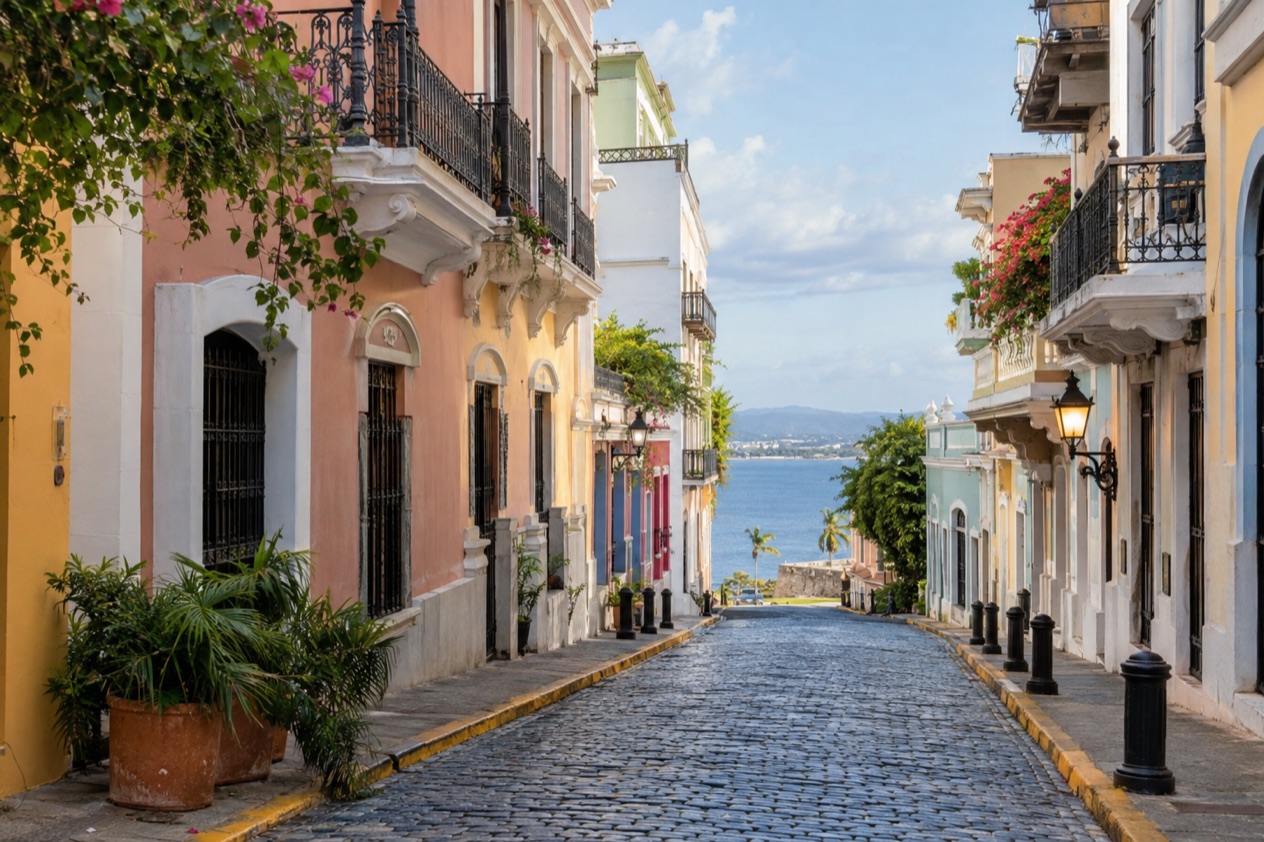
It suits families, groups with a pile of bags, and anyone landing after dark. The drive into Condado is short, and Old San Juan is only a little farther along the same coast. Once you are in the old city, remember that its blue cobblestone streets are narrow.
Public bus
The public bus costs 75 cents, which makes it by far the cheapest way into town. The Metropolitan Bus Authority runs two routes through Condado, the T21 and the D53, so Condado is the easiest beach district to reach this way.
It suits light packers, budget travelers and people who enjoy seeing a city as locals do. Expect to carry your own bags and to spend longer than in a car. Old San Juan’s cobblestones are easier to manage with light luggage.
Free hotel-district bus and walking
The SITRAC bus is free but only travels within the Isla Verde hotel district. If your hotel is on that beach strip, it is a pleasant way to move around once you have settled in, linking the hotels, restaurants and the sand.
It will not take you to Condado or Old San Juan, so think of it as a local hop rather than a way into the city. Because the airport borders Isla Verde to the south, the hotels there are the closest to your arrival gate of any in the metro area.
Rental car, shuttle and ride-hailing
A rental car makes sense if you plan to leave San Juan for the island’s beaches, mountains and coastal kiosks. Just east of the airport, Pinones offers a line of beachside stands where alcapurrias and bacalaitos are sold, and with a car you can easily get there on your first afternoon.
If you are staying only in Old San Juan, a car is more trouble than help, since people there get around on foot or by car and the streets are tight.
Airport transfer options compared
| Option | Best for | Cost | Where to find it |
|---|---|---|---|
| Taxi | Families, late arrivals, heavy luggage | About $20 to Condado or Old San Juan | Taxi line outside arrivals |
| Public bus | Budget travelers with light bags | 75 cents | Public bus stops near the airport |
| SITRAC bus | Isla Verde hotel district only | Free | Within the Isla Verde hotel district |
The taxi wins on comfort and time, and for two or three travelers splitting the fare it is not far from the bus in value. The bus wins on price by a wide margin, but you pay for it in minutes and in handling your own luggage.
A good rule is to match the ride to the rest of your day. After a long flight, take the taxi and be in your room quickly. On a relaxed arrival with a light bag and an open afternoon, the bus gives you a first look at Condado’s avenues and the beach beyond.
Once you are in the Isla Verde hotel district, use the free local bus to get around there. If you will drive around the island, collect a rental car and use it as your way into town, remembering that Old San Juan is more comfortable without one once you are there.
Arriving at the airport
Luis Muñoz Marín is the main international airport of Puerto Rico, and it is split into several terminals. Terminal A is used by JetBlue, Air Canada, Avelo and Tradewind Aviation, so many mainland arrivals on JetBlue step off there.
Terminal B reopened in December 2014 after a major renovation, with Delta, United, Southwest and Spirit among its first tenants. Terminal D, which reopened in March 2023, is mostly used for small and regional operators such as Cape Air, Caribbean Airlines and InterCaribbean Airways.
Domestic flights link the airport to Culebra, Mayagüez and Vieques, so some travelers land here only to catch a small plane onward to the islands. Puerto Rico has airports on both Vieques and Culebra, which makes the short hop a real alternative for island-bound visitors.
Check which terminal your airline uses before you land, since it helps you find the right exit and the right place to meet a ride. Because the airport sits in Isla Verde with the Atlantic to the north, the first minutes after you leave the building often mean warm, humid air and the sound of planes overhead.
Plane spotting from the beach near Pinones used to be a pastime, but the viewing spot there has been closed to the public for airport security reasons since 2001. You can still enjoy the kiosks and the coastline there, just not that particular view.
Good to know before you go
U.S. citizens fly in without a passport or visa, just like on any domestic trip, and the money here is the U.S. dollar. Puerto Rico uses Atlantic Standard Time year-round, so the clock matches the East Coast in summer and is an hour ahead of it in winter.
The Atlantic hurricane season runs from June 1 to November 30, with the peak around the second week of September. Once those months arrive, pay attention to the National Hurricane Center and any alerts from local officials, since the forecast can change quickly. A few words of Spanish are always welcome with drivers and hotel staff.
Sources
- Wikipedia, Luis Muñoz Marín International Airport (https://en.wikipedia.org/wiki/Luis_Muñoz_Marín_International_Airport), checked October 8, 2026
- Wikipedia, Condado (https://en.wikipedia.org/wiki/Condado,_Puerto_Rico), checked October 8, 2026
- Wikipedia, Isla Verde (https://en.wikipedia.org/wiki/Isla_Verde,_Puerto_Rico), checked October 8, 2026
- Wikipedia, Old San Juan (https://en.wikipedia.org/wiki/Old_San_Juan), checked October 8, 2026
- Wikipedia, Transportation in Puerto Rico (https://en.wikipedia.org/wiki/Transportation_in_Puerto_Rico), checked October 8, 2026
- NOAA National Hurricane Center, Climatology (https://www.nhc.noaa.gov/climo/), checked October 8, 2026
To plan your stay
- Best Time to Visit San Juan: Weather, Beaches, Festivals and Hurricane Season
- Things to Do in San Juan: Old San Juan Forts, City Beaches, Street Food and Nights Out
- Where to Stay in San Juan: Old San Juan, Condado, Isla Verde and Santurce
- Know Before You Go to San Juan: Entry, Forts, Money and Getting Around