
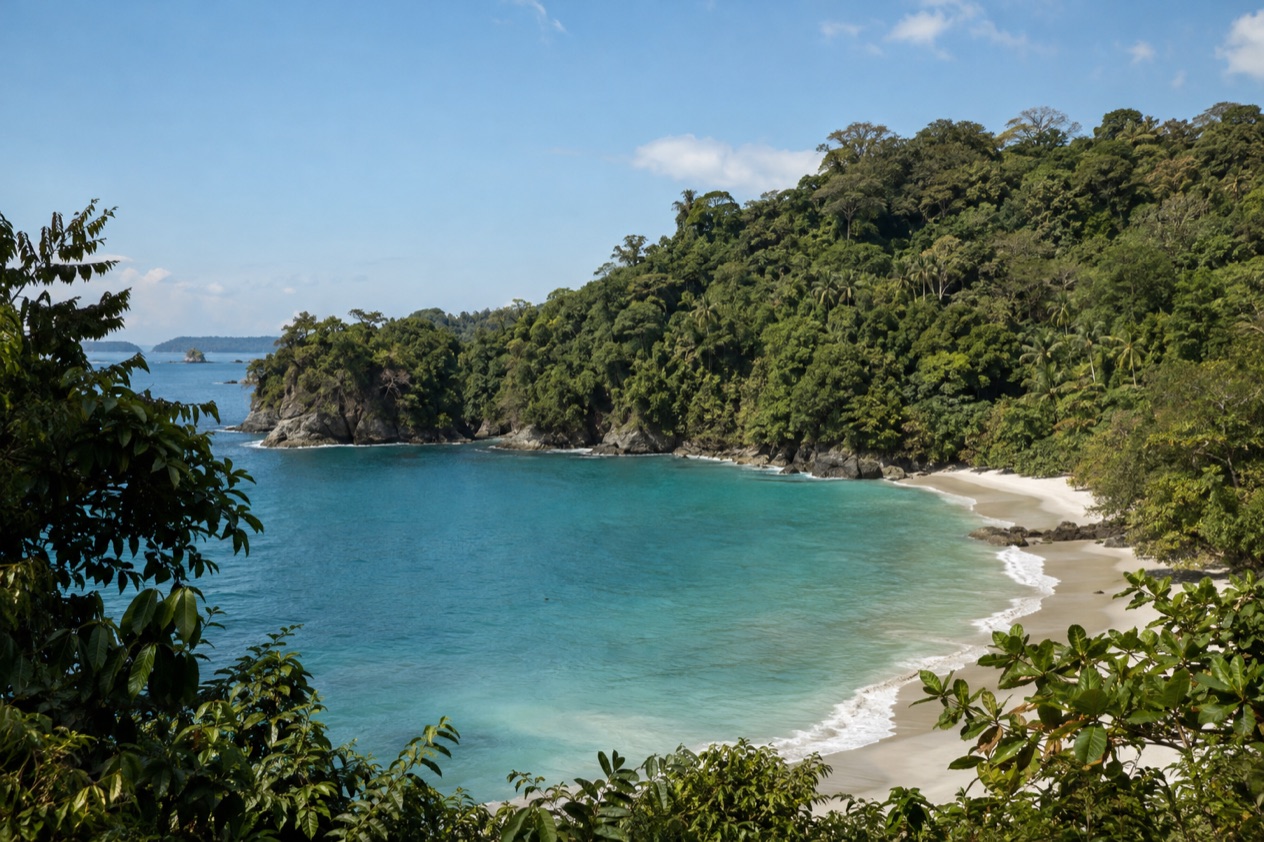
Inside the gate, a rustle overhead may reveal a white-faced capuchin working along a branch while visitors stop to look up. The trail runs beneath tall trees and then opens suddenly onto a small white-sand cove with forest right down to the tide line. Manuel Antonio National Park is a compact, walkable reserve on the central Pacific coast, built for travelers who want wildlife and beaches in the same morning.
Is visiting Manuel Antonio National Park worth it?
Yes, if you want to see Costa Rican wildlife without a long expedition: this is a small park where monkeys and sloths are often seen close to the paths, and it suits first-time visitors, families with older children and anyone who likes a walk that ends at the sea. It is less suited to travelers who want solitude or a remote jungle feel. It is one of the most visited national parks in the country, and the trails reflect that.
What sets it apart from other Pacific stops is the way the pieces sit together. Forest trails, small coves, a lagoon with mangroves, a rocky point between two beaches and a scatter of islands offshore are all packed into one modest park, so a single morning moves through several landscapes.
Many wildlife areas ask for hours of driving, boat rides or steep climbs before the first animal appears. Here, a capuchin may be sitting beside the path within minutes of your arrival.
The park also protects a rare resident, the Central Pacific squirrel monkey, which lives nowhere else in the world. Seeing one is a chance, never a promise, but knowing it shares these trees gives the walk a purpose beyond the beach. The long public beach of Playa Espadilla lies outside the gate, so the town side of Manuel Antonio offers a different, busier day, while the park is the quieter, greener one.
The trade-off is planning. Entry requires an online reservation, there is no parking area at the park, and visitors arrive in numbers. Go with a plan, a sense of patience on narrow trails and a willingness to stop often, and the park gives back a great deal for a small footprint.
What to see at Manuel Antonio National Park
The park covers 683 hectares, small enough that the beaches, forest and viewpoints feel like chapters of one walk. Wildlife is the main draw, and animals seen on the trails include capuchin monkeys, sloths, coatis, raccoons, iguanas and many bird species. Visitors are asked not to feed any of them, which matters most with the bold capuchins and raccoons that learn quickly where snacks come from.
The forest trails and their wildlife
The paths run beneath a dense canopy that stays shady and humid even when the sun is strong on the coast. Look first at eye level for iguanas on trunks and rocks, then higher up for the slow shapes of sloths curled in the crooks of branches, often mistaken at first for termite nests or clumps of leaves. Coatis, with their long ringed tails, patrol the ground in small groups.
Capuchin monkeys are the easiest to find and the hardest to ignore, since they move through the trees with obvious curiosity. The park is also home to the endangered squirrel monkey, endemic to Manuel Antonio, with only about 1,500 individuals left. Walk quietly, keep your food sealed and stop whenever the leaves above you start to shake.
The three beaches
Inside the park there are three beaches: Espadilla Sur, Manuel Antonio and Puerto Escondido. Playa Manuel Antonio and Playa Espadilla Sur are the small, white-sand coves most visitors picture, sitting between forest and sea with trees close enough to throw shade on the sand. They are good places to rest after the trail, watch the sea and look for monkeys passing along the tree line.
Rip currents are very dangerous on Costa Rica’s Pacific coast and cause several drownings of U.S. tourists each year. Treat every beach here as a place to look at the water and its conditions before you decide anything, and do not assume a cove is gentle because it is pretty.
Cathedral Point
Cathedral Point connects Manuel Antonio and Espadilla Sur beaches and is a place of great natural beauty. It is the park’s rocky headland, where the forest climbs above the water and the view opens in both directions along the coast. The best use of it is as a slow stretch of the walk, with pauses to look out over the sea and back at the two coves it joins.
Birds often pass along the coast here, and the shoreline views give a sense of how the park meets the ocean. It is a good place to take photographs, with the hills behind you and the water spread out below.
Lagoon, mangroves and islands
Within the park there is a 14-hectare lagoon with mangroves, a quieter, wetter landscape than the beaches, where roots arch into the water and herons and other waterbirds hunt along the edges. It gives the visit a change of texture after the open sand.
Offshore, the park protects 12 islands that shelter marine birds. From the beaches and from Cathedral Point they appear as dark shapes on the horizon, with seabirds wheeling around them. Bring binoculars if you have them, since the islands are best appreciated from a distance.
Hours, tickets and rules
The park keeps a regular weekly schedule and works entirely on advance reservations, so a spontaneous arrival at the gate is not how a visit begins. You book online first, then present your reservation number with identification when you enter.
| Site | Open | How to book |
|---|---|---|
| Manuel Antonio National Park | 7 a.m. to 4 p.m., Tuesday through Sunday | Online only, through SICORE at serviciosenlinea.sinac.go.cr |
Tickets must be purchased online through SICORE, and the park requires online reservation. Visitors must show physical or digital personal identification when presenting the reservation number. Single-use plastics are not allowed in the national park, so bring a refillable bottle. The park does not have a parking area. Visitors are asked not to feed the animals.
How to get to Manuel Antonio National Park
Manuel Antonio is a stretch of hills and beaches on the central Pacific coast, just south of the town of Quepos, and the park sits at the heart of it. Quepos is the practical base for most trips, and the hotels, restaurants and shops in the hills above the beaches make up the rest of the area. The park has no parking area, so confirm with your lodging or transportation provider how you will reach the entrance.
The most important practical point is that the park has no parking area. Plan your arrival so that you are not depending on leaving a car at the entrance, and think of the gate as a place you reach from where you are staying. Staying in Quepos or in the Manuel Antonio hills puts you close to the start of the trails.
The long public beach of Playa Espadilla lies outside the park gate, so you pass it on the way in. It is a useful landmark and a place to see how the day is shaping up before you go inside. Visitors who finish early in the park often come back here for a look at the open coastline.
Because entry depends on your online reservation, plan your journey around the details shown on your confirmation. Decide where you will sleep, then work backward from the opening hour so that you arrive with your confirmation number and identification ready. The park’s official reservation page is the place to confirm the details of your booking.
When to visit Manuel Antonio National Park
Go early. Arriving at opening gives you the longest possible visit before the park closes. By midday the heat builds under the trees, and the beaches fill. The park closes in the late afternoon, so the day inside is shorter than the daylight outside, and an unhurried visit starts at the opening bell.
The Pacific side is drier from about December to April and greener from about May to November, with rain that usually falls in the afternoon. In January the park still sees rain on most days, though showers tend to be lighter, and the high is in the low 80s. April is warmer and wetter, with rain on most days and a few heavy ones.
July and October are the heart of the green season. Rain falls on nearly every day, and about a dozen days in each month bring a downpour of an inch or more. Mornings can be clear, and the forest is lush and loud, but trails can be muddy and the afternoons often turn gray and wet. Highs stay in the upper 70s, so the air is warm even when the sky is not.
There is no single perfect month. If you want the greatest chance of easier walking, the early-year months are the better bet. If you do not mind rain and like a green, dripping forest, the middle and later months have their own charm. Whatever the month, aim for the first hours after opening, and remember that the park is open Tuesday through Sunday.
Tips for your visit
Bring a refillable bottle, since single-use plastics are not allowed, along with sunscreen, a hat, a light rain jacket and shoes that grip on damp ground. Pack food in reusable containers and keep it sealed on the trails, because capuchins and raccoons know what a bag contains. Binoculars are worth the room in your pack, as many of the best sightings are high in the canopy or on the offshore islands.
For hiking in national parks, the guidance is to register with the park, have an entry permit and use a certified tour operator. The Costa Rica Tourism Institute (ICT) provides a list of Certified Tour Guides. A guide is a practical way to find sloths and other animals that visitors walking alone often pass without noticing.
Allow enough time for the forest trails, beaches and Cathedral Point, and plan around the park’s closing time. The trails are short enough to enjoy at an easy pace, with time for the beaches and Cathedral Point. Afterward, the town side of Manuel Antonio offers a contrast: Playa Espadilla outside the gate is a long public beach for a late-day walk, and the hills above are lined with restaurants and lookouts for a slow lunch.
Families with older children will find the wildlife engaging, but the park has no parking area and the trails run through forest and along coves, so strollers and limited mobility call for thought before you go. Ask your guide or a park ranger about the trails you plan to use. Keep children close on the beaches, where rip currents are a real danger.
Good to know before you go
The U.S. State Department rates Costa Rica Level 2, ‘Exercise increased caution,’ due to crime; it says petty crime is common throughout Costa Rica and that violent crime also affects tourists, including armed robbery, homicide and sexual assault.
Keep your reservation number and identification handy on your phone, and carry a little extra water for the walk back. Watch your belongings in town and at the beaches, as petty crime is common throughout Costa Rica, and never leave bags unattended on the sand.
Treat the sea with respect, because rip currents are very dangerous, and look at the water carefully before you decide to go anywhere near it. Above all, give the animals space and leave them to their own food.
Sources
- Costa Rica Tourism Board (ICT), Manuel Antonio National Park (https://visitcostarica.com/where-to-go/protected-areas/manuel-antonio-national-park), checked October 8, 2026
- SINAC (Costa Rica national parks authority), online reservations (https://www.sinac.go.cr/ES/resvlinea/Paginas/default.aspx), checked October 8, 2026
- Open-Meteo / ECMWF ERA5, normals 1991-2020 computed for the grid cell at 9.392N 84.1366W, checked October 8, 2026
- U.S. Department of State, Costa Rica Travel Information, Safety and security (https://travel.state.gov/content/travel/en/international-travel/International-Travel-Country-Information-Pages/CostaRica.html), checked October 8, 2026
- U.S. Department of State, Costa Rica Travel Advisory, issued April 1, 2026 (https://travel.state.gov/content/travel/en/traveladvisories/traveladvisories/costa-rica-travel-advisory.html), read via the State Department open data API on October 8, 2026
To plan your stay
- Best Time to Visit Manuel Antonio: Dry Season, Green Season, Sea Temperatures and Festivals
- Where to Stay in Manuel Antonio: Quepos, the Hill Road and the Beach End
- Manuel Antonio in January: Weather, Beaches, Wildlife and a Two-Day Plan
- Manuel Antonio in February: Weather, Beaches, Park Walks and a Two-Day Plan