
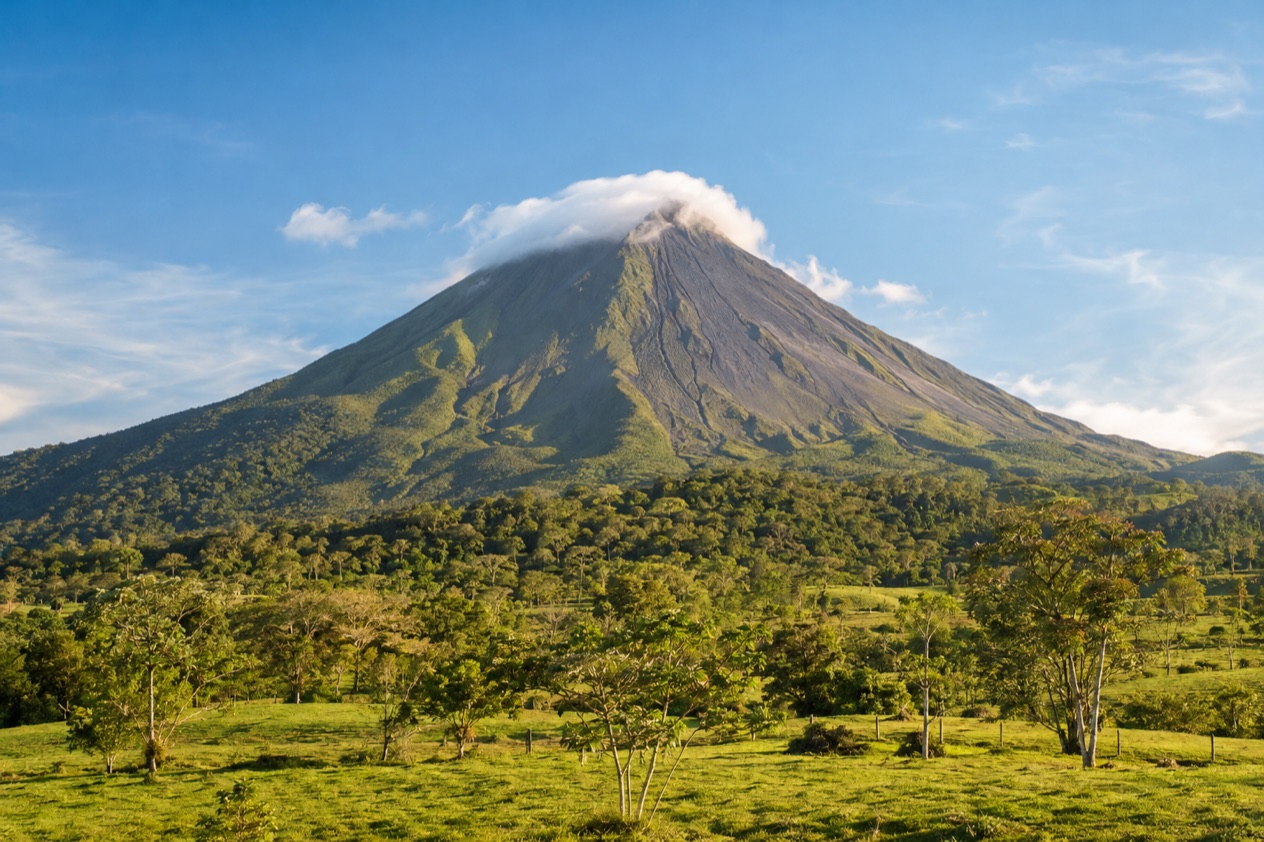
In January, the mornings in La Fortuna start with mist peeling off the cone of Arenal and the shriek of oropendolas in the trees along the main street. By nine, the town square is full of people in hiking sandals, waiting for shuttles to the hot springs and the hanging bridges. The rainy months have just loosened their grip, the forest is still deep green, and the volcano shows itself more often than it does in the autumn.
What is the weather like in La Fortuna in January?
January is warm, green and still fairly wet, with a mix of bright mornings and showers that can drift in at any hour. The northern lowlands keep their rain longer than the Pacific side, so this is not a dry month here, only a gentler one than December.
| Month | Average high (°F) | Average low (°F) | Rain days |
|---|---|---|---|
| December | 77.3 | 68.2 | 17.5 |
| January | 77.6 | 67.1 | 12.9 |
| February | 79.4 | 66.9 | 8.1 |
Clouds often gather around the summit as the day heats up, so early starts give you the better chance of a clear view. Rain tends to arrive as passing showers that can last an hour or settle in for an afternoon, and a few days in the month bring a heavier, steadier downpour.
Days are warm without being hot, which makes walking on trails comfortable, and the evenings cool just enough that a light layer feels good at an outdoor table. Daylight lasts a bit over eleven and a half hours in mid-month, so dinner happens in the dark and trail plans should finish by late afternoon. Bring a rain jacket in your daypack every day, since a bright start guarantees nothing.
What to do in La Fortuna in January
January is the start of the busy dry-leaning stretch, and the town runs at full speed. New Year’s Day is a national holiday, so expect a slow, quiet morning on January 1 in the center, and school is on its long summer break from December into early February, which brings Costa Rican families to the area along with international visitors. Farther west, Guanacaste has the Fiestas Civicas of Santa Cruz in mid-January, with bull-riding, parades and street food, but that is a separate trip from La Fortuna.
What suits this month is anything that mixes forest and water. A warm river or a hot pool feels especially good after a damp morning walk, and the cool evenings make soaking a real pleasure rather than a novelty.
Arenal Volcano and the lava-flow trails
Arenal is the classic cone you picture when you think of Costa Rica, and it dominates every view from town. Nearly continuous eruptions happened from 1968 until 2010, when the volcano went quiet, so people come for the silhouette and the walks over old lava rather than to watch an explosion. The trails cross hardened black rock and secondary forest, and they are a good place for birds, with toucans and trogons turning up now and then.
Go early. The summit is most likely to show in the first hours of the day, and January light on a clear morning makes the cone look sharply drawn. Closed shoes with grip matter on the rock, and a guided walk is the way most visitors spot animals in the trees.
Hot springs and the river
The volcano heats the water below La Fortuna, and the hot springs are the signature afternoon activity. Some are big resort complexes with pools, swim-up bars and dinner buffets, while others are quieter, with a few terraced pools tucked into the forest. Evening visits are lovely in January, when the air has a slight chill and steam rises off the water under the trees.
Pick by mood. Larger complexes suit families and groups who want food and slides in one place, and the smaller ones suit couples who want a slow soak and the sound of frogs. After a rainy afternoon the pools are an easy plan, since you are already wet.
La Fortuna Waterfall and the hanging bridges
The waterfall drops into a deep green pool at the end of a long stairway through the forest. The walk down is steep and the climb back is the real workout, so go in the cooler morning and give yourself time to rest at the bottom. January spray and recent rain keep the falls full and loud.
The hanging bridges are a gentler outing. Paths link a series of suspension walkways through the canopy, and you may see monkeys, birds and, with luck, a sloth. Morning is the best time for wildlife, and the bridges are a good choice when the weather is gray, since the mist inside the forest looks beautiful.
Lake Arenal and the town itself
The lake, on the far side of the volcano, is the place for a boat ride, kayaking or a slow sunset on the water, with the cone reflected when the clouds allow. In town, nightfall brings locals to the central park and its church, while the sodas (small family restaurants) dish up casado, a plate of rice, beans, plantain and either meat or fish that serves as the daily lunch.
Try gallo pinto, the rice and beans mix, at breakfast, and look for fresh fruit juices and tilapia or chicharrones in the evening. Cheese is a regional specialty, and a coffee after dinner fits the cool evenings well.
A two-day itinerary for La Fortuna in January
Day 1 starts early, with breakfast of gallo pinto and eggs in town and a morning walk on the Arenal lava-flow trails, when the summit has its best chance of showing. Be back by midday for a casado at a soda, then head down to the waterfall in the early afternoon while the light is still good. Wet stairs can be slippery, so wear shoes with grip.
Finish the day in the hot springs. Daylight fades by early evening, so a soak under the trees with the air cooling around you makes a good ending, followed by dinner at the resort or back in town. If the rain turns heavy, skip the stairs.
Day 2 begins with the hanging bridges, again in the morning, when birds and monkeys are most active and the canopy is quiet. Walk the loop slowly, stopping where the guide or trail points to something moving.
After lunch, head to Lake Arenal for a boat ride or a paddle, and stay for the end of the afternoon. In the evening, wander the central park, buy something sweet from a stall, and eat at a restaurant with a view of the cone. In a downpour, a chocolate or coffee tasting or a cooking class makes a good indoor plan.
Is La Fortuna busy in January?
Yes, January is one of the busier months in La Fortuna. Costa Rican schools are on their long summer break from December into early February, and international visitors arrive for the greener, calmer weather after the heaviest rains. The hot springs, the waterfall and the main tour operators fill up, especially around New Year’s Day.
Rooms near the center and the springs go first, so book them early for the holiday weeks and a little later for the quieter stretch toward the end of the month. Popular restaurants fill by evening, so a reservation for dinner is a good habit on weekends.
The trails and bridges are most crowded in the middle of the day, when tour buses arrive. Early mornings and late afternoons are calmer, and the lake side of Arenal tends to feel quieter than the waterfall. Check each park’s official page for any reservation or entry rule before you go, since they change.
What to pack for La Fortuna in January
Pack for warm days, wet trails and cool evenings, and expect to dry things out between outings.
- A light rain jacket, since showers can arrive in any hour of the day.
- Closed shoes with grip for lava rock and muddy trail stairs.
- Sandals and a quick-dry towel for the hot springs.
- A swimsuit, since you will want it more than once.
- A light sweater for evenings, when the air cools near the volcano.
- Insect repellent and sunscreen for the forest and the lake.
Good to know before you go
The U.S. State Department rates Costa Rica Level 2, ‘Exercise increased caution,’ due to crime; it says petty crime is common throughout Costa Rica and that violent crime also affects tourists, including armed robbery, homicide and sexual assault.
January 1 is a national holiday, so some businesses in town keep shorter hours that day. Plan transfers with some room. A valid passport for the length of your stay and a return or onward ticket are required, and authorities may allow up to 180 days without a visa, though that is not guaranteed.
La Fortuna in January vs December and February
Moving the trip to December means more rain, with showery days stretching through much of the month, and the holiday crowds peak around Christmas and the new year. The forest looks its freshest and the waterfalls are at their fullest, but cloud over the volcano is more common.
February is the drier choice, with sunnier days and better chances for a clear summit, and the school break winds down in the early part of the month. The trade-off is that the days are a little warmer and the best rooms are still in demand, though the pressure eases as the break ends.
Choose December if you love lush scenery and festive energy and do not mind showers. Stay with January if you want a balance of green forest and decent weather, and shift to February if volcano views and dry trails matter most.
Is January a good time to visit La Fortuna?
Yes, January is a very good time for travelers who want hot springs, waterfalls and forest walks in warm weather, and who accept some rain and a lively town. Families benefit from the school break, and couples find the cool evenings ideal for soaking.
Travelers who want quiet trails or the surest dry weather may prefer a later month, and anyone who dislikes planning ahead will find January rooms harder to get. What stays with you from January here is the contrast: a green, dripping forest in the morning, the cone sharp against a pale sky when the clouds lift, and a hot pool steaming in the cool dusk.
Sources
- Open-Meteo / ECMWF ERA5, normals 1991-2020 computed for the grid cell at 10.4679N 84.6427W, checked October 8, 2026
- sunrise-sunset.org, sunrise and sunset calculated for the 15th of the month, checked October 8, 2026
- U.S. Department of State, Costa Rica Travel Advisory, issued April 1, 2026 (https://travel.state.gov/content/travel/en/traveladvisories/traveladvisories/costa-rica-travel-advisory.html), read via the State Department open data API on October 8, 2026
- U.S. Department of State, Costa Rica Travel Information, Entry and exit requirements (https://travel.state.gov/content/travel/en/international-travel/International-Travel-Country-Information-Pages/CostaRica.html), checked October 8, 2026
To plan your stay
- Things to Do in La Fortuna: Arenal Volcano, Hot Springs, the Waterfall and Day Trips
- Where to Stay in La Fortuna: Town Center, Volcano Road, Hot Springs Strip and Lake Arenal
- La Fortuna vs Monteverde: Hot Springs, Cloud Forest, Weather and Which to Choose
- Day Trips from La Fortuna: Rio Celeste, Arenal Volcano Park, Monteverde and Hot Springs