
Early in the morning in the Zócalo, the laurel trees fill with birds, the smell of chocolate and fresh bread drifts from the side streets, and a brass band is somewhere tuning up for a wedding procession. Oaxaca is a city of Zapotec ruins on the hill, markets that run on their own calendar, and kitchens that take lunch seriously. It suits anyone who likes to eat well, wander colonial streets and spend days in the villages around the valley.
What are the best things to do in Oaxaca?
The best of Oaxaca is a mix of ancient stone, good food and village crafts, with the city as a comfortable base for all three.
- Walk the Gran Plaza at Monte Albán, the Zapotec capital above the valley.
- Sit under the laurels of the Zócalo and watch the city go by.
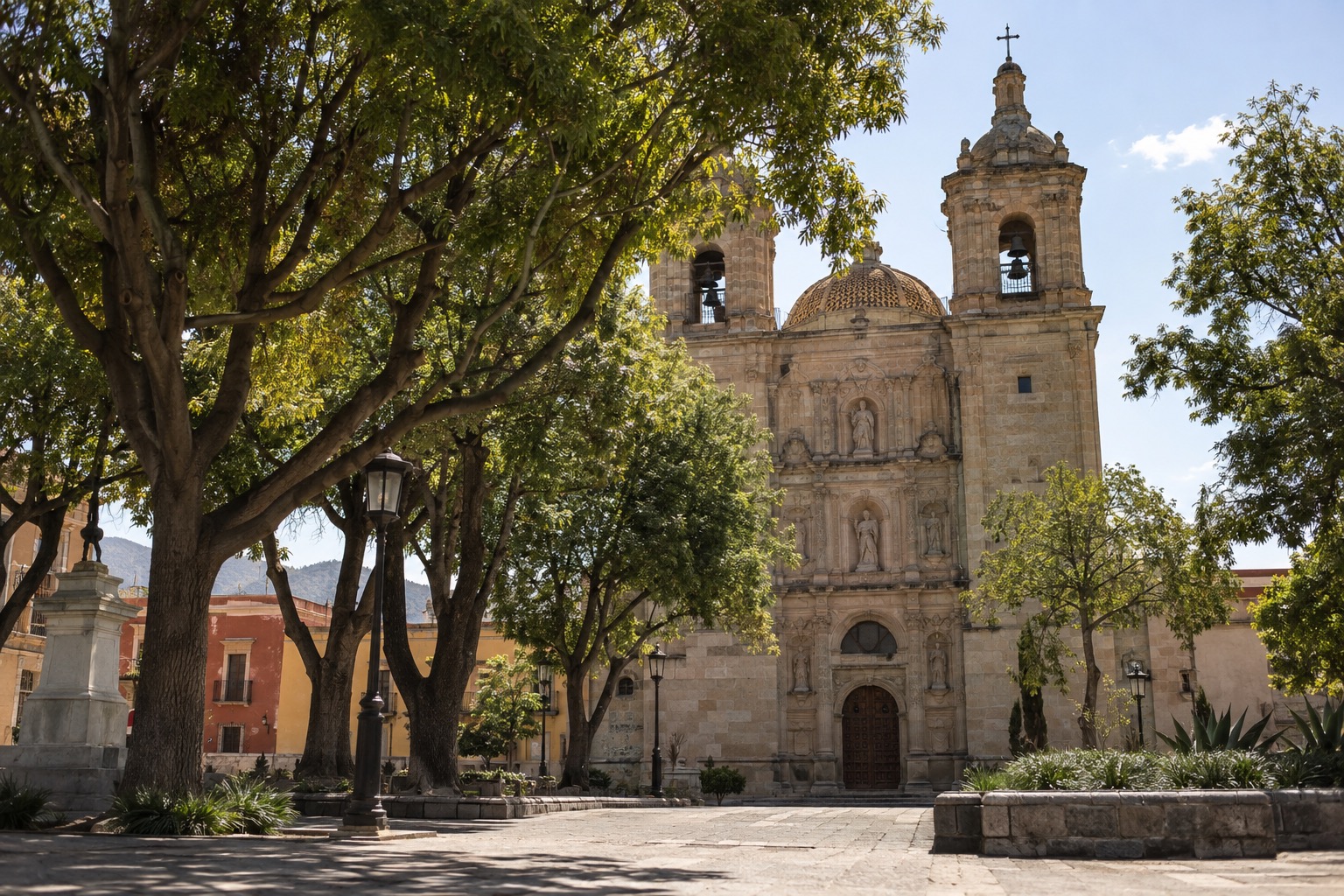
- Visit the Museo de las Culturas in the old Santo Domingo convent.
- Spend a Sunday in the crowded market at Tlacolula.
- Taste mezcal at a family palenque near Santiago Matatlán.
- Watch weavers at work in Teotitlán del Valle and see the stone mosaics of Mitla.
- Eat mole, tlayudas and chocolate at the markets and in the old kitchens.
- Stand among the candlelit graves during Día de Muertos.
Sights and landmarks in Oaxaca
Monte Albán
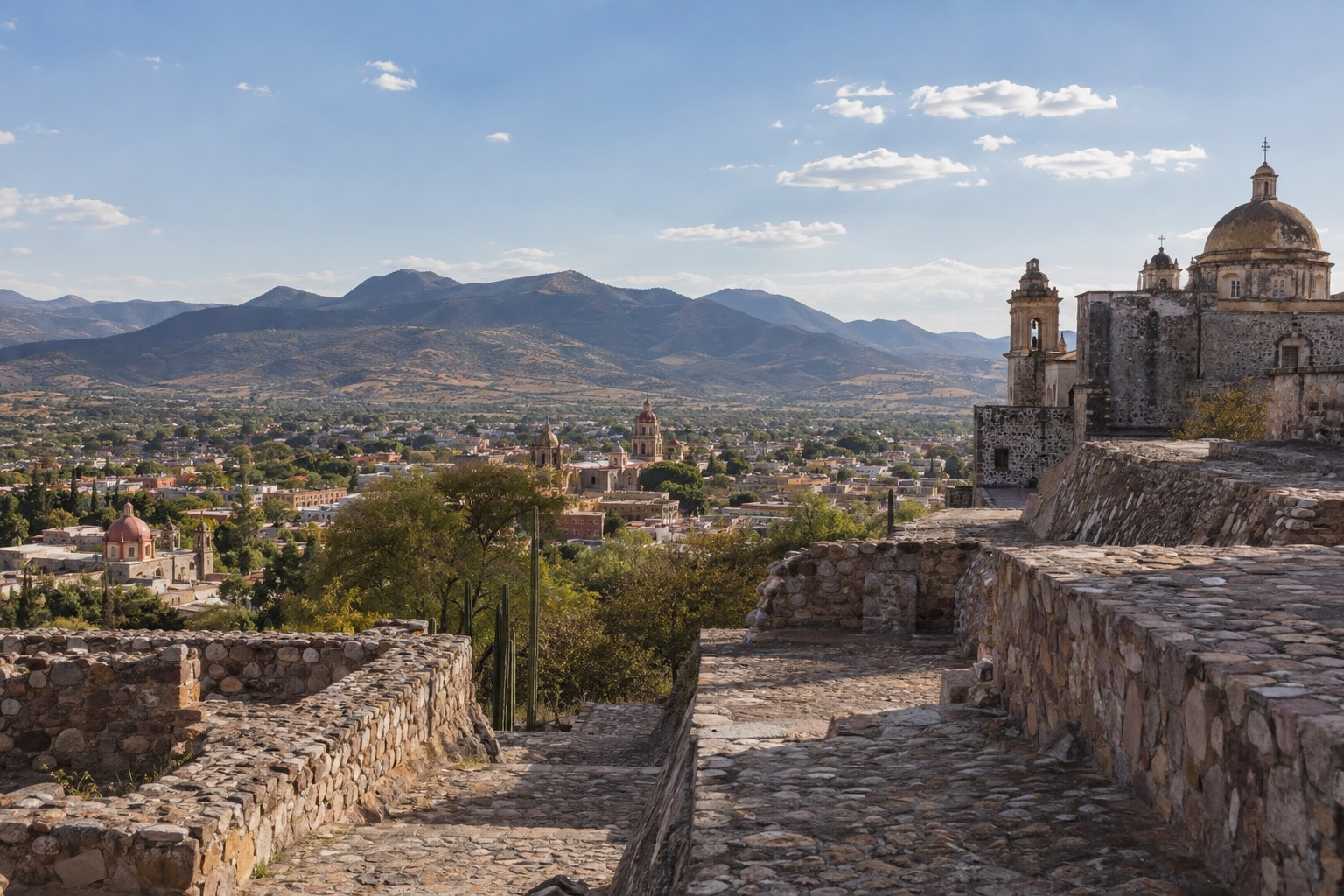
Monte Albán crowns a flattened hilltop above the valley and was the great Zapotec capital for some thirteen centuries. It is a UNESCO World Heritage Site, and the setting alone, with mountains on every side, is reason enough to go. The visit takes in the vast Gran Plaza, the Danzantes gallery, the Ball Court and the two great platforms at either end, with original stelae in the site museum.
From the city you can take a car, a taxi or a local bus that leaves from near the center, and the drive takes about 20 to 30 minutes. Early morning or late afternoon is best, when the midday sun is off the plaza and the tour groups are thinner. The ground is uneven and shade is scarce, so it is hard going for wheelchair users, and there is no food or drink stand inside, so bring water, a hat and sun protection.
Museo de las Culturas de Oaxaca
The museum fills the former Santo Domingo convent, a massive stone complex beside one of the most ornate baroque churches in Mexico. Rooms open onto cloistered courtyards, and the collection tells the story of the region from its earliest peoples through the colonial era. The jewelry and offerings from the Monte Albán tombs are the pieces people remember.
Plan a slow morning here. Afterward, the pedestrian street running down from the church is lined with galleries, cafés and shops, a good place to keep wandering.
The Zócalo and the historic center
The Zócalo, shaded by laurel trees, is framed by the cathedral and the state government palace. Café tables spill under the arcades, balloon sellers and mariachis drift through, and by evening the whole square feels like a party that nobody planned. The streets around it are colonial grids of green-stone buildings and painted walls, with craft shops and courtyards behind big wooden doors.
Walk out in any direction and you reach another market, church or small plaza. The center is easy to cover on foot, which makes it a pleasure to get a little lost.
| Site | Open | Admission |
|---|---|---|
| Monte Albán | Daily, 8 a.m. to 5 p.m. (last entry 4 p.m.) | 210 pesos; 105 pesos for Mexican nationals and foreign residents |
| Museo de las Culturas de Oaxaca | Tuesday to Sunday, 9 a.m. to 5 p.m. | 210 pesos; 105 pesos for Mexican nationals and foreign residents |
Outdoor things to do in Oaxaca
Hierve el Agua
East of the city near San Lorenzo Albarradas, Hierve el Agua is a set of petrified waterfalls, white mineral cliffs that look like cascades frozen mid-fall, with mineral pools at the edge of a canyon. The views over the valley are huge, and the hillside paths let you see the formations from several angles. The local community manages the site and collects its own entrance fee on arrival.
The road trip takes about 1.5 to 2 hours one way. You can take a bus or collective taxi toward Mitla, then a local truck or taxi from San Lorenzo Albarradas, though many drivers go directly. It makes a long day, so it pairs well with an early start.
Markets and open-air mornings
Much of Oaxacan life happens outdoors. Market streets spill past their buildings with piles of chiles, tropical fruit, woven baskets and flowers, and the Zócalo and nearby plazas fill with strollers, vendors and musicians.
Mornings are the best time to walk, before the sun gets strong. The valley around the city is mostly farmland, agave fields and villages, and the drives out to the ruins and craft towns are scenic in themselves, with mountains rising on every side.
Day trips from Oaxaca
Mitla and Teotitlán del Valle
Both towns lie along Highway 190, the Mitla road. Mitla is known for its geometric stone mosaics and its Patio of the Columns, and the Church of San Pablo rises on a pre-Hispanic platform right beside the ruins. Wool rugs woven and dyed by hand make Teotitlán del Valle famous, and you can visit its family workshops plus the 16th-century Church of the Precious Blood.
Teotitlán is about 30 to 40 minutes from the city, and continuing to Mitla takes about 45 minutes to 1 hour in all. Second-class buses and shared colectivos leave from the baseball stadium or the Central de Abastos. Go to Mitla on a weekday morning to avoid weekend tour groups, and to Teotitlán on a weekday afternoon to see weavers at work.
The route suits craft lovers, history enthusiasts and families, though Mitla has low doorways and uneven stone floors. Teotitlán has no entry fee, and workshops expect you to watch before buying. Carry small bills for colectivo fares and purchases, and ask before photographing artisans.
Tlacolula Sunday market
Tlacolula’s Sunday market is a weekly market for local food and crafts that fills the streets around the main plaza and the 16th-century Church of the Assumption. At the stalls, you can buy barbacoa, pan de yema, produce, pottery, and woven baskets, while smoke and the sound of bargaining hang heavy in the air.
Catch a bus or colectivo with Tlacolula on its sign from either the baseball stadium or the second-class bus station, and the trip takes around 45 minutes to 1 hour. Arrive between 8 and 10 a.m. on Sunday to beat the crowds and the heat, because many stalls close by mid-afternoon.
It suits food lovers and market-goers. The narrow aisles are hard for wheelchairs and strollers, so arrive hungry for barbacoa, bring small bills and keep valuables close.
Mezcal palenques near Santiago Matatlán
Small family palenques around the valley open their stills to visitors, distilling from roasted agave in the traditional way. A palenque visit shows the whole process, from the earthen ovens where the agave roasts and the stone wheel that crushes it to the wooden vats and the copper or clay stills, and ends with a tasting of espadín and wild agave mezcals.
Santiago Matatlán is about 45 minutes to 1 hour from the city on Highway 190, by car or bus and colectivo, and many tours stop at several palenques. The dry season, November to April, is when many are actively distilling after the agave harvest, and mornings are cooler with more time for tastings.
At most of these places, there is no admission fee, and tastings are typically free because they expect you to consider purchasing a bottle, so carry small bills. This is an outing for adults.
Children can watch, but the work areas have open fire pits, heavy equipment and slippery floors. Yagul, an hilltop Zapotec site just past Tlacolula on the Panamerican Highway, is an easy add-on to the same road, and the Hierve el Agua trip is another full day.
| Site | Open | Admission |
|---|---|---|
| Mitla | Daily, 8 a.m. to 5 p.m. (last entry 4 p.m.) | 210 pesos; 105 pesos for Mexican nationals and foreign residents |
| Yagul | Daily, 8 a.m. to 5 p.m. (last entry 4 p.m.) | 210 pesos; 105 pesos for Mexican nationals and foreign residents |
What to eat in Oaxaca
Oaxaca is known as the land of seven moles, and the dark, glossy mole negro, laced with chiles and chocolate, is the dish that most defines it. Alongside it come the lighter amarillo, the green mole and the red coloradito, each served over chicken or pork with fresh tortillas.
The tlayuda is the everyday favorite, a large crisp tortilla spread with beans, quesillo (the local string cheese) and meat, then grilled over coals. Memelas, tamales wrapped in banana leaf, and chapulines (toasted grasshoppers with lime and chile) are market staples, and barbacoa fills the Sunday tables in the valley towns.
To drink, there is mezcal, often served with orange slices and salt made with worm and chile, and hot chocolate whipped with cinnamon and almonds, served beside pan de yema. Tejate, a cold foamy drink of maize and cacao, is sold from big clay bowls in the markets. Eat at the market stalls for grilled meats and smoky stalls, or at courtyard restaurants for the slower moles.
Things to do in Oaxaca at night
Evenings in Oaxaca center on the Zócalo, where families, couples and musicians fill the benches and café tables under the lights. Marimba groups, brass bands and mariachis come and go, and street vendors sell ice cream, elotes and balloons well into the night.
Rooftop bars and mezcalerías around the historic center offer tastings by the glass, usually in small, dim rooms with a good selection. Live music is easy to find, from traditional son to jazz, and the city is relaxed enough that a slow stroll after dinner is the usual plan.
Día de Muertos in the cemeteries
At the end of October, nights belong to the cemeteries. During Día de Muertos, families in the Panteón General in the city, Xoxocotlán and Atzompa welcome respectful visitors at the night vigils. As you pass between graves lit by candles and adorned with cempasúchil, pan de muerto, fruit, and personal items, families take their seats, make music, and share food and mezcal. Xoxocotlán and Atzompa also have elaborate sand tapestries and arch decorations.
The primary vigils begin on the night of October 31 and stretch into November 1, while some visits carry over to November 2. Arrive after 9 p.m. and stay past midnight to see the altars fully lit.
Xoxocotlán and Atzompa are about 20 to 30 minutes from the center, Panteón General a short taxi ride, and you can go by taxi, colectivo or a special shuttle on those nights. Entry is free, though some community altars ask for a voluntary donation.
Ask before photographing people, do not walk on the graves and keep your voice low. The cemeteries get crowded, smoky and dark, so they suit culturally curious adults and older children rather than very young ones.
Things to do in Oaxaca with kids
Children usually enjoy Oaxaca for its color and movement: balloons and street musicians in the Zócalo, ice cream stands, and wandering market aisles full of toys, sweets and piles of fruit. Hot chocolate with a piece of pan de yema is an easy win.
Monte Albán suits families with older children, who can run across the big plaza and look for the carved Danzantes, though the plaza has little shade. Teotitlán del Valle lets them watch wool being dyed and woven, and Mitla’s stone patterns and low doorways are fun to explore.
Keep the altitude and sun in mind, with water and hats close by. Mezcal palenques and the crowded Tlacolula aisles are better left for adults, and very young children are better off skipping the night cemeteries.
Good to know before you go
The U.S. State Department rates the state of Oaxaca Level 2, Exercise Increased Caution, and places no restrictions on travel to Oaxaca City, Monte Alban, Puerto Escondido or Huatulco.
The historic center is compact and walkable, with taxis for the hillside and colectivos and buses for the valley towns. Small bills are handy at markets, in villages and for colectivo fares. The U.S. State Department rates the state of Oaxaca Level 2, Exercise Increased Caution, and places no restrictions on travel to Oaxaca City, Monte Albán, Puerto Escondido or Huatulco.
Sources
- INAH, Zona Arqueologica de Monte Alban (inah.gob.mx/zonas/94-zona-arqueologica-de-monte-alban), checked September 29, 2026
- UNESCO (whc.unesco.org/en/list/415) ; INAH, Monte Alban ; chronologie corrigee le 03/10 (relecture Fable)
- INAH, lugares.inah.gob.mx (Mitla), via Fable re-read of 03/10/2026
- INAH, Zona Arqueologica de Yagul (inah.gob.mx/zonas/zona-arqueologica-de-yagul), checked September 29, 2026
- INAH, Museo de las Culturas de Oaxaca Santo Domingo (inah.gob.mx/museos/museo-de-las-culturas-de-oaxaca-santo-domingo), checked September 29, 2026
- U.S. Department of State, Mexico Travel Advisory, State of Oaxaca (travel.state.gov, date issued May 29, 2026), checked October 3, 2026
To plan your stay
- Best Time to Visit Oaxaca: Weather, Día de Muertos, Rainy Season and Festivals
- Where to Stay in Oaxaca: Historic Center, Jalatlaco, Xochimilco and the Pacific Beaches
- Oaxaca Airport to City: Taxi and Car Rides to the Historic Center, Jalatlaco and Xochimilco
- Know Before You Go to Oaxaca: Fees, Cash, Getting Around and Local Customs