
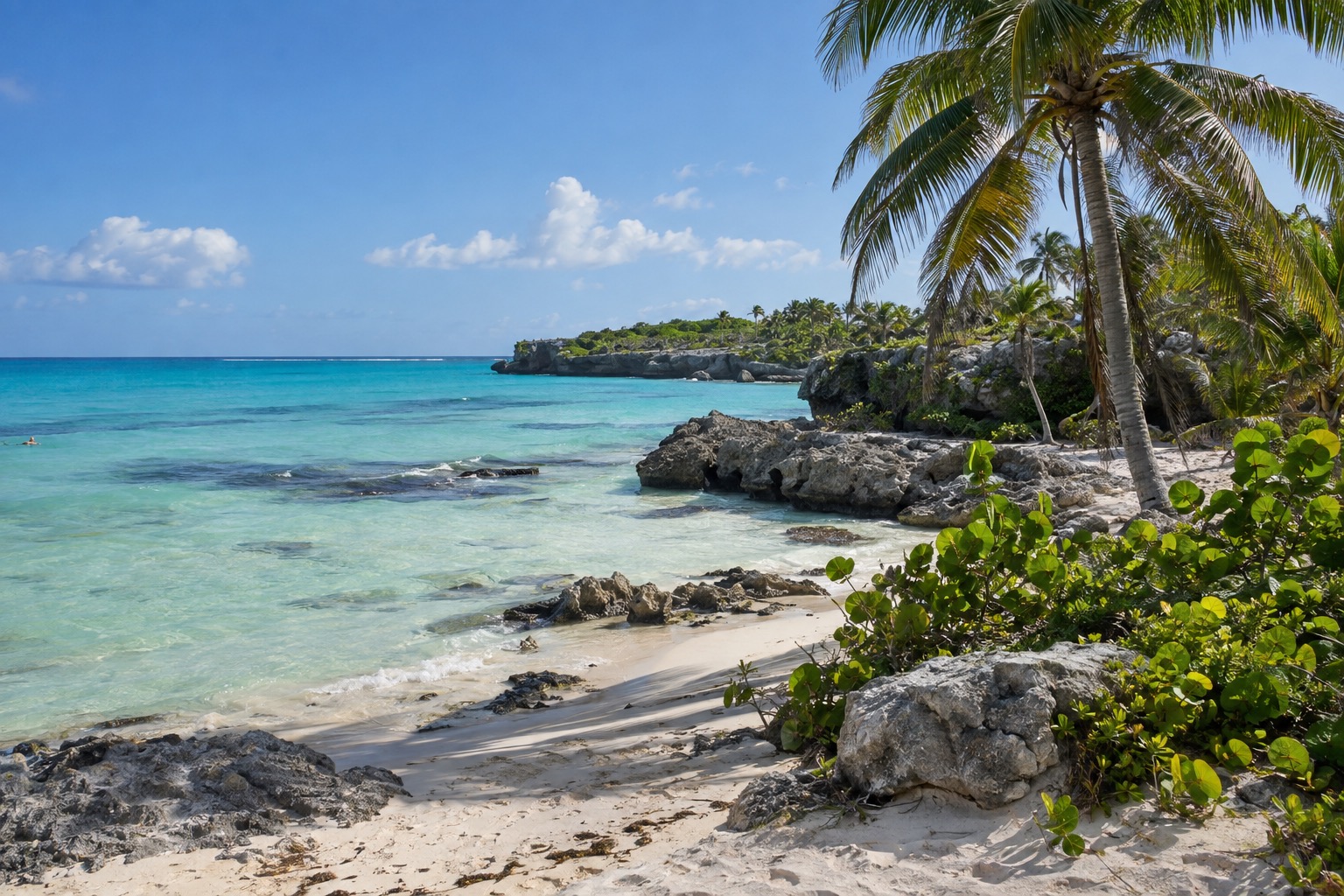
In August, the afternoon sky over Tulum turns the color of slate, thunder rolls in from the sea, and for half an hour the palm roofs of the beach restaurants drum with rain. Then the sun returns, the jungle steams, and the sand fills again with people heading for a late swim. This is Tulum in high summer: green, humid and unhurried, with turtles coming ashore at night and a beach scene that never quite empties.
What is the weather like in Tulum in August?
August is hot and humid, with a rainy-season pattern of sunny mornings and short, sometimes heavy storms later in the day.
| Month | Average high (°F) | Average low (°F) | Rain (in) | Rain days | Sea (°F) | Daylight on the 15th |
|---|---|---|---|---|---|---|
| July | 88.7 | 72.1 | 3.87 | 8.3 | 86.0 | 13 hours 16 minutes |
| August | 88.3 | 72.3 | 3.59 | 9.0 | 87.1 | 12 hours 51 minutes |
| September | 88.0 | 71.6 | 6.97 | 11.2 | 87.1 | 12 hours 17 minutes |
Rain rarely rules out a whole day. It tends to arrive after lunch, soak the street for a while and leave the air smelling of wet earth. Sunrise-to-noon hours are the reliable ones, and the days are long enough that a cloudburst at three still leaves you plenty of light.
At night, the air remains sticky, making a ceiling fan or air conditioning more important than a blanket. The Caribbean is bathwater-warm, which means a swim after a downpour feels natural rather than a shock.
What to do in Tulum in August
August is turtle season. Along the beaches north and south of town, sea turtles come ashore at night to nest, and local conservation groups protect the nests and sometimes organize hatchling releases. It is one of the quiet pleasures of a summer stay, and it explains why many beachfront hotels keep lights low after dark.
Turtle nesting on the beaches
The nesting beaches run along the coast road and into the reserve to the south. You will see roped-off patches of sand marked with signs, each one guarding a clutch of eggs. Walking the shore in the early morning, you may spot the broad, plowed tracks a turtle left overnight.
The best manners are simple: keep away from marked nests, skip flashlights and flash photography on the sand at night, and leave chairs and gear off the beach when you go. Families tend to love the idea, and children who like animals usually remember it longer than any ruin.
Cenotes after the rain
The limestone sinkholes around Tulum are a natural answer to August heat. Gran Cenote and the Dos Ojos system sit just a brief ride outside town, and because separate companies manage each, the atmosphere changes as you move between them. Under the jungle canopy the water is cool and clear, with light slanting through the openings in the rock.
Go in the morning, before the tour groups and before any afternoon storm. Heavy rain can cloud the water a little and make jungle paths muddy, so shoes with grip are a good idea. Turtles often drift through the shallows at the more open sinkholes.
Ruins, reserve and the table
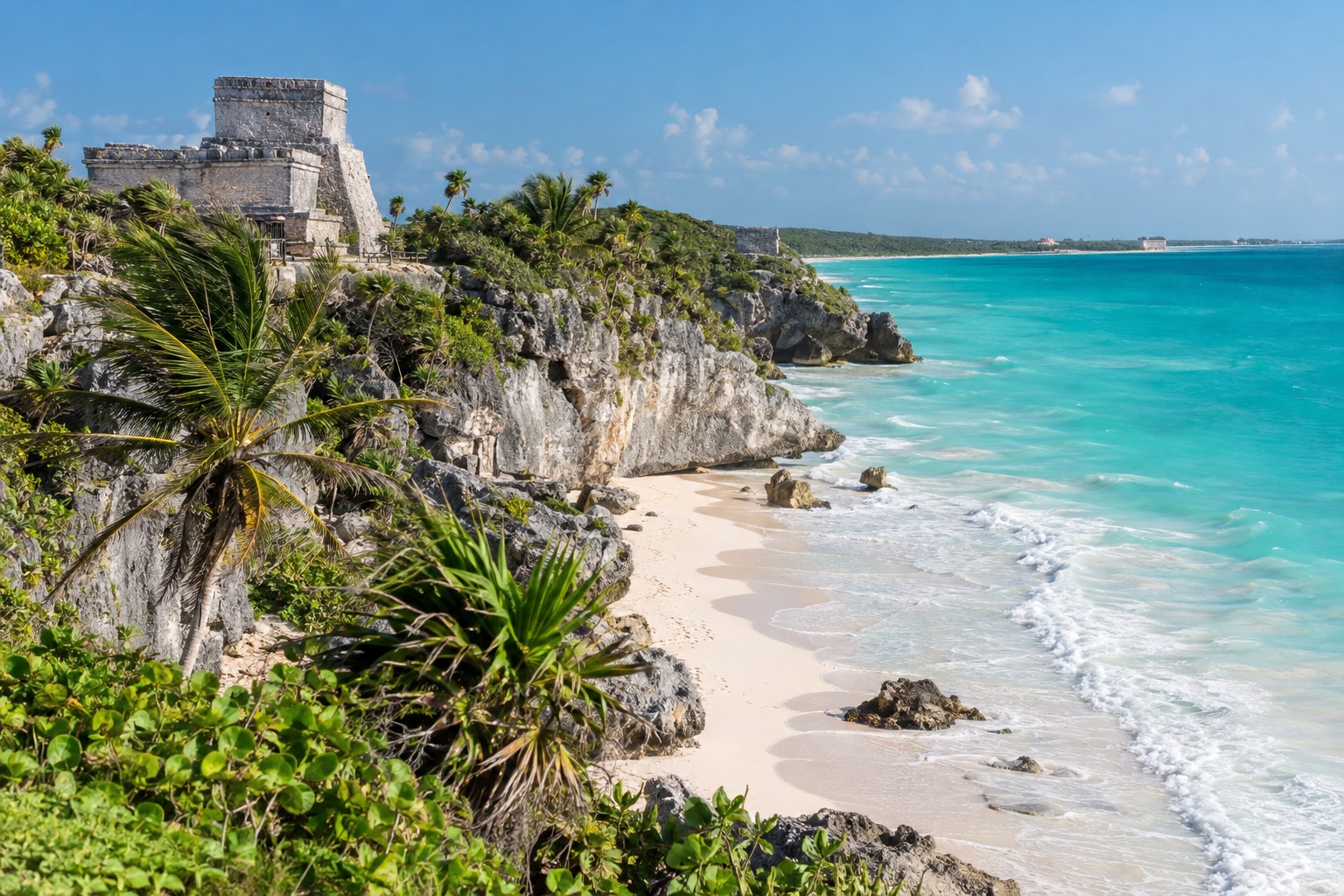
The Maya walled city on the cliff is best seen early, when the sea below is a hard, bright turquoise and the heat has not built. South of town, the Sian Ka’an reserve offers lagoons and mangrove channels, and August’s green is at its thickest there, with birds everywhere.
For food, summer means cold drinks and light plates: ceviche, fresh coconut water, mango and watermelon aguas frescas, and grilled fish eaten with sand still on your feet. Cochinita pibil tacos at a market stall are the answer on a rainy afternoon, with a lime-heavy salsa of habanero on the side.
Evenings in town have a relaxed, slightly damp glow. Strings of lights come on along the main avenue, music drifts from rooftop bars, and after a storm the terraces refill quickly as if nothing had happened.
Is Tulum busy in August?
Moderately: August is a vacation month for many American and Mexican families, so the beaches and the ruins see steady crowds, though the town is calmer than in winter.
School breaks bring families to the coast, and Mexican visitors fill weekends. Late morning draws the biggest crowds to the ruins and the most famous cenotes, yet both are much quieter in the early hours and the late afternoon. You can usually eat out without planning far ahead, and compared with winter’s holiday weeks, rooms tend to be more available, while hotels beyond the beach strip are more likely to offer a deal.
What to pack for Tulum in August
Think light, quick-drying and ready for a sudden downpour, since one stormy afternoon can soak a cotton outfit.
- Breathable clothes that dry fast, plus a spare set for after the rain.
- A packable poncho, which beats an umbrella in coastal wind.
- Reef-safe sunscreen, because cenotes and the sea both ask for it.
- Sandals with a good grip for wet stone and muddy jungle paths.
- Insect repellent for the evenings near the jungle and mangroves.
- A dry bag to protect your phone on boat trips and beach days.
Good to know before you go
The U.S. State Department rates the state of Quintana Roo Level 2, ‘Exercise increased caution,’ due to terrorism and crime.
August sits inside the Atlantic hurricane season, and the busiest stretch begins in the second half of the month. A storm is not likely on any given day, but it is smart to follow the forecast and choose bookings you can change. Visitors can also turn to the Tourist Assistance Module in Tulum for tourist information and paperwork help if something goes wrong.
Is August a good time to visit Tulum?
Yes, for travelers who enjoy warm water, lush scenery and a lively but not overwhelming town, and who accept an afternoon storm as part of the rhythm.
July feels very similar, a little drier by the numbers, while September brings more rain days and the heart of the hurricane season. August sits between them, with the sea at its warmest and the green at its fullest. What stays in the memory is the night side of the month: a turtle track across pale sand, thunder far out over the water, and a table by the sea once the rain has moved on.
Sources
- Servicio Meteorologico Nacional (CONAGUA), normales climatologicas 1991-2020, estacion 23025 (Tulum, Tulum), checked September 29, 2026
- Open-Meteo Marine API, average 2015-2024, checked September 8, 2026
- sunrise-sunset.org, sunrise and sunset on the 15th of the month, checked September 8, 2026
- U.S. Department of State, Bureau of Consular Affairs, Mexico Travel Advisory, travel.state.gov, checked September 29, 2026
- NOAA National Hurricane Center, checked September 29, 2026