
On a January morning in Playa del Carmen, the first thing you hear is the scrape of beach chairs being dragged to the water on Fifth Avenue’s side streets, and the first thing you smell is coffee and grilled corn. By August the same sand is hot enough to send everyone running for the shallows, and the afternoon sky builds into thunderheads over the jungle. The Riviera Maya, the string of beach towns between Puerto Morelos and Tulum, has a dry, bright winter season that fills the hotels and a long, sticky, stormy stretch from June to November, when crowds thin outside the summer vacation weeks.
When is the best time to visit the Riviera Maya?
The best months for most travelers are from late November through April, when the days are hot but not heavy, the evenings are comfortable and the rain stays mostly in the background.
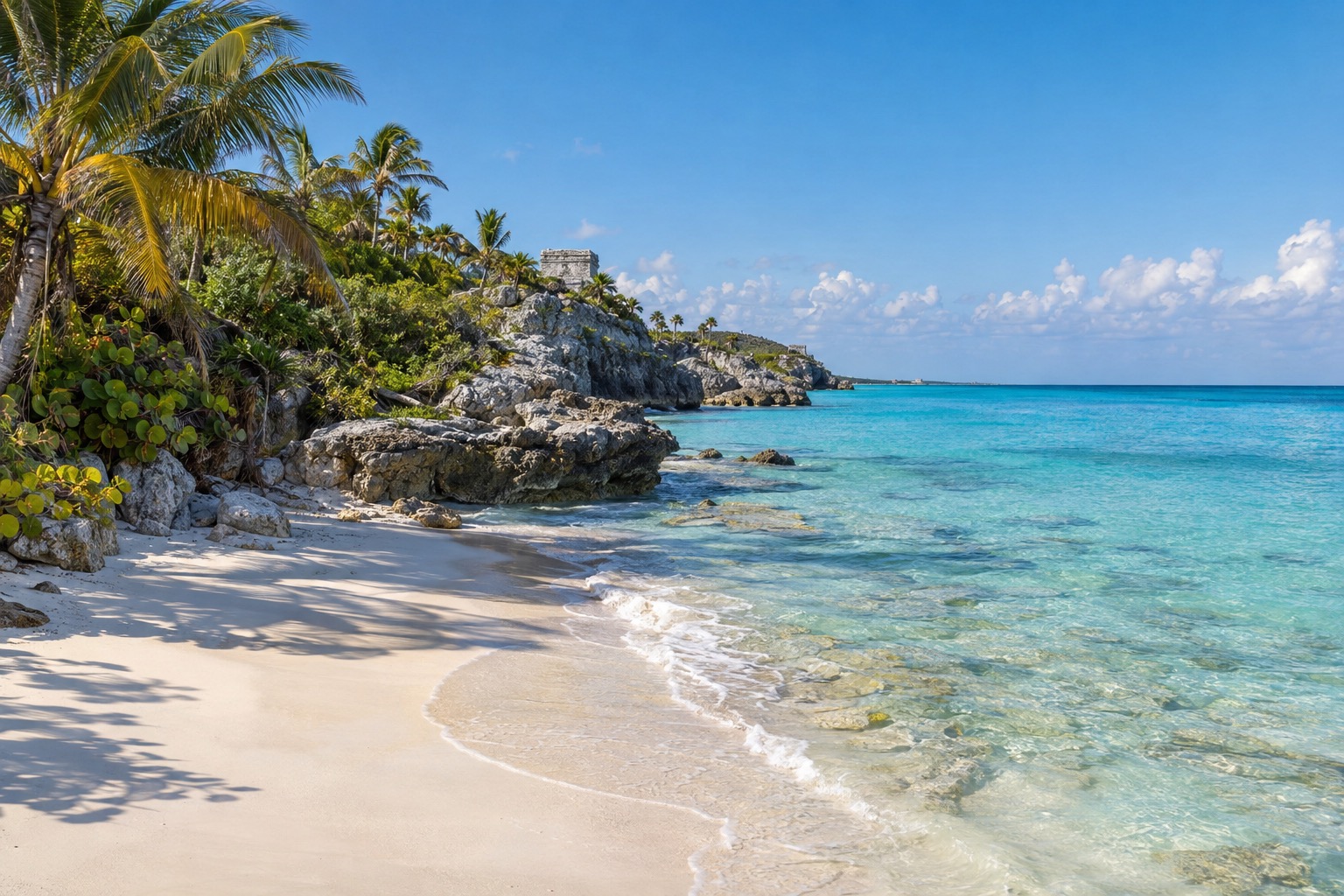
For beach and sea, February to April is the sweet spot. Mornings are bright, the water is warm enough to stay in for a long time, and the heat builds slowly instead of pressing down by 9 a.m. By May the sea is bathtub warm and the sun feels fierce, which suits people who want to float and do little else. Snorkelers and divers on the Mesoamerican Reef, the second-largest barrier reef system in the world, do well in the same winter and spring months.
For sightseeing, aim for December to February. Walking around the ruins at Tulum or wandering the Maya sites inland is far more pleasant when the afternoon high stays in the upper 80s instead of the low 90s. Cenote visits fit nicely in the cooler weeks too, with cool water to match the warm air.
Budget travelers and people who dislike crowds should look at May, June and the autumn months, with the trade-offs of heat and rain. Families need to know that March is spring break season: the beaches, pools and Playa del Carmen’s main strip are loud, young and busy, and it is wonderful if you want that energy and exhausting if you do not. A quieter family window is January after the holidays, or late April and early May.
The Riviera Maya weather by month
Heat is a constant here, so the real differences between months come down to humidity, rain and how warm the nights feel.
| Month | Average high (°F) | Average low (°F) | Rain days | Sea (°F) |
|---|---|---|---|---|
| January | 86.5 | 62.6 | 6.2 | 81.6 |
| February | 87.8 | 61.9 | 3.3 | 81.0 |
| March | 90.1 | 64.2 | 2.9 | 81.4 |
| April | 91.4 | 66.9 | 2.6 | 82.5 |
| May | 92.1 | 69.6 | 5.3 | 84.4 |
| June | 92.5 | 71.6 | 7.3 | 86.0 |
| July | 93.2 | 71.6 | 6.5 | 85.9 |
| August | 93.6 | 71.2 | 8.5 | 87.1 |
| September | 91.9 | 70.5 | 10.6 | 87.4 |
| October | 90.0 | 69.6 | 10.3 | 86.2 |
| November | 87.4 | 66.6 | 5.9 | 84.3 |
| December | 87.1 | 63.7 | 5.0 | 82.4 |
The year runs from a comfortable winter to a hot, humid summer and back. February through April brings the fewest rainy days, and the nights are pleasantly cool in the winter months.
From June the nights stay warm and sticky, and September and October bring the most rain days of the year, often as heavy downpours or long gray spells. January is a little different from February: it can have a few more wet days, usually short showers or the gray, breezy weather that comes with a winter cold front, and not the long tropical storms of early autumn.
When is the Riviera Maya cheapest and least crowded?
The quietest stretches are May and June, then September and October, when hotels have plenty of rooms and the beaches have long empty patches even at midday.
The busiest weeks follow the U.S. calendar: Christmas and New Year, the weeks around Presidents’ Day, all of March for spring break, and Easter week, which moves from year to year. Mexican families add their own wave from about early July to late August, when school lets out and the beach clubs, ferry docks and weekend roads fill with domestic visitors. During these peaks, rooms in the best-known beach areas go first and peak-season rates apply.
In the shoulder weeks, such as early December, late January and the stretch from mid-April into May, you often get winter-quality weather with easier reservations. Restaurants in Playa del Carmen and Tulum have open tables, beach loungers are easy to find and the main sights feel unhurried. In the low season some smaller places take a break, so the town feels sleepier, which many travelers like.
Which months should you avoid in the Riviera Maya?
September and October are the months to skip if you want a reliable beach vacation, since they combine the rainiest weather of the year with the peak of the Atlantic hurricane season, which runs from June through November.
Rain in those months arrives in long, heavy bursts, and a tropical system can close beaches, cancel boat trips and disrupt flights for a few days. Between June and November the risk is always there, so travelers with firm dates should keep their plans flexible. December comes just after the season ends, and the weather steadies quickly.
Sargassum is the other spoiler. The brown seaweed drifts in from the Atlantic, is usually at its worst from spring into summer, and is the first disappointment of many beach trips, with piles on the sand and a murky, smelly shoreline. It varies from beach to beach and week to week, and no stretch of coast is guaranteed to be spared, so it is worth asking your hotel what the water looks like before you go.
Midsummer’s heat is the third factor. July and August bring the hottest afternoons, and the humidity makes midday walks around ruins hard work. In winter, nortes, the cold fronts that sweep down the Gulf, can bring a few gray, breezy days with choppy water and a chill in the evening. They pass quickly and rarely spoil a whole trip, but they can make a beach day disappointing.
When can you swim in the Riviera Maya?
You can swim in the Riviera Maya every month of the year, because the Caribbean here never turns cold.
From December to March the sea is pleasantly warm, refreshing rather than bath-like, which is ideal on a hot afternoon. By May it is noticeably warmer, and from June through October it is warmer than the night air, which is lovely for long swims but offers little relief from the heat. Autumn is the warmest water of the year.
Conditions change more than temperature does. After a winter norte or a passing storm the surf can be rough, and some beaches have stronger waves than others, so check the beach flags before you go in. Sargassum can make some stretches unpleasant in spring and summer, while winter and early spring usually bring the clearest, bluest water for swimming and snorkeling.
Festivals and events in the Riviera Maya through the year
Winter holidays and Carnival
Christmas and New Year are celebrated on the beach here. Hotels string lights along the palms, restaurants serve special dinners, and the plazas in Playa del Carmen and Puerto Morelos fill with families. In the days before Christmas, look for posadas, the processions with songs and piñatas that go back to Mexican tradition. New Year’s Eve brings fireworks over the water and parties at beach clubs.
Carnival arrives in February or early March, depending on the calendar, with costumed dancers, floats and music in the main plazas. Playa del Carmen and Cozumel, a short ferry ride away, hold the best-known celebrations. It is a lively, colorful weekend for adults and children alike, and a good moment to be in town if you like local color and crowds.
Easter week and Día de Muertos
Semana Santa, Holy Week, moves every year, and it is when Mexican families head to the coast in large numbers. Beaches fill, roads are busy, and the mood is festive and relaxed. Reservations go early, so it is not the week for a spontaneous trip.
Día de Muertos, from October 31 to November 2, is a deeply moving time to be here. Altars with marigolds, candles, photographs and favorite foods appear in homes, plazas and hotel lobbies, and cemeteries are decorated by families.
In the Riviera Maya, Maya traditions of honoring ancestors give it a distinct flavor, and the pan de muerto in local bakeries is worth seeking out. It is a good reason to visit even though the weather is still damp.
Nature seasons: whale sharks and turtles
Sea turtles come ashore to nest on beaches such as Akumal and the quieter stretches around Tulum, mostly in the warm months of summer. Local conservation groups and some hotels protect nests and organize releases of hatchlings at night, which is one of the most memorable sights of the Riviera Maya summer. Keep lights off the beach and respect any marked nesting areas.
Whale sharks gather in the waters north of the Riviera Maya, off Isla Mujeres and Holbox, from roughly early summer into early autumn. Tours leave from the nearby coast, and swimmers go in beside these huge, gentle fish with a guide. The same months bring rain and sargassum on land, so for travelers chiefly drawn by marine wildlife, the wetter weather is the price of the encounter.
Sources
- Secretaria de Turismo federal, page for "Riviera Maya" (sectur.gob.mx), confirmed by the Consejo de Promocion Turistica de Quintana Roo, checked September 29, 2026
- fait de geographie administrative de notoriete publique
- Healthy Reefs for Healthy People Initiative / The Nature Conservancy, checked September 29, 2026
- common geographic knowledge
- Servicio Meteorologico Nacional (CONAGUA), normales climatologicas 1991-2020, estacion 23014 (Leona Vicario, Puerto Morelos), checked September 29, 2026
- Open-Meteo Marine API, average 2015-2024, checked September 8, 2026
- sunrise-sunset.org, sunrise and sunset on the 15th of the month, checked September 8, 2026
- NOAA National Hurricane Center, "Tropical Cyclone Climatology", nhc.noaa.gov, checked September 29, 2026