
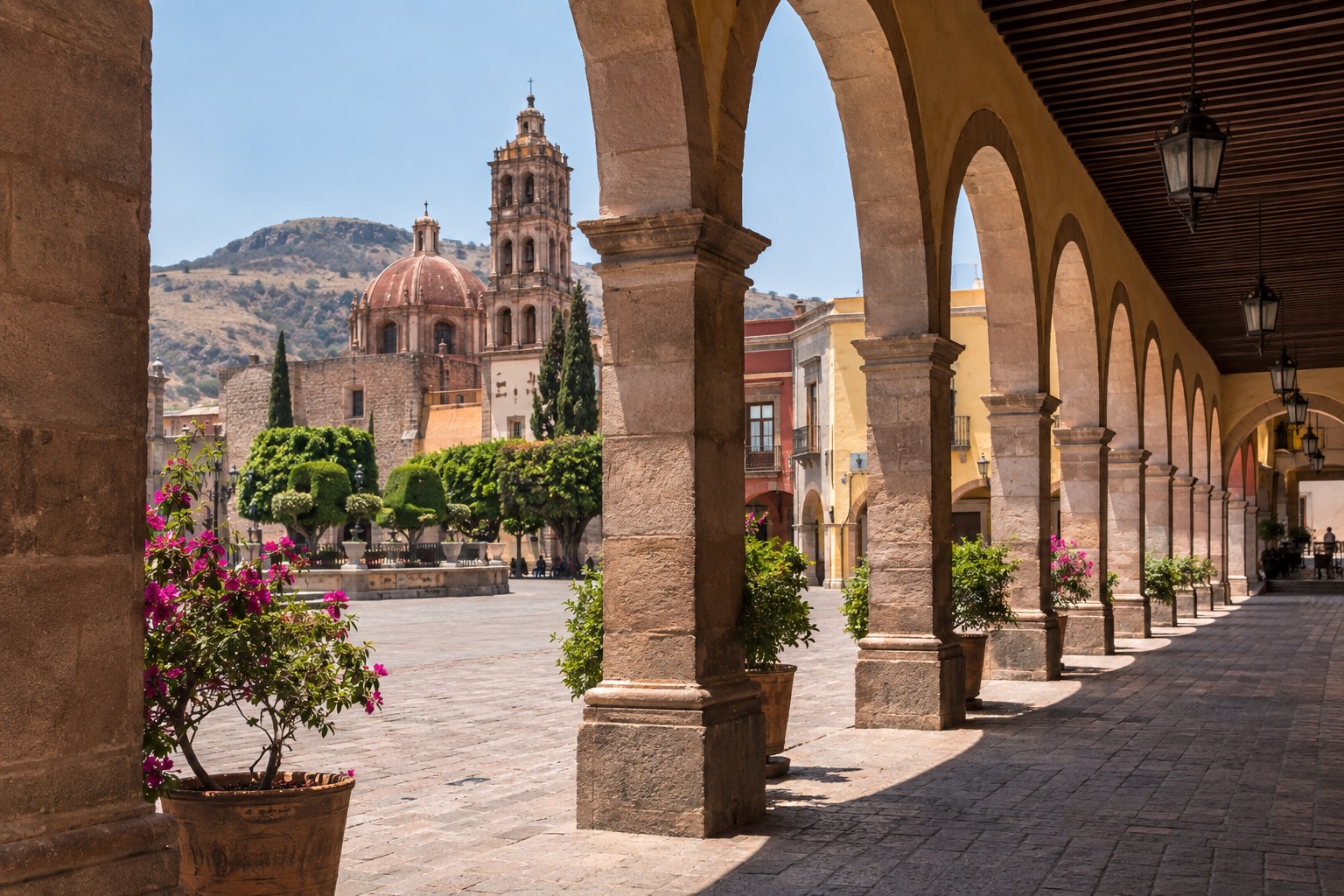
Late in the afternoon in Queretaro, the bells start up over the Plaza de Armas, the stone arcades turn the color of honey, and families settle onto benches under the laurel trees with a paper cone of snacks. Couples drift down the pedestrian lanes while a street musician tunes up in the next corner. This is a colonial city that still lives in its old center, made for walkers, food lovers and anyone who likes a place with history and a good table.
What are the best things to do in Queretaro?
The best of Queretaro is a slow walk through its colonial center, followed by a long meal, and then a day or two out in the surrounding countryside.
- Wander the arcaded lanes and irregular plazas of the historic center, the heart of the city.
- Visit the Museo Regional in the former convent of San Francisco for the story of the region.
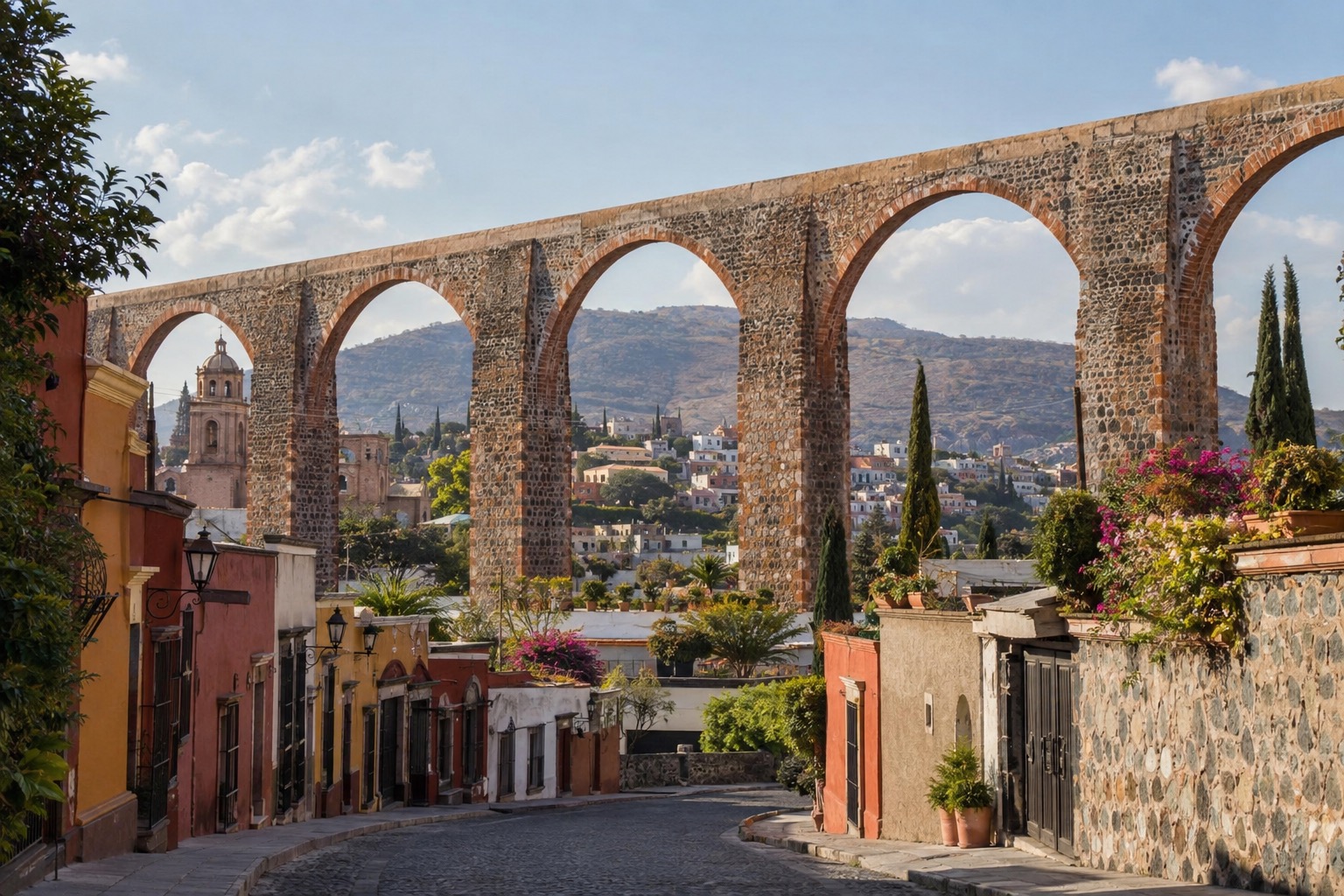
- Stand under the tall arches of the stone aqueduct, the city’s best-known silhouette.
- Take a day trip to Bernal and the monolith that towers over it.
- Eat enchiladas queretanas and gorditas at a market or a plaza-side table.
- Spend an evening around Plaza de Armas and Jardín Guerrero, when the bars and restaurants fill up.
- Follow the regional wine and cheese country out of town for a lazy afternoon.
Sights and landmarks in Queretaro
The historic center and its plazas
The center is laid out around colonial plazas that never quite match in shape, linked by arcaded pedestrian streets. That irregularity is the charm. You turn a corner and find a small square with a fountain, a baroque church front, or a courtyard café you did not expect. The core is part of a UNESCO-listed area, and the whole thing is easy to cover on foot.
Start at the Plaza de Armas, then drift toward Jardín Zenea and the churches around it. Late afternoon is the pleasant hour, when the stone cools down and the lanes fill with strollers. Wear comfortable shoes, because the cobbles are uneven, and keep the evening free for the same streets lit up.
Museo Regional in the old convent
The Museo Regional occupies the former Convento de San Francisco, a building of cloisters, arches and quiet stone corridors that is worth seeing for itself. Inside, the rooms trace the region from its early peoples through the colonial period and into the independence story that Queretaro is proud of. It opened as a museum in the 1930s and sits within the historic center’s protected core.
Give it a relaxed morning, and finish in the cloister garden. It suits history lovers and anyone who wants shade and calm in the middle of the city.
| Site | Open | Admission |
|---|---|---|
| Museo Regional de Queretaro | Tuesday to Sunday, 9 a.m. to 6 p.m. (closed Monday) | 210 pesos general; 105 pesos for Mexican nationals and foreign residents |
The aqueduct and the Los Arcos neighborhood
The stone aqueduct strides through the Los Arcos neighborhood east of the center on tall, rounded arches, and it is the image most people carry home. It is best seen from the avenue that runs beside it, where the arches line up in a long rhythm against the sky.
Go in the late afternoon for the warm light, or at dusk when it is lit. A short taxi or ride-hailing hop from the center gets you there, and photographers will want to linger.
More landmarks
On the west side, the Cerro de las Campanas is the hill where Emperor Maximilian was executed, now marked by a chapel and a monument, with a park around it. Back in the center, the churches of Santa Clara and Santa Rosa de Viterbo show off ornate baroque interiors, and the Teatro de la República recalls the city’s role in Mexican political history.
Outdoor things to do in Queretaro
Gardens and plazas for sitting
Jardín Zenea is the city’s outdoor living room, with a bandstand, shaded benches and a steady stream of vendors, families and old friends talking. The Alameda Hidalgo, a larger shady park with paths and tall trees, is where locals jog, walk dogs and picnic on weekends.
Both are better in the morning or toward sunset. Bring a snack from a nearby stall and simply sit, which is how the city likes to be enjoyed.
Walking the aqueduct line and the hills
A walk along the aqueduct makes an easy outing, with its stone arches overhead and neighborhood life below. For a green break, the park at the Cerro de las Campanas has open space and a view back over the city, and a large city park on the north side has long paths for a morning stroll.
The sun is strong at this altitude, so a hat and water help. Early in the day is more comfortable than midday for longer walks.
Day trips from Queretaro
Peña de Bernal and the Pueblo Mágico
Bernal is the classic outing, a small Pueblo Mágico whose cobbled lanes sit in the shadow of La Peña de Bernal, a vast monolith that rises sharply over the rooftops. The town is a pleasure on foot, with a main square, a modest church, craft shops, and stalls selling sweets, wool goods and gorditas. The rock dominates every view.
You reach it from the city by car or by an organized transfer, and a full day is plenty. Go early to beat the weekend crowds, when the streets fill with visitors from across the region. It suits couples, families and anyone who wants a slower day than the city offers. Bring a hat, since the plaza has little shade at midday.
Wine and cheese country
The countryside east of the city holds one of Mexico’s best-known wine and cheese routes. Vineyards, cellars and farm dairies open their doors for tastings, often paired with a lunch of local cheeses, cured meats and bread. The scene is relaxed, with long tables, rows of vines and the hills in the distance.
This is a day for people who like to eat and sip at a leisurely pace. Pick a couple of stops rather than a long list, and arrange a driver so everyone can enjoy the tastings.
Other nearby towns
Tequisquiapan is a relaxed town of flower-draped plazas, craft shops and cheese vendors, good for a gentle afternoon on foot. Cadereyta de Montes is known for its cactus gardens and its quarry stone, and it pairs well with a wine stop on the same trip.
For those with more time, the missions of the Sierra Gorda to the north have ornate facades set in mountain scenery, while San Miguel de Allende and Guanajuato are popular longer excursions with their own colonial charm. Choose one or two for a day and leave the rest for another visit.
What to eat in Queretaro
Eating in Queretaro starts with enchiladas queretanas, tortillas dipped in chile sauce, fried, and topped with potato, carrot, cheese and lettuce, a dish every local has an opinion about. Gorditas de migajas, thick corn cakes stuffed with a rich pork crumble, are another regional staple, found at markets and stalls.
At the markets you will also find tacos, carnitas, fresh fruit juices and sweets made with local fruit such as the prickly pear. The surrounding countryside supplies the cheeses and wines that turn up on better menus, and in town a coffee in an arcade café rounds out the afternoon.
For a fuller evening, the old center has courtyard restaurants in restored colonial houses, serving both traditional cooking and modern takes on it. Lunch is the main meal for many locals, so a long midday table is a good habit to adopt.
Things to do in Queretaro at night
Night life in Queretaro gathers around Plaza de Armas and Jardín Guerrero, where restaurants and bars stay open late and the arcades fill with people. The mood is lively but easygoing, with live music drifting from terraces and groups lingering over a last drink.
For something quieter, a walk through the lit-up lanes of the center is enough, with the churches and the aqueduct glowing after dark. A late dinner in a courtyard restaurant or a coffee on a plaza makes a calm end to the day. Light sleepers should ask for a room with an interior courtyard or double-glazed windows, since the plazas and bars can be noisy.
Things to do in Queretaro with kids
Queretaro suits children best through its open spaces and its easy rhythm. Jardín Zenea and the Alameda Hidalgo give them room to run, with vendors selling balloons and snacks, and the long walkable streets of the center are safe from heavy traffic in the pedestrian lanes.
The Museo Regional works for curious older kids, with its cloisters and old objects, and the aqueduct is a good stop for its sheer size. A day in Bernal gives them a town to explore and a giant rock to stare at.
Keep in mind the sun and the altitude, which can tire little ones faster than expected. Water, hats and a break in the shade during the afternoon make the day smoother.
Good to know before you go
The U.S. State Department rates the state of Queretaro at Level 2, Exercise Increased Caution, the same baseline level as most of the country.
The historic center is highly walkable, and taxis, ride-hailing apps and local buses cover the longer trips. The airport is about 30 to 40 minutes from the center by car or taxi.
Neighborhoods such as Juriquilla, Zibatá and El Refugio are more car-oriented, so a rental car or ride-hailing helps if you stay there, while a hotel in the center lets you leave the car behind. Lodging in the center is mostly boutique hotels and guesthouses in restored colonial buildings, and you pay in pesos, with cards widely accepted in restaurants and hotels.
Sources
- INAH, Museo Regional de Queretaro (inah.gob.mx/museos/museo-regional-de-queretaro), checked September 29, 2026
- INAH, meme page, checked September 29, 2026
- US Department of State, Mexico Travel Advisory (travel.state.gov), advisory of May 29, 2026, checked September 29, 2026