
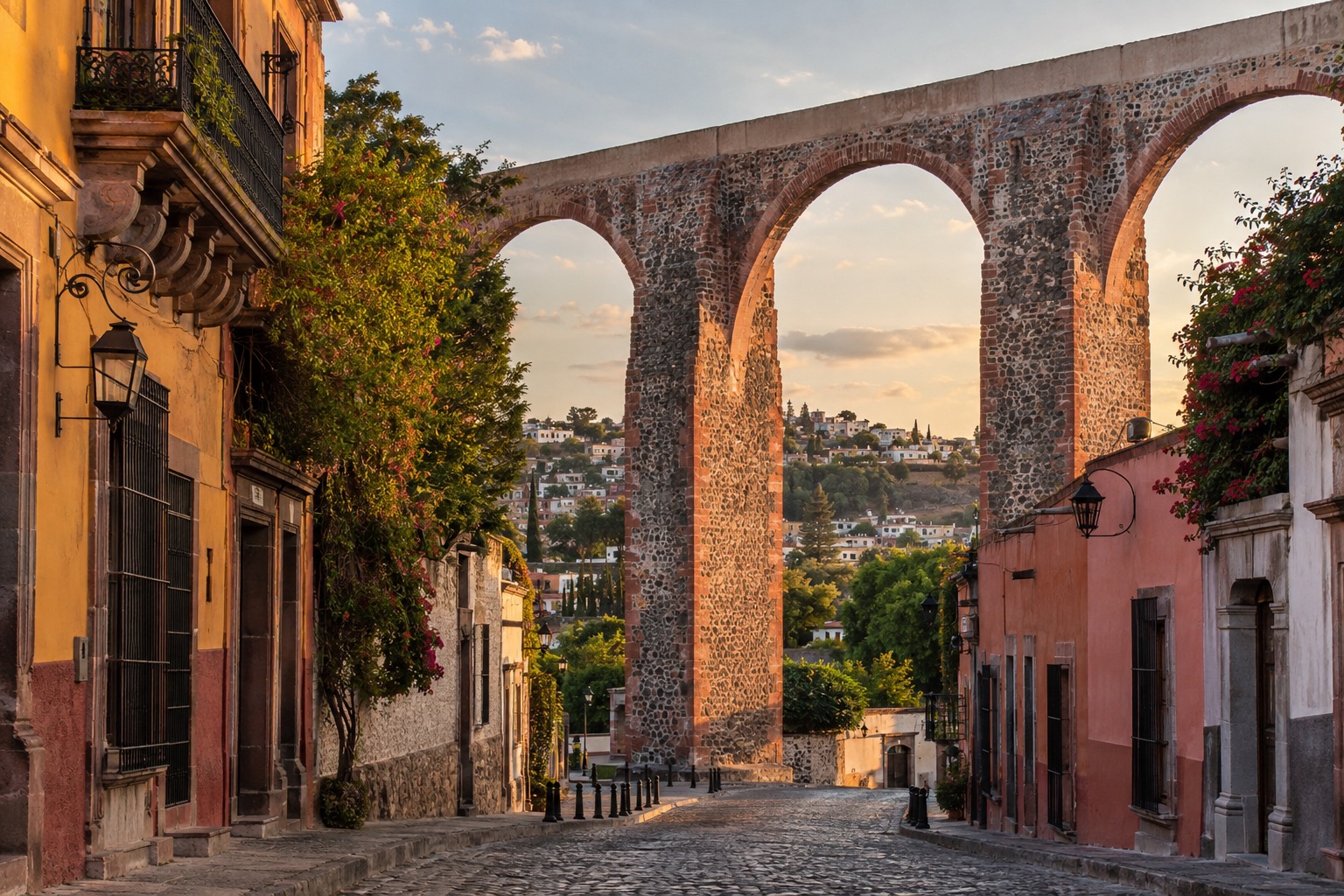
In Queretaro the evening air in the Plaza de Armas smells of roasted corn and wet stone, and the arcades fill with families who have nowhere else to be. The city sits on a high plateau, so the year runs from crisp, bright winter mornings to a hot dry spring and then a green, stormy summer. Colonial plazas, aqueduct arches and nearby wine and cheese country make it a place for walking, and each season changes how you do it.
When is the best time to visit Queretaro?
The best months are October through February for most travelers, with March and April a good second choice if you can handle afternoon heat. Days in the plateau air are warm, nights are cool, and the sun is steady enough to spend whole afternoons on the plazas.
For sightseeing, late autumn and winter are hard to beat. Mornings call for a light jacket, afternoons are comfortable for the historic center, the aqueduct and the Cerro de las Campanas, and rain is rare. A day trip to the Peña de Bernal also suits these months, since the walk around the base of the monolith is far nicer without storm clouds or spring heat.
Budget and quiet seekers do well in the shoulder weeks of late January, early February and the autumn months before Día de Muertos. Summer is green and often cheaper in feel, but it brings stormy afternoons, so plan museums and long lunches for the wet hours.
Families will find March louder, because spring break fills the plazas and the weekend markets. The weather is lovely, but expect more strollers, more noise and busier restaurants. Queretaro has no beach, so this is a city and countryside trip, with ice cream stands, fountains and open squares keeping children happy.
Queretaro weather by month
Queretaro is warm by day and cool at night for most of the year, with a clear rainy season in summer.
| Month | Average high (°F) | Average low (°F) | Rain (in) | Rain days |
|---|---|---|---|---|
| January | 73.8 | 46.2 | 0.79 | 2.6 |
| February | 77.9 | 48.6 | 0.50 | 2.0 |
| March | 82.2 | 52.0 | 0.41 | 2.0 |
| April | 86.4 | 56.5 | 0.45 | 2.8 |
| May | 87.6 | 59.2 | 1.14 | 6.4 |
| June | 84.6 | 59.7 | 3.65 | 9.4 |
| July | 82.2 | 59.0 | 3.72 | 11.1 |
| August | 81.9 | 58.8 | 2.99 | 9.4 |
| September | 79.9 | 58.1 | 3.92 | 9.6 |
| October | 78.6 | 54.9 | 0.92 | 5.9 |
| November | 76.6 | 50.4 | 0.52 | 2.6 |
| December | 74.8 | 47.1 | 0.32 | 1.4 |
The year has two moods. From November to April it is dry and bright, with chilly early mornings and nights that call for a sweater. May is the hottest stretch, and then the rains arrive. From June to September, showers come most days of the week, often as a heavy afternoon downpour after a sunny morning. October loosens its grip, and by November the skies are clear again.
When is Queretaro cheapest and least crowded?
The quietest times are the rainy months of June and September, and the calm weeks of January and early February after the holidays. Hotels in the historic center have more rooms available, and the plazas feel relaxed in the evening.
The busiest weeks are Christmas and New Year, Easter week, spring break in March and the long Mexican school vacation from early July to late August. Long weekends bring visitors from Mexico City, so Friday and Saturday evenings can be lively at any time of year. Rooms in the center fill first, and the best ones go early.
Midweek is calmer in every season. Museums, the arcaded streets and the cafés are easier to enjoy from Monday to Thursday, when the city belongs more to residents than to weekenders.
Which months should you avoid in Queretaro?
Few months are truly bad, but July is the wettest and May the hottest, so those are the ones to think twice about.
Summer storms are the main trouble. Rain falls on most days in July, usually in the afternoon, and it can flood a street and interrupt a walk. Mornings are often clear, so you can still sightsee, just with a plan for the afternoon. Late spring is dry but hot, and the sun on the plazas is strong at midday.
Queretaro is inland, so sargassum plays no part in a stay here, but tropical systems can bring extra rain in late summer and early autumn. Winter nortes mostly matter on the coast. Here, a cold front simply means a chillier, windier day or two. The U.S. State Department places the state at Level 2, Exercise Increased Caution.
Festivals and events in Queretaro through the year
Winter holidays and Carnival
December brings posadas, the nightly processions before Christmas, when neighborhoods sing, break piñatas and serve hot ponche and tamales. The historic center is lit with lights, and the plazas are lively with families after dark. New Year arrives with fireworks and crowds in the main squares.
February often brings Carnival season in towns around the region, with costumes, music and street food. Celebrations vary from place to place and tend to be local and cheerful rather than huge. Ask at your hotel for what is happening that weekend.
Easter week and spring
Semana Santa fills the old streets with solemn processions, especially on Good Friday, when silent marches pass under the arcades by candlelight. It is moving and also very busy, so rooms go early. Spring is when the city is most crowded with Mexican visitors.
Churches and convents in the historic center are central to the observances, and the atmosphere is quieter than a typical weekend. Come for the ritual and the evening air, and wear comfortable shoes for the cobbles.
Autumn: Independence and Día de Muertos
Mexican Independence is celebrated on the night of September 15, when the plazas fill with flags, music and shouts of ¡Viva México! Even in the rainy season the party goes on, with food stalls selling pozole and antojitos around the main squares.
Día de Muertos runs from October 31 to November 2. Families decorate altars with marigolds, photos and favorite foods, and shops sell pan de muerto and sugar skulls. Cemeteries are family spaces, so as a visitor you enjoy the altars and displays in public squares and museums rather than entering private vigils.
Sources
- Servicio Meteorologico Nacional (CONAGUA), normales climatologicas 1991-2020, estacion 22013 (Queretaro (Obs), Querétaro), checked September 29, 2026
- sunrise-sunset.org, sunrise and sunset on the 15th of the month, checked September 8, 2026
- INAH, Museo Regional de Queretaro (inah.gob.mx/museos/museo-regional-de-queretaro), checked September 29, 2026
- INAH, meme page, checked September 29, 2026
- US Department of State, Mexico Travel Advisory (travel.state.gov), advisory of May 29, 2026, checked September 29, 2026