
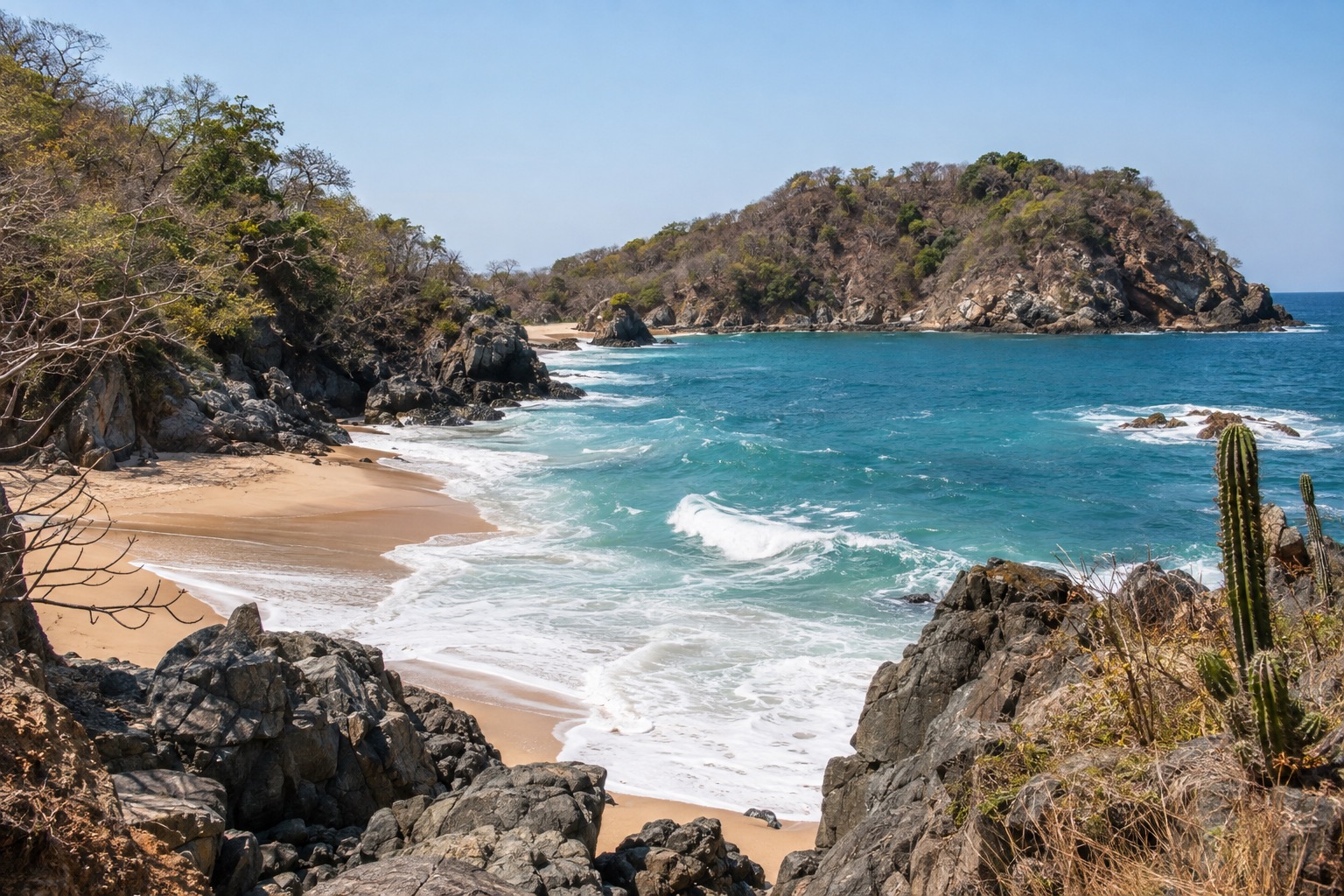
Early on a March morning, pelicans skim the flat water off Santa Cruz while fishing boats head out and the first cafés in La Crucecita set out pots of Oaxacan chocolate and warm pan de yema. The days start bright and the sea invites you in by midmorning. March gives Huatulco a long run of sunny beach days, with the last humpback whales still passing offshore.
What is the weather like in Huatulco in March?
March is hot and sunny with very little rain, though a little more humid than the winter months just behind it.
| Month | Average high (°F) | Average low (°F) | Rain (in) | Rain days | Sea (°F) | Daylight on the 15th |
|---|---|---|---|---|---|---|
| February | 84.1 | 70.3 | 0.43 | 0.9 | 81.9 | 11 hours 40 minutes |
| March | 85.3 | 71.8 | 0.72 | 1.9 | 82.4 | 12 hours 5 minutes |
| April | 86.3 | 73.8 | 1.04 | 3.1 | 83.8 | 12 hours 32 minutes |
Mornings are the comfortable hours for walking the streets of La Crucecita or hiking a shaded trail, and by early afternoon the sun is strong enough that most people are in the water or under a palapa. Nights stay warm, so dinner outside needs no sweater.
When rain does fall, it is a rare brief shower that most visitors never notice. The sea is soft and swimmable all day, a degree or so warmer than in February, which makes snorkeling pleasant without a wetsuit.
What to do in Huatulco in March
March suits boat days, snorkeling and long beach afternoons, with a last chance at whales and a calm, easygoing mood in town.
The tail end of whale season
Humpback whales visit this stretch of the Oaxaca coast roughly from December to March, so early March is among the final chances to see them. Mothers with calves tend to stay close to the shore, and sightings come as a blow of mist on the horizon, then a tail or a breach.
Whale-watching trips leave from the Santa Cruz marina in the morning, when the water is calmest. Expect a few hours on open sea, which can be bumpy, so a spot at the middle of the boat helps. Sightings are never guaranteed, and by late in the month the whales thin out as they head toward cooler waters.
Snorkeling and bay-hopping
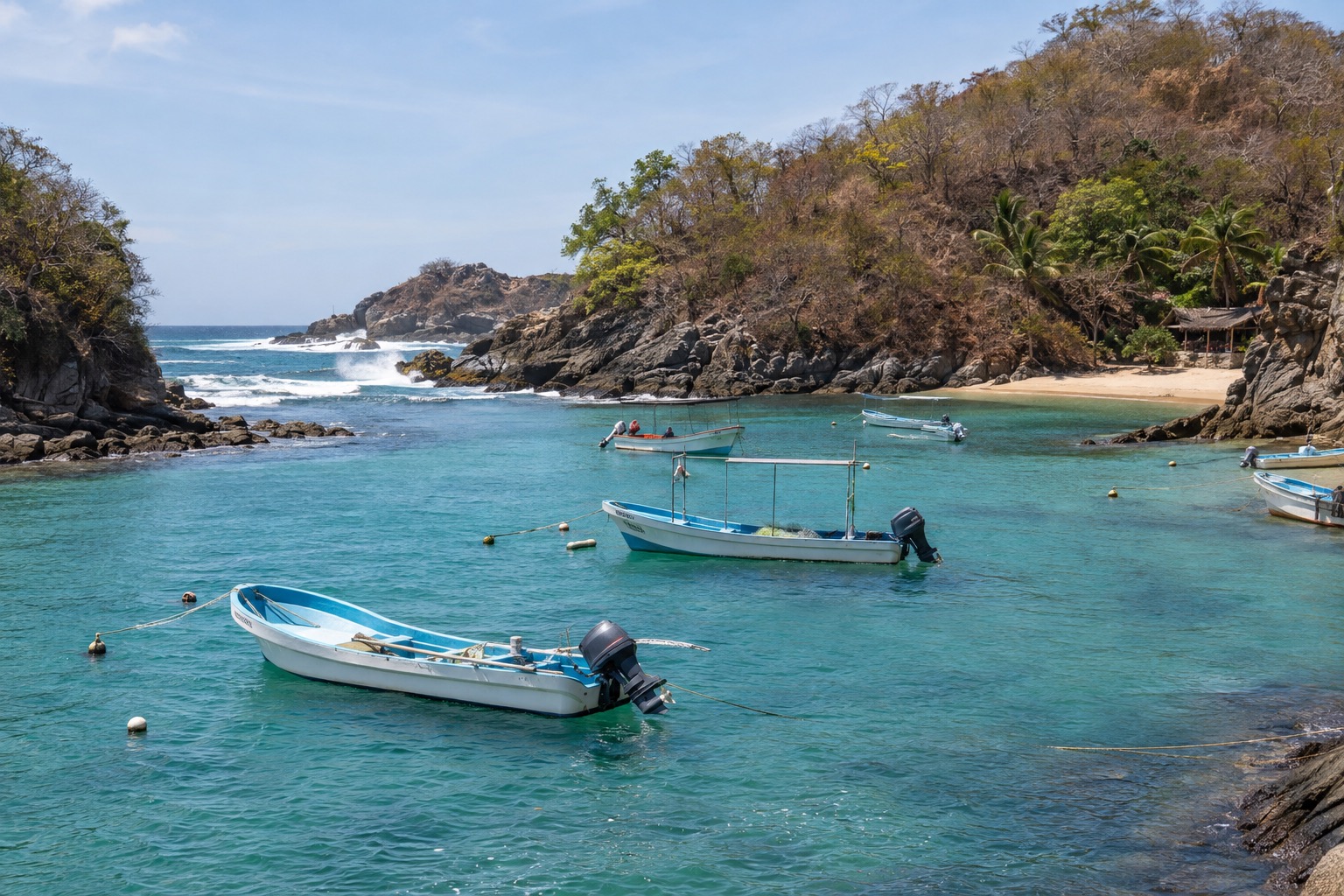
With calm seas and clear mornings, March is a fine moment to hop between bays. Some can only be reached by boat, while Maguey and Organo are accessible by road or on foot. Maguey has a long, sheltered beach with simple seafood shacks, and Organo sits a short walk from Santa Cruz.
Water-taxi boats run from the Santa Cruz pier through the day, and a half-day loop usually takes in three or four coves. The best snorkeling is in the morning, before wind ripples the surface. Bring a hat, because the open boats offer little shade.
Eating and drinking in the heat
Heat calls for cold, salty and sour flavors. Order a plate of ceviche or a whole grilled red snapper with garlic (pescado a la talla is the classic style), then finish with a fresh coconut or an agua de jamaica.
In La Crucecita, the evening crowd gathers around the central plaza for tlayudas, mezcal and ice cream. Spring in Oaxaca also means mangoes and watermelon at the market stalls, and the thick local chocolate is still on every café menu, usually served warm even when the afternoon is not.
Is Huatulco busy in March?
March is moderately busy, with the peak of winter crowds easing but spring travelers arriving.
Many American visitors come on spring break, and Mexican families fill the beaches around Holy Week when it falls in late March or early April. Cruise ships may bring day crowds to Santa Cruz, and the marina and the closest beaches feel it most. Farther bays and La Crucecita’s side streets stay calm.
Rooms are easier to find early in the month than around Holy Week, when seaside restaurants fill at lunch. Booking ahead makes sense for that stretch.
What to pack for Huatulco in March
Pack for sun, salt water and a few evenings in town.
- Light, quick-drying clothes for hot afternoons
- For open boats, a wide-brimmed hat plus sunscreen that is reef-safe
- A snorkel mask that fits well
- Water shoes for rocky coves
- A thin cover-up for cooler restaurants and breezy crossings
Good to know before you go
The U.S. State Department’s Mexico travel advisory rates Oaxaca at Level 2, ‘Exercise increased caution’.
March falls outside the official eastern Pacific hurricane season for Mexico’s Pacific coast, so a storm is unlikely to disrupt your trip. The one thing that adds to the bill is a lodging tax charged by the state of Oaxaca.
| Fee | Amount | Who pays |
|---|---|---|
| Lodging tax (Impuesto Sobre Hospedaje) | 3% | Guests staying in Oaxaca hotels and rentals |
Is March a good time to visit Huatulco?
Yes, March is a fine time for beach lovers, snorkelers and anyone chasing warm water and steady sun.
Compared with February, the air and sea are a little warmer and the evenings a touch softer. April is hotter and more humid, with showers beginning to appear. March sits in the sweet spot between them. What marks March here is the overlap: the last whales of the season passing offshore in the morning, and swimming in a warm, calm bay by the afternoon.
Sources
- Open-Meteo / ECMWF ERA5, 1991-2020 normals, grid cell 15.7794N 96.1353W, model reanalysis, not a station record, checked September 8, 2026
- Open-Meteo Marine API, average 2015-2024, checked September 8, 2026
- sunrise-sunset.org, sunrise and sunset on the 15th of the month, checked September 8, 2026
- El Contribuyente and J.A. del Rio, ISH tables by State 2026, read on September 29, 2026
- U.S. Department of State, Mexico Travel Advisory (travel.state.gov), checked September 29, 2026
- NOAA National Hurricane Center, official Eastern Pacific season (nhc.noaa.gov), checked October 5, 2026