
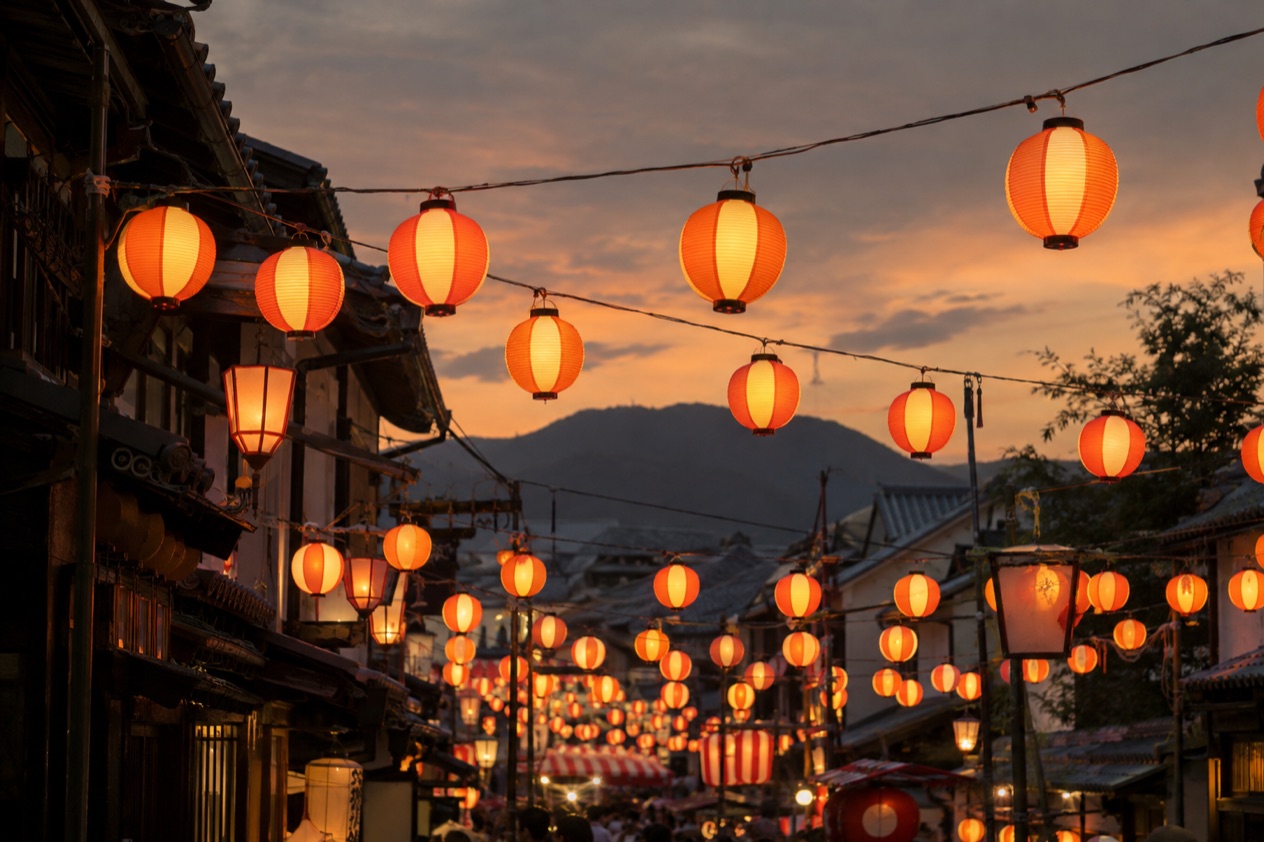
On a July evening along the Okawa River in Osaka, lanterns glow on the decorated boats, drums carry across the water, and the first fireworks lift over the city. This is Tenjin Matsuri, a festival to a scholar turned deity, and Osaka holds the largest one in Japan. It is a summer festival with a procession, a river parade, fire and food, and this is what a traveler needs to plan around it.
What is Tenjin Matsuri?
Tenjin Matsuri is a festival to Tenjin, the deified Sugawara no Michizane, held at Tenmangu shrines across Japan around the 25th of the month. Osaka’s version is the largest, centered on Osaka Tenmangu Shrine, and it is the one most travelers mean when they say the name.
The word matsuri simply means festival, but in Japan it usually carries a religious core. A shrine’s deity is honored, carried out among the people in a portable shrine called a mikoshi, and celebrated with music, food and neighbors in the street. Tenjin Matsuri follows that pattern, and Osaka stretches it onto the river.
The deity behind the festival
Sugawara no Michizane was a court scholar and poet, and he came to be revered as the deity of learning. That is why Tenmangu shrines are a familiar sight to students, who come to ask for help with exams and leave small wooden plaques with their wishes. Plum trees are closely tied to Tenjin as well, and many Tenmangu shrines keep them in their grounds.
At Osaka Tenmangu Shrine the festival is the shrine’s big day of the year. The enshrined spirit of Michizane leaves the shrine in a mikoshi, travels through the streets, and then goes out onto the water. For a visitor, that journey from shrine to river is the thread that ties every part of the festival together.
Why Osaka’s version stands out
Many local Tenjin festivals stay within a shrine precinct and the streets around it. Osaka’s moves onto the Okawa River, with a parade of boats, so the festival is as much a water event as a street one. About 100 different groups take part in that boat parade, from musicians to people carrying lanterns and offerings.
The festival is also called the Festival of Fire and Water. The name comes from the sight of fireworks and lanterns reflected on the river, which doubles every flash of light. If you have only ever seen a matsuri as a row of food stalls and a drum, Osaka’s is a different scale of event.
A festival that returned
The Osaka Tenjin Matsuri was put on hold during the COVID-19 pandemic. The first full festival after that pause took place in July 2023. Since 2017, yakuza have been excluded from the boat parade and from sponsoring fireworks displays, a change that the organizers made to the festival itself.
When is it held?
Osaka’s Tenjin Matsuri is held in the height of summer, over two days in late July, with the main day falling on the second. The dates are fixed on the calendar and do not move from year to year the way Holy Week does in the West, so you can plan a trip around them well ahead.
| Event | When |
|---|---|
| Festival days in Osaka | 24 and 25 July |
| Hokonagashi Ritual | Early morning, 24 July |
| Largest Tenjin Matsuri, at Osaka Tenmangu Shrine | 25 July |
| Fireworks display | Starts around 7:30pm, usually lasts about 90 minutes |
The first day: a ritual at dawn
The festival opens quietly with the Hokonagashi Ritual at Osaka Tenmangu Shrine, early in the morning on the first day. A student floats a sacred spear called kamihoko on the Okawa River. It is a small, ceremonial moment compared with what follows, and it sets the religious tone before the crowds and the music arrive.
If you are building a trip around the festival, this is the part that rewards an early start, since it is held at that hour and not later in the day.
The main day and the evening
The largest Tenjin Matsuri is held on the second day at Osaka Tenmangu Shrine. This is the day of the procession from the shrine to the river and of the boats on the Okawa. As darkness falls, the fireworks begin, and they run for a good part of the evening, long enough to settle in and watch rather than glance and leave.
Because the festival lands in July, it is a summer evening event. Expect to be outdoors by the river in the warm, humid air of the season. Many Japanese festivalgoers wear a yukata, the light cotton summer robe, and it is a common sight at summer matsuri in general.
Planning around the dates
Since the whole festival rests on two fixed days, the useful decision is which one you want. The first offers the ritual spear on the river at dawn. The second holds the procession, the boats and the fireworks. Travelers who can spend both days in Osaka can see the shape of the festival from its quiet beginning to its blazing end.
What can you see?
You can see a mikoshi procession through the streets, a parade of boats on the Okawa River and a long fireworks display, with lanterns and food stalls around it. It is a festival built as a journey, from a shrine to the water and then into the night sky.
The land procession
The street procession is called rikutogyo, and it departs from Osaka Tenmangu Shrine. It carries a mikoshi holding the enshrined Sugawara no Michizane toward the Okawa River. Along the way you see bearers in festival dress, the rhythm of the carrying, and the neighborhood groups that take part in a matsuri of this kind.
The procession ends at Hokonogashi Bridge, where the mikoshi is loaded onto boats. That handover from street to river is one of the most striking moments of the day, because the festival changes character at that bridge. Up to that point it belongs to the streets, and from then on it belongs to the water.
The boat parade on the Okawa
The river parade is called funatogyo. About a hundred groups join it, and the boats carry the festival’s music, offerings and lanterns along the Okawa. Watching from the riverbank, you see the boats pass one after another, each with its own group and its own character, and as the light fades the lanterns become the main attraction.
The parade is where the festival’s other name makes sense. Lanterns and fireworks reflect on the surface of the Okawa, which is why Osaka’s Tenjin Matsuri is called the Festival of Fire and Water. It is worth watching the water as much as the boats themselves.
The fireworks
The fireworks display begins at around the evening hour given in the schedule and usually lasts a good while. Rather than a single burst at the end, it is a long show above the river, and the reflections turn it into a double display. Since 2017, yakuza have not been allowed to sponsor the displays, so the fireworks you see are part of the festival’s current, reformed arrangement.
What to eat
Food connected with the Osaka Tenjin Matsuri includes chilled somen, the thin wheat noodles that suit a hot July evening, and pike conger, the sea eel prepared in many ways in the Kansai region. Somen served cold with a dipping sauce is a classic summer dish in Japan, light enough for the heat.
Around any matsuri you will also find stalls selling the usual festival snacks, such as grilled skewers, shaved ice and sweets. Eating on your feet near the river, with the sound of the drums in the background, is part of the evening.
Good to know before you go
Tenjin Matsuri is a summer festival, so plan for the humid heat of July in Osaka, and note that the rainy season and typhoon season are both part of the Japanese summer calendar. Carry some cash for the food stalls, and remember that the festival is a religious observance as well as a party: the mikoshi and the shrine deserve the same respect you would give them on any other day.
Sources
- Japan National Tourism Organization, festivals and events (https://www.japan.travel/en/see-and-do/festivals-and-events/), checked October 11, 2026
- Wikipedia, Tenjin Matsuri (https://en.wikipedia.org/wiki/Tenjin_Matsuri), checked October 11, 2026
To plan your stay
- Japan Rainy Season (Tsuyu): Dates, Regions and How to Plan Your Trip
- Seasons in Japan: Blossoms, Fall Color, Snow Festivals and Summer Matsuri
- Typhoon Season in Japan: When It Hits, Which Regions Take the Brunt and How the Warning Alerts Work
- Autumn Leaves Dates by City: Usual Maple Dates, 2025 Results and How Much They Shift