
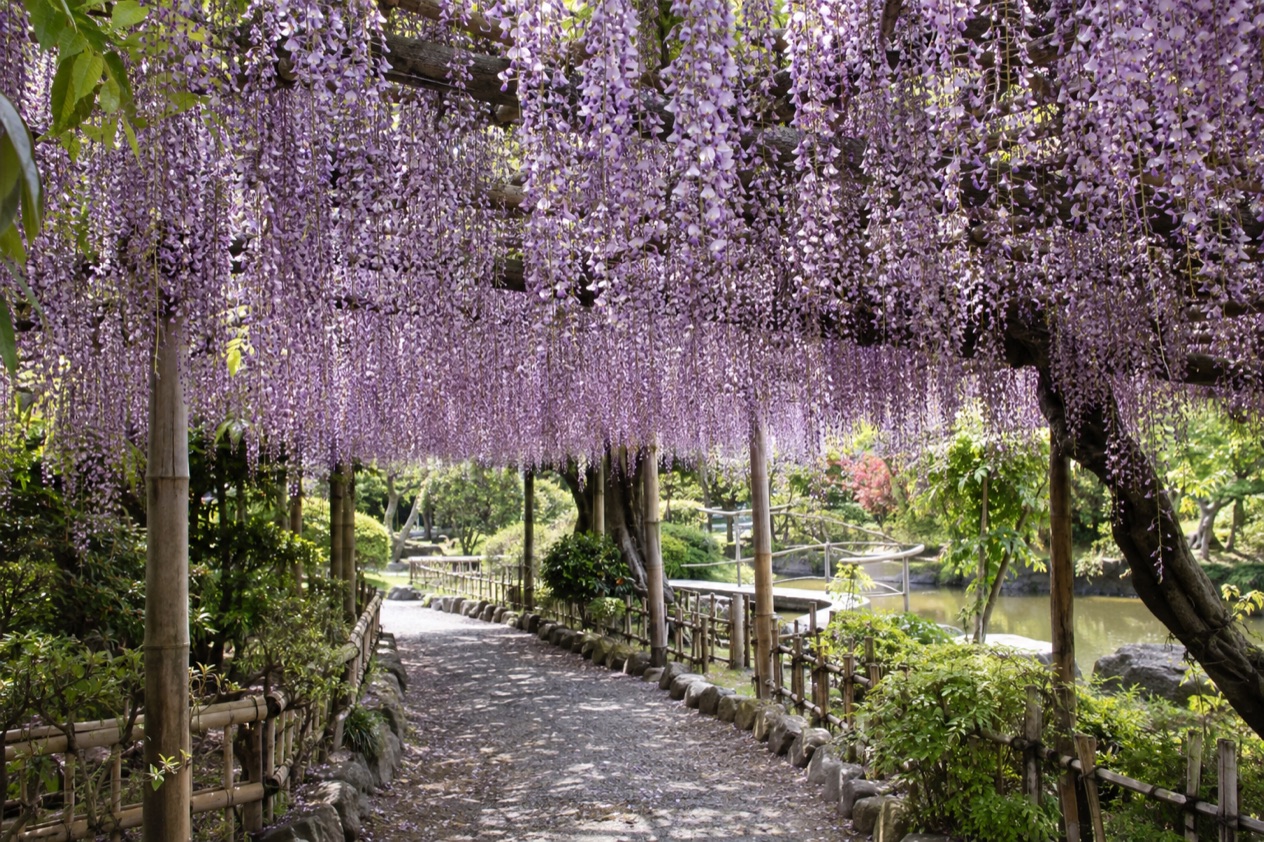
In mid-October the cosmos fields of Toyama are in flower, and a traveler flipping through photos for a spring trip stops at one picture: a ceiling of lilac blossoms hanging over a garden path. That is wisteria, a flower of spring that follows the cherry blossoms and has its own gardens, its own shrine festival, a family crest and a kabuki dance. In spring, wisteria hangs in cascading clusters over garden paths, trellises and shrine grounds in Japan.
When does the wisteria bloom in Japan?
Wisteria blooms in spring, in the weeks after the cherry blossoms have come and gone, and it is a flower of that season only. A garden planted with several varieties stretches the show, since purple, blue and white vines do not all open on the same day.
The timing moves from one spring to the next, following how warm the weeks before have been, and it moves from place to place. There is no single date to plan around, so it helps to think of wisteria as a spring event that comes after sakura rather than a fixed week on the calendar.
Where wisteria sits in the flower year
Japan’s flower calendar is a relay. The cherry blossom comes first and is the flower most closely tied to the arrival of spring. Hitachi Seaside Park then fills with blue nemophila against the sea and sky, and the wisteria gardens come into their own as the spring season goes on.
After the spring flowers, the hydrangeas arrive in early summer and brighten temple gardens such as Hasedera in Kanagawa. In July, Tomita Farm in Hokkaido reaches its peak with lavender and poppies. Autumn belongs to other flowers, among them the cosmos at Tonami in Toyama, which bloom between early and mid-October.
Why a trip in autumn will not catch it
A traveler arriving in October, as the cosmos open, has missed the wisteria by many months. What the season offers instead are those cosmos fields and the turning of the year, and the wisteria vines are bare or in leaf, which makes the gardens a place to see how the trellises are built rather than the flowers.
Spring flowers rarely follow a timetable, and a trip built around a single day can land just before the first clusters open or just after they begin to fall.
Wisteria in the imagination
The flower has been part of Japanese life long enough to leave a mark on names and costume. The surname Fujiwara literally means wisteria field, and the Fujiwara clan adopted wisteria as its family crest and helped popularize it. Wisteria is now one of the five motifs most often used in mon, the family crests, and more than 150 types of wisteria mon exist.
On stage, the kabuki dance Fuji Musume, The Wisteria Maiden, shows a young woman who embodies the spirit of the flower. It is a well-loved dance in Japan, and knowing it gives the vines hanging over a garden path a second meaning: you walk under a flower that has its own character in Japanese theater.
Where can you see it?
The best-known wisteria sights are Ashikaga Flower Park in Tochigi, Kawachi Fujien Wisteria Garden, and Kameido Tenjin Shrine in Tokyo, which together give you a garden of record size, a walk-through tunnel and a city shrine.
| Place | Where | What you see |
|---|---|---|
| Ashikaga Flower Park | Ashikaga, Tochigi | The largest wisteria in Japan, dated to around 1870 |
| Kawachi Fujien Wisteria Garden | Kawachi Fujien | Tunnels of purple, blue and white wisteria, more than 100 meters long |
| Kameido Tenjin Shrine | Tokyo | A Wisteria Festival at the shrine |
Ashikaga Flower Park, Tochigi
Ashikaga Flower Park holds the largest wisteria in Japan, a single vine dated to around 1870. The size changes how the flower feels: instead of a pergola at the end of a path, you stand under a roof of blossom.
The park sits in the city of Ashikaga in Tochigi Prefecture. It suits travelers who want to see wisteria at its largest and who are willing to build a spring day around a single garden. Its season is the spring wisteria season, so the timing follows the bloom described above.
Kawachi Fujien, the wisteria tunnels
At Kawachi Fujien Wisteria Garden the flowers hang over walkways, and you pass through tunnels of purple, blue and white wisteria that extend for more than 100 meters. Walking through, you see the clusters from below, with light coming through the blossoms and the colors shifting from lilac to deep violet to white as the tunnel changes.
This is the place for travelers who want to be inside the flowers rather than looking at them from a distance. It rewards slow walking and a camera pointed upward. The mix of three colors also makes it a good stop for anyone curious about how different the varieties look side by side.
Kameido Tenjin Shrine, Tokyo
Kameido Tenjin Shrine in Tokyo holds a Wisteria Festival, and a photo record from April 2016 shows it taking place that month. It is the choice for a traveler who is staying in the capital and wants wisteria set among shrine buildings, in a city where spring flowers appear in a temple or shrine rather than a large park.
A shrine visit also gives the flower a setting: wisteria is part of Japan’s cultural vocabulary, from family crests to the stage, and seeing it at a shrine keeps that connection in view. It pairs naturally with other spring flower outings in the same trip.
Other spring flowers to pair with it
A wisteria trip can sit beside other flower stops. In Toyota, Aichi Prefecture, peach trees signal the arrival of spring along a kilometer-long stretch of weeping trees in white, red and pink. Tonami Tulip Park in Toyama has 3 million tulip bulbs in varied colors and landscapes.
At the Grinpa amusement park, a sea of 200,000 tulips grows with Mount Fuji as a backdrop. Hitachi Seaside Park is praised by CNN in spring for its blue nemophila set against the sea and sky. Each gives a different color to a spring itinerary.
What should you know before you go?
The main thing to know is that wisteria is a short, weather-dependent spring bloom, so the trip is best built around the flower with some flexibility rather than around a single fixed day. Everything else, from which garden to choose to what to pair it with, follows from that.
Choosing between a garden and a shrine
The three places do different things. Ashikaga is about scale, a vine dated to around 1870 spreading over a very large area. Kawachi Fujien is about the walk, with tunnels of three colors. Kameido Tenjin is about the city, with a festival held at a Tokyo shrine.
A traveler with only a day to spare in Tokyo has the shrine. A traveler building a spring itinerary around gardens has the other two to choose from. Nothing prevents combining wisteria with the other spring blooms, as long as the season lines up.
Reading the bloom
Wisteria has no single date. It opens a little earlier in a warm spring and a little later in a cool one, and a garden at one end of the country will not match a garden at the other.
Both stages have their own look, and neither is a wasted visit for someone who enjoys gardens.
What to look for once you are there
Look up, then look at the structure. Wisteria is trained over frames, and in the tunnels and large trellises the way the vines have been shaped is part of the sight. Colors differ from vine to vine, from purple through blue to white, and the white ones read differently against the green leaves.
Look also at the names around you. When you see a family crest with a wisteria motif, or hear the surname Fujiwara, you are seeing the same flower that fills the garden. It is a small way to connect what you see on a trellis with how the flower lives in Japanese culture.
Good to know before you go
Spring flower outings are mostly walks, so a day at a wisteria garden is a day on your feet, and a plan that allows time between stops fits the pace of the season. Rain can arrive in spring and the bloom itself shifts from one year to the next, so leave a little room in the schedule. Yen is the currency in Japan.
Sources
- Japan National Tourism Organization, flowers by season: cherry blossom, plum, wisteria, hydrangea, where and when (https://www.japan.travel/en/see-and-do/flowers/), checked October 11, 2026
- Wikipedia, Wisteria (https://en.wikipedia.org/wiki/Wisteria), checked October 11, 2026
To plan your stay
- Japan Rainy Season (Tsuyu): Dates, Regions and How to Plan Your Trip
- Seasons in Japan: Blossoms, Fall Color, Snow Festivals and Summer Matsuri
- Typhoon Season in Japan: When It Hits, Which Regions Take the Brunt and How the Warning Alerts Work
- Autumn Leaves Dates by City: Usual Maple Dates, 2025 Results and How Much They Shift